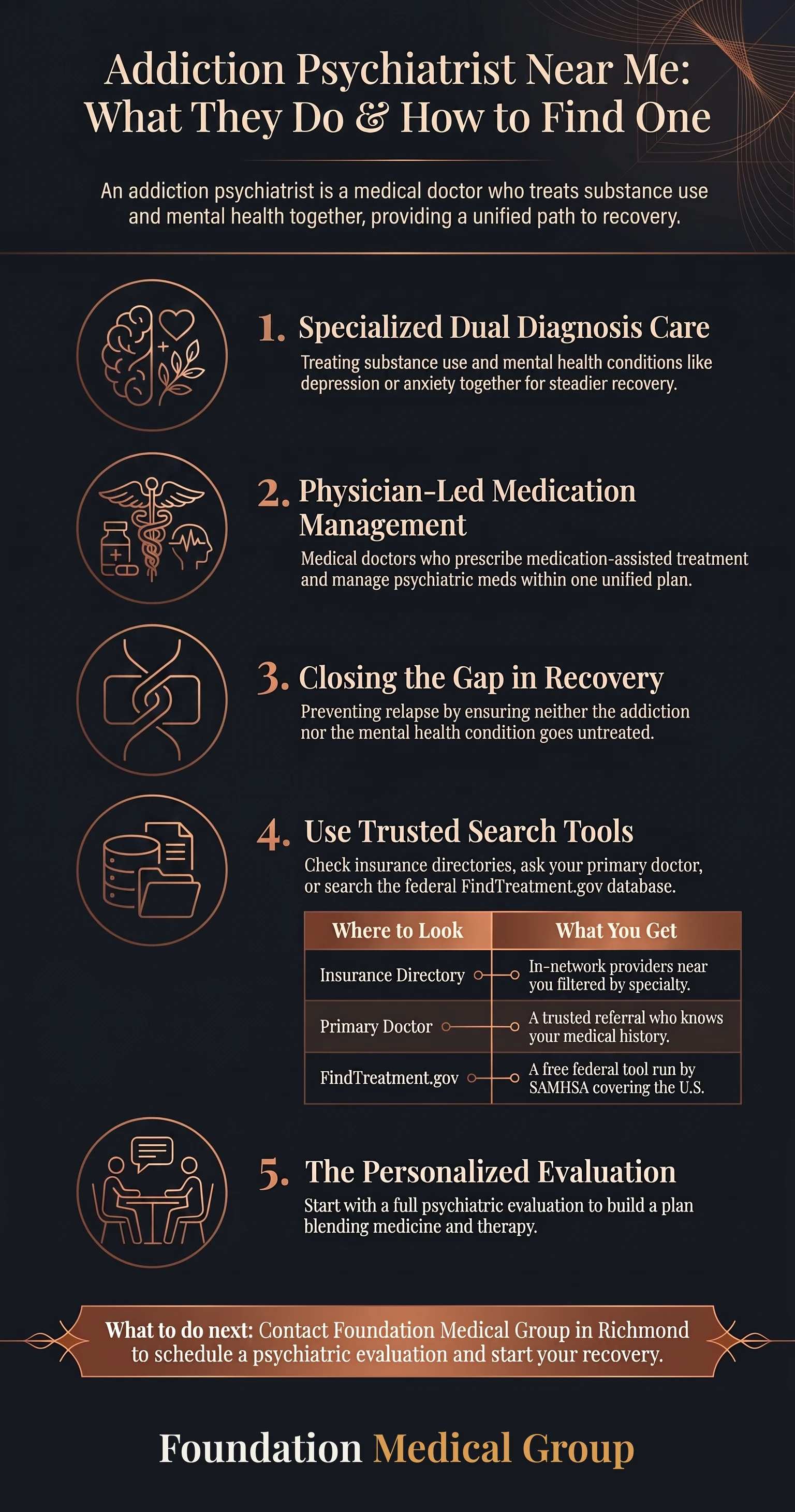
An addiction psychiatrist is a medical doctor who treats substance use disorders along with the mental health conditions that often come with them. That overlap is called dual diagnosis. To find one near you, start with your insurance directory, ask your primary doctor, or search FindTreatment.gov. Here’s how this kind of care works, and how to choose the right fit.
If you’re reading this for yourself, that first search took courage. If you’re reading it for someone you love, that counts too. Either way, you don’t have to sort this out alone.
What is an addiction psychiatrist?
An addiction psychiatrist trains first as a physician. Next comes a residency in psychiatry. After that comes a fellowship in addiction psychiatry, which usually takes another year. The American Board of Psychiatry and Neurology treats addiction psychiatry as its own subspecialty, so that extra training is formal and tested.
That medical background is the key. It’s what lets this doctor prescribe medicine, watch how your body responds, and change the dose when it isn’t right. A counselor can’t do that.
The difference from a general psychiatrist is scope. An addiction psychiatrist looks at both sides of your health at once. On one side sits the substance use disorder. On the other sit the psychiatric disorders that ride along with it. Drug addiction rarely shows up alone. It often travels with depression, anxiety, bipolar disorder, or another mood disorder, and treating only one of them leaves a gap.
So a single doctor can prescribe medication-assisted treatment for the addiction and handle your psychiatric medication in the same plan. That joined-up approach is the heart of good addiction treatment.
How is an addiction psychiatrist different from a psychologist?
It helps to see where each role fits. Psychologists and other mental health professionals guide talk therapy, testing, and coping work. They don’t prescribe medicine. A psychiatrist is a medical doctor who does. An addiction psychiatrist is that same kind of doctor, with training aimed squarely at addiction and the mental health challenges beside it.
Here’s a simple way to compare the roles.
| Who they are | What they do | Can they prescribe? |
|---|---|---|
| Addiction psychiatrist | Treats substance use disorder and mental illness together | Yes, including medication for addiction |
| General psychiatrist | Treats mental health conditions such as depression or anxiety | Yes |
| Psychologist or therapist | Talk therapy, testing, coping skills | No |
| Primary care doctor | General health, referrals, some buprenorphine care | Yes, within their own scope |
Plenty of patients work with more than one of these people at the same time, and that’s normal. Somebody still has to hold the whole picture, though. In dual diagnosis care, that person is usually the addiction psychiatrist.
What is a dual diagnosis, and why does it matter?
Dual diagnosis means you live with a substance use disorder and a mental health disorder at the same time. It’s common, and it’s nobody’s fault. According to the American Society of Addiction Medicine, addiction is a treatable medical illness, not a moral failing or a lack of willpower.
Here’s why the overlap matters so much. Treat only the addiction, and the untreated mental health condition can pull you back. Treat only the depression or the anxiety, and the substance use can undo your progress. According to SAMHSA, care that handles both conditions at once works better than care that lines them up one after the other.
The conditions we see beside addiction include:
- Depression and other mood disorders.
- Anxiety disorders, including panic disorder.
- Bipolar disorder.
- Trauma and post-traumatic stress.
- Obsessive compulsive disorder, or OCD.
- Personality disorder patterns, such as borderline personality disorder.
- Psychotic disorders, such as schizophrenia.
- Treatment resistant depression, where two or more medicines haven’t helped.
Sometimes the two feed each other in ways that are easy to miss. Someone may start using a substance to quiet anxiety or numb a low mood. Over time, the substance makes those same feelings worse. We see this pattern often in our Richmond clinic, and naming it out loud is a relief for many patients. It isn’t weak character. It’s two health conditions overlapping, and both can be treated. According to the National Institute of Mental Health, depression on its own is common and very treatable, and pairing that care with addiction treatment gives you a fuller plan.
How does an addiction psychiatrist treat you?

Care starts with a full psychiatric evaluation. This first visit is a real conversation about your history, your symptoms, your substance use, and your goals. From there, the two of you build a personalized treatment plan.
Most plans blend three tools.
Medicine for the addiction. Several medicines are approved by the FDA for substance use disorder. They aren’t a swap of one drug for another. They steady the brain and the body so you can do the rest of the work.
| Medicine | Used for | Good to know |
|---|---|---|
| Buprenorphine (Suboxone) | Opioid use disorder | Eases withdrawal and cravings, prescribed in a regular office visit |
| Naltrexone (Vivitrol) | Opioid and alcohol use disorder | A monthly shot, started once you are fully off opioids |
| Methadone | Opioid use disorder | Given only through a certified opioid treatment program |
| Acamprosate | Alcohol use disorder | Supports staying alcohol free after you stop |
| Disulfiram | Alcohol use disorder | Causes a strong, unpleasant reaction if you drink |
You can read more about medication-assisted treatment near you, or about finding a naltrexone doctor near you.
Psychiatric medication. This is steady prescribing and follow-up for the condition sitting beside the addiction. Doses change and side effects come up, so medication management is ongoing rather than one and done.
Therapy. Talk therapy builds the skills that medicine alone can’t. You may hear about cognitive behavioral therapy, dialectical behavior therapy, acceptance and commitment therapy, or narrative therapy. Individual therapy, group work, and psychotherapy all sit beside the medicine, and your doctor can help you pick a starting point.
Because one team handles psychiatry services and addiction medicine, your care stays in one place instead of scattered across offices. Your plan isn’t fixed in stone either. According to the National Institute on Drug Abuse, 40 to 60 percent of people in recovery return to use at some point, which is close to the rate for other long-term illnesses such as asthma or high blood pressure. A return to use isn’t failure. It’s a signal that the plan needs a change, and a good doctor changes it with you.
What happens at your first visit?
The first appointment usually runs 45 to 60 minutes. Nobody rushes you through it. You’ll talk about your history, your mental health, what you’re using, and what you want daily life to look like.
A few small things make that visit easier:
- Bring a list of every medicine and supplement you take.
- Bring your insurance card and a photo ID.
- Write your questions down before you come.
- Know your pharmacy name and address.
- Be honest about your substance use, including alcohol.
That last one matters most. Your answers are protected health information, and your doctor needs the true picture to prescribe safely. Follow-up visits are shorter, often 20 to 30 minutes, and they focus on progress, side effects, and medication management. Many follow-ups can happen by telehealth when getting to the clinic is hard.
How long does treatment last?
There’s no fixed end date, and that’s an honest answer rather than a vague one. Some people take medicine for a year. Others stay on it far longer, the way a person stays on medicine for blood pressure. According to the National Institute on Drug Abuse, most people need at least three months of treatment before change starts to hold, and longer is usually better.
A good doctor won’t rush you off a medicine that’s working. When you do want to stop, you taper slowly and with a plan. What changes most over time is how often you come in. Weekly visits often turn into monthly ones, and then into check-ins a few times a year.
How do I find an addiction psychiatrist near me?

You have more good options than it may feel like right now. Any one of these is a fair place to start.
| Where to look | What you get | Good to know |
|---|---|---|
| Insurance directory | In-network psychiatrists near you | Filter for addiction psychiatry and check coverage first |
| Your primary doctor | A trusted referral | They know your history and can send records ahead |
| FindTreatment.gov | Free federal search tool | Run by SAMHSA, no cost, covers the whole country |
| A local clinic | One team for psychiatry and addiction | Ask if they treat dual diagnosis under one roof |
| SAMHSA National Helpline | A live person, any hour of the day | Free and confidential at 1-800-662-4357, every day of the year |
If you’re in Virginia, our Richmond psychiatry team offers this care in one physician-led clinic.
What should I ask before I book?
A short phone call tells you a lot. These questions sort out fit fast.
- Do you treat mental health and substance use together?
- Does a medical doctor manage my medication?
- Do you take my insurance, and what will I owe?
- How soon can I be seen?
- Do you offer therapy in house, or refer out?
- Do you handle adolescent psychiatry, if the patient is a teen?
- Do you look at whole wellness, including sleep, work, and physical health?
A clinic that welcomes those questions is usually a good sign. One that dodges them tells you something too.
Does insurance cover an addiction psychiatrist?
Usually, yes. The federal parity law passed in 2008 requires many health plans to cover mental health and substance use care no more strictly than other medical care. Medicaid and Medicare cover behavioral health as well, though the details shift by state and by plan.
Call and check three things anyway. Ask whether the doctor is in network. Ask what your copay is per visit. Ask whether any medicine needs prior authorization, since that step can add a few days. A good clinic checks your benefits before the first visit so you aren’t guessing. Foundation Medical Group accepts most major commercial plans, Medicare, Tricare, and state Medicaid in Virginia, Utah, Georgia, and Texas.
What if you’re helping someone you love?
Watching this from the outside is hard. You can’t force the appointment. You can make the next step smaller, though, and that often matters more.
- Offer to sit with them while they call.
- Offer a ride, or cover child care for that hour.
- Ask what they need instead of guessing.
- Keep your own support going too.
Nobody has to wait for a rock bottom. Treatment options work at every stage, and earlier is nearly always easier. If someone is in danger right now, call or text 988 for the Suicide and Crisis Lifeline, or call 911.
Key Takeaways
- An addiction psychiatrist is a medical doctor who treats substance use disorder and the mental health conditions that come with it.
- Dual diagnosis means addiction plus a mental health condition, and treating both together holds up better than treating one alone.
- This doctor can prescribe medicine for addiction and manage psychiatric medication in the same plan.
- Your first visit runs about an hour, and follow-up visits are short.
- To find one, use your insurance directory, ask your primary doctor, or search the free FindTreatment.gov tool.
- Foundation Medical Group offers physician-led addiction psychiatry in Richmond, Virginia.
Talk With Our Richmond Team
Reaching out is the hardest part, and that feeling is understandable. Foundation Medical Group is a physician-led clinic in Richmond, Virginia, and our care team treats addiction and mental health side by side, with respect and no judgment. We also see patients in Utah, Georgia, and Texas, with telehealth across all four states. Reach out today to book a psychiatric evaluation, and let us help you find the next right step.
Sources
- Substance Abuse and Mental Health Services Administration (SAMHSA), National Helpline and guidance on co-occurring disorders.
- National Institute on Drug Abuse (NIDA), research on addiction as a treatable long-term illness.
- American Society of Addiction Medicine (ASAM), definition of addiction and standards of care.
- American Psychiatric Association, what psychiatrists do and how addiction psychiatry fits.
- National Institute of Mental Health (NIMH), plain guides to depression, anxiety, and other conditions.
- FindTreatment.gov, the free federal tool for finding treatment near you.