
ADHD and depression treatment works best when one evaluation looks at both conditions. Each one can make the other harder to live with, and harder to treat. A prescriber may treat the more impairing condition first, then add the other step by step, so it’s clear what’s helping. Options include ADHD medication, antidepressants, talk therapy such as cognitive behavioral therapy (CBT), and sleep and exercise. Most treatment plans mix these. If you’re having thoughts of suicide, call or text 988.
What Is the Link Between ADHD and Depression?
Attention deficit hyperactivity disorder (ADHD) and depression are separate conditions. But they often show up in the same person.
ADHD is a developmental condition. Its core features are inattention, hyperactivity and impulsivity. The symptoms begin in childhood, even when the diagnosis comes much later. Depression, also called major depressive disorder or clinical depression, isn’t the same as the ordinary sadness most of us feel now and then. The NIMH describes it as an illness that can cause severe symptoms. Those symptoms affect how you feel, think and handle daily activities such as sleeping, eating or working.
The overlap is common. The NIMH notes that ADHD often occurs with other conditions, such as sleep problems, anxiety or depression, which can make the conditions harder to diagnose and treat. ADHD is also common in adults: a recent study cited by the American Psychiatric Association estimated that 6% of U.S. adults have an ADHD diagnosis, and about half of them were diagnosed as adults. Half. Not as kids, as grown-ups.
Comorbid ADHD matters for treatment. A 2025 review of adult ADHD reports a high rate of depressive disorder alongside ADHD, due to overlapping and interacting symptoms. The same review found that people with two or more conditions often have increased disease burden, a longer illness and weaker treatment response. So your mental health treatment should look at both at once, not one at a time in separate offices.
If you suspect you have one or both, a full psychiatric evaluation is where treatment starts.
Can Untreated ADHD Cause Depression and Low Mood?
Untreated ADHD can wear on a person’s mood. Still, no source we rely on says ADHD is a proven cause of depression.
The American Psychiatric Association notes that ADHD symptoms often continue into adulthood. It says many adults face challenges that need ongoing treatment because of the significant negative life consequences of untreated ADHD. Adult ADHD can bring missed deadlines, lost items, unfinished projects and trouble with planning. The NIMH lists these kinds of problems among the ways ADHD symptoms show up in adults. Living with them for years, without knowing why? That’s discouraging. And frustrating, in a way that builds up quietly.
That frustration is part of the picture doctors look at. A published review on major depression with ADHD in children and teens notes that “one can never tell for sure when the depressive symptoms are secondary to frustration with the ADHD symptoms.” In plain words, low mood can grow out of ADHD struggles. It can also be a depressive disorder of its own. Both can be true at the same time.
So, can ADHD cause sadness? Sadness and frustration are common reactions to ADHD struggles. The NIMH points out that everyone feels sad or low sometimes, and these feelings usually pass with time. Depression is different. It affects how you feel, think and get through the day. If your low mood doesn’t lift, or it starts to change how you sleep, eat or work, get checked. Don’t let it be written off as “just ADHD.”
ADHD Symptoms vs Depressive Symptoms: Where They Overlap
Some ADHD symptoms and depression symptoms look alike from the outside. Trouble focusing, poor sleep and getting less done can come from either condition. Or from both. Here’s how the sources we cite describe each one.
| Symptom area | In ADHD | In depression | What to keep in mind |
|---|---|---|---|
| When it starts | Symptoms begin in childhood; adults must have had symptoms before age 12 (NIMH) | Can affect anyone, regardless of age (NIMH) | A timeline of when problems started helps tell them apart |
| Focus and daily tasks | Getting distracted, disorganization, poor time management, trouble finishing projects (NIMH) | Symptoms affect how you think and handle daily activities such as working (NIMH) | Poor focus alone does not tell you which condition is behind it |
| Sleep | Sleep problems affect up to 70% of adults with ADHD (NIMH) | Can affect daily activities such as sleeping (NIMH) | Ask your prescriber to look at sleep as its own problem |
| Restlessness | Restlessness and a need for constant activity; in adults, hyperactivity may appear as extreme restlessness (NIMH, APA) | Not described on the NIMH depression page | Restlessness can also come from anxiety or a medicine |
| Mood and emotions | Adults with ADHD often show broader emotional dysregulation (PMC review) | Symptoms affect how you feel; it is more than ordinary sadness (NIMH) | Mood disorders can mimic ADHD, so a careful history matters (APA) |
You may also hear the terms “ADHD paralysis” and “ADHD burnout.” These are informal phrases people use online, not diagnoses. People often use them to describe feeling stuck on a task, or worn out after long stretches of pushing through ADHD symptoms. Sound familiar? Tell your clinician what it looks like for you, in your own words. That helps them sort out whether it fits ADHD, a mood disorder or both.
How Does an ADHD Assessment Check for Depression Too?

A good ADHD assessment is also a mood check. The American Psychiatric Association says several conditions can mimic ADHD, including mood disorders, anxiety, substance use, thyroid conditions and some medicines. It adds that ADHD can co-exist with other mental health conditions. That’s why a full psychiatric evaluation and careful history taking matter so much. There are no specific blood tests or routine imaging for an ADHD diagnosis.
The NIMH explains how an adult ADHD diagnosis works. A provider may use clinical interviews, rating scales or symptom checklists, and may talk with people who know you well. They’ll also ask you to report on your mood and your current and past medical conditions, to rule out other explanations.
Screening for bipolar disorder is part of this. Before you start methylphenidate, the MedlinePlus page asks you to tell your doctor if you have depression, bipolar disorder, mania, thoughts of suicide or other mental health problems. Bipolar disorder is a mood disorder that includes episodes of depression. It changes how a prescriber thinks about both antidepressants and stimulants.
What to bring to the visit (short list, but it helps):
- A list of every medicine and supplement you take, and anything you tried before.
- When your focus problems started, and when your low mood started.
- How you’re sleeping.
- Any family history of ADHD, depression or bipolar disorder.
Should ADHD or Depression Be Treated First?
There’s no single rule for everyone. The order is a decision your prescriber makes with you, based on which condition is causing more harm right now. Most of the published guidance on this question comes from children and teens. So read it as background, not a rule for adults.
A published review on major depression with ADHD in children and adolescents describes expert recommendations for where to start when neither condition has been treated yet:
- Depression first. A prescriber may start with an antidepressant when depressive symptoms make up 50% or more of the overall severity. The review also lists marked loss of appetite, weight loss, severe insomnia, a well-planned suicide attempt or strong suicidal intent, or a past history of no response or significant side effects with stimulants.
- ADHD first. A prescriber may start with a stimulant when ADHD symptoms make up 50% or more of the overall severity. The review also lists few physical signs of depression, suicidal thoughts without intent or a plan, and ADHD that began more than a year before the depression.
The same review says a stimulant and an antidepressant shouldn’t be combined as the very first step. Why? The low mood may turn out to be frustration with ADHD, and it may lift once the ADHD is treated well. The review also says depression shouldn’t be seen as a reason to rule out stimulant treatment. Once the first medicine is at the right level, the clinician looks at what it changed before adding anything else.
This is why treatment plans move one step at a time. If two things change at once, it’s hard to know which one helped. Or which one caused a side effect. If you’re having thoughts of suicide, don’t wait for a plan to unfold: call or text 988.
What Is the Best Medication for ADHD and Depression?
There’s no single best medicine for both. We know that’s not the tidy answer most people hope for. The right choice depends on your evaluation, your history and how you respond. Here’s how the main treatment options fit together, starting with medicine. Therapy comes further down. For a full tour of ADHD medication, see our guide to ADHD medication for adults.
Stimulant medication. The NIMH says medication for adult ADHD is usually a stimulant. The FDA names methylphenidate and amphetamine products among the common prescription stimulants. It requires a Boxed Warning on prescription stimulants about the risks of misuse, abuse, addiction and overdose, and it notes that sharing these medicines with others can lead to harm. MedlinePlus warns that methylphenidate can be habit-forming and should be taken exactly as directed.
Atomoxetine. Atomoxetine is a non-stimulant ADHD medicine for children and adults. MedlinePlus carries an important warning about it. Children and teenagers with ADHD who take atomoxetine are more likely to think about killing themselves than those who don’t, so mood is watched closely.
Antidepressants. MedlinePlus explains that most newer antidepressants are SSRIs, SNRIs or atypical antidepressants. They usually take 4 to 8 weeks to work. That wait can feel long. Which is frustrating, we know. Still, don’t change your dose or stop taking an antidepressant medication on your own. Read more about how long antidepressants take to work.
Bupropion. MedlinePlus lists bupropion as a depression medication and notes it’s also sometimes used to treat ADHD. It carries a warning: medicines such as bupropion may increase the risk of suicidal thoughts and actions in children, teenagers and young adults under 24 years of age. That applies especially in the first few months and when the dose goes up.
Which medication treatment fits you, and in what order, is your prescriber’s call. A web page can’t settle it (this one included).
Is It Safe to Take Stimulant Medication With an Antidepressant?
Many people with ADHD and comorbid depression end up on two medicines, so it’s a fair question. The best adult data we have is reassuring for one pairing. With limits.
A large cohort study from a nationwide claims database followed 17,234 adults with ADHD and a depressive disorder who were prescribed methylphenidate. It found no difference in the risk of adverse outcomes between people on methylphenidate alone and people on methylphenidate plus an SSRI. The one exception was a lower risk of headache in the SSRI group (hazard ratio 0.50).
What this study doesn’t tell you:
- It looked only at methylphenidate and SSRIs, not every stimulant or every antidepressant.
- It’s an observational study of insurance claims, not a randomized trial, and the authors list limits such as missing data on how severe each person’s illness was.
- Whether a combination is right for you (it can’t answer that).
MedlinePlus also asks you to tell your doctor about every medicine you take before starting methylphenidate. That includes MAO inhibitors taken in the past two weeks, because some medicines shouldn’t be taken with it.
The safe path is simple: your prescriber adds one medicine at a time and checks how you’re doing before the next change. Please don’t start, stop or combine ADHD meds and antidepressants on your own.
Can ADHD Medication Help With Depression?
ADHD medication isn’t an antidepressant, and none of the sources we cite say stimulants treat a depressive disorder. Still, treating ADHD can matter for mood.
The review on children and teens explains the idea. When low mood comes from frustration with ADHD symptoms, it may lift once the ADHD is treated well. The authors even suggest that if depression fully clears after stimulant treatment alone, that diagnosis may need a second look. That’s a surprising twist, honestly. The flip side is that a true depressive disorder needs its own treatment.
When a mix of ADHD and depressive symptoms is present, the medicine MedlinePlus lists for both uses is bupropion. It’s prescribed for depression and sometimes used for ADHD. Whether it fits you depends on your history.
Keep an eye on your mood while taking ADHD medications. MedlinePlus asks you to tell your doctor about depression or past suicidal thoughts before starting methylphenidate. The atomoxetine page warns about suicidal thinking in young people. If you notice new or worse depression, call your prescriber right away.
Therapy, Sleep and Exercise in ADHD Treatment

Medicine is one part of ADHD treatment. The NIMH says the most common treatments for ADHD in adults are medication, usually stimulants, and psychotherapy such as behavioral and cognitive behavioral therapy. It adds that effective treatment often combines elements.
Talk therapy. The NIMH describes CBT as a type of talk therapy that helps you notice harmful thoughts, question them and change self-defeating patterns. The 2025 review of adult ADHD reports that CBT is effective for both ADHD and depression. It also reports that combining medicine with therapy such as CBT and digital tools has shown significant improvements in symptom relief and quality of life for people with both conditions. If you’d like to add therapy, see our page on finding a depression therapist near you.
Sleep. Sleep problems affect up to 70% of adults with ADHD, according to the NIMH. Depression can disrupt sleep too. A regular bedtime and wake time are simple places to start. So is telling your prescriber how you sleep.
Exercise. The NIMH notes that some adults with ADHD try lifestyle changes, like adding more physical exercise to their daily schedule. Movement won’t replace treatment. But it’s something you control, and on a rough week that counts for a lot.
Day to day. Managing ADHD often comes down to small habits. Boring ones, mostly. Write tasks down. Break big jobs into small steps, and keep your appointments, even on good weeks. Every symptom you track gives your care team more to work with when they adjust treatment plans.
When Do Depressive Symptoms Need Urgent Help?
Some depressive symptoms can’t wait for your next appointment.
Get help right away if you have thoughts of suicide, a plan to harm yourself, or new or worsening depression after starting or changing a medicine. For people taking bupropion, MedlinePlus lists new or worsening depression and thoughts of harming yourself as reasons to call your doctor right away. It also asks families to watch for mood changes in young people taking atomoxetine.
- Call or text 988, the Suicide and Crisis Lifeline, or chat at 988lifeline.org. SAMHSA says 988 offers 24/7 support for mental health, substance use and more.
- Call 911 if you or someone else is in immediate danger.
If your mood hasn’t improved after trying several treatments, ask about options for treatment-resistant depression. At Foundation Medical Group, TMS and Spravato are offered as depression treatments at our Richmond, Virginia clinic. They aren’t treatments for ADHD.
How We Support ADHD and Depression at Foundation Medical Group
Foundation Medical Group treats both conditions together, with one team and one plan, which can include medicine and therapy. We start with a full evaluation and continue with steady follow-up.
A full psychiatric evaluation. Suspected ADHD, anxiety, depression, bipolar disorder and trauma are among the reasons people book. First visits can run up to 60 minutes, with a board-certified physician or psychiatric nurse practitioner. They can be in person or by video, depending on your state and the kind of medication that may be involved. You don’t need a referral, and most people are seen within 3 to 5 business days.
Medication management. With medication management, you’re seen monthly at first, then every 1 to 3 months once you’re stable. We prescribe controlled medications such as stimulants when clinically appropriate and in line with state telehealth rules. For some controlled prescriptions, the first visit needs to be in person.
Telehealth and therapy. We offer telehealth in Virginia, Utah, Georgia and Texas. You need to be physically located in one of those states for the visit. Talk therapy is available by secure video in all four states, and in person at our Richmond, Virginia clinic.
Insurance. Our team verifies your benefits before your first visit. Coverage depends on your plan, so call to confirm coverage. Medicare isn’t accepted at our Virginia clinic at this time.
Questions or ready to book? Call (800) 983-1974.
Key Takeaways
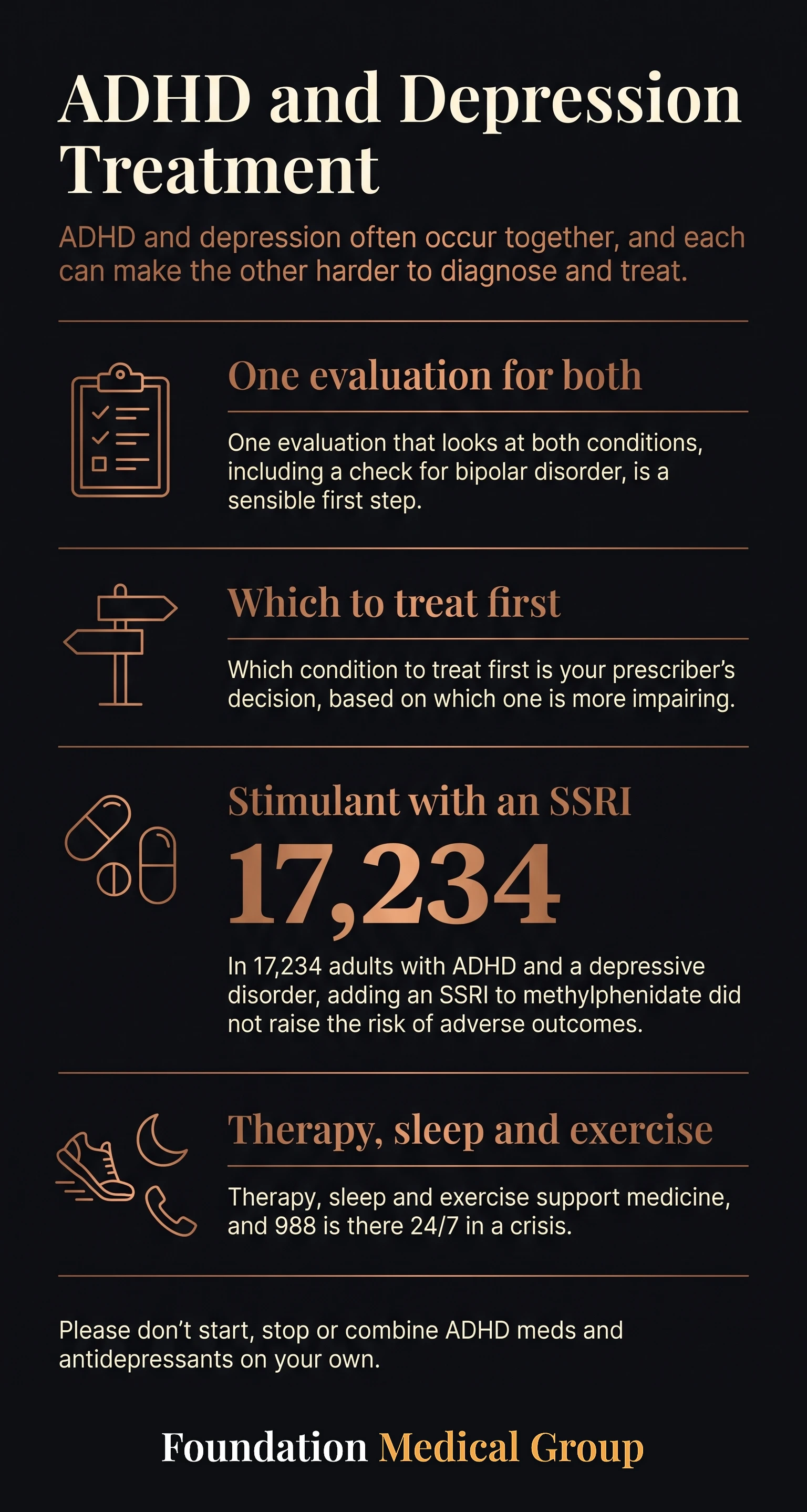
- ADHD and depression often occur together, and each can make the other harder to diagnose and treat.
- One evaluation that looks at both conditions, including a check for bipolar disorder, is a sensible first step.
- Which condition to treat first is your prescriber’s decision, based on which one is more impairing.
- In 17,234 adults with ADHD and a depressive disorder, adding an SSRI to methylphenidate did not raise the risk of adverse outcomes.
- Therapy, sleep and exercise support medicine, and 988 is there 24/7 in a crisis.
Sources
- PMC, Adult ADHD and comorbid anxiety and depressive disorders: a review of etiology and treatment.
- PMC, Major Depression with ADHD: In Children and Adolescents.
- PMC, Combined Methylphenidate and Selective Serotonin Reuptake Inhibitors in Adults With Attention-Deficit/Hyperactivity Disorder.
- National Institute of Mental Health, Attention-Deficit/Hyperactivity Disorder (ADHD).
- National Institute of Mental Health, Depression.
- National Institute of Mental Health, ADHD in Adults: 4 Things to Know.
- National Institute of Mental Health, Psychotherapies.
- MedlinePlus, Methylphenidate.
- MedlinePlus, Atomoxetine.
- MedlinePlus, Bupropion.
- MedlinePlus, Antidepressants.
- U.S. Food and Drug Administration, FDA updating warnings to improve safe use of prescription stimulants used to treat ADHD and other conditions.
- American Psychiatric Association, What is ADHD?.
- SAMHSA, 988 Suicide and Crisis Lifeline.