
ADHD medication and anxiety are closely linked. Stimulants can cause nervousness, restlessness and trouble sleeping, which can feel a lot like anxiety. For people with strong anxiety, tension or agitation, the amphetamine drug label says a doctor will probably advise against amphetamine. But ADHD and anxiety disorders often show up together, so plenty of people need a plan for both.
None of the sources we cite say ADHD medicine treats an anxiety disorder. So which condition do you treat first, and how do the medicines fit together? That’s a decision you make with your prescriber. Not the neat answer you were hoping for, we know. But it’s the honest one.
What Is the Link Between ADHD Medication and Anxiety?
There are two links here. It helps to keep them apart.
The first is that the conditions overlap. The NIMH notes that attention deficit hyperactivity disorder often occurs with other conditions, including sleep problems, anxiety and depression. That can make each one harder to diagnose and treat. ADHD shows up as inattention, hyperactivity and impulsivity. An anxiety disorder is different: the NIMH describes anxiety that doesn’t go away, is felt in many situations and can get worse over time. Types include generalized anxiety disorder, panic disorder, social anxiety disorder and phobias.
The second link is the medicine itself. Stimulants raise alertness and energy. Some of their side effects, such as nervousness, restlessness and a racing heart, overlap with how anxiety feels. That’s what makes this tricky. Is new worry coming from the medicine, from anxiety that was already there, or from the strain of untreated ADHD? Honestly, it can be hard to tell on your own. And that’s frustrating, because you started the medicine to feel more in control, not less.
Sorting that out is the job of medication management: regular visits where a prescriber tracks how each medicine affects both conditions. For a walk through each ADHD medicine class, see our guide to ADHD medication for adults. For the main anxiety medicines, see our guide to anxiety medication. This page focuses on where the two meet.
How Often Do ADHD and an Anxiety Disorder Occur Together?
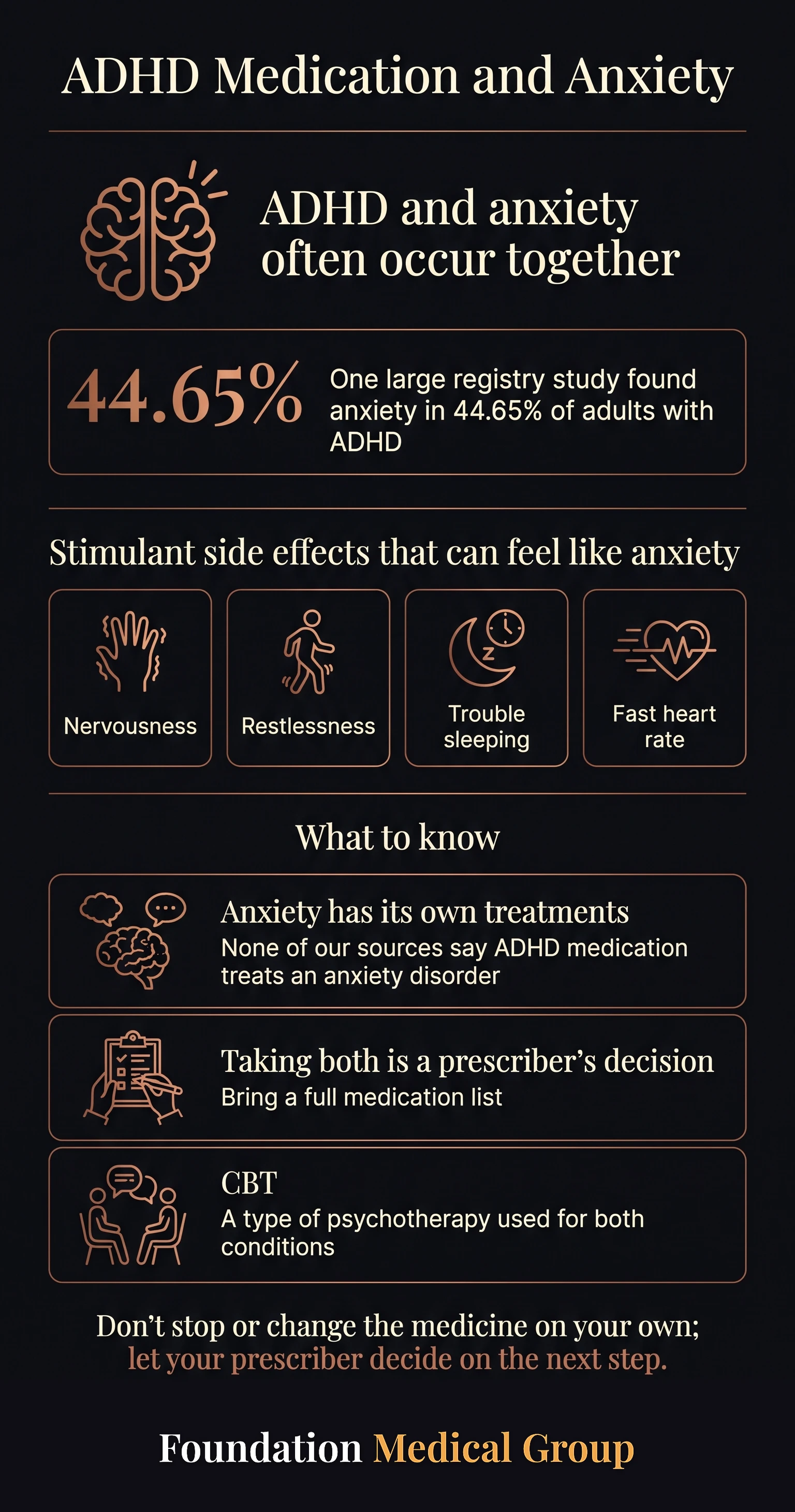
Often. In a nationwide registry study of 5,551,807 adults, 44.65% of adults with ADHD also had anxiety and 42.28% had depression. Rates of substance use disorder, depression and anxiety were each more than nine times higher than in adults without ADHD.
A large U.S. study of insurance claims for 172,010 patients with ADHD found a lower but still large share: 23.0% of adults with ADHD had anxiety, and 32.2% had anxiety, depression or both. Adults with anxiety were also more likely to have a change in their ADHD treatment than those without it.
Anxiety is common in general, too. The NIMH says about a third of U.S. adolescents and adults experience an anxiety disorder at some point in their lives.
Why do the numbers differ? The studies used different methods and populations. Still, the message holds: if you have adult ADHD, it’s worth asking about anxiety. And the reverse. We’d say the same thing whether you’re walking into our clinic off Busy Street in Chesterfield or logging in from a kitchen table in the Fan.
Can ADHD Medication Cause Anxiety?

It can cause symptoms that feel like anxiety. For some people, it can also make existing anxiety harder to manage.
The FDA lists the common side effects of prescription stimulants as loss of appetite, trouble sleeping, headache, stomachache, irritability, fast heart rate and high blood pressure. The NIMH adds that stimulants can elevate blood pressure, heart rate and breathing. A pounding heart, quick breathing and poor sleep are also classic signs of anxiety. No wonder the two get mixed up. Same racing heart, two very different causes. Kind of maddening, really.
The drug pages say more:
- Methylphenidate. MedlinePlus lists nervousness, irritability, restlessness, trouble sleeping, dizziness and headaches among its side effects. It also lists agitation and a fast, pounding or irregular heartbeat among the effects that need a call to your doctor right away.
- Amphetamine. MedlinePlus says to tell your doctor if you have strong feelings of anxiety, tension or agitation. Your doctor will probably tell you not to take amphetamine.
- Bupropion. This antidepressant is sometimes used for ADHD, and MedlinePlus lists anxiety and agitation among its side effects.
If you notice new or stronger anxiety after starting a stimulant, write down when it happens and how long it lasts. Then call your prescriber. Don’t stop on your own: the amphetamine page says not to stop without talking to your doctor, who will probably lower the dose gradually.
Can ADHD Medication Help Anxiety Symptoms?
Here’s where a careful answer matters. None of the sources we cite say ADHD medication treats an anxiety disorder.
What the NIMH does say is that prescription stimulants can markedly improve daily functioning for people with significant focus problems, such as people with ADHD. Better daily functioning is a real gain. But it isn’t the same as treating an anxiety disorder, so don’t count on an ADHD medicine to calm worry that comes from anxiety.
A small side note, because the word itself causes confusion. In everyday talk, “anxious” covers everything from a job interview to a crawl on the Powhite Parkway at rush hour. That’s ordinary nerves, and it passes, whereas the anxiety disorders the NIMH describes are the kind that stick around and spread into many situations. Worth keeping that difference in mind when you describe how you feel. Anyway, back to treatment.
Anxiety disorders have their own treatments. The NIMH explains that antidepressants such as SSRIs and SNRIs are commonly prescribed because they improve symptoms of a broad group of depressive and anxiety disorders. Anti-anxiety medicines can help reduce panic attacks and extreme fear and worry. Buspirone is taken every day and takes 3 to 4 weeks to reach its full effect. Benzodiazepines are generally used for short periods, and the NIMH warns that long-term use can lead to tolerance and dependence. Beta-blockers are sometimes prescribed off-label for short-term anxiety symptoms.
If anxiety is a big part of your day, treating ADHD alone may not be enough. Your prescriber decides whether anxiety needs its own medicine, therapy or both.
ADHD and Anxiety Medicines at a Glance
This table shows what our sources say about each medicine and anxiety. It isn’t a guide to choosing one.
| Medicine | Main use | What the source says about anxiety |
|---|---|---|
| Methylphenidate (stimulant) | ADHD | Lists nervousness, restlessness and trouble sleeping as side effects |
| Amphetamine (stimulant) | ADHD | Tell your doctor about strong anxiety, tension or agitation; you may be told not to take it |
| Atomoxetine (non-stimulant) | ADHD | A selective norepinephrine reuptake inhibitor; FDA-approved non-stimulant |
| Guanfacine extended-release (non-stimulant) | ADHD | Stopping it suddenly can raise blood pressure and make you nervous or anxious |
| Bupropion (antidepressant) | Depression; sometimes ADHD | Lists anxiety and agitation as side effects |
| SSRIs and SNRIs (antidepressants) | Depression and anxiety disorders | Commonly used for anxiety disorders |
| Benzodiazepines | Anxiety, short term | Long-term use can lead to tolerance or dependence |
Can You Take ADHD and Anxiety Medicines Together?
Many patients are treated for both ADHD and anxiety. Whether a particular combination is right for you is a decision for your prescriber. We don’t give combination advice on this page.
What you can do is make sure one prescriber sees the whole picture. The MedlinePlus methylphenidate page asks you to keep a written list of all the prescription and over-the-counter medicines, vitamins, minerals and dietary supplements you take. Bring it each time you see a doctor.
The methylphenidate page is a good example of why this matters. It asks you to tell your doctor or pharmacist if you take, or have stopped within the past two weeks, a monoamine oxidase (MAO) inhibitor. It also says some medications shouldn’t be taken with methylphenidate, while others may need dose changes or closer monitoring. Your prescriber checks these interactions. Your job is simpler: make the list complete and carry it with you.
Expect adjustments. In the U.S. claims study, adults with ADHD and anxiety were more likely to have their treatment changed than adults without anxiety. That fits what the NIMH says about ADHD in general: people sometimes need to try several treatments before finding what works. Some trial and error is part of it, frustrating as that can be. If you’re on your third adjustment and fed up, that’s fair. It doesn’t mean you’re doing anything wrong.
A few practical points help the process:
- Ask your prescriber what change to expect first and when you should feel it.
- Keep a short log of sleep, focus, worry, exercise and moments of panic.
- Ask how any antidepressant or other medicine fits with your ADHD plan before filling a new prescription from another office.
- Don’t share stimulants, and store them securely, as the FDA advises.
Is It ADHD or Anxiety? How the Symptoms Overlap
It can be one, the other or both. The American Psychiatric Association notes that several conditions can mimic ADHD, including anxiety, mood disorders, substance use, head injuries and thyroid conditions. ADHD may also co-exist with anxiety disorders. For that reason, the association says a full psychiatric evaluation and careful history taking are very important.
Some features help clinicians tell them apart:
- When it started. ADHD symptoms begin in childhood. The NIMH says symptoms must have been present before age 12 for an adult diagnosis.
- Where it shows up. The American Psychiatric Association says ADHD symptoms must cause difficulties in more than one setting, not only at home, over at least the past six months.
- How the worry behaves. The NIMH describes an anxiety disorder as anxiety that does not go away, is felt in many situations and can get worse over time.
- Restlessness. Both conditions can cause it, which is one reason a self-check isn’t enough.
- Depression. Low mood can blur both pictures, which is why our guide to anxiety vs depression may help.
You don’t need to work this out alone. A psychiatric evaluation looks at mood, sleep, focus, anxiety and your history in one visit. That way your treatment plan matches what’s actually going on. Hearing it’s both can feel like a relief. Or like one more thing on your plate. Either reaction is normal.
Non Stimulant Medication Options When Anxiety Is a Concern
When stimulant side effects are a worry, prescribers sometimes look at non-stimulant options. The American Psychiatric Association lists the alpha agonists clonidine and guanfacine as FDA-approved non-stimulant options for ADHD. It lists atomoxetine too, along with the newer non-stimulant viloxazine (Qelbree).
What the drug pages add:
- Atomoxetine. MedlinePlus describes it as a selective norepinephrine reuptake inhibitor used for ADHD in children and adults.
- Guanfacine extended-release. It may take 2 weeks to feel the full benefit. MedlinePlus warns that stopping it suddenly can raise blood pressure and make you nervous or anxious. So your doctor will probably lower the dose gradually.
- Bupropion. MedlinePlus lists ADHD among its other uses. It carries an important warning about suicidal thoughts in children, teenagers and young adults.
None of these is a treatment for generalized anxiety disorder on its own according to our sources. A non stimulant medication is an ADHD option your prescriber may weigh when anxiety is part of the picture. It isn’t a switch to make without them, though.
Where Cognitive Behavioral Therapy Fits
Medicine is only part of the plan. The NIMH says the most common treatments for adults with ADHD are medication and psychotherapy, such as cognitive behavioral therapy. Effective treatment often combines the two. For anxiety disorders, the NIMH describes CBT and exposure therapy, a type of CBT, as common approaches.
In practice, that makes therapy a natural bridge when you have both conditions. The NIMH describes therapy that helps people identify ways to cope with stress and develop problem-solving strategies. It also describes exposure therapy, in which a person spends brief periods in a supportive setting learning to tolerate distress until, over time, the fear goes down. Those skills can help with worry and panic while ADHD medication works on focus. Each one handles its own piece of the problem.
At Foundation Medical Group, talk therapy is offered by secure video in Virginia, Utah, Georgia and Texas, and in person at our Richmond, VA clinic. If sitting in traffic on Chippenham Parkway is the last thing your anxiety needs before a session, video is a perfectly good option. If you already see a therapist elsewhere, our prescribers can coordinate with them, so your therapy and your medicine aren’t pulling in different directions.
What to Tell Your Prescriber About ADHD and Anxiety Symptoms

Good treatment plans start with a full picture. Before you start or change ADHD medication, the drug pages and the NIMH point to the same kinds of information your prescriber needs:
- Your anxiety history. Say whether you have had panic attacks, constant worry or periods of strong tension or agitation, and what has helped before.
- Your heart and blood pressure. MedlinePlus asks you to tell your doctor if you or anyone in your family has had an irregular heartbeat, a heart defect, high blood pressure or sudden death.
- Mood conditions. Mention depression, bipolar disorder or thoughts of suicide, now or in the past.
- Substance use. The FDA updated the Boxed Warning on prescription stimulants to cover misuse, abuse, addiction and overdose. MedlinePlus asks you to say if you or your family have ever used street drugs, overused prescription medicines or drunk large amounts of alcohol.
- Thyroid problems. The amphetamine page asks about hyperthyroidism, and the American Psychiatric Association lists thyroid conditions among the things that can mimic ADHD.
- How your ADHD symptoms show up. Note when your focus problems and your worry started, how often they happen and what makes them better or worse.
Honest answers don’t rule you out of treatment. They help your prescriber choose a safer starting point. We’d much rather hear the awkward stuff at the first visit than find out about it later.
Signs Your ADHD Treatment Needs a Review
Call your prescriber if you notice any of these after starting or changing treatment:
- New or worse anxiety, worry or panic.
- Trouble falling or staying asleep that doesn’t settle.
- A fast, pounding or irregular heartbeat, or chest pain (MedlinePlus says to call your doctor right away or get emergency care).
- Blood pressure readings that run high at home or at another doctor’s office.
- Agitation, irritability or mood changes that worry you or the people close to you.
- Chronic stress that keeps climbing even though your focus has improved.
These signs don’t always mean the medicine is wrong. They mean the plan needs a look. Don’t stop or change the medicine on your own; let your prescriber decide on the next step. We know that’s a tough ask when you’ve finally started to feel focused. Call anyway.
How We Treat ADHD and Anxiety at Foundation Medical Group
We start with a psychiatric evaluation of up to 60 minutes with a board-certified psychiatrist or psychiatric nurse practitioner. It’s done in person or by secure video, depending on your state and the kind of medication. You don’t need a referral, and most patients are seen within 3 to 5 business days. By the end of the visit, you leave with a working diagnosis and a plan.
Through medication management, visits are usually monthly at first, then every 1 to 3 months once things are steady. We can prescribe controlled medications like stimulants when clinically appropriate. For some controlled prescriptions, the first visit must be in person. Follow-ups can happen by video in all four of our states, so not every check-in means a drive down Midlothian Turnpike. We coordinate with outside therapists, and our own therapists see patients by video in every state and in person in Richmond. That’s how we run medication management here: steady follow-up, and real adjustments when something isn’t working.
Our team checks your benefits before the first visit. Our Richmond clinic doesn’t accept Medicare. To book, call (800) 983-1974.
Key Takeaways
- ADHD and anxiety often occur together; one large registry study found anxiety in 44.65% of adults with ADHD.
- Stimulants can cause nervousness, restlessness, trouble sleeping and a fast heart rate, which can feel like anxiety.
- None of our sources say ADHD medication treats an anxiety disorder; anxiety has its own treatments.
- Taking ADHD and anxiety medicines together is a prescriber’s decision; bring a full medication list.
- CBT, a type of psychotherapy, is used for both conditions and fits alongside medication.
Sources
- PLOS ONE (PMC), Common psychiatric and metabolic comorbidity of adult attention-deficit/hyperactivity disorder: A population-based cross-sectional study.
- Advances in Therapy (PMC), Treatment Patterns Among Patients with Attention-Deficit/Hyperactivity Disorder and Comorbid Anxiety and/or Depression in the United States: A Retrospective Claims Analysis.
- U.S. Food and Drug Administration, FDA updating warnings to improve safe use of prescription stimulants used to treat ADHD and other conditions.
- MedlinePlus, Methylphenidate.
- MedlinePlus, Amphetamine.
- MedlinePlus, Atomoxetine.
- MedlinePlus, Guanfacine.
- MedlinePlus, Bupropion.
- National Institute of Mental Health, Attention-Deficit/Hyperactivity Disorder (ADHD).
- National Institute of Mental Health, Mental Health Medications.
- National Institute of Mental Health, Psychotherapies.
- National Institute of Mental Health, ADHD in Adults: 4 Things to Know.
- National Institute of Mental Health, Anxiety Disorders.
- American Psychiatric Association, What is ADHD?.