
For adults, ADHD medication is usually a stimulant, such as a methylphenidate or amphetamine product, or a non-stimulant such as atomoxetine. According to NIMH, medication and talk therapy are the most common ADHD treatment for adults, and they often work together. You find the right fit with a licensed prescriber who checks benefits, side effects and blood pressure over time.
What Is ADHD Medication for Adults?
These are prescription medicines that ease ADHD symptoms so you can focus, plan and get through your day with less strain. They don’t change who you are. They help the brain systems that manage attention and impulse control work more steadily.
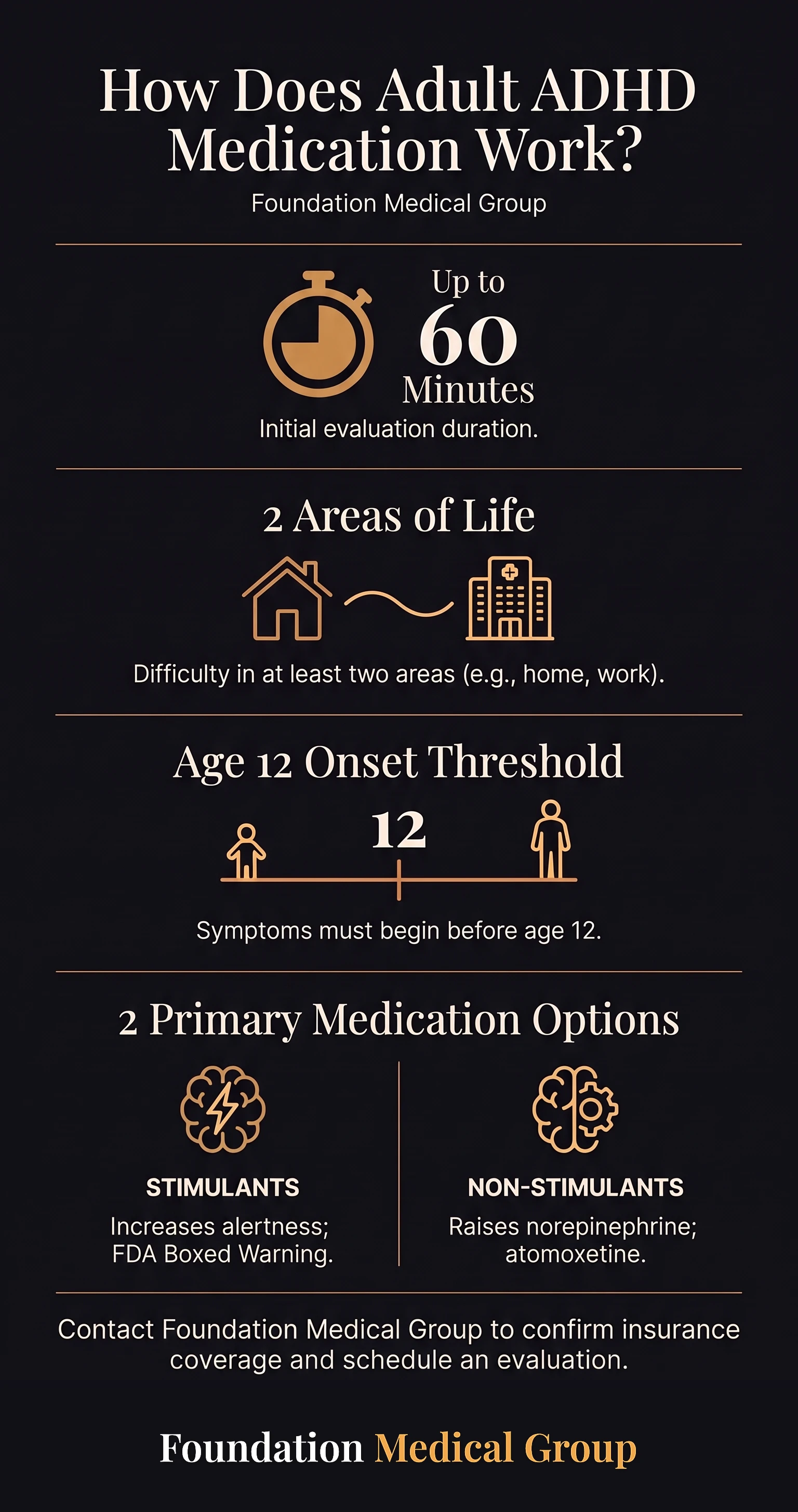
The National Institute of Mental Health (NIMH) describes attention deficit hyperactivity disorder, or ADHD, as a persistent pattern of inattention and/or hyperactivity and impulsivity. To count, the pattern has to make it hard to function in at least two areas of life, such as work and home.
Symptoms must begin in childhood, but many adults have ADHD. In adults, inattention often stays, while hyperactivity tends to ease with age. That’s why an adult may look calm on the outside but still struggle to keep track of tasks. Calm face. Chaotic to-do list. Sound familiar?
ADHD medications fall into two broad groups: stimulant medications and non-stimulants. NIMH notes that stimulants can help adults as well as children. Non-stimulants work in a different way. They give adults another choice when a stimulant isn’t a good fit.
What Does ADHD Medication Do for Adults?
For many adults, ADHD medications make ordinary tasks feel less like a fight. NIMH says stimulants increase alertness, attention and energy. It also says they can markedly improve daily functioning for people with significant focus problems such as ADHD. The FDA adds that prescription stimulants may help decrease impulsivity and hyperactivity and increase attention.
It helps to picture what untreated ADHD can look like in adult life. Because hyperactivity often fades with age, it may show up more as the problems NIMH lists: disorganization, poor time management, forgetfulness and trouble finishing projects. Adults who live with it often have a history of work problems or strained relationships. That’s frustrating to live with, and honestly, it can wear you down. And these ADHD symptoms aren’t a lack of effort or a flaw in your character.
So does medication help adults? For a lot of people, yes. NIMH says treatment can reduce symptoms and improve functioning. Still, let’s be honest about the limits. Medication doesn’t cure ADHD. It improves how you function, and NIMH notes that effective treatment often combines medication with other kinds of treatment and support.
Here’s a simple habit that helps. Keep a short list of what you notice before and after you start. Every symptom counts, from missed deadlines to restless hyperactivity in long meetings. That list helps you and your prescriber see whether a medication is helping, instead of relying on memory alone.
Stimulant Medications for Adults: Methylphenidate and Amphetamine Types
When adults take ADHD medication, it’s usually a stimulant, according to NIMH. Stimulant medications come in two main families: methylphenidate products and amphetamine products.
The FDA names these as examples of common prescription stimulants:
- Adderall (amphetamine/dextroamphetamine)
- Concerta (methylphenidate)
- Dexedrine (dextroamphetamine)
- Ritalin (methylphenidate)
These are examples, not a ranking. No single stimulant medication is right for every adult. The one that suits a friend may not suit you (a little annoying, maybe, but it’s how bodies work).
Methylphenidate
MedlinePlus describes methylphenidate as a central nervous system (CNS) stimulant used to control symptoms of attention-deficit/hyperactivity disorder. Methylphenidate comes as tablets, chewable tablets, liquids and long-acting (extended-release) forms. The FDA notes that prescription stimulants in general come in many formulations, including tablets, capsules and liquid. Why does that matter? Having both short-acting and long-acting stimulant medications gives your prescriber more ways to fit a medication to your day.
Amphetamine and Dextroamphetamine
Adderall combines amphetamine and dextroamphetamine, while Dexedrine contains dextroamphetamine alone, as the FDA lists them. Both belong to the amphetamine family of stimulant drugs. These stimulant medications aim at the same symptoms as methylphenidate. Same target. But people can respond to each family differently, which is part of why finding a fit can take more than one try.
Why Stimulants Need Extra Care
Stimulant medications can be misused. MedlinePlus says methylphenidate can be habit-forming. The FDA requires a Boxed Warning about misuse, abuse, addiction and overdose for all prescription stimulants. That’s why ADHD stimulant medications come with careful follow-up, honest talks about risk and safe storage at home. Only take a stimulant that was prescribed for you.
Are There Non-Stimulant ADHD Medications for Adults?
Yes. MedlinePlus lists atomoxetine as a non-stimulant ADHD medication used to treat attention-deficit/hyperactivity disorder in children and adults. It’s a selective norepinephrine reuptake inhibitor. In plain words, it works by increasing norepinephrine, a natural substance in the brain that helps control behavior.
Why might an adult consider non-stimulant medications? Some people have side effects on stimulant medications. Others have health factors that make a stimulant a poor fit. A non-stimulant medication gives you and your prescriber another path. You make that choice together, based on your history.
Atomoxetine has its own cautions. MedlinePlus notes a warning about suicidal thinking in children and teenagers who take it. Before you start, your prescriber will ask about depression, bipolar disorder and any history of suicidal thoughts. These questions can feel personal, and that’s okay. Please be open about them. Honest answers help keep you safe.
Where does an antidepressant fit? If you also live with depression, an antidepressant may come up when you and your prescriber plan care. NIMH notes that older antidepressants, such as tricyclic antidepressants, tend to cause more side effects than newer ones. Your prescriber weighs that along with everything else. The goal is one treatment plan that supports both your attention and your mood.
Stimulant vs Non-Stimulant ADHD Medication: How They Compare

Here’s a side-by-side look at your medication options, using only what NIMH, the FDA and MedlinePlus say about each group.
| Feature | Stimulants (methylphenidate, amphetamine types) | Non-stimulant (atomoxetine) |
|---|---|---|
| How it works | Increases alertness, attention and energy (NIMH) | Selective norepinephrine reuptake inhibitor that raises norepinephrine (MedlinePlus) |
| Examples named by sources | Adderall, Concerta, Dexedrine, Ritalin (FDA) | Atomoxetine (MedlinePlus) |
| Common side effects | Loss of appetite, trouble sleeping, headache, stomachache, irritability, fast heart rate, high blood pressure (FDA) | Nausea, loss of appetite, weight loss, dizziness, tiredness, headache (MedlinePlus) |
| Key warning | Boxed Warning on misuse, abuse, addiction and overdose; never share (FDA) | Warning about suicidal thinking in children and teenagers (MedlinePlus) |
| Habit-forming | Yes, methylphenidate can be habit-forming (MedlinePlus) | Ask your prescriber |
| Who decides | A licensed prescriber, with you | A licensed prescriber, with you |
Neither column is the “better” one. The right medication depends on your symptoms, your health history and how your body handles side effects. So the choice is made with a licensed prescriber who knows your full story.
What Are the Common Side Effects of ADHD Medication?
All ADHD medications can cause side effects. Knowing them ahead of time makes them less scary. Not zero scary. Less. The FDA lists these common side effects of stimulants: loss of appetite, trouble sleeping, headache, stomachache, irritability, fast heart rate and high blood pressure. For methylphenidate, MedlinePlus adds nervousness, weight loss and stomach pain.
The good news? NIMH says most stimulant side effects are minor and aren’t seen at low doses. Sleep problems can generally be managed by your provider, so tell them if your nights change.
Heart Rate and Blood Pressure
NIMH notes that stimulants can raise blood pressure, heart rate and breathing. This is why your prescriber checks your blood pressure and asks about your heart. MedlinePlus says to tell your doctor before taking methylphenidate if you have heart problems, high blood pressure, tics, depression or bipolar disorder. Expect blood pressure checks at follow-up visits too. They’re a normal part of safe care, not a sign that something is wrong.
When to Call Right Away
MedlinePlus says to call your doctor right away, or get emergency treatment, if you have any of these while taking methylphenidate:
- Fast, pounding or irregular heartbeat
- Chest pain
- Shortness of breath
- Fainting
Those aren’t wait-and-see symptoms. Never stop a medication or change your dose on your own, even if a side effect bothers you. Call your prescriber first.
Is ADHD Medication Safe With a History of Substance Abuse?
There’s no simple yes or no. If you have a history of substance abuse, the honest answer is that it needs a careful talk with your prescriber. That might make you nervous. It shouldn’t stop you from asking.
The FDA requires a Boxed Warning on all prescription stimulants about misuse, abuse, addiction and overdose. It asks prescribers to assess your risk of misuse before prescribing and to keep watching during treatment. MedlinePlus says to tell your doctor about any past heavy alcohol use, street drugs or overused prescription medicines before you take methylphenidate.
At the same time, NIMH says the evidence shows misuse or dependence is unlikely when stimulants are used as prescribed. And a non-stimulant option exists, which some adults and their prescribers prefer. That may come as a relief.
Two habits protect you and the people around you. The FDA says most people who misuse prescription stimulants get them from family or peers. So never share your ADHD meds, whether that’s Adderall or any other stimulant, and store them in a secure place.
Your prescriber will also look at your wider mental health, including conditions such as bipolar disorder. Being open about all of it helps them choose ADHD drugs and a treatment plan that fit your life safely.
What Should You Expect When Starting ADHD Medication?

Your first step is an evaluation, not a prescription. NIMH explains that an adult diagnosis relies on symptoms that began before age 12. A provider may talk with your partner or family. They may also use clinical interviews, rating scales or symptom checklists about inattention, hyperactivity and impulsivity, and review your mood and medical history. At Foundation Medical Group, a psychiatric evaluation (the first visit) lasts up to 60 minutes. Our clinicians review your full history before recommending or changing a prescription.
If ADHD medications are part of your plan, you start one. Then you come back for follow-ups that check:
- How well it eases your ADHD symptoms and helps with daily tasks
- Any side effects, including sleep and appetite
- Your blood pressure and heart rate
Be patient with the process. NIMH says people may need to try several treatments before finding the one that works. It may take a few tries to find the medication with the best effect and the fewest side effects. Which is maddening when you just want to feel like yourself again. Still, that’s normal, not a failure, even if it feels slow.
Most of all, remember that medication decisions are individual and made with a licensed prescriber. Two adults with the same diagnosis can need very different treatment. Your plan should fit you, not someone else’s.
How Therapy Fits Into Managing ADHD
Medication is only one tool for managing ADHD. NIMH says the most common adult ADHD treatment includes medication and psychotherapy, such as behavioral therapy and cognitive behavioral therapy. Effective treatment often combines these elements.
Think of it this way. Therapy helps with the skills medication can’t teach, like organizing your day, managing time, building habits and handling the stress that can build up at work and at home. You can learn more in our guide to CBT.
At Foundation Medical Group, talk therapy, including CBT and other approaches, is available by secure video in Virginia, Utah, Georgia and Texas. So whether you live in Utah County, metro Atlanta or North Dallas, you can meet with a therapist without a drive. In-person sessions are offered only at the Richmond, VA clinic.
Who Can Prescribe ADHD Medication? Adult ADHD Care at FMG
NIMH says a primary care provider or a mental health professional can diagnose adult ADHD. ADHD medications are then prescribed by a licensed prescriber who follows your care over time.
At Foundation Medical Group, psychiatry and medication management are offered at three clinics:
- Richmond, VA: our flagship clinic, at 11600 Busy Street, Suite 203, Richmond, VA 23236. See our Virginia location page. On its Virginia psychiatry page, FMG says its psychiatrists and psychiatric nurse practitioners prescribe and carefully monitor controlled medications, including stimulants for ADHD, when clinically appropriate.
- American Fork, UT: 456 E State Street, Suite 1400, American Fork, UT 84003, in person and by telehealth. Handy if you live farther up or down the Wasatch Front. See our Utah location page.
- Dallas, TX: our North Dallas office on LBJ Freeway, at 8390 Lyndon B Johnson Freeway, Suite 500, Dallas, TX 75243. See our Texas location page.
Our Decatur, GA clinic, a few blocks from downtown Decatur in metro Atlanta, offers psychiatric evaluation.
Insurance
Coverage varies by plan, so please call to confirm coverage before your visit.
- Virginia: Anthem, Aetna, Cigna and Virginia Medicaid (Cardinal Care), call to confirm coverage. Medicare is not accepted in Virginia.
- Utah: Blue Cross Blue Shield, SelectHealth and Aetna, call to confirm coverage.
- Texas: Aetna, Cigna, Blue Cross Blue Shield and Texas Medicaid plans, call to confirm coverage.
Feeling stuck? If you think adult ADHD is holding you back, call the clinic nearest you to ask about an evaluation and what treatment could look like for you.
Key Takeaways
- Stimulant medications, including methylphenidate and amphetamine types, are the most common ADHD medications adults take.
- Atomoxetine is a non-stimulant medication that works by raising norepinephrine in the brain.
- Common side effects include trouble sleeping, less appetite, a faster heart rate and higher blood pressure, so follow-up checks matter.
- Prescription stimulants carry an FDA Boxed Warning on misuse, abuse, addiction and overdose. Never share them, and store them safely.
- Medication works best as part of a plan that can include therapy, made with a licensed prescriber.
FAQ
What is the best ADHD medication for adults?
There’s no single best one. The right ADHD medication depends on your symptoms, your health history and how your body handles side effects. NIMH notes it may take several tries to find the medication with the best effect and the fewest side effects. So you and your prescriber choose together and adjust as you go.
Does ADHD medication work for adults?
For many adults, yes. NIMH says stimulants can help adults as well as children, and treatment can reduce symptoms and improve daily functioning. Some people need to try more than one option before they find the one that works for them.
Are there non-stimulant ADHD medications for adults?
Yes. Atomoxetine is a non-stimulant that raises norepinephrine in the brain. Before you start it, your prescriber will ask about heart problems, mood conditions such as depression, and any history of suicidal thoughts. MedlinePlus lists these as things your doctor needs to know.
Who can prescribe ADHD medication for adults?
A licensed prescriber, after an evaluation. NIMH says a primary care provider or a mental health professional can diagnose adult ADHD. At Foundation Medical Group, medication management is offered in Richmond, VA, American Fork, UT and Dallas, TX.
Sources
- NIMH, ADHD in Adults: 4 Things to Know.
- NIMH, Mental Health Medications.
- FDA, FDA updating warnings to improve safe use of prescription stimulants used to treat ADHD and other conditions.
- MedlinePlus, Atomoxetine.
- MedlinePlus, Methylphenidate.