
ADHD medication for women is the same set of medicines men take: stimulants such as methylphenidate and amphetamine, and non-stimulants. So what’s different? The context around them. ADHD in girls and women is often missed in childhood. Anxiety and depression often come along with it, and hormones across the menstrual cycle, pregnancy and menopause can change how symptoms feel. Starting, changing or stopping a medicine stays a decision you make with your prescriber.
What Is Different About ADHD Medication for Women?
The FDA describes two kinds of ADHD medicine: stimulants and non-stimulants. It lists four FDA-approved non-stimulants: Strattera (atomoxetine), Intuniv (guanfacine), Kapvay (clonidine) and Qelbree (viloxazine). There’s no separate set of medicines for women. If you’d like a walk through each class, our guide to ADHD medication for adults covers it.
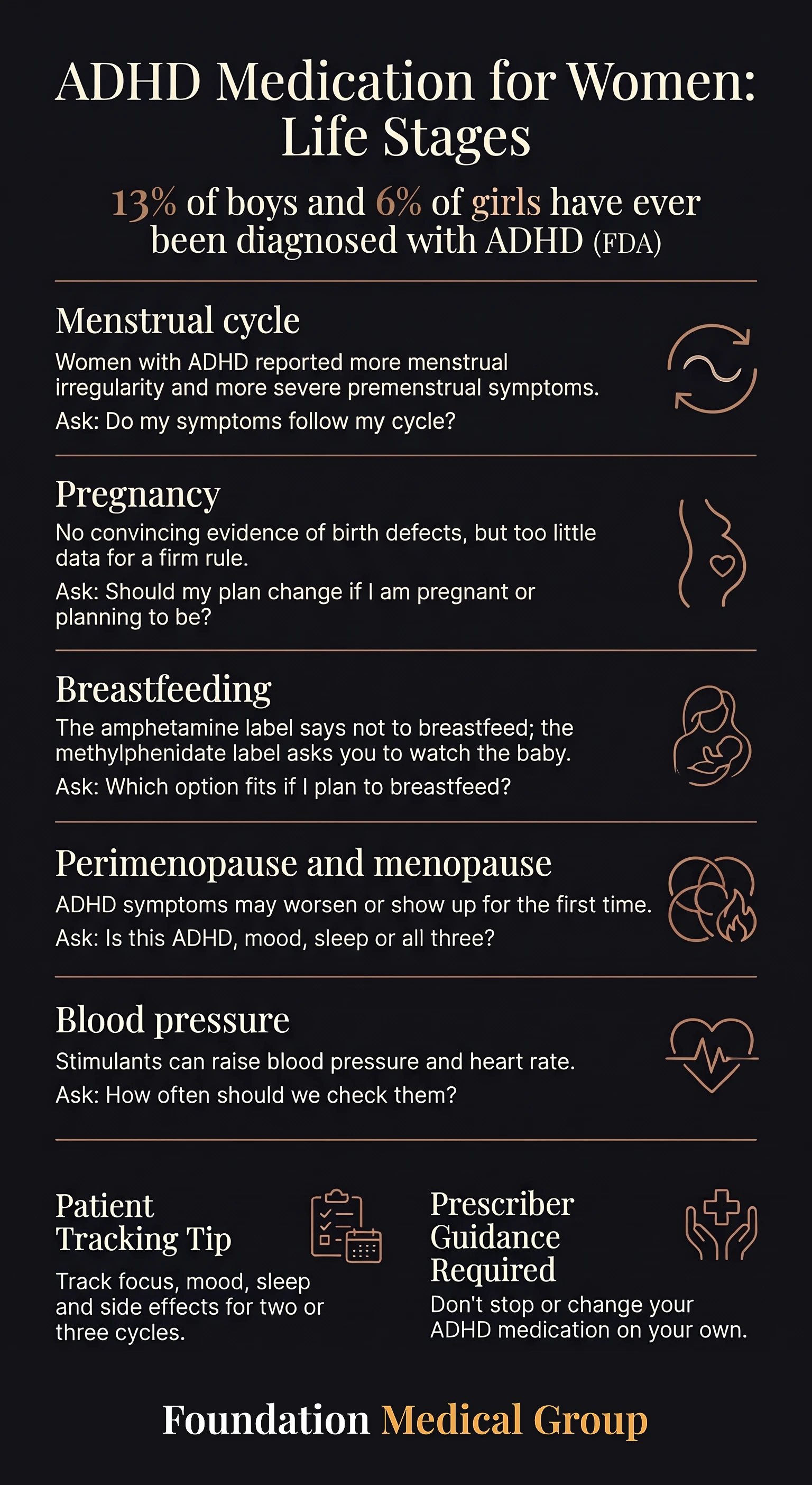
Where women differ is the ADHD diagnosis. According to the FDA, 13% of boys and 6% of girls have ever been diagnosed with attention deficit hyperactivity disorder. That’s a wide gap. The NIMH notes that symptoms in girls and women are especially likely to have been missed in childhood. A 2026 review adds that women often show more inattention than hyperactivity. Many also adopt strategies such as perfectionism that hide their difficulties, which is frustrating when you’re the one quietly struggling.
Once treatment starts, sex still matters. A 2020 systematic review of 21 studies found that girls received fewer prescriptions in all seven prescription studies. In adults, that gap was mostly gone. Each of the 14 studies on effects found at least one difference between the sexes. If you think you have ADHD, a psychiatric evaluation is the place to start.
ADHD Medication for Women at a Glance
| Life stage or concern | What the research or drug label says | What to ask your prescriber |
|---|---|---|
| Menstrual cycle | Women with ADHD reported more menstrual irregularity and more severe premenstrual symptoms | Do my symptoms follow my cycle? |
| Pregnancy | No convincing evidence of birth defects, but too little data for a firm rule | Should my plan change if I am pregnant or planning to be? |
| Breastfeeding | The amphetamine label says not to breastfeed; the methylphenidate label asks you to watch the baby | Which option fits if I plan to breastfeed? |
| Perimenopause and menopause | ADHD symptoms may worsen or show up for the first time | Is this ADHD, mood, sleep or all three? |
| Blood pressure | Stimulants can raise blood pressure and heart rate | How often should we check them? |
What Are the Common Side Effects of ADHD Medication in Adults?

The FDA lists the common side effects of prescription stimulants as loss of appetite, trouble sleeping, headache, stomachache, irritability, fast heart rate and high blood pressure. They apply to women and men alike.
On top of that, the FDA updated the Boxed Warning on these ADHD medications to cover misuse, abuse, addiction and overdose. Stimulants are controlled substances. Don’t share them, and store them where others can’t reach them. MedlinePlus says to tell your doctor if you or anyone in your family has a history of substance abuse or heavy alcohol use. Why? Your doctor may then decide not to prescribe amphetamine.
What Are the Side Effects of Ritalin (Methylphenidate) in Women?
Ritalin is a brand name for methylphenidate. MedlinePlus lists the same side effects for everyone: nervousness, restlessness, trouble sleeping, loss of appetite and headache. Serious effects are another matter. A fast or irregular heartbeat, or chest pain, needs a call to your doctor right away. Tell your doctor before you start if you have heart problems, high blood pressure, bipolar disorder or depression.
Here’s the thing: MedlinePlus doesn’t list women-only side effects for methylphenidate. Some other ADHD medicines do mention the menstrual cycle. The amphetamine page lists painful menstruation, and the atomoxetine page lists painful or irregular periods, hot flashes and mood swings.
That 2020 review hints the picture may differ by sex. It concluded that a single daily dose of methylphenidate may not be ideal for girls, and that atomoxetine may be promising for girls and women. But the authors say this needs more study. So treat it as a question for your prescriber, not a reason to change your stimulant.
Does the Menstrual Cycle Affect ADHD Symptoms?
In practice, many women notice that their focus and mood shift across the month. A 2026 study of 602 women, 377 of them with ADHD, found that those with ADHD had more menstrual irregularity and more severe premenstrual symptoms, with higher rates of PMS and PMDD. Its authors note that falling estradiol may affect executive function and attention.
This doesn’t mean a medicine stops working at certain times. It means your ADHD symptoms may have a monthly pattern worth tracking. Keep a short daily note on focus, mood, sleep and side effects for two or three cycles, and bring it to your visit. A phone note or a paper diary will do. NIMH guidance is to describe when symptoms started, how severe they are and how often they happen.
Can You Take ADHD Medication While Pregnant or Breastfeeding?
Tell your prescriber as soon as you’re pregnant or planning a pregnancy. Don’t stop or change your ADHD medication on your own.
A 2020 systematic review found no convincing evidence that prescribed ADHD medication in pregnancy causes birth defects. Any absolute risk differences it did find were small. Still, the authors said the data are too limited for a firm recommendation, so doctors should weigh benefits and risks for each patient. That’s not the tidy answer most people hope for, we know.
Breastfeeding needs its own talk. The MedlinePlus amphetamine page says not to breastfeed while taking amphetamine. Its methylphenidate page is softer: your doctor may ask you to watch the baby for agitation, poor sleep, poor appetite or weight loss.
Mental health after birth matters too. And the 2026 study found higher postpartum depression scores in women with ADHD. The NIMH says perinatal depression often begins within 4 to 8 weeks after birth. Thankfully, it can be treated.
Does Menopause Make ADHD Symptoms Worse?

It can. According to ACOG, the average age of menopause is 51, and perimenopause often begins in the 30s and 40s, when estrogen rises and falls.
A 2026 review on ADHD in midlife describes perimenopause as a time when adult ADHD symptoms may worsen or appear for the first time. Think inattention, trouble managing emotions, anxiety, low mood and brain fog. Here’s the part people miss: anxiety and depression can also hide ADHD, so a woman may be treated for one condition while another goes unseen. If an antidepressant or other treatment is already part of your plan, your psychiatrist looks at the whole picture before changing anything. That same review discusses menopausal hormone therapy as a possible add-on, a decision to make with your doctors.
When Is an ADHD Medication Dose Changed, and Can You Stop?
MedlinePlus says your doctor may start methylphenidate at a low dose and adjust it gradually, so the first stretch tends to involve some adjusting. Call your doctor if symptoms get worse, or if they don’t improve after a month. Your doctor may also pause the medicine from time to time to see whether you still need it.
Stopping is a planned step, not a sudden one. Both the amphetamine and guanfacine pages say not to stop without talking to your doctor. Stopping guanfacine suddenly can raise blood pressure. The NIMH notes that people sometimes try several ADHD meds or treatments before finding the right fit, which can feel slow. Dose changes and switches are your prescriber’s call.
Stimulant Medication and Blood Pressure Checks
Because stimulant medication can raise blood pressure and heart rate, your prescriber checks both. It’s a quick step. It matters, though. The 2026 midlife review advises regular checks of blood pressure, pulse and weight in women taking stimulants, since heart risk rises with age. Mention any history of substance use, heart problems or high blood pressure in your family as well.
How Our Psychiatrists Approach ADHD Treatment for Women
At Foundation Medical Group, ADHD treatment starts with a psychiatric evaluation of up to 60 minutes with a board-certified psychiatrist or psychiatric nurse practitioner. It happens in person or by secure video, depending on your state and the kind of medication. You don’t need a referral, and most patients are seen within 3 to 5 business days. We look at mood, sleep, focus, anxiety, your medical history and past medications before we suggest a plan.
Through medication management, we can prescribe controlled medications like stimulants when clinically appropriate. For some controlled prescriptions, the first visit must be in person. Follow-ups by video are available in Virginia, Utah, Georgia and Texas; read more about online medication management. Talk therapy is offered by video in all four states and in person at our Richmond, VA clinic. We can also help you sort out anxiety vs depression, and our Richmond and Dallas clinics offer brain mapping for ADHD as an assessment aid.
Our team checks your benefits before the visit. One note: our Richmond clinic doesn’t accept Medicare. Call (800) 983-1974 to book.
Key Takeaways
- Women take the same ADHD medicines as men, but ADHD in women is more often missed and often comes with anxiety or depression.
- Common stimulant side effects include loss of appetite, trouble sleeping, headache, irritability, fast heart rate and high blood pressure.
- Women with ADHD report more severe premenstrual symptoms; tracking your cycle helps your prescriber.
- Pregnancy and breastfeeding plans are made case by case; don’t stop a medicine on your own.
- Perimenopause can worsen or unmask ADHD symptoms, so a fresh evaluation can help.
Sources
- U.S. Food and Drug Administration, Treating and Dealing with ADHD.
- U.S. Food and Drug Administration, FDA updating warnings to improve safe use of prescription stimulants used to treat ADHD and other conditions.
- National Institute of Mental Health, ADHD in Adults: 4 Things to Know.
- National Institute of Mental Health, Perinatal Depression.
- MedlinePlus, Methylphenidate.
- MedlinePlus, Amphetamine.
- MedlinePlus, Atomoxetine.
- MedlinePlus, Guanfacine.
- PLOS ONE (PMC), The female side of pharmacotherapy for ADHD: A systematic literature review.
- Archives of Women’s Mental Health (PMC), ADHD and the female reproductive stages: menstruation, perinatal and menopause.
- CNS Drugs (PMC), Associations of Prescribed ADHD Medication in Pregnancy with Pregnancy-Related and Offspring Outcomes: A Systematic Review.
- Drugs & Aging (PMC), Pharmacological Management of ADHD in Women Across Perimenopause, Menopause and Post-Menopause.
- American College of Obstetricians and Gynecologists, The Menopause Years.