
An ADHD psychiatrist is a medical doctor who diagnoses attention deficit hyperactivity disorder, manages treatment such as medication, and sorts out conditions that look like ADHD or sit alongside it. If you’re searching for one in Dallas, know that other licensed prescribers can also provide ADHD care. A good first step is a full psychiatric evaluation. Then check the prescriber’s Texas license and ask how they handle medication and follow-up.
What Does an ADHD Psychiatrist Do?
Psychiatry is the branch of medicine that focuses on mental health. ADHD psychiatrists diagnose ADHD, prescribe and manage medication, and check what else is going on, such as mood, sleep, anxiety and substance use. But they aren’t the only option. The American Psychiatric Association says ADHD is typically diagnosed by mental health providers or primary care providers.
Adult ADHD is more common than you might expect. The American Psychiatric Association estimates that about 2.5% of adults have ADHD, and a recent study found that 6% of U.S. adults have an ADHD diagnosis, with about half of them diagnosed in adulthood. If you’ve wondered about ADHD for years, that number can be a relief. You’re far from alone. Late, but not unusual.
Whoever you see, the work usually starts with a psychiatric evaluation. That visit looks at your symptoms, history and current health before anyone talks about treatment.
How Is ADHD Diagnosed in Adults?

ADHD is a developmental disorder, so symptoms must begin in childhood. According to NIMH, adults must have shown symptoms starting before age 12, and adults or adolescents over 16 must show five (instead of six) symptoms of inattention or hyperactivity and impulsivity. Those ADHD symptoms must interfere with daily life, show up across more than one situation, and last at least 6 months.
Common adult ADHD symptoms include trouble paying attention, disorganization, procrastination, poor time management, losing things, interrupting others and feeling restless. Read that list on a bad Monday and you might tick half of it. Anyone can have a scattered week, though. For ADHD, the pattern has to be steady, it has to go back years, and it has to get in the way of daily life in ways you’d notice at work and at home alike.
Because symptoms must date back to childhood, an adult diagnosis relies heavily on past reports of behavior. A provider may ask to talk with a partner, family members or friends, and may look at school reports. You may also complete clinical interviews, behavior rating scales or symptom checklists. The American Psychiatric Association adds that an evaluation covers your psychiatric and medical history, family history and upbringing. It can feel odd to dig out old report cards as a grown adult, maybe from a box at a parent’s house. Odd or not, they help. And if you spent years hearing that you just needed to try harder, seeing the pattern on paper can sting a little before it starts to feel like an answer.
There’s no single test for ADHD. Several conditions can mimic it, including learning disorders, mood disorders, anxiety, substance use, head injuries and thyroid conditions. That’s why a careful evaluation matters more than a quick screen. Slower, yes. Worth it.
What Are the Main ADHD Treatment Options?
NIMH says standard ADHD treatment includes medication and psychosocial treatments, such as cognitive behavioral therapy. For adults, the most common treatments are medication, usually stimulants, and psychotherapy, such as behavioral therapy and cognitive behavioral therapy. Effective treatment often combines both. And some people need to try several treatments before one works, which is frustrating when you just want something that helps. Trial and adjustment, basically, with your prescriber watching how each change lands.
ADHD medication. The American Psychiatric Association says stimulants (amphetamines and methylphenidate) are first-line medicines for ADHD. Non-stimulant options include atomoxetine and the alpha agonists clonidine and guanfacine. The FDA has approved two types of ADHD medicines: stimulants and non-stimulants.
Stimulants need care. The FDA requires a Boxed Warning, its most prominent warning, on prescription stimulants about misuse, abuse, addiction and overdose. The FDA tells patients to take a stimulant exactly as prescribed and never to share it.
ADHD therapy and counseling. NIMH describes cognitive behavioral therapy as helping people notice and question their thoughts, understand how those thoughts affect emotions and behavior, and change self-defeating patterns. Some adults also use an ADHD coach to build executive function skills. Want more on medicine choices? See our guide to ADHD medication for adults.
| Option | What it is | How it helps | What to ask |
|---|---|---|---|
| Stimulant medication | Amphetamines or methylphenidate, first-line for ADHD | Reduces symptoms and improves functioning | How the dose is checked, and the Boxed Warning on misuse |
| Non-stimulant medication | Atomoxetine, clonidine or guanfacine | Another FDA-approved option for ADHD | Whether it fits your health and other medicines |
| Cognitive behavioral therapy and skills work | Talk therapy that targets thoughts and habits | Builds coping skills and changes unhelpful patterns | Who provides it and how often you meet |
Can ADHD and Depression or Anxiety Be Treated at the Same Time?
Yes, and it often has to be. NIMH notes that ADHD often co-occurs with other conditions, such as learning disorders, sleep problems, anxiety or depression, which can make them harder to diagnose and treat. A 2025 review of adult ADHD with anxiety and depressive disorders found that people with two or more of these conditions often have a heavier disease burden, a longer illness and weaker treatment results.
The same review says care for adults with ADHD and depression or anxiety may combine medication with non-drug strategies, such as cognitive behavioral therapy. It reports that these combined approaches have improved symptoms and quality of life.
Other mental health conditions matter too. The American Psychiatric Association lists mood disorders and anxiety among the conditions that can mimic ADHD or exist alongside it. A full evaluation should ask about a mood disorder such as bipolar disorder, and about panic disorder, so nothing is missed. That’s a big reason to have one prescriber who keeps track of all of it, rather than three offices that each see a slice. If you’re unsure whether you are dealing with low mood, worry or both, our guide to anxiety vs depression can help you describe it.
Why Do People with ADHD Often Struggle to Get Out of Bed?
Sleep is a common problem with ADHD. NIMH reports that sleep problems are especially common, affecting up to 70% of adults with ADHD. NIMH also notes that research now treats sleep as a target for early ADHD intervention.
Sleep is worth raising at your first visit. Tell your provider when you fall asleep, when you wake and how rested you feel. That gives them a fuller view of your health, not just your daytime symptoms. It can seem like a side issue. With numbers like that, it isn’t one.
A small tangent, but a useful one: caffeine. Tell your provider how much coffee, tea or energy drinks you have, and roughly when. Caffeine late in the day can make it harder to fall asleep, and it’s an easy thing to leave off the list when the visit is meant to be about focus.
Psychiatrist or Psychiatric Nurse Practitioner: Who Should Treat Adult ADHD?
Both can help. The American Psychiatric Association says ADHD is typically diagnosed by mental health providers or primary care providers, so you have more than one route. Across our clinics, medication management is provided by board-certified physicians and psychiatric nurse practitioners. Our Dallas clinic is led by Justin Thompson, MD, who also reviewed this article.
Honestly, the title matters less than the fit. What matters most is training, experience with adult ADHD, a valid Texas license and time for follow-up.
| Role | Training | Prescribes medicine | Often a good fit for |
|---|---|---|---|
| Psychiatrist (MD or DO) | Medical school plus psychiatry residency | Yes | Complex or unclear diagnoses |
| Psychiatric nurse practitioner | Graduate nursing plus a psychiatric board exam | Yes, within Texas rules | Steady medication management |
| Primary care provider | Ask the clinic | Ask the clinic | Can diagnose ADHD; ask about adult ADHD experience |
Ask any provider how they diagnose adult ADHD and how often they review your medication. Learn more about medication management.
How Do You Find a Good ADHD Doctor in Dallas?
Location counts more than people admit. A clinic off LBJ Freeway is an easy stop for some people in North Dallas and a long crawl at rush hour for others, so ask early about video follow-ups. When you compare ADHD prescribers in Dallas, look for these basics:
- A full adult evaluation, not a quick checklist.
- Medication management with regular follow-up and monitoring.
- Therapy, or a referral to a therapist (worth asking about up front).
- In-person and video visit options.
- A plan for insurance you can use.
How do you check a doctor’s license in Texas? Use the Texas Medical Board Look Up a License tool. It lets you search license information, physician profiles and Board actions for professionals licensed by the State of Texas.
What should you ask at the first ADHD visit? A good prescriber welcomes questions like these:
- How do you diagnose adult ADHD, and who else might you talk to?
- How do you check for depression, anxiety or bipolar disorder?
- How is medication started, and how is it followed up?
- How often will we meet, in person or by video?
- How do you help with emotional regulation and daily habits?
- Do you offer therapy, or do you refer out?
Bring a list of your symptoms, your current medicines and any old school records. NIMH notes that a provider may use these past reports to help with a diagnosis. Can’t find the old school records? Bring what you have. A perfect file isn’t the point.
Starting Mental Health Care with FMG in Dallas

Foundation Medical Group’s North Dallas clinic is at 8390 Lyndon B Johnson Freeway, Suite 500, Dallas, TX 75243. We see adults for depression, anxiety, bipolar disorder, trauma and addiction, in person or by telehealth anywhere in Texas. You don’t need a referral or a diagnosis to book.
The Dallas office offers psychiatric evaluation and diagnosis for concerns like these, and psychiatric medication management. If you suspect ADHD, a psychiatric evaluation is the place to start. Call to ask what the Dallas team or telehealth can offer for ADHD. If you want a board certified psychiatrist specifically, say so when you call. Talk therapy is available by secure video.
In Texas we commonly work with Texas Medicaid, Blue Cross Blue Shield of Texas, Aetna, Cigna and several Medicare Advantage plans. Call to confirm coverage for each plan. Coverage varies by plan and state. Call us to confirm your plan before your visit.
The first call can feel like the hardest part, and that’s normal. Need the clinic details? They’re on our pages about finding a psychiatrist in Dallas and finding a therapist in Dallas. To book, call (469) 909-1312 and tell our team what’s been going on.
Key Takeaways
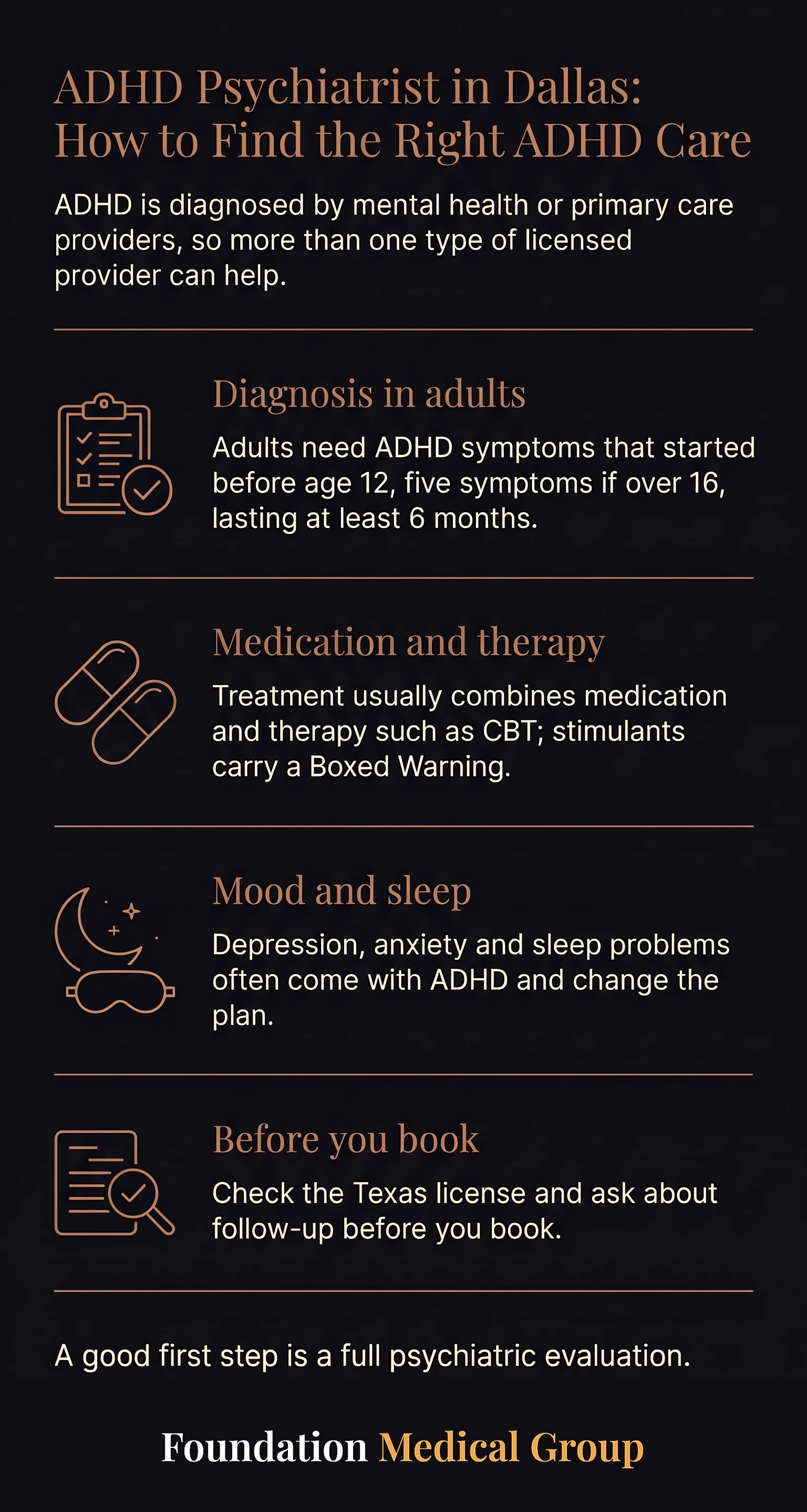
- ADHD is diagnosed by mental health or primary care providers, so more than one type of licensed provider can help.
- Adults need ADHD symptoms that started before age 12, five symptoms if over 16, lasting at least 6 months.
- Treatment usually combines medication and therapy such as CBT; stimulants carry a Boxed Warning.
- Depression, anxiety and sleep problems often come with ADHD and change the plan.
- Check the Texas license and ask about follow-up before you book.
Sources
- National Institute of Mental Health, ADHD in Adults: 4 Things to Know.
- National Institute of Mental Health, Attention-Deficit/Hyperactivity Disorder (ADHD).
- American Psychiatric Association, What is ADHD?.
- U.S. Food and Drug Administration, Treating and Dealing with ADHD.
- U.S. Food and Drug Administration, FDA updating warnings to improve safe use of prescription stimulants used to treat ADHD and other conditions.
- National Institute of Mental Health, Psychotherapies.
- MedlinePlus, Attention Deficit Hyperactivity Disorder.
- Frontiers in Psychiatry (PMC), Adult ADHD and comorbid anxiety and depressive disorders: a review of etiology and treatment.
- Texas Medical Board, Look Up a License.