
An adult ADHD evaluation is a clinical assessment, not a single test. A psychiatrist or other qualified clinician asks about your symptoms today and in childhood. They review your medical and family history, may use rating scales and may talk with people who know you well. They also check for conditions that can look like ADHD. You leave with a diagnosis, or a clear no, and a plan. Wondered about ADHD for years? There’s no expiration date on getting checked.
What Is an Adult ADHD Evaluation?
The evaluation looks for a lasting pattern of three kinds of symptoms: inattention, hyperactivity and impulsivity. The NIMH notes that symptoms often change with age. Attention problems tend to persist as people get older. The other two are more likely to fade. So many adults show more restlessness and distraction than the obvious hyperactivity seen in children.
ADHD in adults is common. The NIMH reports that the current prevalence of adult ADHD is 4.4% among U.S. adults aged 18 to 44. The American Psychiatric Association cites a recent study estimating that 6% of U.S. adults have an ADHD diagnosis, and about half received it in adulthood.
At Foundation Medical Group, this assessment happens during a psychiatric evaluation with a board-certified psychiatrist or psychiatric nurse practitioner. Suspected ADHD is one of the reasons people book one. You don’t need a referral.
How Do Adults Get Tested for ADHD?
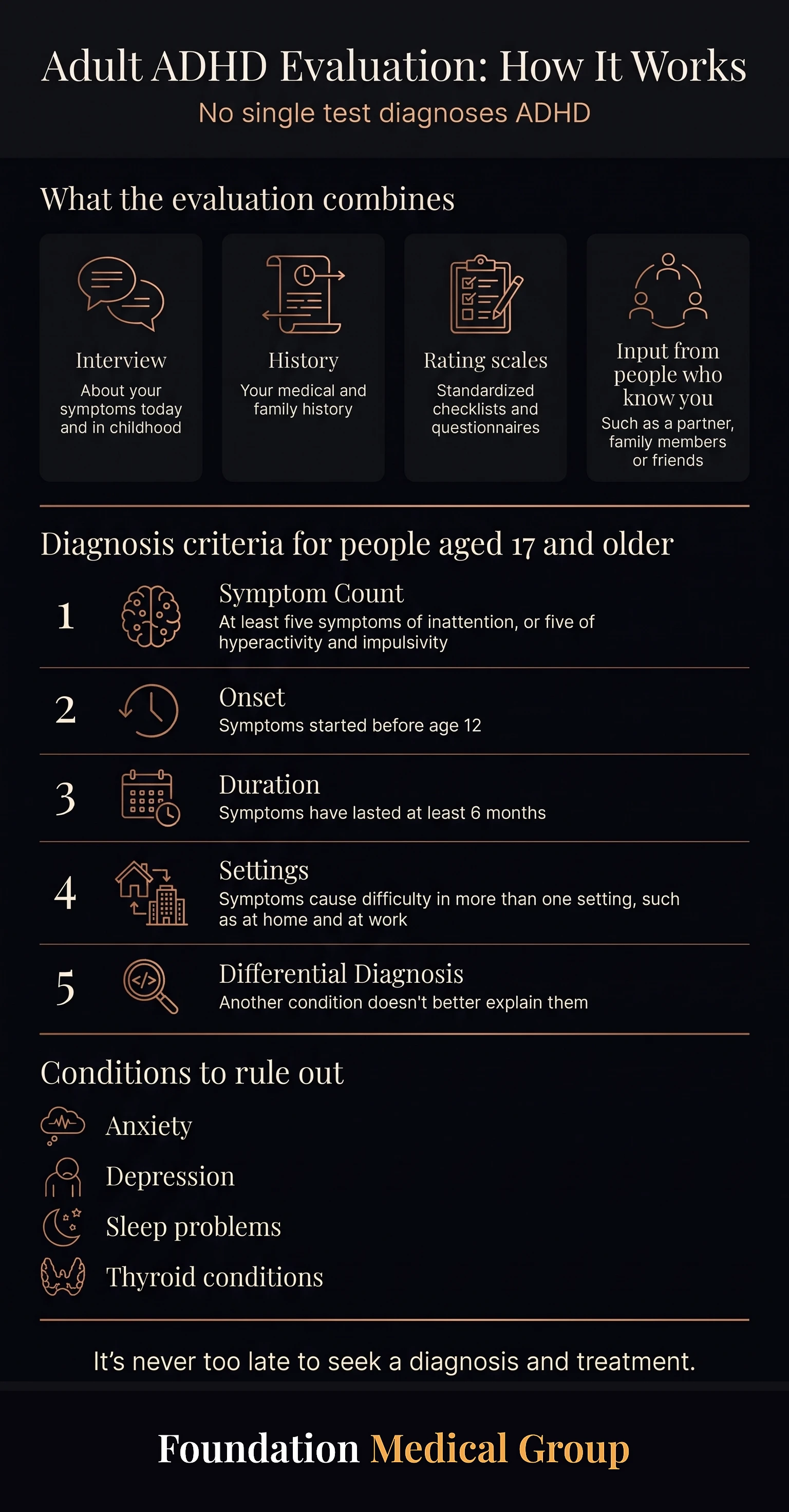
This part catches a lot of people off guard: there’s no single test to diagnose ADHD, as MedlinePlus points out. Instead, assessing ADHD in adults combines several sources:
- A physical exam, which may include vision and hearing tests, to rule out other problems with similar symptoms.
- Your medical and family history.
- Standardized checklists, questionnaires and rating scales.
The American Psychiatric Association adds that there aren’t any specific blood tests or routine imaging for an ADHD diagnosis either.
To make the diagnosis, a clinician checks your history against set criteria. According to MedlinePlus and the American Psychiatric Association, for people aged 17 and older:
- At least five symptoms of inattention, or five of hyperactivity and impulsivity, are present.
- Symptoms started before age 12.
- Symptoms have lasted at least 6 months.
- Symptoms cause difficulty in more than one setting, such as at home and at work.
- Another condition doesn’t better explain them.
The evaluation also sorts out which type of ADHD fits. MedlinePlus describes three types: mostly inattentive, where people have trouble paying attention, are easily distracted and find it hard to organize or finish tasks; mostly hyperactive-impulsive; and combined. The American Psychiatric Association uses the same three presentations. Why does the type matter? It helps shape the treatment plan.
What Happens During the Assessment?

The NIMH describes what an assessment for adults may include. A provider may ask you to:
- Complete clinical interviews.
- Fill out behavior rating scales or symptom checklists.
- Take psychological tests that look at memory and planning.
- Answer questions about your mood and medical history to rule out other diagnoses.
Because symptoms must have started before age 12, the diagnosis leans heavily on your past. That’s the part people miss when they expect a quick quiz. The NIMH says a provider may ask to talk with people who know you well, such as a partner, family members or friends. The aim is to learn how you behave in different situations and how you were as a child. They may also look at school reports or other childhood records. Digging up old report cards as a grown adult can feel a little awkward, even embarrassing. That’s normal, and it really does help.
Rating scales are a common part of the visit. The Adult ADHD Self-Report Scale (ASRS) is the official screening instrument of the World Health Organization. How well do these scales work? A 2020 study of 646 adult patients with ADHD and 908 people without it found both the ASRS and the Wender Utah Rating Scale highly accurate, and the short ASRS screener performed about as well as the full scale.
But a screener is only a starting point. A high score is a reason to book an evaluation, not a diagnosis on its own. Expect a long conversation. The more detail you share about your experience, the clearer the picture tends to get.
ADHD Testing Options at a Glance
Each option does a different job, and they’re easy to mix up. Here’s what each can and can’t do.
| Option | What it is | What it can do | At Foundation Medical Group |
|---|---|---|---|
| Psychiatric evaluation | A clinical interview with history and symptom review | Leads to a diagnosis and treatment plan | Yes, in all four states |
| Rating scales such as the ASRS | Standard symptom questionnaires | Screens for ADHD and tracks symptoms; not a diagnosis alone | Used as part of the evaluation |
| Neuropsychological or psychoeducational testing | Formal psychological tests | Sometimes used for more detail, per the American Psychiatric Association | Not offered; our visit is a psychiatric evaluation |
| Brain mapping (quantitative EEG) | A recording of brain electrical activity | An assessment aid; it does not diagnose ADHD | Richmond, VA and Dallas, TX clinics |
Can Anxiety or Depression Look Like ADHD?

Yes. Honestly, this is one of the most important parts of the evaluation. The American Psychiatric Association lists several conditions that can mimic ADHD: learning disorders, mood disorders, anxiety, substance use, head injuries, thyroid conditions and some medications, such as steroids. MedlinePlus also names anxiety, depression, sleep problems and certain learning disabilities as problems with similar symptoms.
ADHD can also occur alongside these conditions. The NIMH notes that ADHD often co-occurs with sleep problems, anxiety and depression, which can make each one harder to diagnose and treat. That’s frustrating when you’re the one looking for answers. Sleep deserves special attention: according to the NIMH, sleep problems affect up to 70% of adults with ADHD.
That overlap is why distractibility or restlessness alone doesn’t settle the question. A careful evaluation asks when your symptoms began, whether they show up across settings and whether another condition explains them better. The American Psychiatric Association says that’s why a full psychiatric evaluation and careful history taking are very important.
Why Undiagnosed ADHD Is Common in Adulthood
Many adults reach their 30s, 40s or later with undiagnosed ADHD. The NIMH explains that some people manage their symptoms well until the stresses and demands of adult life, especially at work, push them past what they can handle. ADHD symptoms in girls and women are especially likely to have been missed in childhood.
The FDA notes that ADHD may continue into the adult years. Remember the American Psychiatric Association’s figure from earlier? About half of diagnosed adults learned of it as adults. A late diagnosis is common. If you’re only now putting a name to years of struggle, that isn’t a personal failing.
Maybe you recognize lifelong trouble with attention, planning or sitting still that gets in the way of daily life. The NIMH’s advice is simple: it’s never too late to seek a diagnosis and treatment. For a lot of people, that’s a relief to hear.
Can an Online Psychiatrist Diagnose ADHD?
Yes, a psychiatrist can evaluate ADHD by video, within the rules of each state. At Foundation Medical Group, psychiatric evaluations take place in person or by secure video, depending on your state and the kind of medication that may be considered. You need to be physically in Virginia, Utah, Georgia or Texas at the time of a video visit.
There’s one important limit, though, for anyone who may need a stimulant. Stimulants are controlled medications, and for some controlled prescriptions the first visit must be in person. When you book, ask our team which visit type fits your situation.
Learn more about how video care works in our guide to seeing an online psychiatrist.
How Long Does an ADHD Assessment Take?
At Foundation Medical Group, the first visit runs up to 60 minutes. Most patients are seen within 3 to 5 business days of booking. By the end of the first visit, you leave with a working diagnosis and a plan. A follow-up visit usually happens within 2 to 4 weeks.
The full process can take longer than one visit if your clinician wants more information, such as school records or input from a partner or family member. So gathering those ahead of time can speed things up.
What Should I Bring to My Appointment?
A little preparation makes the visit more useful. Nervous you’ll forget something? Based on NIMH guidance, bring:
- A list of questions. Write down what you want to know about the diagnosis and treatment options.
- A list of all your medications. Include over-the-counter medicines, herbal remedies and supplements.
- Your family history. The NIMH notes that knowing your family history can help your provider understand your risk for certain conditions.
- Notes on your symptoms. Describe when they started, how severe they are and how often they happen. Include an example or two from work, home and relationships, such as losing track of a task.
- Childhood information. School reports or other childhood records can help show that symptoms began early.
- A friend or relative, if you like. The NIMH notes that it can be hard to take in everything a provider says. Someone who knows you well can also offer support and add their view of your attention and behavior.
If you want to know more about the doctor’s role, read what a psychiatrist does.
What Happens After an ADHD Diagnosis?
A diagnosis opens the door to treatment. The NIMH says adult ADHD is usually treated with medication, psychotherapy or both. Some people need to try several treatments to find what works, the NIMH adds. That can be tiring and, honestly, discouraging at times. Stick with it. The FDA describes two kinds of ADHD medication: stimulants, such as methylphenidate and amphetamine, and non-stimulants. Our guide to ADHD medication for adults explains each type.
Treatment isn’t a one-time decision. MedlinePlus says good treatment plans include close monitoring, follow-ups and changes along the way when needed. At Foundation Medical Group, the first follow-up usually comes within 2 to 4 weeks of your evaluation, so we can check how the plan is working and adjust it with you.
Some people with ADHD symptoms that affect their work may qualify for reasonable accommodations under the Americans with Disabilities Act, the NIMH notes.
The NIMH also reminds people that there is no one-size-fits-all treatment. If a suggested option doesn’t feel right, say so, ask about others, and consider getting another opinion. Your care has to work for the person living with it day to day.
Using Insurance for an ADHD Assessment at Our Clinics
Our team checks your insurance benefits before your visit. Plans we commonly work with, by state:
- Virginia: Aetna, Anthem, Cigna, UnitedHealthcare, TRICARE, Virginia Medicaid and Sentara Health Plans. Call to confirm coverage. Our Richmond clinic does not accept Medicare.
- Texas: Aetna, Blue Cross Blue Shield, Cigna, UnitedHealthcare, Humana, TRICARE, Medicare and Texas Medicaid. Call to confirm coverage.
- Utah: Aetna, Blue Cross Blue Shield and SelectHealth. Call to confirm coverage.
- Georgia: Cigna. Call to confirm coverage.
Coverage depends on your specific plan, so call us at (800) 983-1974 before your visit.
Getting Evaluated for ADHD at Foundation Medical Group
We have clinics in Richmond, VA; American Fork, UT; Decatur, GA; and Dallas, TX, with video visits in all four states. You don’t need a referral.
Your ADHD assessment is a full psychiatric evaluation, not a quick screen. We look at mood, sleep, focus, anxiety, trauma history, medical context and medications you’ve already tried, so look-alike conditions aren’t missed. The visit is a psychiatric evaluation. It doesn’t include formal psychological tests.
Our Richmond and Dallas clinics also offer brain mapping. As our guide to brain mapping for ADHD explains, the FDA classifies the EEG device as an assessment aid, not a diagnosis, so diagnosis still comes from the clinical evaluation.
To book, call (800) 983-1974.
Key Takeaways
- No single test diagnoses ADHD; an evaluation combines an interview, history, rating scales and input from people who know you.
- Symptoms must have started before age 12 and cause difficulty in more than one setting.
- Anxiety, depression, sleep problems and thyroid conditions can look like ADHD, so a careful evaluation rules them out.
- An online psychiatrist can evaluate ADHD, though some controlled prescriptions need an in-person first visit.
- Bring your questions, a medication list, family history, symptom notes and any childhood records.
Sources
- National Institute of Mental Health, ADHD in Adults: 4 Things to Know.
- National Institute of Mental Health, Attention-Deficit/Hyperactivity Disorder (ADHD).
- National Institute of Mental Health, Attention-Deficit/Hyperactivity Disorder (ADHD) statistics page.
- National Institute of Mental Health, Tips for Talking With a Health Care Provider About Your Mental Health.
- American Psychiatric Association, What is ADHD?.
- MedlinePlus, Attention Deficit Hyperactivity Disorder.
- Brain and Behavior (PMC), Validity and accuracy of the Adult Attention-Deficit/Hyperactivity Disorder (ADHD) Self-Report Scale (ASRS) and the Wender Utah Rating Scale (WURS) symptom checklists in discriminating between adults with and without ADHD.
- U.S. Food and Drug Administration, Treating and Dealing with ADHD.