
The main types of anxiety medication are SSRI and SNRI antidepressants (usually the first choice), benzodiazepines for short-term relief, buspirone for longer-term use, and beta-blockers for physical symptoms. Each one trades off speed, side effects and dependence risk. So the choice is made with a prescriber, often alongside therapy, as part of treatment for anxiety disorders.
What Is Anxiety Medication?
It’s a prescription medicine that helps reduce symptoms such as panic attacks, extreme fear and worry. The National Institute of Mental Health (NIMH) explains that anti-anxiety medications do this job. It also notes that many medications first used for depression help with anxiety disorders. These are prescription medications. A licensed prescriber decides whether one fits you.
You’re far from alone if you’re weighing this. NIMH estimates that 19.1% of U.S. adults had an anxiety disorder in the past year, based on survey data from 2001 to 2003. That’s a lot of people. For generalized anxiety disorder alone, NIMH puts the figure at 2.7% of U.S. adults in the past year.
There are four main groups:
- SSRIs and SNRIs: antidepressants that are usually the first choice.
- Benzodiazepines: fast-acting medicines for short-term or severe symptoms.
- Buspirone: an antianxiety medication taken every day for longer-term use.
- Beta-blockers: used off-label for physical symptoms, such as a racing heart.
Medications ease the symptoms of anxiety disorders. Treatment often combines them with psychotherapy. NIMH notes that treatment for generalized anxiety disorder (GAD) is psychotherapy, medication or both. It may also take several tries to find the medicine that works well for you with the fewest side effects. That can be frustrating (maddening, honestly, when you just want to feel like yourself again). But it’s normal in mental health care, not a sign that something is wrong with you. It’s also why our Richmond, VA clinic offers GeneSight testing, which comes up again near the end.
SSRIs and SNRIs: Why an Antidepressant Is Often the First Anxiety Medication

Selective serotonin reuptake inhibitors (SSRIs) and serotonin norepinephrine reuptake inhibitors (SNRIs) are antidepressants. Despite the name, they’re often the first pick. For panic disorder or social anxiety disorder, NIMH says providers typically start with SSRIs or other antidepressants. The reason? They have fewer side effects than older options.
Why do they help? According to NIMH, SSRIs, SNRIs and NDRIs are commonly prescribed because they improve symptoms across a broad group of depressive and anxiety disorders. That’s why one antidepressant medication can help with several anxiety disorders. NIMH’s GAD guide adds that SSRI and SNRI antidepressants can help GAD symptoms.
And how do they actually work? Even the official answer comes with a “may” in it. MedlinePlus says researchers think antidepressants may help improve the way your brain uses certain chemicals that control mood or stress. Its drug pages get more specific. Escitalopram, an SSRI, works by increasing the amount of serotonin, a natural substance in the brain that helps maintain mental balance. Venlafaxine, an SNRI, works by increasing serotonin and norepinephrine, so that’s two brain chemicals rather than one. We’re naming these as examples only, not as a recommendation.
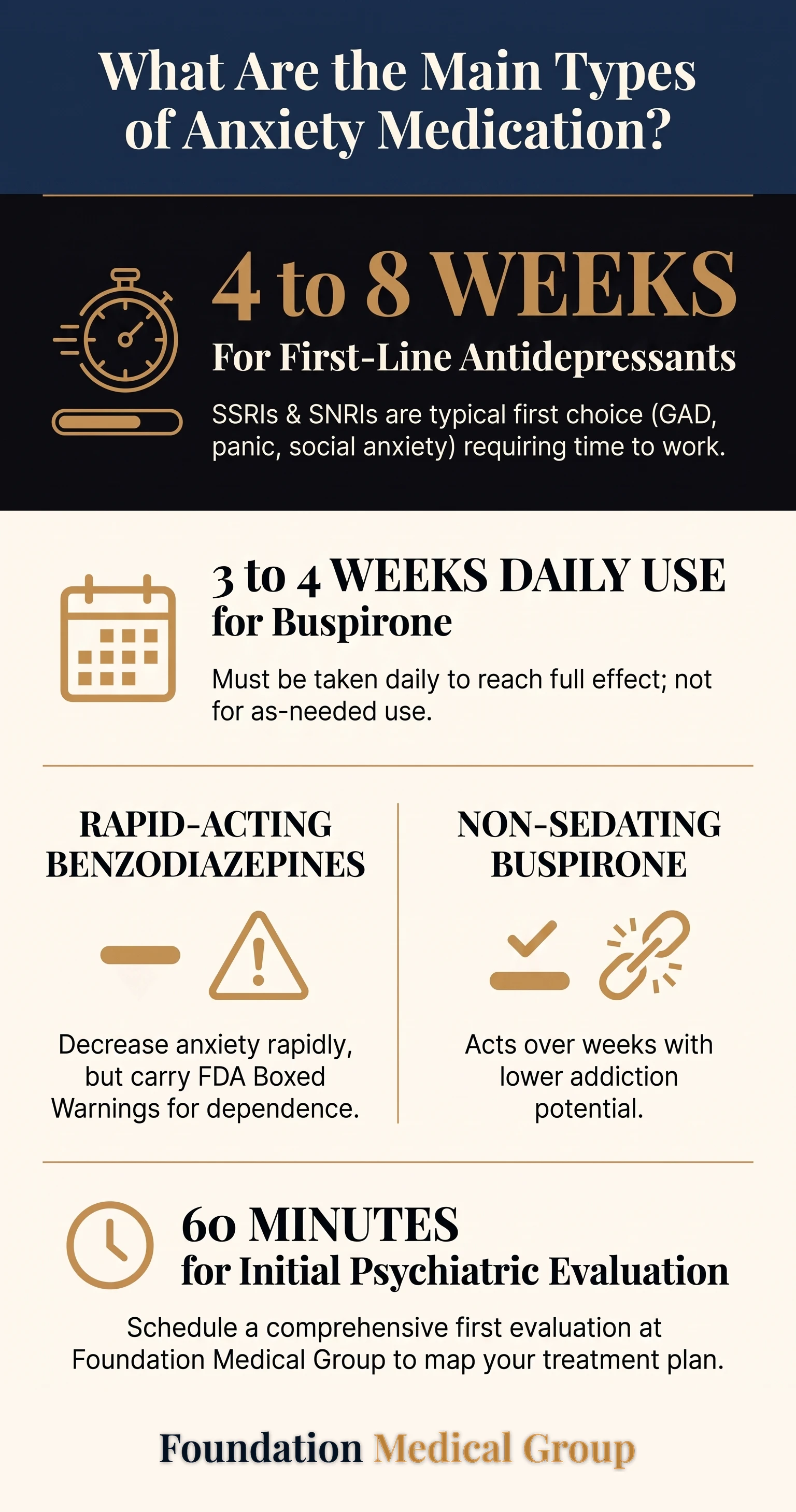
The catch? Time. Whether your clinician starts you on a selective serotonin reuptake inhibitor or a serotonin norepinephrine reuptake inhibitor, it works slowly. NIMH says antidepressants usually take 4 to 8 weeks to work, so the first weeks can feel like nothing is happening. That wait is hard. Really hard, when you’re anxious and want relief now. At our clinics in Richmond, American Fork and North Dallas, follow-ups are monthly at first, so you’re not riding out those weeks on your own. Our guide on how long it takes antidepressants to work explains the timeline in more detail. If side effects worry you, see our article on SSRI side effects.
Older options exist too, such as tricyclic antidepressants and MAOIs. NIMH says these tend to cause more side effects, yet a tricyclic antidepressant may still suit some people better than a newer medicine. That’s a call you and your clinician make together.
Benzodiazepines: Fast Relief for Acute Anxiety, With Limits
Benzodiazepines are sedative medications. According to the FDA, they work by binding to GABA receptors to slow brain activity. It’s why they can bring a calm, drowsy feeling. NIMH’s GAD guide says they can rapidly decrease anxiety and can be used for severe GAD. That speed is why people think of them for quick anxiety relief.
The FDA lists common benzodiazepines such as alprazolam (Xanax), clonazepam (Klonopin), diazepam (Valium) and lorazepam (Ativan). We name them only so you recognize them, not as a recommendation.
How common are they? Very. The FDA estimates that about 92 million benzodiazepine prescriptions were dispensed from U.S. outpatient pharmacies in 2019, and alprazolam made up 38% of them. In 2018, the FDA adds, about 50% of patients who got oral benzodiazepines received them for two months or longer. Read that last part again. Two months or longer, for medicines usually meant for short stretches.
There are real limits. Per NIMH, these medicines are used for some short-term symptoms. Prescribers usually keep them to short periods and taper them slowly to reduce withdrawal symptoms, the agency notes. The FDA lists common side effects including drowsiness, dizziness, weakness and slowed breathing. A benzodiazepine can also be risky when mixed with other medications or substances. We cover that in the side effects section below.
If a benzodiazepine is part of your plan, ask your prescriber how long you’re expected to take it and how stopping will be handled. Never stop on your own.
How Does Buspirone Work for Anxiety?
Buspirone is an anxiolytic, which simply means an anti-anxiety drug. MedlinePlus says it is used to treat anxiety and works by changing the amounts of certain natural substances in the brain. NIMH says it’s used over longer periods, for things like chronic anxiety or generalized anxiety.
Buspirone differs from benzodiazepines in two big ways. First, NIMH’s GAD guide says it is not a sedative and has less potential to be addictive. Second, it’s slow. Patience required. NIMH says buspirone must be taken every day for 3 to 4 weeks to reach its full effect, and it does not work as needed.
MedlinePlus lists side effects that can include dizziness, nausea, headache, nervousness and trouble sleeping, and it may cause drowsiness. Tell your clinician if any of these bother you during treatment. Don’t just quietly put up with them.
Beta-Blockers for Performance Anxiety and Other Options
NIMH notes that providers may prescribe beta-blockers off-label for short-term anxiety symptoms. Off-label means the medicine is used for something other than its approved purpose. Beta-blockers help with physical symptoms: a rapid heart rate, sweating and tremors. NIMH gives the example of a phobia of public speaking. That’s why they come up for stage fright. They are generally not recommended for people with asthma or diabetes, though, so your full health history matters.
Side note, because people ask: if the name rings a bell, that’s probably because beta-blockers are better known as heart and blood pressure medicines. Calming a pounding heart before a big presentation is the off-label part. Anyway, back to the anxiety options.
You may also hear about atypical antipsychotics. NIMH says these are sometimes used for bipolar depression or for depression that hasn’t responded to an antidepressant alone. Pregabalin is a slightly odd case. A research review on anxiety medicines notes it was approved for GAD by the European Union but not by the FDA in the United States, where its approvals cover nerve pain, fibromyalgia and partial seizures. Same medicine, different answer depending on the country. Whether any other option fits someone with anxiety or panic attacks is a treatment decision for a prescriber.
Anxiety Medications Compared Side by Side
Here’s how the main options compare, using only what NIMH, the FDA and MedlinePlus say.
| Medication type | Typical use | Time to work | Main trade-off |
|---|---|---|---|
| SSRIs and SNRIs | Usually first-line; panic disorder, social anxiety disorder, GAD (NIMH) | About 4 to 8 weeks (NIMH) | Upset stomach, headache, sexual side effects, usually mild (NIMH) |
| Benzodiazepines | Short-term or severe symptoms; sometimes GAD (NIMH) | Rapid (NIMH) | Boxed Warning: abuse, addiction, physical dependence, withdrawal (FDA) |
| Buspirone | Longer-term use (NIMH) | Daily for 3 to 4 weeks for full effect; not as needed (NIMH) | Dizziness, nausea, headache (MedlinePlus) |
| Beta-blockers (off-label) | Short-term physical symptoms, such as before public speaking (NIMH) | As needed (NIMH) | Not for people with asthma or diabetes (NIMH) |
Truth is, no row in this table is the winner for all anxiety disorders. Annoying, if you came here hoping for a clear answer. But that’s the honest one. The right choice depends on the type of anxiety disorder you have, your physical and mental health history and the other medications you take. A medicine that’s a poor fit for one person can be a good fit for another. So the choice belongs in a conversation with the clinician who knows your history.
What Are the Common Side Effects of Anxiety Medication?

All anxiety medications have possible side effects, and many are mild. Here’s what the sources describe by class:
- SSRIs and SNRIs: NIMH lists upset stomach, headache and sexual problems, and its GAD guide adds nausea and difficulty sleeping. These are generally mild and tend to go away.
- Benzodiazepines: drowsiness, dizziness, weakness and slowed breathing, according to the FDA.
- Buspirone: dizziness, nausea, headache, nervousness and trouble sleeping, per MedlinePlus.
A few warnings are more serious. NIMH says combining an antidepressant with other products that act on serotonin, such as triptans or the supplement St. John’s wort, can cause a rare but serious problem called serotonin syndrome. NIMH also notes that people under 25 may have more suicidal thoughts early in treatment. MedlinePlus gives a similar warning: medications such as escitalopram may increase the risk of suicidal thoughts and actions in children, teenagers and young adults (less than 24 years of age). If you notice new or worsening depression, extreme worry, agitation or panic attacks, it says to call your doctor right away. Don’t hold it for the next appointment. The FDA warns that taking benzodiazepines with opioid pain relievers, alcohol or illicit drugs raises the risk of overdose. This one deserves a pause. The FDA reports that from 2013 to 2017, 55% of overdose deaths involving benzodiazepines also involved prescription opioids.
Drug interactions are easier to avoid when the person prescribing sees the whole picture. So share every medicine and supplement you take, even the ones that feel too minor to mention. If a side effect worries you, call your prescriber rather than stopping. If you have thoughts of suicide, call or text 988. In an emergency, call 911.
Pregnant, planning a pregnancy or breastfeeding? Talk to your prescriber before you change anything, and that includes stopping a medicine on your own. MedlinePlus says your provider will help you find a treatment that’s safe for you and your baby. Its buspirone page also says to tell your doctor if you are pregnant, plan to become pregnant, or are breast-feeding, so bring it up early.
Is Anxiety Medication Addictive?
It depends on the type. Benzodiazepines carry the main risk. The FDA requires a Boxed Warning on all benzodiazepines that covers abuse, misuse, addiction, physical dependence and withdrawal reactions. The FDA says physical dependence can develop after several days to weeks, even when the medicine is taken as prescribed. And per the FDA, stopping abruptly can cause withdrawal reactions, including seizures. That’s sobering to read. It’s also why the plan for stopping matters as much as the plan for starting. NIMH adds that long-term use may lead to tolerance or dependence.
What about the others? The sources paint a different picture. NIMH’s GAD guide says buspirone has less potential to be addictive than benzodiazepines. And the sources don’t describe SSRIs and SNRIs as addictive in the same way.
Even so, do not stop any of your anxiety meds suddenly or on your own. If you want to come off a medicine, plan it with your prescriber, who can help you manage withdrawal symptoms safely.
Is Anxiety Medication the Same as Depression Medication?
Partly. Antidepressants are used to treat depression, and NIMH says they may also be prescribed for anxiety. SSRIs, SNRIs and NDRIs improve symptoms across a broad group of depressive disorder and anxiety disorder types. That’s why one antidepressant can sometimes help with both kinds of disorder.
Other anxiety medications are more specific. Benzodiazepines, buspirone and beta-blockers are used for anxiety rather than depression. That means your prescriber may choose differently, depending on which disorder is driving your symptoms. If you’re not sure which one you’re dealing with (or whether it’s both), our guide to anxiety vs depression walks through the symptoms.
When Is Anxiety Medication Prescribed? Getting Care at FMG
So where does all this leave you? For a lot of people with anxiety disorders, medication comes up when symptoms start to get in the way of daily life. NIMH notes that GAD treatment can be psychotherapy, medication or both. Cognitive behavioral therapy is commonly used for this disorder. Therapy can work in person or by telehealth, too, whether that’s a chair in our Richmond office or a video session from home in metro Atlanta. NIMH also encourages you to build a treatment plan with a health care provider or mental health professional. A primary care provider can be a first stop. Over time, a psychiatric prescriber can manage medication treatment.
At Foundation Medical Group, medication management is offered at our Richmond clinic, 11600 Busy Street, Suite 203, Richmond, VA 23236 (Virginia location). The Richmond office is on the second floor, just off Midlothian Turnpike, with a free lot. From Chesterfield, Midlothian, Short Pump or Henrico, it’s under thirty minutes most days. Call (804) 506-0526. Vincent Nardone, MD, is the Richmond clinic’s medical director. Out on the Wasatch Front, medication management is also offered at American Fork, UT (in person and by telehealth, (801) 876-5998), where Paul Frandsen, MD, is medical director. In Texas, our North Dallas office on LBJ Freeway in Dallas, TX ((469) 909-1312) offers it too, with Justin Thompson, MD, as medical director.
Prescribing is done by board-certified physicians and psychiatric nurse practitioners. Wondering whether a nurse practitioner can actually prescribe? In Virginia, yes. Under Virginia law, a licensed advanced practice registered nurse has the authority to prescribe Schedule II through Schedule VI controlled substances, though in some cases only under a practice agreement with a physician.
Follow-ups run 20 to 30 minutes, monthly at first. At each one, our team checks symptoms, side effects and labs when needed. And if a medicine isn’t pulling its weight, we change the plan. Because finding the right medicine can take several tries, our Richmond, VA clinic also offers GeneSight testing. It’s a simple cheek swab, and the results sort psychiatric medicines into color-coded groups that help your clinician prescribe with more confidence. Our Decatur, GA clinic, a few blocks from downtown Decatur, offers psychiatric evaluation ((706) 534-8574), and William Epps, MD, is medical director there. A first psychiatric evaluation is up to 60 minutes.
For our patients who want therapy alongside medication, talk therapy (CBT, DBT and ACT) is by secure video in VA, UT, GA and TX, and in person only in Richmond. See our page on finding an anxiety therapist near me. Richmond also offers IV and IM ketamine therapy for treatment-resistant depression, chronic PTSD, and severe anxiety.
Virginia plans include Anthem, Aetna, Cigna, Sentara Health Plans, UnitedHealthcare, TRICARE and Virginia Medicaid (Cardinal Care). Call to confirm coverage. Medicare is not accepted in Virginia. FMG does not offer detox, IOP, PHP, residential care or 24/7 supervision. Call the Richmond office to ask about anxiety treatment.
Key Takeaways
- SSRIs and SNRIs are usually the first choice, and each antidepressant takes about 4 to 8 weeks to work.
- Benzodiazepines work fast but are meant for short-term use and carry an FDA Boxed Warning on dependence and withdrawal.
- Buspirone works only when taken every day for 3 to 4 weeks.
- Beta-blockers can calm physical symptoms, such as a racing heart before a stressful event.
- The right choice among anxiety medications depends on your anxiety disorders, health history and other medicines. Never stop or change a medicine on your own; plan changes with your prescriber.
FAQ
What are the types of anxiety medication?
The four main groups of anxiety medications are SSRI and SNRI antidepressants, benzodiazepines, buspirone and beta-blockers. NIMH notes it may take several tries to find the medicine that works with the fewest side effects, so some people try more than one. Your prescriber helps you weigh the trade-offs.
How long does it take for anxiety medication to work?
It depends on the type. Benzodiazepines work rapidly, buspirone needs 3 to 4 weeks of daily use, and SSRIs and SNRIs usually take about 4 to 8 weeks. Some changes, such as better sleep or energy, may show up before the anxiety itself eases.
Is anxiety medication addictive?
Benzodiazepines can cause physical dependence even when taken as prescribed, and the FDA requires a Boxed Warning about it. Buspirone has less potential to be addictive. Before you start a benzodiazepine, ask your prescriber what the plan for stopping it will look like.
When is anxiety medication prescribed?
Usually when anxiety symptoms get in the way of daily life. NIMH notes that treatment can be psychotherapy, medication or both, so medicine is often paired with therapy. A prescriber decides after an evaluation, so the plan to treat anxiety fits you, even with chronic anxiety.
Sources
- National Institute of Mental Health, Mental Health Medications.
- National Institute of Mental Health, Generalized Anxiety Disorder: What You Need to Know.
- U.S. Food and Drug Administration, FDA requiring Boxed Warning updated to improve safe use of benzodiazepine drug class.
- MedlinePlus, Buspirone.
- National Institute of Mental Health, Any Anxiety Disorder.
- National Institute of Mental Health, Generalized Anxiety Disorder statistics.
- MedlinePlus, Antidepressants.
- MedlinePlus, Escitalopram.
- MedlinePlus, Venlafaxine.
- Frontiers in Psychiatry (PMC), Pharmacotherapy of Anxiety Disorders: Current and Emerging Treatment Options.
- Code of Virginia, Prescription of certain controlled substances and devices by licensed advanced practice registered nurses.