
Bipolar disorder is treated with medications, psychotherapy or a combination of the two, according to the National Institute of Mental Health (NIMH). Mood stabilizers such as lithium or valproate, and some atypical antipsychotics, are the most common medicines. Therapy helps you stay on treatment, keep a steady routine and spot early warning signs.
If you’ve just heard this diagnosis, for yourself or for someone you love, it can feel scary. Oddly, it can be a bit of a relief too, because the swings finally have a name. Both reactions are normal, and you don’t have to sort them out on day one. NIMH notes that this mental illness “usually requires lifelong treatment and does not go away on its own.” So a good bipolar disorder treatment plan covers two things: getting through the current episode and preventing the next one. At Foundation Medical Group, treatment starts with a psychiatric evaluation. If you are thinking about suicide, call or text 988 now. In an emergency, call 911.
What Is Bipolar Disorder, and How Is It Treated?
Bipolar disorder is a mental illness that causes mood changes far beyond everyday ups and downs. NIMH describes two kinds of episode. In manic episodes, a person feels very up, irritable or “wired,” with much more activity than usual. In depressive episodes, they feel sad, hopeless and unable to function. People sometimes still use the older names manic-depressive disorder or manic depression.
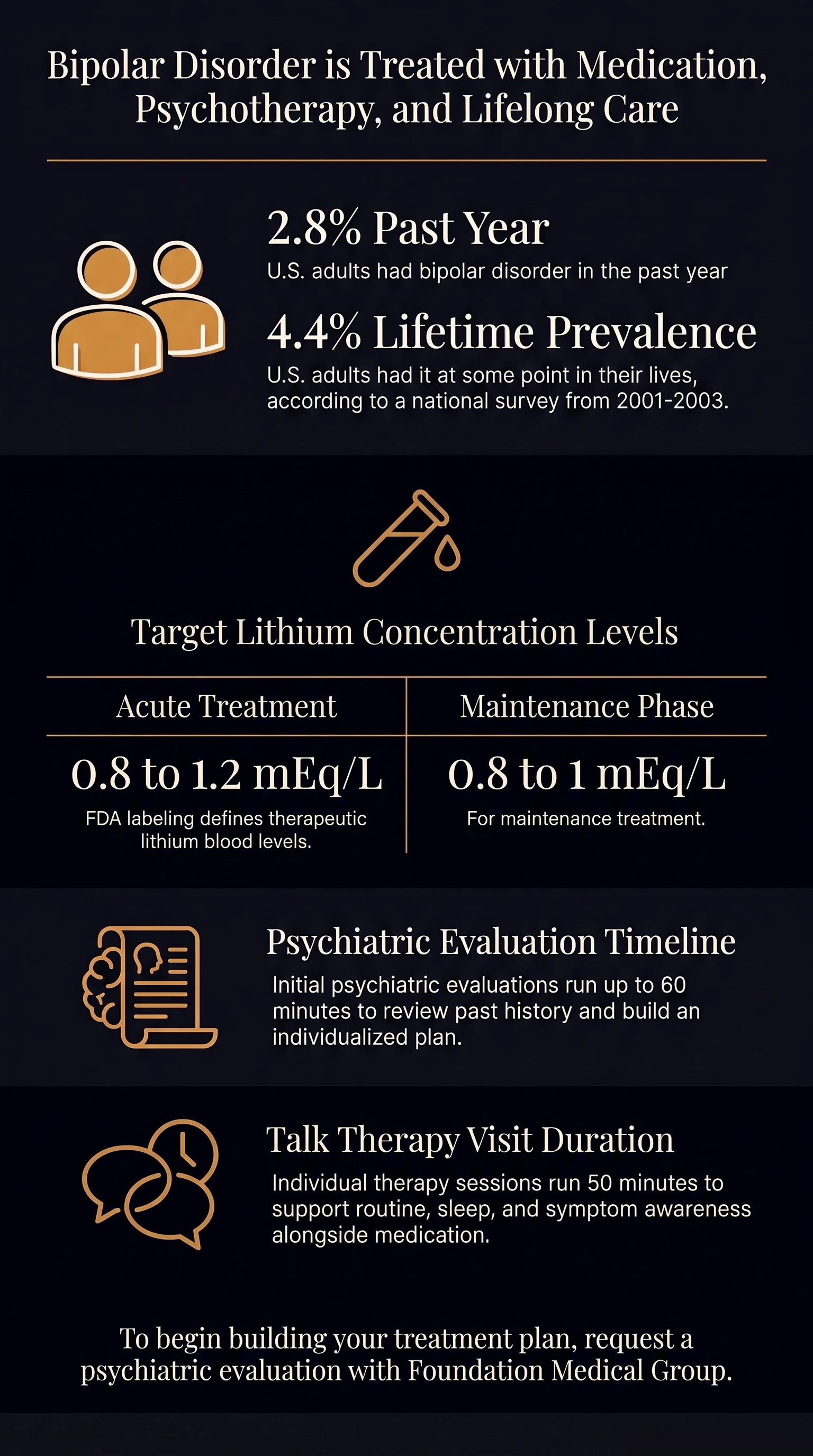
It isn’t rare. In a national survey run from 2001 to 2003, about 2.8% of U.S. adults had bipolar disorder in the past year, and about 4.4% had it at some point in their lives. Those figures are from an older survey, so treat them as a rough guide rather than today’s count.
Bipolar treatment usually works in three layers:
- Acute treatment. Medicine to bring a manic or depressive episode under control.
- Maintenance. Ongoing medicine to prevent the next episode.
- Therapy and education. Alongside medicine, to help you understand the illness, protect sleep and routine, and catch warning signs early.
The guidance on this page comes from NIMH, FDA drug labels and the CANMAT and ISBD guideline. That last one is a Canadian and international guideline, with a 2023 update of the evidence. It’s a strong reference for mental health care. Still, your own plan depends on your history, so the decisions belong with your psychiatrist.
What Are the Types and Symptoms of Bipolar Disorder?
The type of bipolar disorder matters because treatment differs between them.
Bipolar I. Manic episodes last at least 7 days, or the manic symptoms are so severe that hospital care is needed. Separate depressive episodes usually happen too, typically lasting at least 2 weeks.
Bipolar II disorder. A pattern of depressive episodes and hypomanic episodes. Hypomania is like mania but less severe, and it doesn’t disrupt daily life as much. People with bipolar II often spend long stretches in a low-grade depressed state. That’s usually what brings them in.
Cyclothymia. Repeated hypomanic and depressive symptoms that aren’t intense enough, or don’t last long enough, to count as full episodes.
Rapid cycling. Four or more episodes of mania or depression within a year.
Common bipolar disorder symptoms during a manic episode, from NIMH:
- Feeling very up, high, elated, or extremely irritable or touchy.
- Feeling jumpy or wired, or more active than usual.
- Racing thoughts and talking fast about many different things.
- Needing less sleep.
- An excessive appetite for pleasurable activities, including risky ones.
During a depressive episode:
- Feeling very down, sad or anxious.
- Trouble concentrating or making decisions.
- Sleeping too little or too much.
- Losing interest in almost all activities.
- Feeling hopeless or worthless, or thinking about death or suicide.
These aren’t ordinary mood swings. Everyone has good and bad days. With bipolar disorder, NIMH says episode symptoms last a week or two, sometimes longer. They’re there for most of the day. And the changes in mood, energy and behavior are big enough for family and friends to notice. That’s the difference between extreme mood swings in the everyday sense and a real episode.
How Is Bipolar Disorder Diagnosed Before Treatment Starts?
A full evaluation comes first, because the right treatment depends on the right diagnosis. You might hope a blood test or brain scan could settle it. It can’t. There’s no single test or scan that confirms bipolar disorder.
According to NIMH, a health care provider may do a physical exam and order medical tests to rule out other illnesses. They may also refer you to a mental health professional for an evaluation. The diagnosis rests on how severe your symptoms are, how long they last and how often episodes happen. Some health conditions, such as thyroid disease, can cause symptoms like those of bipolar disorder. Some prescribed, recreational or illicit drugs can also mimic or worsen mood symptoms.
Bipolar disorder often travels with other mental disorders. NIMH lists anxiety disorders, attention deficit hyperactivity disorder (ADHD), misuse of drugs or alcohol, and eating disorders. During severe manic or depressive episodes, some people also have psychotic symptoms, such as hallucinations or delusions. Those symptoms can get mixed up with other conditions. That’s one more reason to look at the course of a mood disorder over time, not just how you feel today.
For a lot of people, the first call for help comes during a low period. They describe depression. Here’s the part people miss: the high periods often don’t come up at all, especially if hypomania felt good or productive. So your clinician will ask about past highs, family history and how each mental health condition has shown up over the years. A past episode of mania or hypomania changes which medicines are safe to start, as the next sections explain.
At Foundation Medical Group, a psychiatric evaluation runs up to 60 minutes. We review your history and current symptoms first, then build a treatment plan with you.
What Medications Treat Bipolar Disorder?

Two groups of medicine do most of the work in bipolar disorder medication plans, according to NIMH: mood stabilizers and atypical antipsychotic medications.
Mood stabilizers. Lithium, valproate (or divalproex) and lamotrigine are the main ones. NIMH says lithium, “an effective mood stabilizer, is approved for the treatment of mania and bipolar disorder,” and that lithium “also can decrease the risk of suicide.”
Lithium needs careful monitoring. Its FDA label sets target blood levels of 0.8 to 1.2 mEq/L for acute treatment and 0.8 to 1 mEq/L for maintenance. It also carries a boxed warning: toxicity is “closely related to serum lithium concentrations, and can occur at doses close to therapeutic concentrations.” That’s why regular blood tests are part of lithium treatment, not an extra. Honestly, the blood draws can feel like a chore. They’re also how your prescriber keeps the level in a safe range. When we prescribe lithium, we coordinate the lab orders and review the results with you.
Atypical antipsychotics. Quetiapine, lurasidone and cariprazine are among the antipsychotics used in bipolar disorder. Some are used for acute mania, some for bipolar depression, and some for long-term mood stability.
Which medicine fits? That depends on the phase you’re in (acute mania, depression or maintenance) and your type of bipolar disorder. Side effects matter too, and so does how past medicines worked for you. For bipolar II depression, the guideline is narrow: the CANMAT and ISBD update lists quetiapine as the only first-line option.
Here’s how the CANMAT and ISBD guideline (2018, with a 2023 evidence update) ranks the main medicines for adults with bipolar I, unless stated.
| Medicine | Acute mania | Bipolar I depression | Maintenance | Monitoring named in sources |
|---|---|---|---|---|
| Lithium (mood stabilizer) | First-line | First-line | First-line | Blood levels, kidney and thyroid function (FDA label, NIMH) |
| Divalproex or valproate (mood stabilizer) | First-line | Second-line | First-line | Not stated in these sources at drug level |
| Lamotrigine (mood stabilizer) | Not recommended | First-line | First-line | Not stated in these sources |
| Quetiapine (atypical antipsychotic) | First-line | First-line | First-line | Not stated in these sources |
| Lurasidone (atypical antipsychotic) | Not listed | First-line, alone or added to lithium or divalproex | Second-line, added to lithium or divalproex | Not stated in these sources |
| Cariprazine (atypical antipsychotic) | First-line | First-line | Not listed | Not stated in these sources |
| Antidepressant alone | Not listed | Not recommended | Long-term use generally not recommended | Not applicable |
A table like this shows the options, not your choice. A mood stabilizer that suits one person may not suit another. And mood regulation often takes some adjustment over time. Your psychiatrist chooses the medicine and the dose with you. Never switch, cut back or stop a medicine on your own, even when you feel well. Doing that can bring back an episode.
Ongoing prescribing and follow-up happen through medication management.
Why Isn’t an Antidepressant Alone Used for Bipolar Depression?
Bipolar depression can look exactly like ordinary depression. The treatment is different, though.
NIMH says antidepressants for bipolar disorder “are not used alone because they can trigger a manic episode or rapid cycling.” The CANMAT and ISBD guideline agrees: an antidepressant alone for bipolar I depression is listed as “Not Recommended.” Where an antidepressant is used at all, it’s added to a mood stabilizer rather than given on its own. If you came in hoping for an antidepressant, that can be frustrating to hear. But the rule is there for your safety.
Atypical antipsychotics, NIMH notes, are “sometimes used to treat bipolar depression.” Lithium and lamotrigine are also first-line options for depressive symptoms in bipolar I, as the table above shows.
This is where the earlier point about diagnosis matters. Lithium shows up in unipolar depression care too, but in a different role. Our page on treatment-resistant depression covers that separately. And if you’re about to start an antidepressant, tell your prescriber about any past high periods first. A history of mania or hypomania changes the plan.
Does Talk Therapy Help Bipolar Disorder?

Yes, as a partner to medication rather than a replacement for it. NIMH names three kinds of therapy used for bipolar disorder:
- Interpersonal and social rhythm therapy (IPSRT). Focuses on steady daily routines, especially sleep.
- Family-focused therapy. Brings family members into treatment.
- Cognitive behavioral therapy (CBT). Includes a version for insomnia, CBT-I, used for bipolar depression.
The CANMAT and ISBD guideline ranks these for the maintenance phase. Psychoeducation, which means learning about the illness, its treatment and its warning signs, is first-line. CBT and family-focused therapy are second-line. IPSRT and peer interventions are third-line. CBT and family-focused therapy are also second-line add-ons for acute bipolar depression.
Peer support can help too. The Depression and Bipolar Support Alliance, a national nonprofit, runs peer-support groups.
At Foundation Medical Group, talk therapy is available by secure video in Virginia, Utah, Georgia and Texas, and in person at our Richmond, VA clinic. Sessions run 50 minutes. Talk therapy doesn’t replace your medicine, but it gives you tools between psychiatry visits. Learn more on our talk therapy page.
When Are Electroconvulsive Therapy and Other Options Considered?
Most people do well with medicine and therapy. For severe bipolar disorder, a few other options exist.
Electroconvulsive therapy (ECT). NIMH describes ECT as a treatment option for severe symptoms when other treatments haven’t helped. NIMH also lists it for when a fast response is needed, for example with a high risk of suicide or with catatonia. The CANMAT and ISBD guideline ranks ECT as second-line for acute mania and for bipolar I depression. Foundation Medical Group does not offer ECT. This is general information so you know the option exists.
TMS, Spravato and ketamine. You may have read about these for depression. They are not approved treatments for bipolar disorder. The Spravato label covers treatment-resistant depression in adults, and depressive symptoms in adults with major depressive disorder with acute suicidal ideation or behavior. Bipolar disorder isn’t on it. The CANMAT and ISBD guideline ranks add-on rTMS and IV ketamine for bipolar I depression only as third-line options, after first- and second-line treatments.
Supplements and complementary approaches. NIMH states that “The FDA has not approved any complementary health approaches for treating bipolar disorder.” If you take any supplement or over-the-counter product, tell your psychiatrist.
What Does a Long-Term Bipolar Treatment Plan Look Like?
The CANMAT and ISBD guideline is clear: “Almost all individuals with bipolar disorder require maintenance treatment.” In practice, the medicine that brought an episode under control is usually continued to keep it from coming back. Feeling well again is a relief. It’s a sign the plan is working, not a sign that you can stop.
A good long-term treatment plan usually covers:
- Maintenance medicine and regular follow-up. Follow-up continues even when you feel well.
- Lab monitoring. For lithium, the FDA label calls for kidney function, thyroid function, electrolytes and pregnancy status checks before starting. The first blood level comes after about 3 days, drawn 12 hours after the last dose. If you see your prescriber by video, labs are drawn at a local lab; see online medication management.
- Sleep and routine. Regular sleep and daily rhythms, the core idea behind IPSRT.
- An early warning sign list. Agreed with family, so changes in sleep, spending or speech get noticed early.
- A crisis plan. Who to call, and what to do, if things get worse fast.
If you or someone you know has suicidal thoughts, call or text 988. As SAMHSA puts it, “988 offers 24/7 judgment-free support,” by call, text or chat. In an emergency, call 911 or go to the nearest emergency room. Foundation Medical Group is an outpatient practice and isn’t a 24/7 or inpatient service.
Long-term mood stability is the goal, and it usually comes from steady follow-up rather than one big change.
Where Can You Get Bipolar Disorder Treatment at Foundation Medical Group?
Here’s what each Foundation Medical Group clinic offers for bipolar disorder treatment today.
| Clinic | Offered now for bipolar care | Phone |
|---|---|---|
| Richmond, VA (11600 Busy Street, Suite 203) | Psychiatric evaluation, medication management, talk therapy in person or by video | (804) 506-0526 |
| Decatur, GA (160 Clairemont Ave, Suite 200) | Psychiatric evaluation; talk therapy by secure video | (706) 534-8574 |
| American Fork, UT (456 E State Street, Suite 1400) | Talk therapy by secure video; psychiatric evaluation and medication management listed as coming soon | (801) 876-5998 |
| Dallas, TX (8390 Lyndon B Johnson Freeway, Suite 500) | Talk therapy by secure video; psychiatric evaluation and medication management listed as coming soon | (469) 909-1312 |
If you live in Richmond, Midlothian, Chesterfield or Henrico, the Richmond clinic is the one to call. It’s the only Foundation Medical Group clinic where talk therapy happens in person as well as by video, and for some people that face-to-face time matters more than they expect. On the weeks when getting across town feels like too much (bipolar depression can do that), talk therapy by video is still there for you from home, as long as you’re in Virginia at the time.
For video visits, you need to be physically in Virginia, Utah, Georgia or Texas at the time of the visit. See our telehealth page for how video visits work.
Insurance. Coverage varies. Call us to confirm your plan before your visit. Here are the common plans by state. For each one, call to confirm coverage.
- Virginia: Virginia Medicaid (Cardinal Care plans: Aetna Better Health of Virginia, Anthem HealthKeepers Plus, Humana Healthy Horizons in Virginia, Sentara Health Plans, UnitedHealthcare Community Plan of Virginia), Aetna, Anthem, Cigna, UnitedHealthcare and TRICARE; call to confirm coverage. Medicare is not accepted in Virginia.
- Texas: Medicare, Texas Medicaid (Molina Healthcare of Texas, Parkland Community Health Plan, Wellpoint, Superior HealthPlan, UnitedHealthcare Community Plan of Texas), Aetna, Blue Cross Blue Shield of Texas, Cigna, UnitedHealthcare, Humana and TRICARE; call to confirm coverage.
- Georgia: Cigna, plus other common plans such as Amerigroup, CareSource, Peach State, Aetna, Anthem, BCBS, UnitedHealthcare, Humana, TRICARE and Medicare; call to confirm coverage.
- Utah: Blue Cross Blue Shield (Regence), SelectHealth and Aetna, plus other common plans such as Health Choice Utah, Healthy U, Molina Healthcare of Utah, SelectHealth Community Care, Medicare, Humana and TRICARE; call to confirm coverage.
To get started, call the clinic for your state or book a psychiatric evaluation online. Our team checks your insurance benefits before your visit.
Key Takeaways
- Bipolar disorder is treated with medication, therapy or both, and usually needs lifelong care.
- Lithium, valproate, lamotrigine and some atypical antipsychotics are the main medicines; the choice depends on the phase and type.
- Antidepressants are not used alone for bipolar depression because they can trigger mania or rapid cycling.
- Psychoeducation, CBT, family-focused therapy and IPSRT help alongside medicine.
- TMS and Spravato are not approved for bipolar disorder. In a crisis, call or text 988, or call 911.
FAQ
What is the most effective treatment for bipolar disorder?
For most people, it’s medication and therapy together, chosen for the phase of the illness. NIMH says mood stabilizers and some atypical antipsychotics are the most common medicines. The CANMAT and ISBD guideline lists lithium as a first-line option for acute mania, bipolar I depression and maintenance.
Is bipolar I treated differently from bipolar II?
In part, yes. For bipolar II depression, the CANMAT and ISBD guideline lists quetiapine as the only first-line medicine. For bipolar I depression, its first-line list is wider and includes lithium, lamotrigine, quetiapine, lurasidone and cariprazine.
Are TMS or Spravato approved to treat bipolar disorder?
No. The Spravato label covers treatment-resistant depression and depressive symptoms in adults with major depressive disorder with acute suicidal ideation or behavior, not bipolar disorder. The CANMAT and ISBD guideline ranks add-on rTMS and IV ketamine for bipolar I depression only as third-line options.
Do you need blood tests while taking lithium?
Yes. The FDA label sets target blood levels of 0.8 to 1.2 mEq/L for acute treatment and 0.8 to 1 mEq/L for maintenance, and it calls for kidney and thyroid checks. Your prescriber orders the tests and reads the results with you.
Can bipolar disorder be treated without medication?
Therapy helps a lot, but it works alongside medication rather than replacing it for most people. NIMH notes the FDA has not approved any complementary health approaches for treating bipolar disorder. Talk to your psychiatrist before you change or stop anything.
Is bipolar disorder treatment lifelong?
Usually, yes. NIMH says bipolar disorder usually requires lifelong treatment and does not go away on its own, and the CANMAT and ISBD guideline says almost all people with bipolar disorder need maintenance treatment.
Sources
- National Institute of Mental Health, Bipolar Disorder.
- National Institute of Mental Health, Bipolar Disorder statistics.
- National Institute of Mental Health, Mental Health Medications.
- Keramatian K, Chithra NK, Yatham LN, The CANMAT and ISBD Guidelines for the Treatment of Bipolar Disorder: Summary and a 2023 Update of Evidence, Focus (2023).
- DailyMed (FDA label), Lithium carbonate.
- DailyMed (FDA label), Spravato (esketamine) nasal spray.
- SAMHSA, 988 Suicide and Crisis Lifeline.