
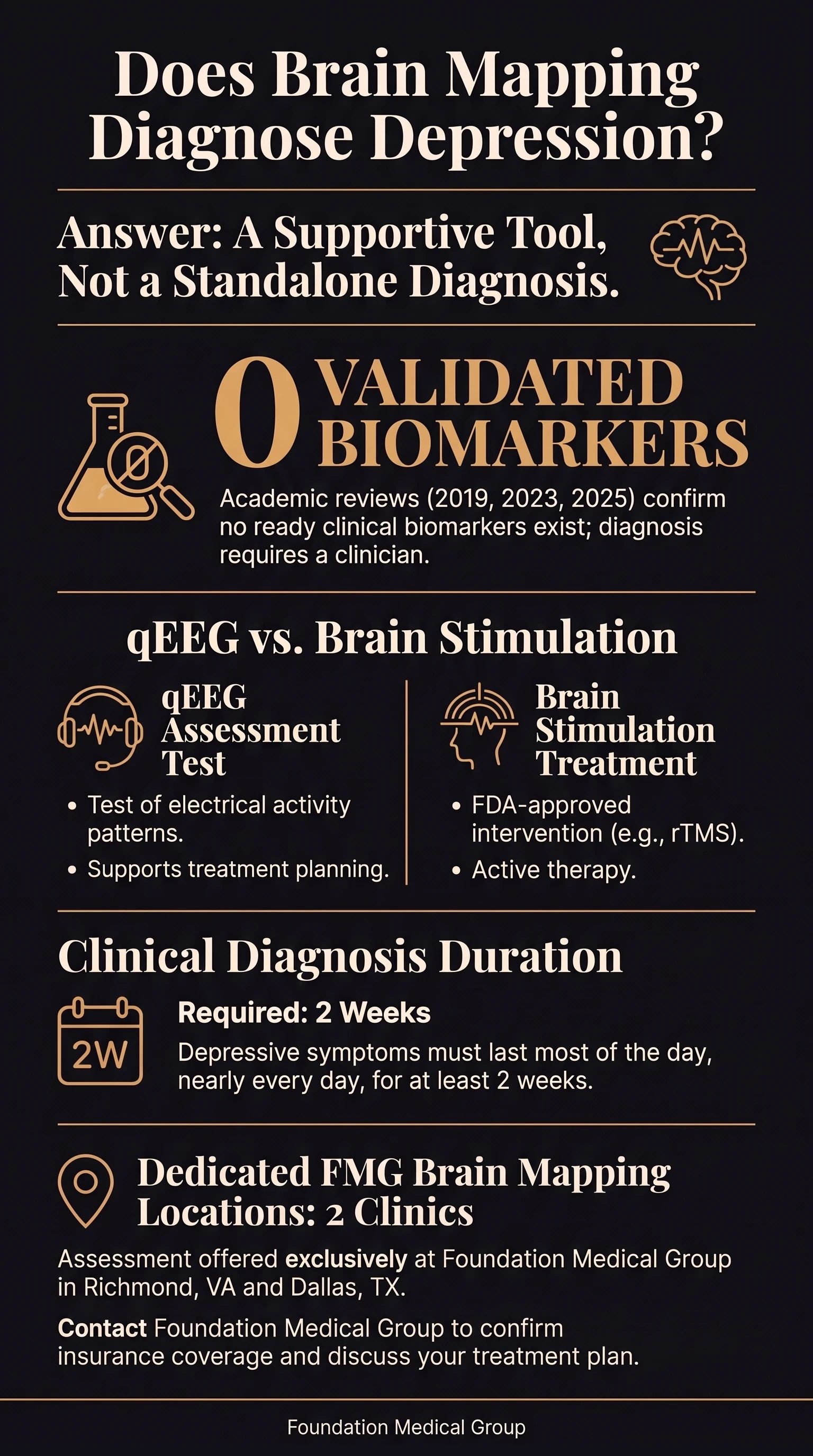
Brain mapping for depression usually means a quantitative EEG (qEEG), a safe test that records your brain’s electrical activity through sensors on the scalp. It can’t diagnose depression on its own. A clinician makes the diagnosis from your symptoms and an evaluation, and qEEG results may add information to help plan treatment.
What Is Brain Mapping for Depression?
Here’s how it works. The test records your brain waves with an EEG. Then computer analysis compares brainwave patterns across the head and turns them into a map.
What brain mapping measures is brainwave activity and brain function, not structure. It takes no pictures. (A little confusing, honestly, since the word map makes most of us imagine an image.) You may see the phrase “brain mapping therapy,” but mapping is an assessment, not a therapy. It isn’t neurofeedback either. For ADHD, see brain mapping for ADHD.
Side note, because the name trips people up: the EEG part is the same basic brain wave recording doctors use for other reasons, such as checking for seizures. The q, for quantitative, is the extra step. A computer crunches that recording and turns it into a map. Anyway, back to depression.
Can Brain Mapping Show Depression?
Not in a way that replaces a diagnosis. Researchers have looked for brain activity linked to depression, such as frontal alpha asymmetry. But a 2019 Frontiers in Psychiatry review found studies with higher, lower or no differences in frontal alpha power. Higher, lower or no change. Not exactly a clear signal, is it? A 2025 review notes that depression affects brain regions including the prefrontal cortex. It also says qEEG indicators need more standardization and validation.
According to NIMH, a depressive disorder is diagnosed when depressive symptoms last most of the day, nearly every day, for at least 2 weeks. Providers also rule out other causes with a physical exam, an interview and lab tests. A 2023 review adds that no clinical biomarkers for depression are readily available. So mental health professionals make the diagnosis, not a map.
That can be frustrating if you were hoping a test would finally explain how you feel. Maybe you wanted something on paper to show the people around you that this is real. That’s a fair thing to want. Still, the diagnosis comes from your symptoms and your story, and a careful clinician takes both seriously.
Does Brain Mapping Really Work for Depression Treatment?
The short answer: it’s still being studied. Not the exciting news you might’ve hoped for, we know. The 2019 review describes a meta-analysis that said qEEG prediction of treatment response needs greater rigor and replication before it’s a reliable clinical tool.
Researchers are testing whether mapping can help personalize care, including in treatment resistant depression, such as predicting response to rTMS therapy. Other work looks at how brain regions communicate, sometimes called neural pathways. It’s a hopeful line of research. Early, though.
According to NIMH, depression is treated with psychotherapy, medication or both. Brain stimulation therapy such as TMS for depression may help when those aren’t enough. At FMG, both brain mapping clinics offer psychiatry, and talk therapy is available by secure video in Virginia and Texas (in person only at the Richmond clinic). Think of a map as one piece of information in your mental health treatment plan, not the whole plan.
What Happens During a qEEG Brain Map, and Is It Safe?
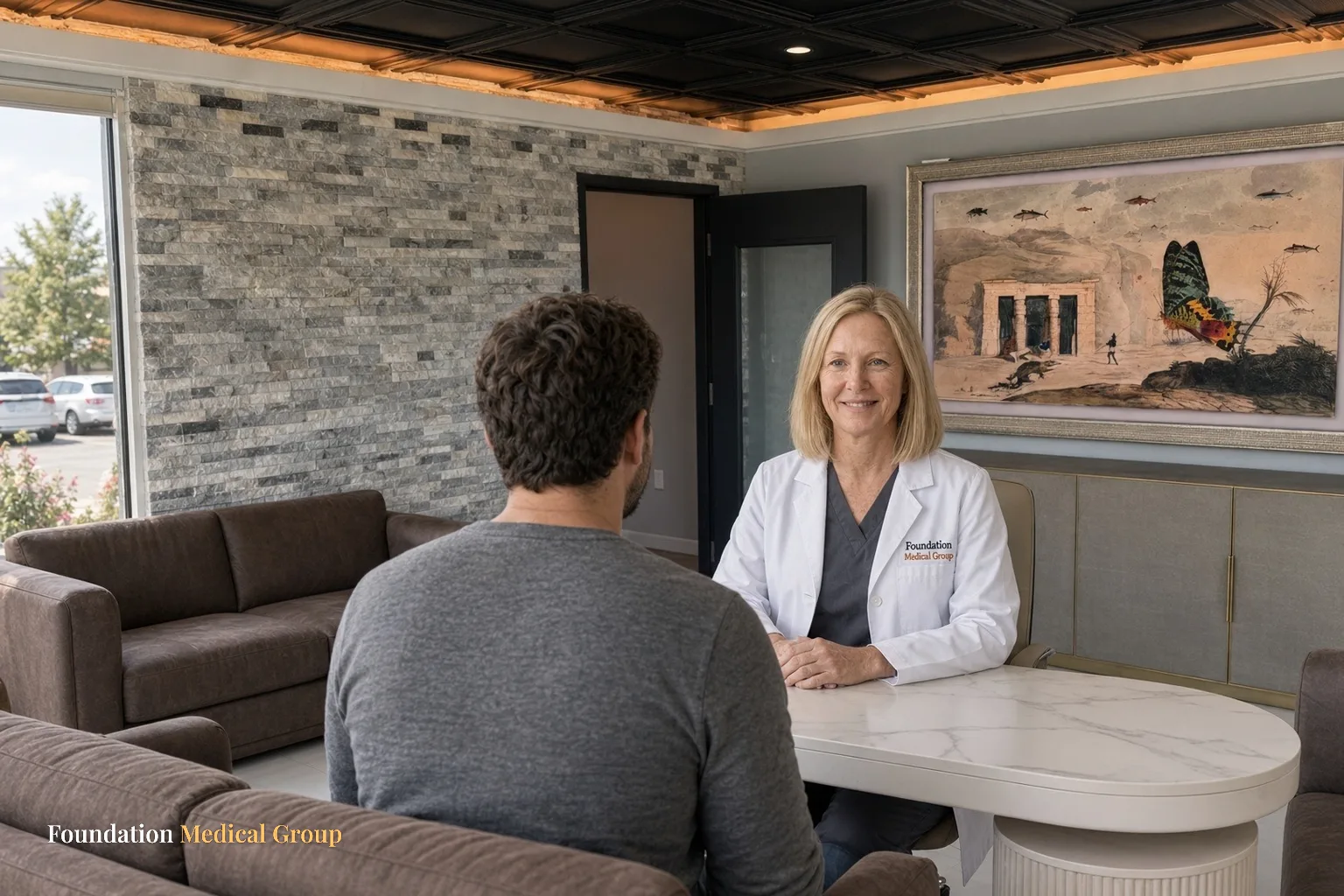
Per MedlinePlus, small metal disks called electrodes go on your scalp with a sticky paste. You sit or lie still, and you may be asked to breathe deeply or look at a flashing light. Wash your hair the night before without conditioner, oils or gel, and bring a list of your medicines.
Nervous? That’s normal, especially if electrodes on your head sound like a lot. Thankfully, an EEG is very safe. In people with seizure disorders, flashing lights or fast breathing can trigger a seizure, and staff are trained for this. It isn’t a brain scan or imaging test. It checks brain health through brain wave activity.
Brain Mapping, Neurofeedback, and Brain Imaging Compared
Neurofeedback, also called neurofeedback training, EEG neurofeedback or brain training, is separate from mapping. The names blur together, so it’s an easy mix-up.
| Term | What it is | Test or treatment? | What it can tell you about depression | Source |
|---|---|---|---|---|
| qEEG brain mapping | EEG recording shown as a map of electrical activity | Test | Patterns being studied; not a diagnosis | MedlinePlus; Frontiers reviews |
| Neurofeedback (EEG neurofeedback) | A separate approach | Intervention | Ask your provider | Named only |
| Brain imaging (such as MRI) | Pictures of brain structure | Test | Not a qEEG; ask your provider | Named only |
| Brain stimulation (rTMS, ECT; deep brain stimulation is different) | Treatments that act on brain activity | Treatment | rTMS and ECT are the most used FDA-approved brain stimulation therapies | NIMH |
At FMG, brain mapping is an assessment offered in two places: our Richmond flagship on Busy Street and our North Dallas office on LBJ Freeway. Our team reviews the analysis alongside your history and goals. In Richmond, that review sits next to other depression care under one roof (TMS, Spravato and psychiatry). In Dallas, it sits next to psychiatry. FMG doesn’t list neurofeedback therapy, neurofeedback treatment or any other neurofeedback service.
Can Brain Mapping Be Used for Anxiety and Depression?

Depression often comes with anxiety. The 2023 review notes it often co-occurs with generalized anxiety disorder, and that EEG is studied to tell depression from bipolar disorder. The 2025 review links some EEG findings to emotional regulation.
When anxiety symptoms and depressive symptoms overlap, a qEEG may be part of an anxiety and depression assessment. But a map can’t sort out mental health disorders by itself. The clinician still diagnoses a mood disorder and other mental health conditions. Living with both at once is a lot. It’s still worth describing each one to your clinician, even the parts that feel hard to put into words.
Where to Get Brain Mapping in Richmond, VA and Dallas, TX
FMG offers brain mapping at two clinics only:
- Richmond, Virginia: our flagship, at 11600 Busy Street, Suite 203, Richmond, VA 23236, which also offers TMS, Spravato and psychiatry. The clinic’s medical director is Vincent Nardone, MD. See our Virginia location page.
- Dallas, Texas: 8390 Lyndon B Johnson Freeway, Suite 500, Dallas, TX 75243, in North Dallas, which also offers psychiatry. Justin Thompson, MD, is the medical director there. See our Texas location page.
It’s not offered at our Utah or Georgia clinics. We know that’s a long trip if you live near American Fork or Decatur. Learn more on our brain mapping page. Call to confirm coverage with your plan; FMG does not accept Medicare in Virginia. Our qEEG cost and insurance guide covers mental health care coverage and therapy planning.
Key Takeaways
- For depression, brain mapping usually means a qEEG, which records electrical activity.
- It cannot diagnose depression; a clinician does that from symptoms and an evaluation.
- qEEG research on choosing treatment still needs more validation.
- The test is very safe and is not an imaging scan.
- FMG offers brain mapping in Richmond, VA and Dallas, TX only.
FAQ
Can brain mapping show depression?
Not on its own. Researchers have found EEG patterns linked to depression, but no biomarker is ready for everyday diagnosis. A clinician diagnoses it from your symptoms.
Does brain mapping help with depression?
It may add information to a treatment plan. But qEEG still needs more rigor and validation before it’s a reliable clinical tool.
Is brain mapping safe?
Yes. MedlinePlus says an EEG is very safe. Mention any seizure disorder first, because flashing lights or fast breathing can trigger seizures in some people.
What is brain mapping therapy for depression?
The phrase usually means using a brain map to help guide care. The map is a test, not a treatment. Any therapy comes from the plan you build with your clinician.
Where can I get a brain scan for depression?
A qEEG isn’t an imaging scan. It records electrical activity. Foundation Medical Group offers qEEG brain mapping in Richmond, VA and Dallas, TX.
Sources
- PubMed Central, Technical and clinical considerations for electroencephalography-based biomarkers for major depressive disorder.
- PubMed Central, Quantitative Electroencephalography in Guiding Treatment of Major Depression.
- PubMed Central, Quantitative and qualitative electroencephalography in the diagnosis and monitoring of depression.
- National Institute of Mental Health, Depression.
- MedlinePlus, EEG (electroencephalogram).