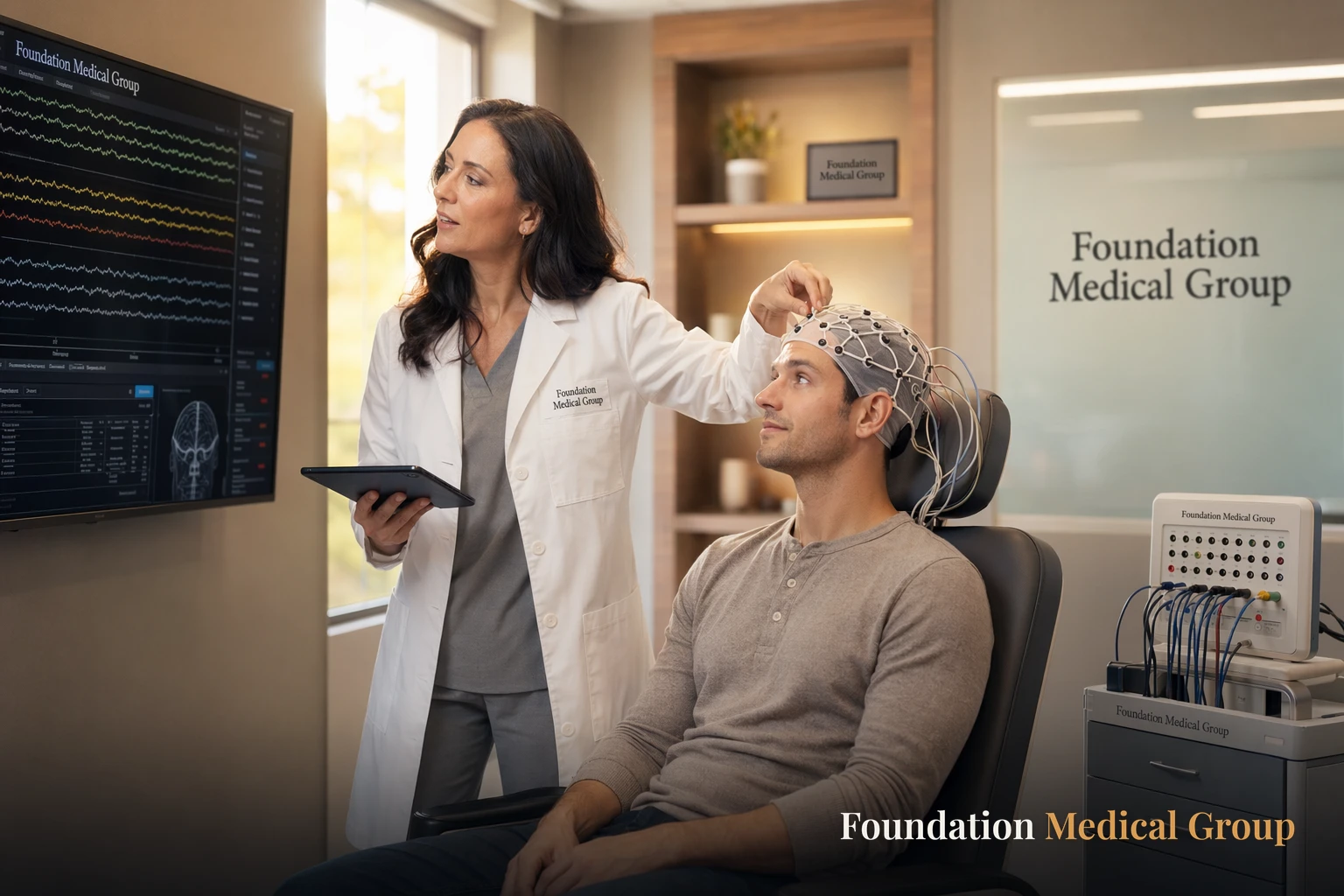
Brain mapping in Virginia is a non-invasive way to measure brain waves and guide mental health and addiction care. EEG and qEEG readings give clear data on how the brain fires, which supports therapy, neurofeedback, and brain training alongside medication treatment. Many Virginia patients use it to sharpen focus, lower anxiety, and hold onto long-term recovery, including plans that deal with trauma.
Brain mapping records brain wave signals so a clinician can see how your brain works. It picks up patterns tied to specific symptoms. It’s safe, widely used, and backed by decades of brain research. Hans Berger recorded the first human EEG in 1924 and published it in 1929, so the core technology is about a century old. The electrode spots clinics still use, the international 10-20 system with its 19 standard sites, date from the 1950s.
Introduction to Brain Mapping in Virginia
Brain mapping Virginia services help clinicians see how the brain works in daily life. The process measures brain waves with small sensors placed on the scalp. No medication. No radiation. No discomfort.
Plenty of Virginians search for brain mapping near me because they want care that feels more personal. Data from a brain map can guide therapy for anxiety, depression, ADHD, mood disorders, and trauma. That includes the patterns you often see after long-term stress. It also plays a key role in neurofeedback and in structured training programs.
Virginia patients in recovery often pair brain mapping with counseling and medication care. That lets a provider tailor treatment to the person, not just the symptom list. Interest keeps growing across Richmond, northern Virginia, and Virginia Beach as more clinics add these services.
What Is Brain Mapping and How Does It Work?
Brain mapping measures and reads brain wave activity. EEG brain mapping Virginia clinics use small sensors to record the brain’s electrical signals. Those signals show how different brain regions talk to each other, at rest and during tasks. That’s how a clinician learns your own brain wave pattern.
Clinics use a few methods. A standard EEG records raw brain wave data in real time. A qEEG compares that data against large databases, using statistics rather than a clinician’s eye.
Results can show patterns tied to focus, mood control, and stress response. Clinicians use that to shape therapy choices.
Group-level differences are real, and they’re smaller than the marketing suggests. A 2013 meta-analysis in the Journal of Attention Disorders pooled 9 studies covering 1,253 young people with ADHD and 517 without. It reported a grand-mean effect size of 0.75 for ages 6 to 13. The same authors called that number an overestimate, because the studies varied so much. They concluded the theta/beta ratio can’t stand alone as a reliable test.
Brain mapping doesn’t diagnose a condition by itself. It works best next to a clinical interview, a history, and clear therapy goals.
EEG vs qEEG Brain Mapping Explained
EEG and qEEG brain mapping Virginia services do different jobs. A standard EEG looks for abnormal electrical activity, so it’s often used to check seizure activity or brain injury. It gives real-time data, but little to compare it with.
qEEG brain mapping Virginia clinics run software that builds a qeeg brain map. That map holds your brainwave activity up against age-based norms. What stands out are the patterns tied to specific symptoms and disorders.
Providers often suggest qEEG when they’re planning neurofeedback or tracking progress. It gives a deeper read on how the brain answers treatment.
Brain Mapping Services Available in Virginia
Brain mapping Richmond clinics offer EEG and qEEG testing for adults and teens. You’ll also find services in northern Virginia and at select Virginia Beach locations. Some patients drive a fair distance for expert care.
Access varies by region. Cities usually mean shorter waits and more neurofeedback options. Rural patients may have to travel, or wait longer for a slot.
Virginia center access keeps widening as demand grows. Many clinics now line up brain mapping with therapy and medication planning, which is what makes care feel continuous instead of stop-start.
How Brain Mapping Supports Mental Health Treatment
Brain mapping supports mental health care by showing how the brain answers stress, emotion, and attention demands. Clinicians use that data to guide therapy choices. That might be talk therapy, cognitive behavioral therapy, or a neurofeedback plan built for you.
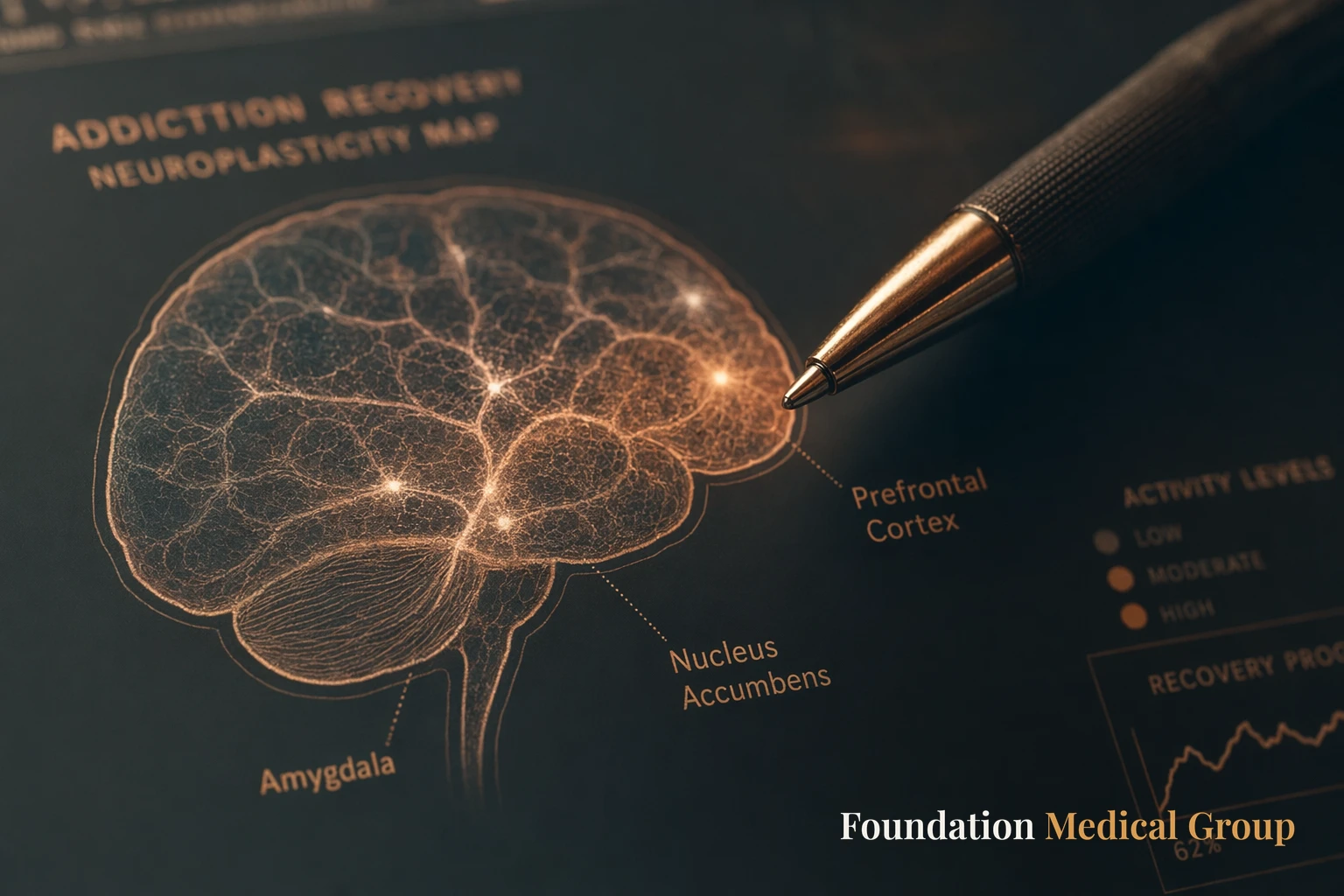
Neurofeedback uses real-time brainwave feedback to build self-control. Over repeated sessions, the brain learns healthier patterns through guided training.
Be careful with the numbers you’ll see quoted for this. A 2016 meta-analysis in the Journal of the American Academy of Child and Adolescent Psychiatry pooled 13 randomized trials with 520 participants. It found a standardized mean difference of 0.35 on ratings from assessors closest to the treatment. Once raters were blinded, or an active sham was used, the effect vanished. So the honest summary is a modest signal that hasn’t yet survived the strictest study designs.
Brain mapping also helps track progress. Repeat testing shows how brain patterns shift with therapy and training. That feedback can help people stay motivated and keep their eyes on recovery goals.
Brain Mapping and Addiction Recovery Planning
Addiction hits brain areas tied to reward, impulse control, and stress. Brain mapping helps spot those changes and shapes the recovery plan around them. It can also hint at relapse risk and emotional triggers.
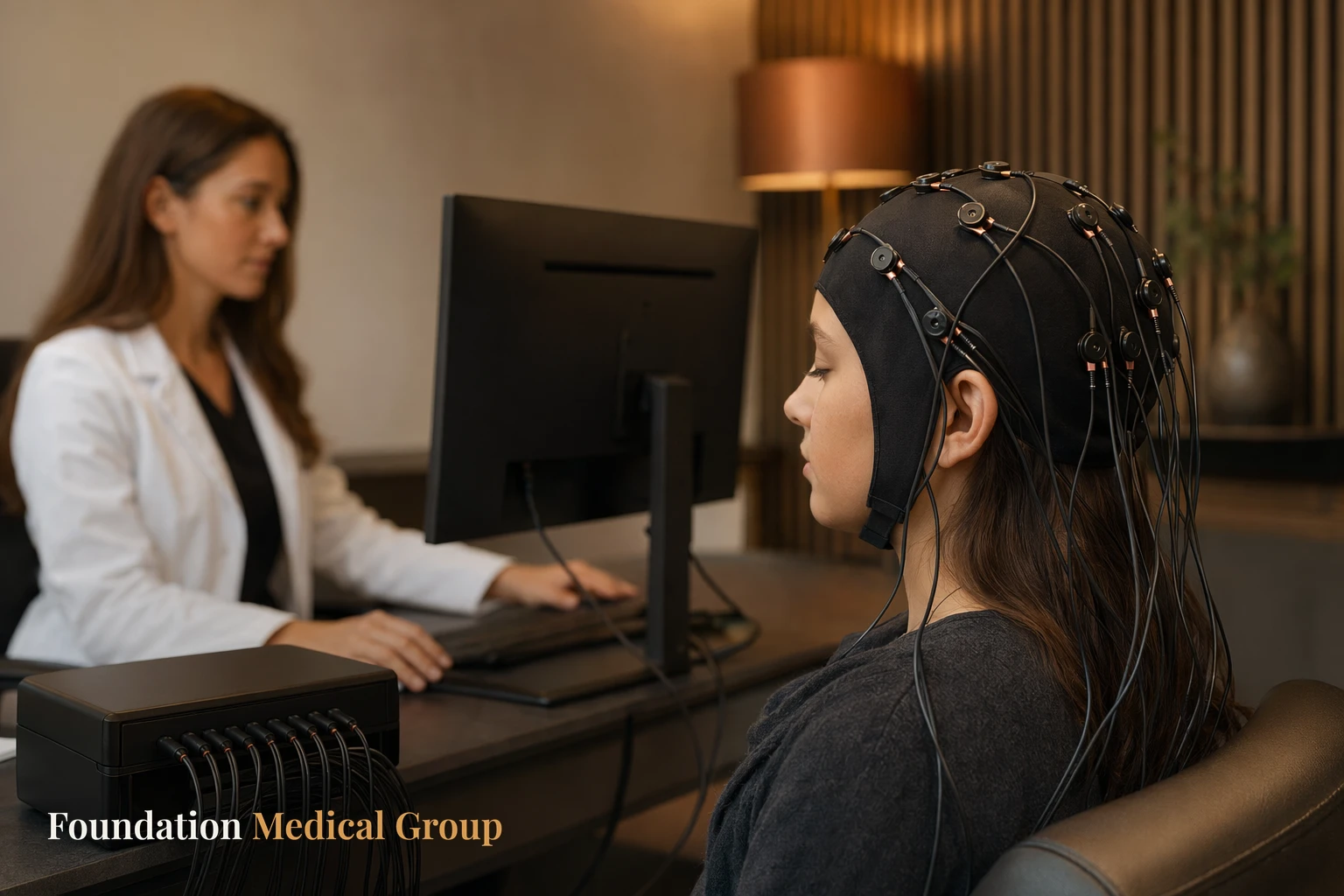
Providers use brain data to line therapy up with what the brain needs. Neurofeedback training may improve mood control and cut cravings. Over time, that supports steadier days and long-term recovery.
Brain mapping works alongside counseling and behavioral therapy. It doesn’t replace therapy. It often makes therapy land better.
Brain Mapping and Medication-Assisted Treatment
Brain mapping works well next to medication-assisted treatment using buprenorphine. Many patients in care at a suboxone clinic Virginia location also choose brain mapping. Together, they cover both the biology and the behavior.
It helps to keep the evidence in proportion. A 2017 meta-analysis in The BMJ pooled 19 cohorts. It found 4.3 deaths per 1,000 person-years among people on buprenorphine while they stayed in treatment, against 9.5 per 1,000 after they left. Nothing in the brain mapping literature comes close to that. The medicine carries the recovery. The map helps shape the therapy around it.
Clinics often share results with subutex doctors near me and Suboxone providers. Brain data may inform dosing talks and therapy focus. It can also help patients working with online suboxone doctors that take insurance.
For people who want joined-up care, brain mapping adds a hard, outside read. It supports patients on Subutex or Suboxone who are also doing neurofeedback and therapy. That layered plan can improve focus, ease anxiety, and steady daily life.
Insurance and Medicaid Coverage for Brain Mapping
Insurance coverage for brain mapping depends on the plan. Some private insurers cover EEG testing when it’s medically needed. qEEG coverage often needs prior authorization and a detailed paper trail.
Read the policy language before you assume. Aetna’s clinical policy bulletin on qEEG allows it as an add-on to a standard EEG for a narrow list of indications. For everything else it’s classed as experimental, investigational or unproven, citing thin evidence of clinical usefulness. Most other carriers land in the same place.
Virginia Medicaid may cover a standard EEG in certain cases. Cover for qEEG and neurofeedback is thinner. Patients working with a suboxone clinic Virginia Medicaid provider often pay out of pocket for the advanced brain mapping work.
Most clinics will help you check benefits ahead of time. Good records improve your odds of approval.
Brain Mapping Availability in Other States
Brain mapping Texas services are easy to find in the major cities. Brain mapping Dallas clinics often run both EEG and qEEG testing along with neurofeedback. Access there is usually faster, since there are more providers per patient.
Utah is widening its options too. Brain mapping Utah Valley clinics serve patients from American Fork and nearby towns. Some people cross state lines for expert neurofeedback training.
Looking at other states helps you see the access gap for what it is. Wait times, coverage, and cost differ a lot by region.
Safety, Accuracy, and Limitations of Brain Mapping
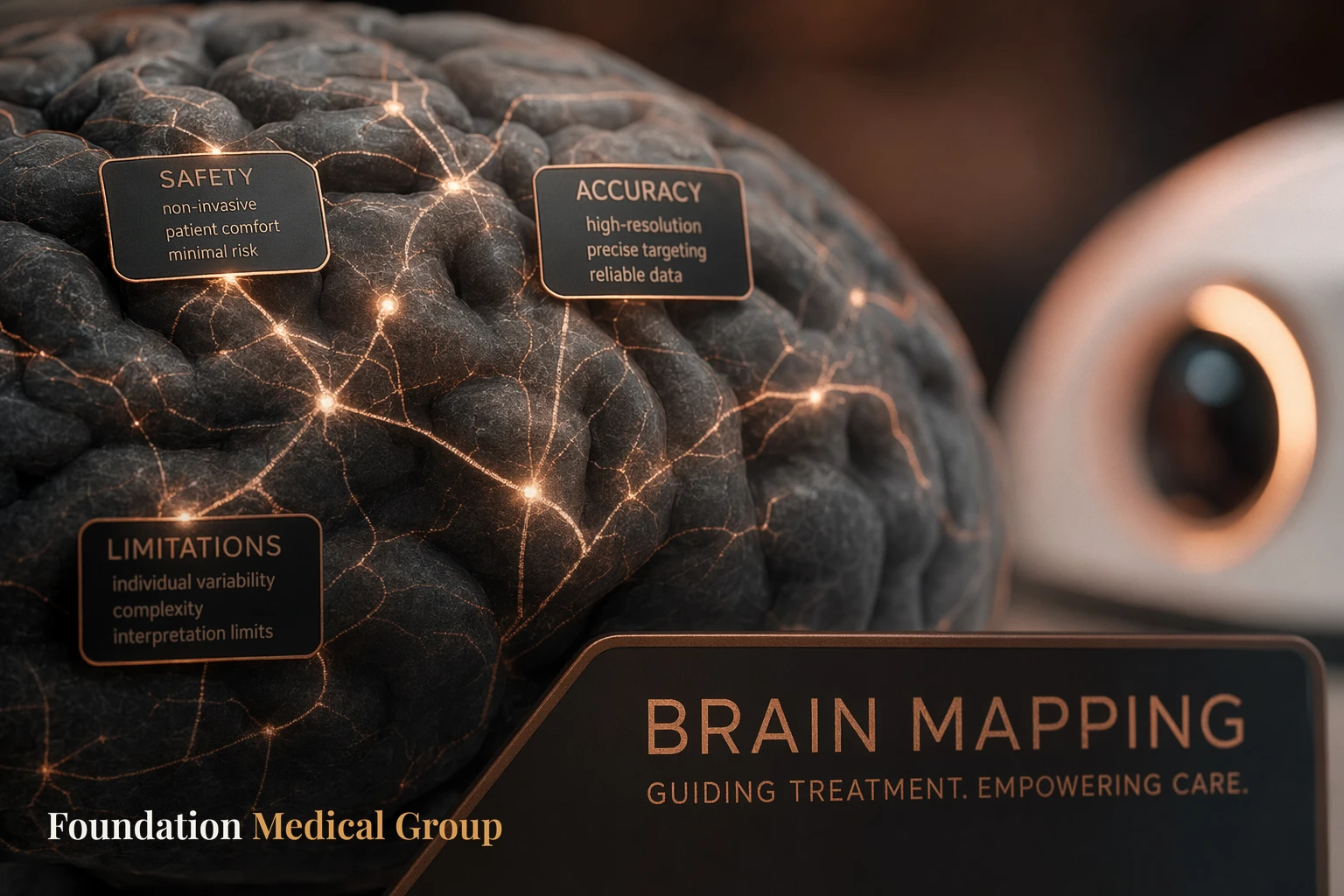
Brain mapping is safe and non-invasive. EEG sensors only record brainwave activity. They don’t send any signal into the brain. According to the Mayo Clinic, EEG testing carries no known long-term risks.
Is brain mapping legitimate? Yes, in the hands of a trained clinician. It rests on decades of brain research. Is brain mapping safe? Yes, for children and adults alike.
There are limits worth holding in mind. Brain mapping can’t diagnose a brain condition on its own. Results need a clinician to read them, and they should support whole-person care rather than replace it.
The strongest statement on this is old and blunt. A 1997 assessment from the American Academy of Neurology and the American Clinical Neurophysiology Society ruled qEEG investigational for attention disorders, depression, alcoholism and drug abuse. It did accept qEEG as an add-on to digital EEG for epilepsy screening and for ICU monitoring. It also insisted the reading be done by doctors already skilled in clinical EEG. The AAN later retired that document without a replacement, so read it as a historical marker, not current policy.
What to Expect Before, During, and After Brain Mapping
Before a session, you’ll usually be asked to skip caffeine and wash your hair. That improves signal quality. Keep taking your medicines unless a provider tells you otherwise.
During the session, sensors go on the scalp. It runs about 30 to 60 minutes. You sit comfortably while the machine records.
Afterward, a provider reviews the results and walks you through the patterns. Findings guide therapy, neurofeedback, or dose planning. Follow-up sessions track what changes.
Infographic: Brain Mapping Process and Care Pathway
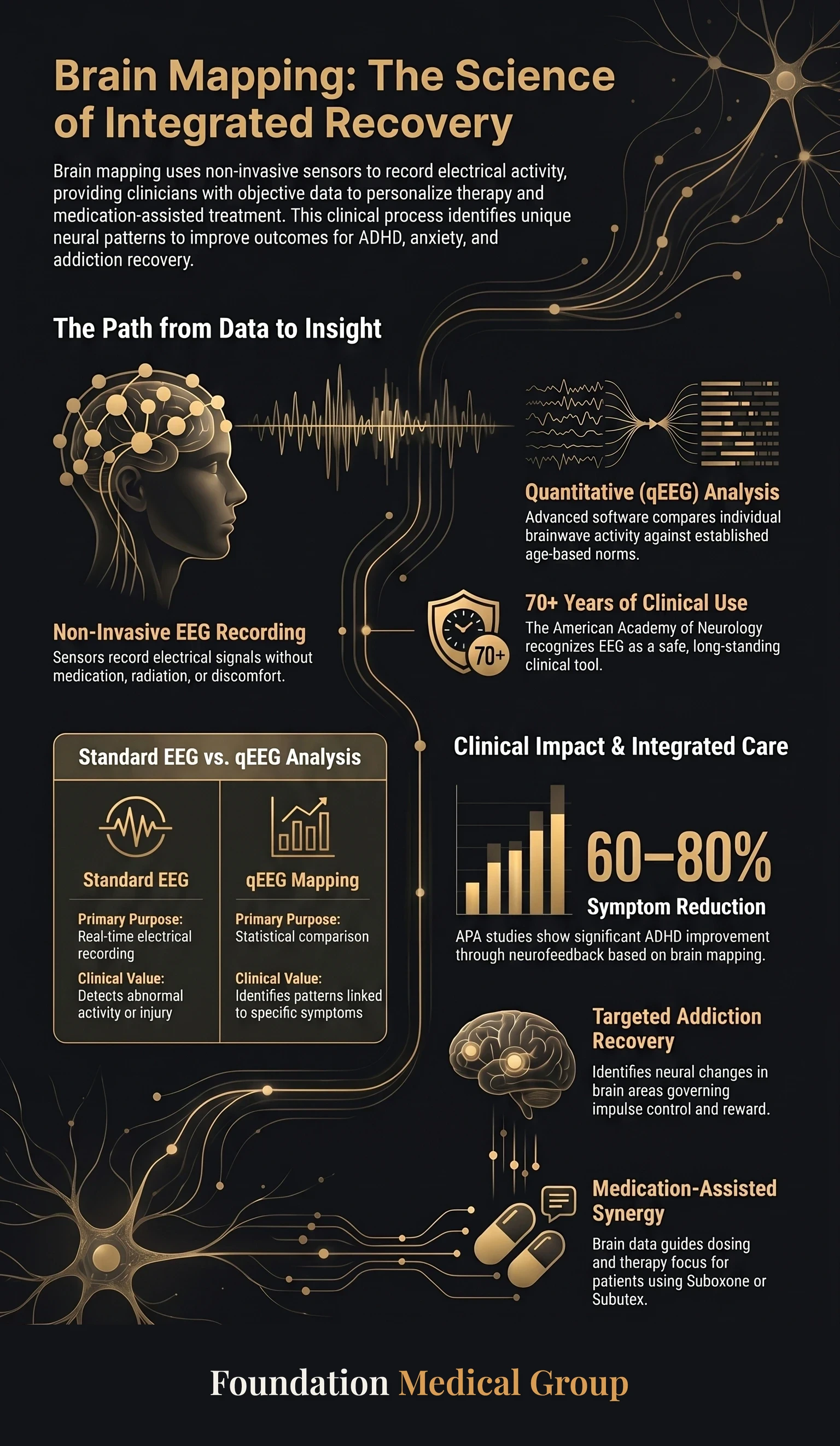
This infographic shows the key brain mapping steps, from EEG recording through qEEG analysis. It explains how results support therapy, neurofeedback, and medication care. The timeline covers assessment, treatment planning, and progress tracking.
Frequently Asked Questions
Is brain mapping Virginia safe for adults and teens?
Yes. Brain mapping uses passive sensors and is considered very safe at any age.
Does Medicaid cover brain mapping in Virginia?
Medicaid may cover standard EEG testing. qEEG and neurofeedback are often self-pay.
Can brain mapping help with anxiety and focus?
Yes. It can flag patterns linked to anxiety and attention trouble.
How does brain mapping support addiction recovery?
It guides therapy and neurofeedback training to build self-control and lower relapse risk.
Do I need a referral for brain mapping?
Some clinics want a referral. Others take self-referrals for assessment.
Key Takeaways and Final Thoughts
Brain mapping Virginia services give real insight into brain function and recovery needs. EEG and qEEG testing support therapy, neurofeedback, and medication care. Used inside a coordinated plan, and read by a provider who knows the difference between a clean signal and a noisy one, brain mapping can help people sharpen focus, manage anxiety, and work toward long-term goals.
Sources
- Nuwer M. Assessment of digital EEG, quantitative EEG, and EEG brain mapping: report of the American Academy of Neurology and the American Clinical Neurophysiology Society (retired). Neurology 1997;49(1):277-92.
- Arns M, Conners CK, Kraemer HC. A decade of EEG theta/beta ratio research in ADHD: a meta-analysis. J Atten Disord 2013;17(5):374-83.
- Cortese S, et al. Neurofeedback for attention-deficit/hyperactivity disorder: meta-analysis of clinical and neuropsychological outcomes from randomized controlled trials. J Am Acad Child Adolesc Psychiatry 2016;55(6):444-55.
- Aetna, Clinical Policy Bulletin 0221: Quantitative EEG (Brain Mapping).
- Sordo L, et al. Mortality risk during and after opioid substitution treatment. BMJ 2017;357:j1550.
- National Institute on Drug Abuse, Medications for Opioid Use Disorder.