
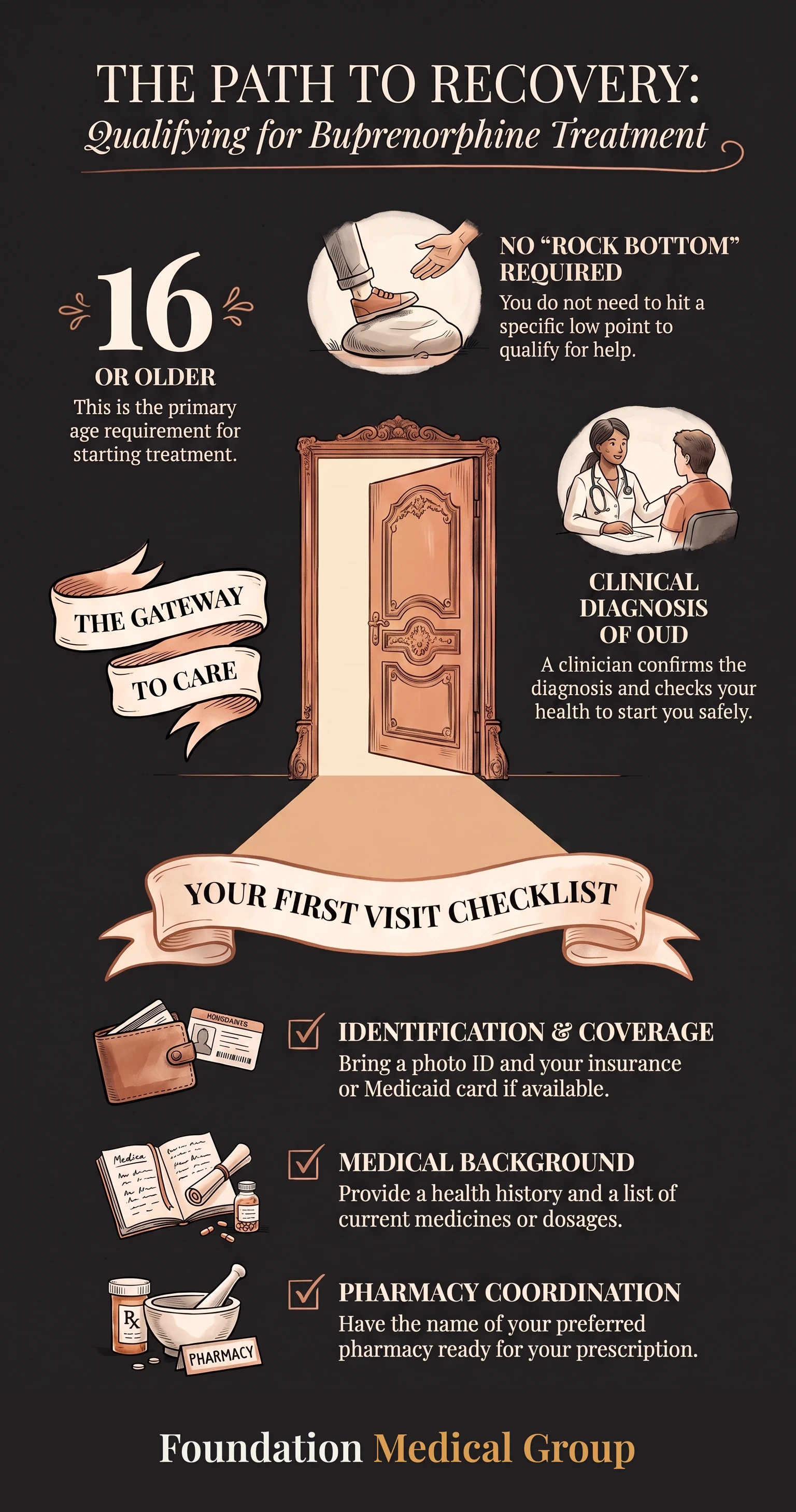
Wondering if you qualify for buprenorphine treatment? If you have opioid use disorder and you’re 16 or older, you very likely qualify. There’s no minimum “rock bottom” you must hit first. A clinician confirms the diagnosis, checks your health, and starts you safely. That’s really the whole gate.
Plenty of people in Midlothian, VA put off care because they think the door is hard to open. It isn’t. About 3 million people in the United States meet the criteria for opioid use disorder, by the estimate in StatPearls’ clinical review, and only a fraction are in treatment at any given time. The gap is rarely about who qualifies. This guide walks you through who qualifies for buprenorphine, what to bring to your first visit, how the intake team decides, and how Virginia Medicaid and insurance fit in. For the treatment itself, see our buprenorphine doctor in Midlothian, VA hub page.
Who Qualifies for Buprenorphine Treatment
Buprenorphine is for people with opioid use disorder. That covers misuse of prescription painkillers, heroin, or fentanyl. If opioids have taken over parts of your life, you likely fit.
You don’t have to prove you’ve failed before. You don’t need a long record of trying and slipping. The medicine works as a first step, not a last resort.
According to the Substance Abuse and Mental Health Services Administration (SAMHSA), buprenorphine is approved to treat opioid use disorder and is a recognized standard of care. That’s why the bar to start is about your diagnosis and safety, not about willpower or history.
The diagnosis itself has a defined shape. Under the DSM-5, opioid use disorder means repeated opioid use within a 12-month window causing real problems or distress, with 2 or more of 11 listed criteria present. Six or more puts it in the severe range. So a clinician isn’t judging you. They’re counting.
Here’s a plain look at who usually qualifies and who needs a closer look first.
| Your situation | Usually qualifies? | What the team checks |
|---|---|---|
| Opioid use disorder, age 16 or older | Yes | Diagnosis and current health |
| Pregnant with opioid use disorder | Yes, with extra care | Coordination with your OB |
| Also using alcohol or other drugs | Often yes | A safe start and closer follow-up |
| Serious other health conditions | Case by case | Your full medical picture |
| Not yet using opioids, just curious | No | A different kind of support |
The point is simple, and honestly it’s the part people find hardest to believe. Most people who need this medicine can get it. The intake visit exists to start you safely, not to turn you away.
What You Need to Bring to Your First Visit

You don’t need much. But a few things make your first visit faster and smoother.
- A photo ID. A driver’s license or state ID works fine.
- Your insurance or Medicaid card, if you have one. No card? You can still be seen.
- A list of your medicines, including doses. A phone photo of the bottles is enough.
- Your health history, even a rough version. Note past treatment, allergies, and any big conditions.
- A pharmacy name. So your prescription goes to the right place.
If you can’t gather all of this, come anyway. The team can work with what you have. Missing a card or a list won’t stop you from getting help.
How the Intake Team Decides
The intake isn’t a test you pass or fail. It’s a careful check to keep you safe.
A clinician talks with you about your opioid use and how it affects your days. They confirm the diagnosis using standard medical criteria. Then they review your health, your other medicines, and anything that could complicate the medicine.
Staying in treatment is the part that moves the numbers. In a 2017 BMJ meta-analysis by Sordo and colleagues covering 19 cohorts, all-cause mortality ran 4.3 per 1,000 person-years for people on buprenorphine, against 9.5 per 1,000 for people who had left it. Overdose deaths ran 1.4 versus 4.6. So the team’s goal is to get you started, not to add hurdles.
They’ll also plan your first dose. With buprenorphine, timing matters more than almost anything else on day one. You need to be in early withdrawal before that first dose. Clinicians measure it rather than guess. The Clinical Opiate Withdrawal Scale is an 11-item checklist scored 0 to 47, where 5 to 12 counts as mild and 13 to 24 as moderate. Guidance in StatPearls puts the window for starting at roughly 5 to 24 on that scale.
The ladder from there is short. The FDA label for the film allows up to 8 mg/2 mg in divided doses on day 1, and up to 16 mg/4 mg as a single dose on day 2. If there’s no sign of precipitated withdrawal 1 to 2 hours after the first dose, the clinician can step up in 2 mg to 4 mg increments. Maintenance usually lands somewhere between 4 mg/1 mg and 24 mg/6 mg a day. Buprenorphine’s mean elimination half-life of 24 to 42 hours is what lets that be one dose, once a day.
By the end of the visit, you’ll know your plan, your dose, and your next step. Most people leave with a clear path forward the same day.
Virginia Medicaid and Insurance Eligibility
Cost worries stop a lot of people. In Virginia, they shouldn’t.
Virginia Medicaid covers medication for opioid use disorder through its Addiction and Recovery Treatment Services benefit, which DMAS abbreviates to ARTS. That means the visits and the medicine are covered when you see a provider who takes Medicaid. And the eligibility bar here is wider than in much of the country. Virginia implemented the Affordable Care Act’s Medicaid expansion on 1 January 2019. That covers adults up to 138% of the federal poverty level, about $21,597 a year for one person in 2025. KFF counts 10 states that still have not expanded. Virginia isn’t one of them, so it’s worth checking even if you’ve been turned down before.
If you have insurance from work or the marketplace, your plan very likely covers buprenorphine too. The Mental Health Parity and Addiction Equity Act of 2008 is the reason: it stops most plans from putting harsher limits on addiction care than on other medical care. What you pay depends on your plan. Two quick calls help: ask the clinic if they take your plan, and ask your insurer what a specialist visit costs you. Our Suboxone clinic that accepts Virginia Medicaid guide walks through the coverage steps.
No insurance at all? You can still get care. Ask the clinic about income-based fees or help enrolling in Medicaid. Being uninsured does not make you ineligible for treatment.
What Does Not Disqualify You

People assume small things block them. Usually they don’t. Let’s clear up the common myths.
- A past relapse. Slipping before doesn’t rule you out. It’s part of how recovery often goes.
- Using other substances. Alcohol or other drugs may mean closer follow-up, not a closed door.
- No insurance or ID hassle. Clinics can help you sort coverage and paperwork. Federal rules give the state 45 days to decide most Medicaid applications, so starting that paperwork early is worth it.
- A criminal record. Your history with the law doesn’t decide your medical care.
- Being unsure you’re “ready.” You don’t need perfect certainty. You just need to show up.
If you’re breathing and willing to talk, you’re already most of the way there. The rest is the clinician’s job.
Getting Started in Midlothian
Once you qualify, starting is quick. You book an intake, bring your ID, and meet with a clinician who confirms your plan. Finding a prescriber is easier than it was, too. The Mainstreaming Addiction Treatment Act removed the old X-waiver requirement, so any clinician with a standard DEA controlled-substance registration can now prescribe buprenorphine rather than the small waivered minority who could before.
At Foundation Medical Group, care is led by a physician and built for the long run. The team confirms your eligibility, sorts your coverage, and starts you safely. If you’re weighing local options, our Suboxone doctor in Richmond, VA page covers nearby care too.
The hardest part is often just deciding to call. Which is frustrating, because it’s the one step nobody else can do for you. After that, the door opens fast.
Infographic: Do I Qualify for Buprenorphine Treatment in Midlothian?
Frequently Asked Questions
Do I qualify for buprenorphine if I still use opioids?
Yes. Actively using opioids doesn’t disqualify you. In fact, it’s the reason the medicine exists. The intake team will plan your first dose around your withdrawal so the start is safe and comfortable.
Can I get buprenorphine treatment without insurance in Midlothian?
Yes. Being uninsured doesn’t make you ineligible. Many clinics help you enroll in Virginia Medicaid or offer income-based fees. Ask about both when you call, and come to your visit even without a card.
Does a past relapse make me ineligible for treatment?
No. A relapse doesn’t close the door. Recovery often includes setbacks, and clinicians expect that. What matters is that you’re seeking help now, not what happened before.
What if I use alcohol or other drugs too?
You can often still qualify. Using other substances usually means closer follow-up and a careful start, not a refusal. Be honest at intake so the team can keep your treatment safe.
How does the intake team confirm I have opioid use disorder?
A clinician talks with you about your opioid use and how it affects your life, then applies standard medical criteria. They also review your health and medicines. The visit is about starting you safely, not testing you.
Key Takeaways and Next Steps
Here’s what to hold on to. Qualifying for buprenorphine in Midlothian is simpler than most people fear. If you have opioid use disorder and you’re 16 or older, you very likely qualify. The intake confirms your diagnosis and starts you safely. Virginia Medicaid and most insurance cover it, and no insurance still means care.
- Bring a photo ID, your medicine list, and a card if you have one.
- Don’t let a relapse, other drug use, or no insurance stop you.
- Ask the clinic about Virginia Medicaid or income-based fees.
- Come to your visit even if your paperwork isn’t perfect.
Ready to find out if you qualify? Reach out to Foundation Medical Group and book an intake. One call turns the question of “do I qualify” into a clear, safe plan.
Sources
- Substance Abuse and Mental Health Services Administration (SAMHSA), Buprenorphine.
- Opioid Use Disorder: Evaluation and Management, StatPearls, NCBI Bookshelf.
- Buprenorphine, StatPearls, NCBI Bookshelf.
- FDA prescribing information for Suboxone sublingual film, via DailyMed.
- Virginia DMAS, Behavioral Health Services (including ARTS).
- KFF, Status of State Medicaid Expansion Decisions.
- Sordo et al., Mortality risk during and after opioid substitution treatment, BMJ 2017.