
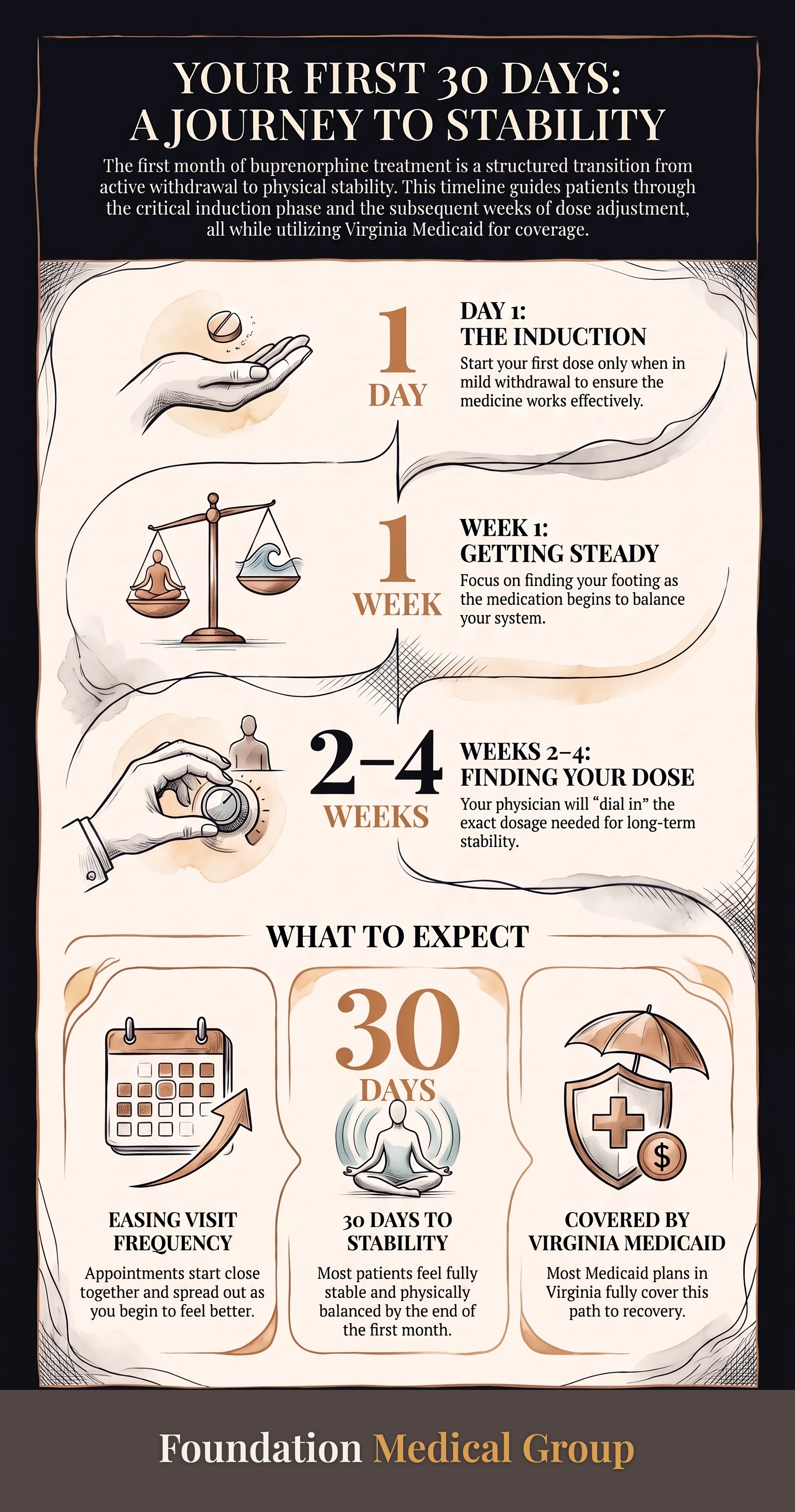
Your first 30 days on buprenorphine follow a clear path. Day one is induction, when you start the medicine and feel withdrawal ease. Week 1 is about getting steady. Weeks 2 through 4 are about finding the right dose. Visits start close together, then spread out as you feel better. Most Medicaid plans in Virginia cover this care.
Starting treatment can feel like a leap into the unknown. So let’s walk through it week by week, in plain terms, from your first day to the end of your first month. If you’re looking for a buprenorphine doctor in Midlothian who takes Medicaid, this guide shows you what those first weeks really look like. For the full service details, see our buprenorphine doctor in Midlothian, VA page.
Day One: Your Induction Day
The first day is called induction. It’s the day you take your first dose of buprenorphine. There’s one important rule: you need to be in mild withdrawal before you start. This keeps the medicine from making you feel worse.
According to the Substance Abuse and Mental Health Services Administration (SAMHSA), you hold off opioids for at least 12 to 24 hours first. You also need to be in the early stages of withdrawal before that first dose. Clinics usually confirm that with the Clinical Opiate Withdrawal Scale, an 11-item checklist a nurse scores at the bedside rather than a guess. The FDA label for Suboxone film keeps day one small on purpose. You start at 2 mg/0.5 mg or 4 mg/1 mg. From there the dose steps up in 2 mg or 4 mg increments, about every 2 hours, to a day-one ceiling of 8 mg/2 mg. Within an hour or two, most patients feel the pull of cravings and withdrawal start to fade. It can feel like a fog lifting.
You may take a second small dose that same day if you still feel rough. By the end of day one, most people feel calmer and more in control. That’s the whole point. Day 2 is where the label allows a single dose of up to 16 mg/4 mg, which is also the target dose most patients settle near.
Week 1: Getting Steady

The first week is about settling in. Your body is learning to run on this new medicine, and small changes are normal. You might feel a bit off one day and much better the next.
Your doctor will likely check in with you often this week, sometimes by phone or video. These check-ins are quick. The goal is simple: make sure you feel safe, sleep better, and stay free of strong cravings. If something feels wrong, you speak up, and your dose gets adjusted.
Staying on the medicine is the part that moves the needle. A meta-analysis of 19 cohorts in The BMJ, covering 15,831 people treated with buprenorphine, found all-cause mortality of 4.3 per 1,000 person-years during treatment versus 9.5 after leaving it, and overdose mortality of 1.4 versus 4.6. So week one isn’t about being perfect. It’s about staying in care and letting the medicine do its job, which is harder than it sounds in week one.
Weeks 2 to 4: Finding Your Dose
The middle weeks are where you and your doctor find the dose that fits you. Everybody is different. The right amount is the one that stops cravings without making you feel foggy or sleepy.
Your doctor may raise or lower your dose a little as you go, usually in 2 mg or 4 mg steps rather than big jumps. The FDA-approved maintenance range runs from 4 mg/1 mg to 24 mg/6 mg a day, so there’s plenty of room to land in the right spot. Buprenorphine also has a long tail, with a mean elimination half-life of 24 to 42 hours, which is why one daily dose holds you and why changes take a couple of days to settle. Once you hit the dose that feels right, you’ll notice it. Cravings stay quiet, your mood steadies, and daily life starts to feel doable again.
By the end of week four, most people feel stable. You’re sleeping, eating, and thinking more clearly. The chaos starts to feel behind you.
Your First 30 Days: A Week-by-Week Timeline
Here’s the whole month at a glance. Think of it as a rough map, since your own path may move a little faster or slower.
| Time | What happens | How you might feel |
|---|---|---|
| Day 1 (induction) | You take your first dose in mild withdrawal | Cravings and withdrawal start to ease |
| Week 1 | Frequent check-ins, small dose tweaks | Steadier each day, sleeping better |
| Weeks 2 to 3 | Dose adjusted to fit you | Cravings quiet, mood evening out |
| Week 4 | Dose feels right, visits spread out | Stable, clearer, more like yourself |
The pattern is steady progress. Each week tends to feel a little more solid than the last.
How Your Visits Change Over Time

At the start, you’ll see your doctor a lot. That’s on purpose. Close contact early keeps you safe and lets your team fix small problems fast.
As you feel steadier, visits spread out. Here’s the usual rhythm:
- Induction day. You start the medicine with your doctor watching closely.
- Week 1. Quick check-ins, often by phone or video, to fine-tune your dose.
- Weeks 2 to 4. Visits every week or two while you settle on the right dose.
- After the first month. Once you’re stable, visits often move to monthly.
Many of these later visits can be done by video, which saves you the drive and time off work. Your care stays close even when you’re at home.
Using Virginia Medicaid for Your Care
If you have Virginia Medicaid, you’re in good shape. Medicaid covers medicine for opioid use disorder, including buprenorphine, for people who qualify. That usually means little or no cost when you see a provider who takes it. Virginia’s Addiction and Recovery Treatment Services benefit is a big reason so many local prescribers exist. After ARTS launched in 2017 and Medicaid expanded in 2019, the number of buprenorphine-waivered prescribers in Virginia grew 148 percent. Across southern states that did not expand, growth was 115 percent. That comparison comes from a 2024 analysis in the Journal of Substance Use and Addiction Treatment. Cost still matters even with coverage: in 2024 Medicare Part D data, generic buprenorphine-naloxone averaged $122.89 per prescription against $473.05 for brand Suboxone.
Two quick questions save trouble later. Ask the clinic if they accept your Medicaid plan. Ask what your first visit will involve. If you’re near Richmond too, our Suboxone doctor in Richmond, VA page covers your options in the wider area.
Infographic: Your First 30 Days on Buprenorphine
Frequently Asked Questions
What happens on induction day?
You take your first small dose of buprenorphine while in mild withdrawal, with your doctor watching. Within an hour or two, most people feel cravings and withdrawal start to ease. You may take a second dose the same day if needed.
Why do I have to be in withdrawal before starting?
Starting the medicine too early can make you feel worse for a short time. Waiting until you’re in mild withdrawal lets buprenorphine work smoothly. Your doctor will tell you exactly when the timing is right for you.
How long until I feel stable on buprenorphine?
Most patients feel much better within the first week, and most feel stable by the end of the first month. Finding your right dose can take a few weeks, so give yourself time and stay in care.
Will I need to visit the doctor a lot?
At first, yes. Visits are close together during the first weeks to keep you safe and fine-tune your dose. As you feel steadier, they spread out, and many can be done by video from home.
Does Virginia Medicaid cover buprenorphine treatment?
Yes. Virginia Medicaid covers buprenorphine for opioid use disorder for people who qualify. That usually means little or no cost when you see a provider who accepts your Medicaid plan.
Key Takeaways and Next Steps
Here’s what to hold on to. Your first 30 days on buprenorphine follow a clear path. Induction day eases the worst of it, week one gets you steady, and weeks two through four dial in your dose. Visits start close, then spread out as you feel better. With Virginia Medicaid, most of this care is covered.
- On induction day, you must be in mild withdrawal before your first dose.
- Expect frequent check-ins early, then fewer visits as you stabilize.
- Most people feel stable by the end of the first month.
- Ask your clinic two questions: do you take my Medicaid plan, and what’s my first visit like.
Ready to begin? Reach out to Foundation Medical Group and ask about starting your first 30 days. One call turns the unknown into a clear, supported plan. If you want the fuller picture of the early days, our Suboxone withdrawal and induction timeline guide breaks it down step by step.
Sources
- Substance Abuse and Mental Health Services Administration. Buprenorphine. https://www.samhsa.gov/substance-use/treatment/options/buprenorphine.
- DailyMed. SUBOXONE (buprenorphine and naloxone) sublingual film, prescribing information, Indivior Inc. https://dailymed.nlm.nih.gov/dailymed/drugInfo.cfm?setid=8a5edcf9-828c-4f97-b671-268ab13a8ecd.
- Sordo L, et al. Mortality risk during and after opioid substitution treatment. BMJ. 2017;357:j1550. https://pmc.ncbi.nlm.nih.gov/articles/PMC5421454/.
- Changes in buprenorphine waivered provider supply after Virginia Medicaid implements ARTS. J Subst Use Addict Treat. 2024. https://doi.org/10.1016/j.josat.2023.209213.
- Centers for Medicare and Medicaid Services. Medicare Part D Spending by Drug, 2024. https://data.cms.gov/summary-statistics-on-use-and-payments/medicare-medicaid-spending-by-drug/medicare-part-d-spending-by-drug.
- National Institute on Drug Abuse. Medications for Opioid Use Disorder. https://nida.nih.gov/research-topics/medications-opioid-use-disorder.