
To choose a good Suboxone provider, look for physician-led, evidence-based care that treats you with respect. A strong provider prescribes buprenorphine as one part of a whole plan, offers counseling, gets you in quickly, and takes your insurance or Medicaid. If a place rushes you or shames you, keep looking.
Finding the right doctor can feel overwhelming when you’re already struggling. That’s why we built this Suboxone provider checklist. Below, you’ll find the green flags of good care, the red flags to avoid, and the exact questions to ask on your first call. Print it out, keep it on your phone, and use it to compare a few clinics before you commit.
What Good Suboxone Care Looks Like
Good treatment isn’t just a prescription. It’s a relationship with a team that wants you well. According to the Substance Abuse and Mental Health Services Administration (SAMHSA), medications like buprenorphine work best when they’re paired with counseling and ongoing support. So the strongest providers treat the whole person, not just the symptom.
Worth knowing before you shop, though: the medicine is doing most of the heavy lifting. The POATS trial randomized 653 patients across 10 US sites to standard medical management with or without added opioid dependence counseling, and at week 12 both arms landed in the same place, 49.2 percent with a good outcome. Counseling helps people rebuild a life. It is not what holds the relapse rate down. A provider who understands that distinction is a provider worth your time.
Here’s what that looks like in practice:
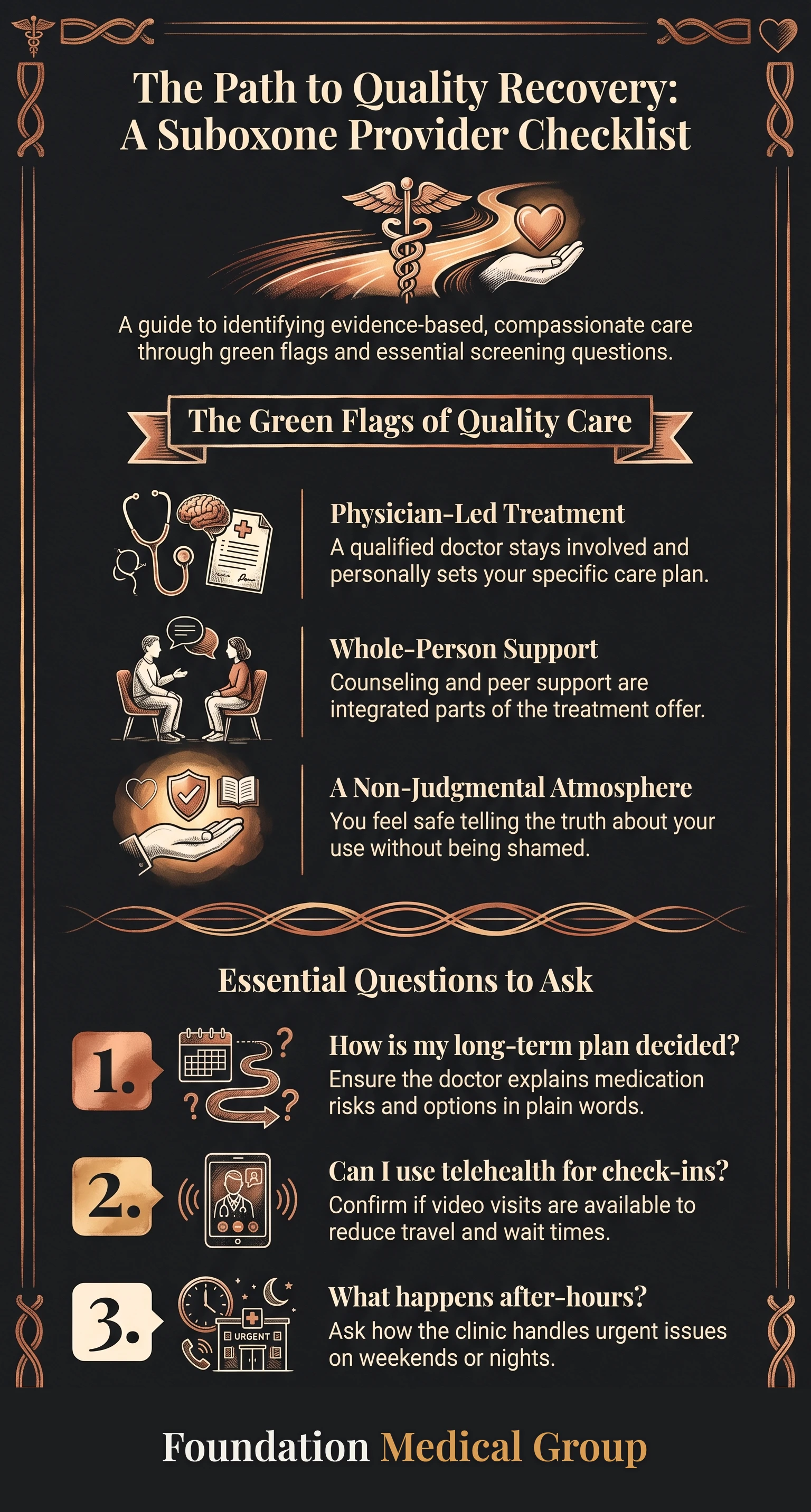
- A doctor leads your care. A physician or qualified prescriber sets your plan and stays involved.
- They explain your options. You hear about the medicine, the risks, and the plan in plain words.
- They don’t judge you. You feel safe telling the truth about your use.
- They connect you to counseling. Therapy or peer support is part of the offer, not an afterthought.
- They stay reachable. You know how to get help between visits.
When a provider does these five things, you’re in good hands. When they skip them, that’s your signal to look elsewhere.
Green Flags vs Red Flags

Some signs tell you a clinic is worth your trust. Others tell you to walk away. Use this table to size up any provider fast.
| Green flags (good care) | Red flags (avoid) |
|---|---|
| Physician-led, evidence-based plan | Prescription with no real exam |
| Warm, non-judgmental staff | Shame, blame, or lectures |
| Offers or refers to counseling | Medicine only, no support |
| Clear pricing and insurance help | Hidden fees or cash-only pressure |
| Reasonable wait for a first visit | Weeks-long wait with no urgency |
| Telehealth and in-person options | No flexibility on how you’re seen |
| Answers your questions patiently | Rushes you out the door |
If a clinic lands mostly in the left column, that’s a great sign. If you spot two or more red flags, trust your gut and keep searching.
Questions to Ask About the Doctor’s Approach
The way a provider answers these tells you a lot. You want someone who’s calm, clear, and honest. Ask these on your first call or first visit:
- Who prescribes and oversees my care? You want a physician or qualified clinician, not a vending-machine refill.
- How do you decide my dose? Good answers mention your history, your safety, and follow-up, not a one-size number. If you want a yardstick, the Suboxone label caps day 1 at 8 mg/2 mg, given in split doses roughly 2 hours apart. Day 2 can be a single 16 mg/4 mg dose. Ongoing maintenance usually sits between 4 mg/1 mg and 24 mg/6 mg per day. Anything above 24 mg/6 mg has not been tested in randomized trials, so a provider who reaches for it should be able to say why.
- What does a treatment plan include besides medicine? Listen for counseling, check-ins, and support.
- How long do people usually stay in treatment? There’s no single right answer, but you want a doctor who plans for the long term, not a quick taper.
- What happens if I have a hard week? You want a team that helps, not one that drops you.
Ask about induction timing too. The label says the first dose waits until clear withdrawal signs appear and not less than 6 hours after your last short-acting opioid. Most clinics score that with the Clinical Opioid Withdrawal Scale, an 11-item checklist running 0 to 47, where 5 to 12 reads as mild and 13 to 24 as moderate. A clinic that can explain that scale to you over the phone is a clinic that has done this before.
Staying in treatment long enough is one of the strongest predictors of recovery, and the numbers are stark. A 2017 BMJ meta-analysis of 19 cohorts found 4.3 deaths per 1,000 person-years among people on buprenorphine while they stayed in care, compared with 9.5 per 1,000 after they left. So a provider who plans for time, not just a prescription, is doing it right.
Wait Times, Access, and Telehealth
Opioid use disorder doesn’t wait, and neither should your care. When you’re ready, delay can be dangerous. So access matters as much as quality.
Ask how soon you can be seen. The strongest providers understand that a fast first visit can save a life, and plenty offer same-week or next-day appointments. Then ask how you’ll be seen.
- Telehealth for the first visit. Many providers can start you by video, which removes travel and long waits.
- A mix of video and in-person. You want flexibility as your needs change.
- Easy refills. Ask how prescriptions get sent and whether you can handle routine check-ins from home.
- After-hours help. Ask what to do if a problem comes up on a weekend.
Telehealth here isn’t a workaround, it’s federal policy. A DEA and HHS rule published on 17 January 2025 lets a prescriber start you on buprenorphine over an audio-only telemedicine visit. They can issue up to a 6-month supply, split across several prescriptions, once they’ve checked your state prescription drug monitoring database. A fourth temporary extension, issued 31 December 2025, keeps the wider set of pandemic-era telemedicine flexibilities running through 31 December 2026. And the outcomes hold up: in a study of 41,266 Kentucky and 50,648 Ohio Medicaid enrollees, starting by telemedicine was linked to slightly better 90-day retention than starting in person, with adjusted odds ratios of 1.13 and 1.19.
If you’re searching by location, our guide to Suboxone clinics near me accepting Medicaid can help you find options that fit your area and your coverage.
Counseling and Whole-Person Care

Medicine steadies your body. Counseling helps you rebuild your life. The strongest providers treat both, because addiction is rarely only about the drug.
Ask whether the clinic offers therapy on-site or refers you out. Ask about peer support, since talking with people who’ve been there helps many patients stay steady. And ask whether they screen for other things, like depression, anxiety, or pain, that often travel alongside opioid use.
You don’t have to accept every service. But a provider who offers this kind of whole-person care is thinking about your recovery, not just your prescription. That’s the difference between a refill and real treatment.
Insurance, Medicaid, and What a First Call Should Feel Like
Cost should never be the reason you skip care. A good provider helps you sort this out before you sit down.
On your first call, ask two simple things: do you take my insurance or Medicaid, and what will my first visit cost. Most plans, including Medicaid, cover buprenorphine treatment for opioid use disorder. Coverage is rarely the real bottleneck. NIDA puts the share of people with opioid use disorder who actually receive any of these medicines at under 20 percent, and stigma, pharmacy stocking and provider supply account for far more of that gap than benefits paperwork does. If you want to check your coverage first, see our guide on whether Medicaid covers Suboxone. For state-specific help, our Suboxone clinic in Utah page shows how one local option handles access and coverage.
That first call also tells you something the website can’t. Did they treat you kindly? Did they answer your questions? Did you feel judged, or did you feel heard? A first call should feel like the start of help, not another wall. If it doesn’t, that’s a red flag worth respecting.
Infographic: Your Suboxone Provider Checklist
Frequently Asked Questions
What should I look for in a Suboxone provider?
Look for physician-led care, warm and non-judgmental staff, counseling or support alongside the medicine, clear pricing, and fast access. If a provider offers most of these, that’s a strong sign you’ll get real treatment, not just a quick refill.
What questions should I ask a Suboxone doctor?
Ask who oversees your care, how your dose is decided, what the plan includes besides medicine, how long people usually stay in treatment, and what happens during a hard week. Their answers reveal whether they treat the whole person.
Are telehealth Suboxone providers as good as in-person?
For many patients, yes. Telehealth can start your care fast and remove travel barriers. The best providers offer both video and in-person options, so you can pick what fits your needs at each stage of recovery.
Does insurance or Medicaid cover Suboxone treatment?
Usually, yes. Most insurance plans and Medicaid cover buprenorphine treatment for opioid use disorder. Ask any clinic if they take your plan and what your first visit will cost before you book, so there are no surprises.
What are the red flags of a bad Suboxone provider?
Watch for a prescription with no real exam, shame or lectures, medicine with no support, hidden fees, and long waits with no urgency. If you spot two or more of these, trust your gut and keep looking.
Key Takeaways and Next Steps
Choosing a Suboxone provider comes down to a few clear questions. You want physician-led care, a team that treats you with respect, counseling alongside the medicine, fast access, and honest help with insurance. Use the checklist above to compare a few clinics, and pay attention to how that first call feels.
- Look for the green flags: physician-led, non-judgmental, whole-person care.
- Ask the doctor how they decide your dose and plan for the long term.
- Confirm wait times, telehealth options, and insurance or Medicaid coverage.
- Trust your gut. If a first call feels rushed or shaming, keep searching.
Ready to talk to someone who checks these boxes? Reach out to Foundation Medical Group and ask the questions from this checklist. One call is all it takes to find care that fits your life.
Sources
- Suboxone (buprenorphine and naloxone) sublingual film prescribing information, DailyMed, National Library of Medicine.
- Weiss RD, et al. Adjunctive counseling during brief and extended buprenorphine-naloxone treatment for prescription opioid dependence. Arch Gen Psychiatry 2011;68(12):1238-46.
- Sordo L, et al. Mortality risk during and after opioid substitution treatment. BMJ 2017;357:j1550.
- Hammerslag LR, et al. Telemedicine buprenorphine initiation and retention in opioid use disorder treatment for Medicaid enrollees. JAMA Netw Open 2023;6(10):e2336914.
- Drug Enforcement Administration and HHS, Expansion of Buprenorphine Treatment via Telemedicine Encounter, 90 FR 6504.
- Drug Enforcement Administration and HHS, Fourth Temporary Extension of COVID-19 Telemedicine Flexibilities.
- Opioid Withdrawal, StatPearls, NCBI Bookshelf.
- National Institute on Drug Abuse, Medications for Opioid Use Disorder.