
Cognitive behavioral therapy is a short, skills-based talk therapy. It helps you catch unhelpful thinking, test it against real life, and change the behavior that keeps you stuck. It’s one of the most studied treatment approaches in mental health care, and it helps with anxiety, depression, and a lot more. Here’s how it works in plain language.
According to the American Psychological Association, CBT is “a form of psychological treatment that has been demonstrated to be effective for a range of problems.” That range is wide. It covers depression, anxiety disorders, alcohol and drug use problems, eating disorders, and severe mental illness. At Foundation Medical Group, our physicians and therapists use cognitive behavioral therapy next to medical care. No piece of your treatment sits on its own.
What Is Cognitive Behavioral Therapy?
CBT rests on one plain idea. Your thoughts, your feelings, and your behavior are wired together. Nudge one, and the other two move.
Say you think, “I’ll embarrass myself at the party.” So you stay home. You feel lonelier, and the thought grows teeth. Cognitive behavioral therapy cuts that loop in two places at once: the thinking and the behavior.
The method grew out of clinical psychology and cognitive science in the 1960s. Aaron Beck, a psychiatrist, saw that his patients ran a quiet stream of snap judgments about themselves. He called them automatic thoughts. He named his method cognitive therapy.
Around the same time, psychologist Albert Ellis built rational emotive behavior therapy on similar ground. Those two lines merged with older work on behavior. Modern CBT was the result.
You’ll see the name written several ways, and they all mean the same care. Cognitive behavior therapy, CBT therapy, and the British spelling cognitive behavioural therapy point to one method. Some clinics just say CBT treatment. The label matters far less than whether your therapist is trained and licensed.
One quick note, because the words look alike. CBT is not a cognitive test. Cognitive tests measure memory, attention, and other parts of cognitive function. That’s a separate question from how you feel. Therapy asks what your mind does with stress. Testing asks how well the machinery runs.
What Happens in a CBT Session?
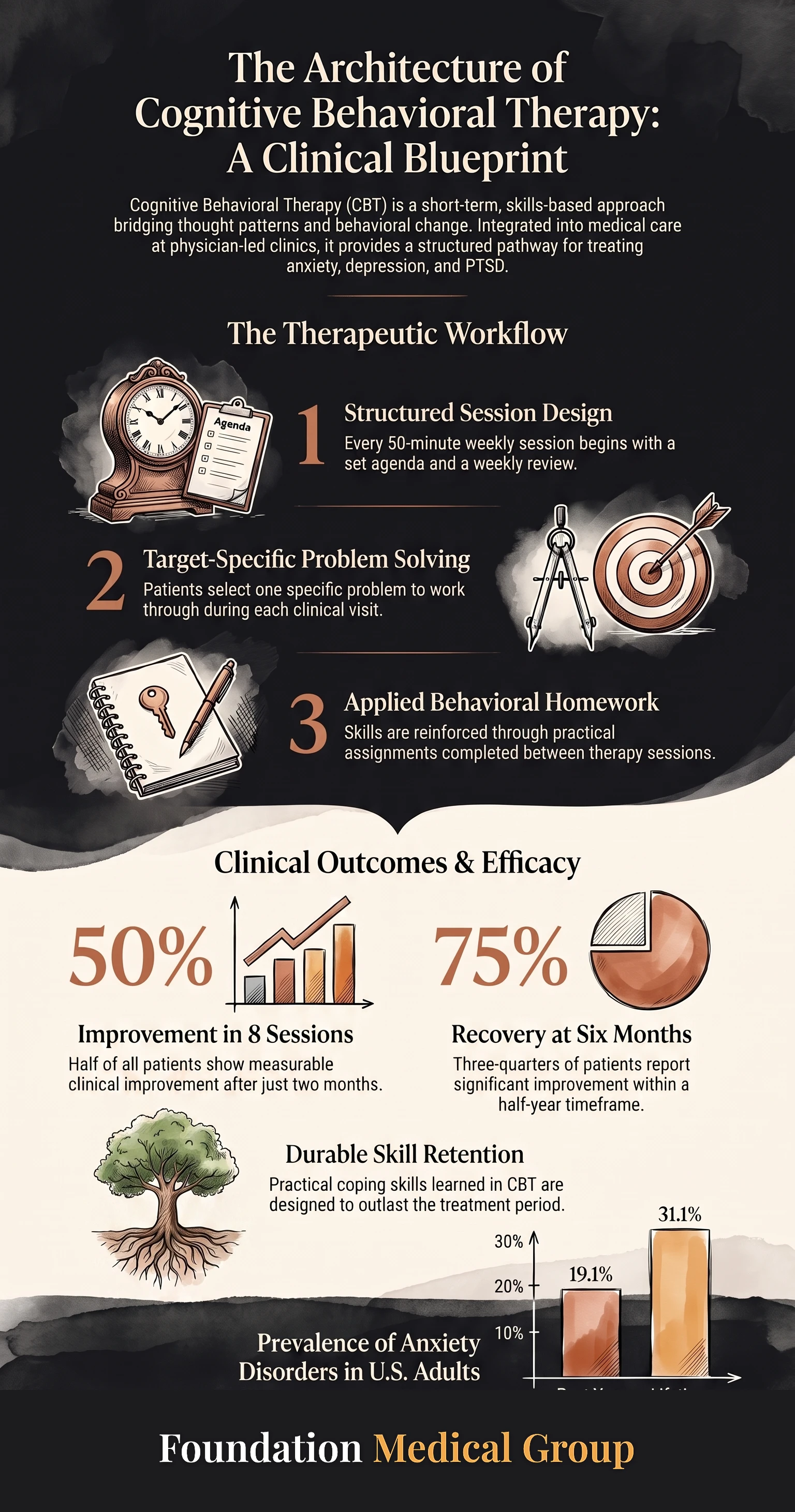
A therapy session runs about 50 minutes, and most patients start out weekly. The hour has a shape. You and your therapist agree on an agenda, look at how the week went, then pick one problem and work it hard. Unlike open-ended venting, the hour has a job to do.
Here’s what the work tends to include.
| Tool | What you do | Why it helps |
|---|---|---|
| Thought record | Write the situation, the automatic thought, and the feeling | Slows the loop down enough to study it |
| Cognitive restructuring | Weigh the thought against real evidence | Loosens negative thought patterns over weeks |
| Behavioral activation | Schedule small actions before motivation shows up | Lifts mood in depression by changing behavior first |
| Exposure therapy | Face what you avoid in slow, planned steps | Shrinks fear in anxiety, phobias, and OCD |
| Coping skills practice | Rehearse breathing, grounding, and problem solving | Gives you a skill to use between visits |
| Homework | Try the plan in real life, then report back | Turns insight into behavior you keep |
The National Institute of Mental Health describes the goal in simple terms. You learn to notice ways of thinking that are wrong or harmful, question them, and change self-defeating behavior patterns. Written out, that sounds academic. In the room, it feels like a coach helping you look at your own week honestly. For instance, a patient dreading a work review might rehearse the conversation out loud before doing it for real.
Your therapist will also name common cognitive distortions when they appear, such as all-or-nothing thinking or mind reading. Naming a pattern takes some of its power away, and spotting your own cognitive biases is a skill you keep long after therapy ends. One simple CBT intervention, a written record of a single automatic thought, often does more than an hour of talking around it. In our experience, the patients who gain the most are the ones who do the homework between visits.
What Mental Health Conditions Does CBT Treat?
CBT isn’t one script. Therapists adapt it to the problem in front of them, so the treatment for panic looks different from the treatment for low mood. That’s why it shows up in care plans for so many mental health conditions.
| Condition | What CBT targets | How care usually looks |
|---|---|---|
| Generalized anxiety disorder | Chronic worry, checking, reassurance seeking | Weekly therapy, worry postponement, thought records |
| Social anxiety | Fear of judgment, avoiding people | Gradual exposure plus rehearsal of real conversations |
| Panic disorder | Fear of body sensations, avoiding places | Interoceptive exposure and breathing retraining |
| Depression | Withdrawal, harsh self-talk, low activity | Behavioral activation first, then thought work |
| Obsessive compulsive disorder | Intrusive thoughts and rituals | Exposure with response prevention, often plus medicine |
| Post traumatic stress disorder | Avoidance, guilt, being on constant alert | Trauma-focused cognitive behavior therapy, paced slowly |
| Insomnia | Racing mind, poor sleep habits | Sleep scheduling and stimulus control |
| Substance use disorders | Triggers, cravings, relapse patterns | Skills training beside medicine for addiction |
Anxiety deserves its own note, because it’s so common. Figures from the National Comorbidity Survey Replication estimate that 19.1% of U.S. adults had an anxiety disorder in the past year. About 31.1% will have one at some point in life. Those numbers come from a household survey run between 2001 and 2003.
CBT also pairs well with medical care. NIMH notes that even when medicine relieves symptoms, therapy still helps you address the problems underneath. Our patients with opioid or alcohol use disorder often get both at once. Skills without stability tend to slip.
How Does CBT Compare With Other Kinds of Therapy?

Plenty of good therapies exist, and fit matters. For example, someone with intense mood swings may do better in dialectical behavior therapy than in standard CBT. Here’s a quick map so the names stop blurring together.
| Approach | Main focus | Best suited for |
|---|---|---|
| Cognitive behavioral therapy | Thoughts and actions in the present | Anxiety, depression, OCD, insomnia |
| Dialectical behavior therapy | Emotion regulation and distress tolerance | Big emotions, self-harm urges, rocky relationships |
| Acceptance and commitment therapy | Accepting hard feelings while acting on values | Chronic pain, stuck avoidance, life changes |
| Rational emotive behavior therapy | Disputing rigid demands and shoulds | Perfectionism, anger, harsh self-judgment |
| Psychodynamic talk therapy | Early relationships and repeating patterns | Long-standing relational themes, identity questions |
The APA also reports that CBT works as well as, or better than, other forms of psychological therapy or psychiatric medicine for a number of problems. That’s a strong track record. It doesn’t mean CBT suits every person, and a good therapist will say so rather than force the method.
How Long Does CBT Take to Work?
Sooner than most patients expect. The APA cites a classic study in which half of therapy patients improved after eight sessions, and 75% improved after six months. Some people feel steadier in 6 to 12 visits. Trauma, or several problems layered together, can take a year.
Progress rarely runs in a straight line. A good week is followed by a rough one, then two better ones. What matters is the trend, not any single visit. Your therapist should track it with you in plain terms.
Sessions often taper as you improve. Weekly becomes every other week, then monthly, then a check-in when you want one. By the end, you’re doing most of the work yourself. That’s the whole point of a skills-based treatment.
How Do I Find a Good CBT Therapist?
Start with licensure. A CBT therapist may be a licensed clinical social worker, a licensed professional counselor, or a psychologist. Any of those can be excellent. Cognitive behavioral therapists come from several training paths, so the letters after the name matter less than the training behind them.
Ask direct questions on the first call.
- Do you use cognitive behavioral therapy as your main approach, and how often?
- Will we set goals and review them, or is this open-ended?
- Do you give homework between sessions?
- Are you in network with my insurance plan?
- How soon can I be seen, and do you offer telehealth?
Search both spellings while you’re at it. Some directories file the same clinician under cognitive behavior therapy, so you’ll miss good options if you search one phrase only.
Fit is the other half. You should feel heard, not graded. If you feel judged or rushed after two visits, say so or move on. A cognitive behavioral therapist worth your time takes that feedback without bristling. If you’re also looking for an anxiety therapist near me, pick someone who names exposure therapy as part of their toolkit. Avoidance is usually the engine of anxiety.
Access shapes the choice too. Online therapy removes drive time and helps when leaving the house is the hard part. In-person visits give some patients a quieter space to think. Both work, and you can switch.
Does Insurance Cover CBT Treatment?

Usually, yes. Federal parity rules require many health plans to treat mental health care no worse than other medical care in limits and cost sharing. Medicaid plans in Virginia, Texas, Utah, and Georgia cover outpatient therapy too, though network lists differ by state and by plan.
Call your insurer and write down the answers to these.
- Is this therapist in network, and at what copay?
- Do I need a referral or prior approval?
- Is telehealth covered at the same rate as an office visit?
- How many therapy visits does my plan allow each year?
Then ask the clinic the same questions. When the two answers disagree, sort it out before your first visit rather than after the bill lands. If you’re looking for a therapist near me that takes Medicaid, ask which Medicaid plan the practice bills. Taking Medicaid and taking your plan are two different things.
Without insurance, ask about sliding-scale fees. Community mental health centers and university training clinics often charge far less, and the care can be very good.
CBT at Foundation Medical Group
Foundation Medical Group is a physician-led outpatient practice. We serve Richmond, Virginia, Dallas, Texas, American Fork, Utah, and Atlanta, Georgia, with telehealth across those states. Therapy sits under the same roof as psychiatry, so your plan holds together.
That matters more than it sounds. If cognitive behavioral therapy alone gets you where you want to go, we stop there. If your sleep is broken or your panic is severe, a physician can talk through medicine and monitor it while therapy continues. Instead of relaying messages between two offices that don’t talk, you get one treatment plan.
We screen for what travels alongside anxiety and depression: substance use, thyroid problems, grief, and poor sleep. Treating one thread and ignoring the rest leaves patients feeling half better. That’s a frustrating place to sit.
Key Takeaways
- CBT is practical. It targets present-day thoughts and behavior instead of digging endlessly through the past.
- The evidence is strong. The APA calls it effective across depression, anxiety, substance problems, and more.
- It’s usually short. Half of patients in the study the APA cites improved after eight sessions.
- Skills outlast the sessions. Thought records, cognitive restructuring, and exposure stay useful for years.
- Therapy and medicine share a plan well. A physician-led clinic offers both without splitting your care.
- Coverage is common. Parity rules and Medicaid put CBT within reach for most patients, and sliding scales help the rest.
Taking the First Step
Reaching out is often the hardest part. The good news is that the first call is short and low pressure. You can ask anything before you commit to a plan.
If you’ve been reading about cognitive behavioral therapy and wondering whether it would help you, that question deserves a real answer. Contact Foundation Medical Group, and we’ll talk it through at your pace.
If you’re in crisis, call or text 988 to reach the Suicide and Crisis Lifeline, any hour, free of charge.
Sources
- American Psychological Association (APA), What Is Cognitive Behavioral Therapy?
- APA, Understanding Psychotherapy and How It Works
- National Institute of Mental Health (NIMH), Psychotherapies
- National Institute of Mental Health (NIMH), Statistics on Anxiety Disorders
- Substance Abuse and Mental Health Services Administration (SAMHSA), 988 Suicide and Crisis Lifeline