Foundation Medical Group (FMG) offers couples counseling in Richmond, VA, in person at our clinic at 11600 Busy Street, Suite 203, and by secure video anywhere in Virginia. In each session, a licensed therapist works with both of you on the arguments you keep having.
Asking for help can feel like saying the relationship has failed. It’s closer to the opposite: it means you both still care enough to try. Studies, including the trials cited below, show structured counseling can reduce relationship distress.
What Is Couples Counseling?
Counseling for couples is talk therapy for two partners together. A therapist helps you both find words for hard topics, listen, and feel heard. According to the U.S. Department of Veterans Affairs, a couples therapist isn’t there to judge or referee, but to help each partner listen and be heard. That can be a relief if you’re worried the session will turn into a verdict on who’s right.
You don’t need to be in a marriage to get this help. Marriage counseling, couples therapy, relationship counseling, and relationship therapy all describe the same kind of care, and some clinics simply call it couples and marriage counseling.
A 2020 review in Clinical Psychology in Europe notes that couples and families often seek help to deal with relational distress. Learn how our sessions work on the talk therapy page.
Why Do Couples Go to Marriage Counseling?
Some couples argue about the same things again and again, which is tiring for both of you. Some have stopped talking about what matters. Others are dealing with stress or a big life change. The VA says some couples need help with the conflicts or complex problems that come up in a marriage or relationship. If you saw your own relationship in one of those, that’s okay. It’s a reason to look into help, not proof that it’s over.
The 2020 review explains that relational distress can come from things outside the relationship or inside it. Relationship challenges and mental health can affect each other. When one partner lives with anxiety, depression, or other mental health conditions, the marriage can be affected too. Counseling can help with both. Our therapists work with relationship stress, family conflict, grief, and life’s challenges like big transitions.
One safety note. The VA says relationship conflict can sometimes be severe and even dangerous. If you feel unsafe, counseling is not the first step. In an emergency, call 911. And if you need safety planning or crisis help, you can call the National Domestic Violence Hotline at 800-799-SAFE (800-799-7233). It’s open 24 hours a day, 7 days a week, according to the Office on Women’s Health.
Does Counseling Help Couples? What Research Says
So, if safety is not the issue, does any of this actually work? Short version: yes, research supports structured relationship counseling. No therapist can promise to save a marriage, but the studies are mostly positive. That’s encouraging. It isn’t the same as easy, though.
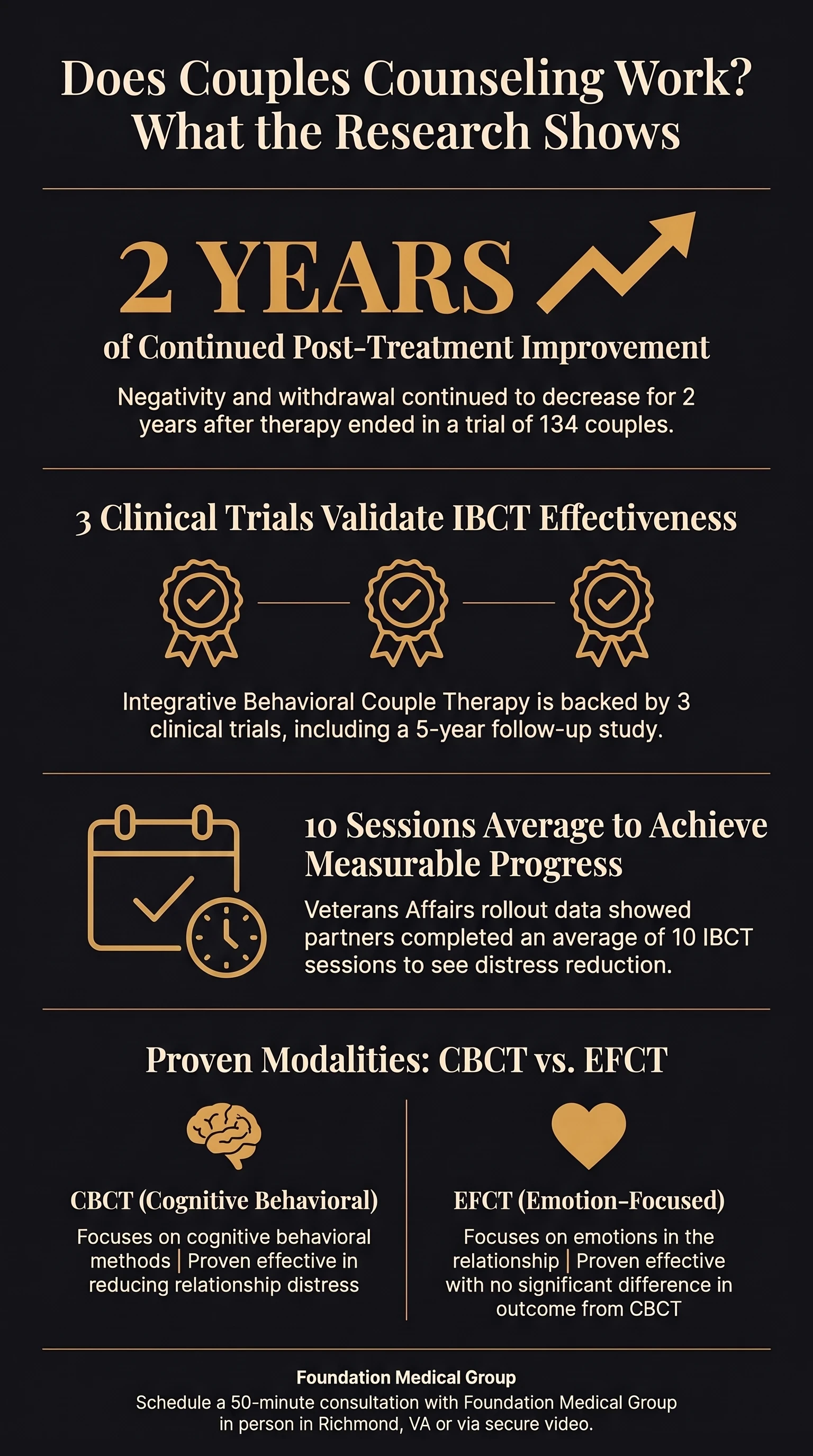
- Integrative behavioral couple therapy (IBCT) is supported by three clinical trials, one with a five-year follow-up, according to a 2017 review in Current Opinion in Psychology.
- In a Veterans Affairs rollout of IBCT, partners completed about 10 sessions on average and still improved, the same review reports.
- In a trial of 134 distressed couples, published in the Journal of Consulting and Clinical Psychology, negativity and withdrawal kept going down for 2 years after treatment ended.
- Cognitive behavioral and emotion-focused couple therapy both reduce relationship distress, with no significant difference between them, according to the 2020 review.
Side note, since you might wonder why the VA shows up so often in an article about Richmond. The VA rolled IBCT out in its own health system (that’s the rollout in the list above), and it publishes plain-language relationship pages for the couples it serves. Much of that guidance applies whether or not anyone in your home ever served. Anyway, back to the research.
What does this mean for you? Gains from good therapy can last after ongoing sessions end. Still, results depend on both people, and on whether you both want to work on the marriage or relationship. That’s the hard part, and it can hurt if you’re the partner who feels more ready.
Common Couples Therapy Approaches Compared
Therapists use different styles. Here are three that are well studied in our sources.
| Approach | Main focus | Evidence in our sources |
|---|---|---|
| IBCT | Emotional acceptance, better communication, secure connection (VA) | Three clinical trials, one with five-year follow-up (2017 review) |
| Cognitive behavioral couple therapy (CBCT) | Builds on cognitive behavioral therapy for couples (2020 review) | Effective in reducing relationship distress (2020 review) |
| Emotion-focused couple therapy (EFCT) | Emotions in the relationship (2020 review) | Effective; no significant difference from CBCT (2020 review) |
EFCT is also called emotionally focused therapy. You may also hear about narrative therapy or humanistic therapy, other relational therapy styles. At FMG, your therapist chooses the approach that fits the two of you. Methods include CBT, acceptance and commitment therapy (ACT), solution focused therapy, psychodynamic therapy, and couples and family approaches.
What Happens in a Session?
In the first session, both partners share what brings them in and what they hope will change. The therapist listens to each of you, so neither person feels left out. In practice, that means you both get a turn. Nervous about that first session? Then say so in the room. It’s a perfectly good place to start. At FMG, the first visit is a structured intake, and we ask about your history, your goals, and what you’ve already tried.
Later sessions often focus on one real problem at a time. In the 134-couple study, for example, each partner chose one current relationship problem to talk about. The therapist helps each of you listen and be heard, and you may get skills to try at home.
At FMG, sessions are 50 minutes, and couples sessions may run longer. We offer individual therapy, couples therapy, and family therapy. And sometimes one partner also wants their own sessions for their mental health, or a family therapist is a better fit when kids are involved.
How Do I Choose a Couples Therapist in Richmond, VA?
Look for a licensed therapist with couples experience, such as a licensed professional counselor (LPC) or a licensed clinical social worker (LCSW). Many couples therapists and marriage therapists post therapist profiles, so read them. Ask about their approach, whether sessions are in person or by video, and your insurance. A good marriage counselor should come across as even-handed with both of you, not quietly on one side.
You’ll also see LMFT, short for licensed marriage and family therapist. That’s another good option. In Virginia, the Board of Counseling at the Department of Health Professions licenses LMFTs and LPCs. Its page links to a License Lookup, so you can check a counselor’s license before you book. Worth the extra step.
At FMG, Allie Bashkoff, LCSW, is Clinical Director of Therapy Services and leads therapy from our Virginia clinic. Yvette Allen-Tatum, MA, LPC, NCC, is a Virginia therapist whose bio lists experience with individual, couples, and group therapy. Our team matches you with licensed therapists whose style fits. And if it isn’t the right fit, we switch.
Want premarital counseling, Christian counseling, or sex therapy? Ask before you book. FMG does not offer these as named programs, and EMDR therapy is not yet offered. See our tips on finding a therapist in Richmond.
Counseling for Couples in Richmond, VA at FMG: In Person or by Video
Want to meet in person? Come to our Richmond clinic, 11600 Busy Street, Suite 203, Richmond, VA 23236. See our Virginia page for clinic details.
You can also meet online. Couples sessions are offered by secure video in Virginia, Utah, Georgia, and Texas. In-person visits happen only at our Richmond clinic. Video tends to be easier to fit around work and kids. Skeptical that a laptop screen can hold a conversation this personal? That’s a fair worry. If you live near Richmond, you can ask about the in-person option at Busy Street instead. Learn more about online therapy with an FMG therapist.
Our Richmond clinic also offers psychiatry. If one partner needs a psychiatric evaluation or medicine, that mental health care is in the same Busy Street office, so the pieces of your care can stay connected. Individual needs, like grief counseling, can be handled with a separate individual therapist.
Will Insurance Cover Couples Sessions?
Many plans cover counseling, but coverage for couples sessions varies. This part can be frustrating. Coverage often depends on whether the sessions treat a mental health condition. Medicare, for example, covers family counseling if the main purpose is to help with your treatment. So counseling for the relationship alone may not be covered. Annoying, but better to know before the first bill, so ask your plan what it needs. Common plans to ask Virginia providers about include Anthem, Aetna, Cigna, Sentara Health Plans, UnitedHealthcare, and TRICARE, each one call to confirm coverage. We also work with Virginia Medicaid (Cardinal Care) plans; see our guide to a Richmond therapist who takes Medicaid. Medicare is not accepted at our Virginia clinic. Our team verifies your benefits before the first session.
Key Takeaways
- In counseling, a neutral therapist helps both partners listen, and be heard, on the hard issues.
- Research shows structured counseling reduces distress, and gains can last for years.
- FMG offers counseling for couples in person in Richmond, VA, or by secure video, with mental health services at the same clinic.
- Call to confirm coverage; Medicare is not accepted in Virginia.
FAQ
Is couples counseling effective?
For many couples, yes. A 2020 review found that cognitive behavioral and emotion-focused couple therapy both reduce distress, with no significant difference between them.
Can couples counseling save a relationship?
It can help, but no one can promise it. In one trial of 134 couples, negativity and withdrawal kept dropping for 2 years after therapy ended.
Where can I find couples counseling in Richmond, VA?
At Foundation Medical Group, 11600 Busy Street, Suite 203, Richmond, VA 23236, or by secure video anywhere in Virginia.
Can I get couples counseling covered by insurance?
Often, but it depends on your plan, so call to confirm coverage. Medicare is not accepted at our Virginia clinic.
Sources
- PubMed Central (NIH), Integrative Behavioral Couple Therapy (Current Opinion in Psychology, 2017).
- PubMed Central (NIH), Cognitive-Behavioral and Emotion-Focused Couple Therapy: Similarities and Differences (Clinical Psychology in Europe, 2020).
- PubMed Central (NIH), Observed Communication in Couples 2 Years after Integrative and Traditional Behavioral Couple Therapy (Journal of Consulting and Clinical Psychology, 2011).
- U.S. Department of Veterans Affairs, Relationship Health and Safety (VA Cheyenne Health Care).
- Medicare.gov, Outpatient Mental Health Coverage.
- Virginia Department of Health Professions, Virginia Board of Counseling.
- Office on Women’s Health (HHS), Get Help.