
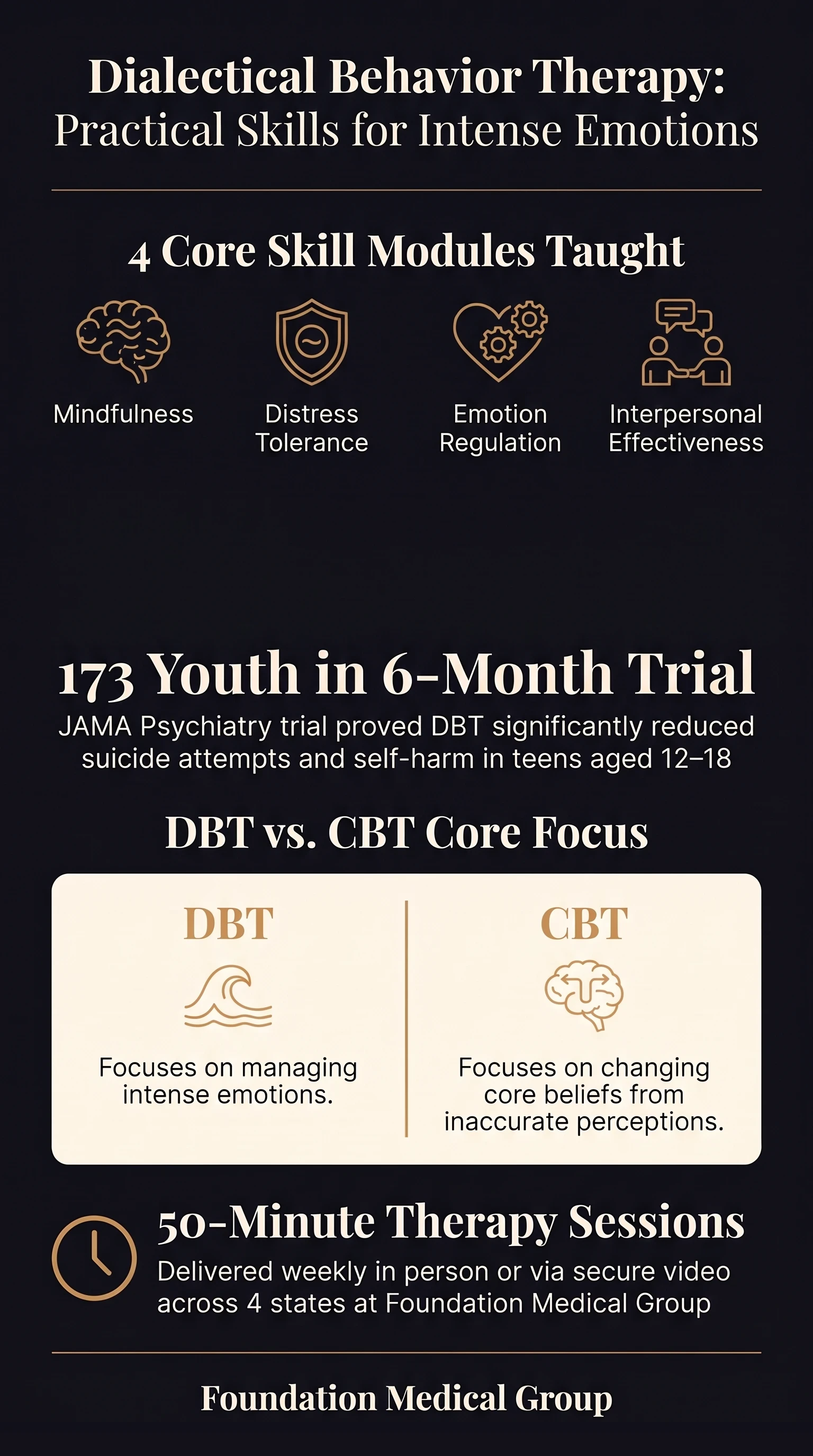
DBT therapy, short for dialectical behavior therapy, is a talk therapy built around skills training. You learn four sets of skills: mindfulness, distress tolerance, emotion regulation and interpersonal effectiveness. It was first built for borderline personality disorder, but it’s now used more widely. The goal is to help you handle intense emotions, cut down harmful behaviors and build steadier relationships.
What Is DBT Therapy and How Does It Work?
Dialectical behavior therapy is a structured, skills-based form of talk therapy. It teaches you practical ways to manage strong emotions, reduce self-destructive behaviors and get along better with the people in your life. You may also see it written as dialectical behavioral therapy, or with the British spelling, dialectical behaviour therapy. Same treatment, three spellings.
Side note, because people ask about that odd first word. “Dialectical” just means holding two ideas that seem to pull against each other, both at once. In DBT, the pair you’ll hear about most is acceptance and change: you accept where you are right now, and you also work to change it. Sounds like a contradiction? It’s meant to. Anyway, back to how it actually works.
So how does it work? According to the National Institute of Mental Health (NIMH), DBT uses mindfulness, which means awareness of your present situation and your emotional state. Alongside that awareness, it teaches skills to control intense emotions, reduce self-destructive behaviors and improve relationships.
A 2025 review in Frontiers in Psychiatry describes the same idea from a slightly different angle. It says dialectical behavior therapy combines cognitive behavioral techniques with mindfulness practices, so people can regulate intense emotions and handle problems with other people more skillfully.
Put simply, DBT is a behavior therapy with a mindfulness core, and its DBT principles are hands-on. You learn a skill in a session, use it in daily life, then talk with your therapist about what helped (and what didn’t). That’s the loop. At Foundation Medical Group, DBT is one of several approaches in our talk therapy service for mental health treatment, in person at our Richmond flagship and by video across the four states we serve.
Why Was Dialectical Behavior Therapy Created?
Dialectical behavior therapy was first developed by Marsha Linehan as a comprehensive treatment for people with borderline personality disorder (BPD). The Frontiers in Psychiatry review describes BPD as a condition marked by difficulties in relationships and trouble regulating emotions, which often leads to self-injury or suicidality. NIMH also notes that DBT was developed specifically for people with BPD.
That history explains why DBT treatment puts so much weight on safety. NIMH lists recurring suicidal thoughts and self-harming behavior among the symptoms of BPD. If you’ve lived through those moments, or watched someone you love go through them, you know how scary they are. DBT was designed to give people concrete tools for those hard moments, so there’s something to do besides waiting for the pain to pass.
If you or someone you love is thinking about suicide, call or text 988 to reach the 988 Suicide and Crisis Lifeline. In a life-threatening situation, call 911.
What Are the Four Main DBT Skills?

DBT treatment sorts the skills into four modules. Patients in the Frontiers in Psychiatry review said that skills and structured worksheets from all four modules helped them cope with distress. Here’s what each one is for, in everyday terms.
Mindfulness
Mindfulness skills help you notice the present moment and your emotional state without being swept away by it. NIMH describes this as awareness of your present situation and emotional state. Picture an argument starting to heat up. Mindfulness helps you notice your racing heart and rising anger before you react. That small pause gives you a moment to choose what to do next.
Distress Tolerance
Distress tolerance is about getting through a crisis or a strong urge without making things worse. These are the skills for moments you can’t fix right away, such as waiting for hard news or feeling a sudden wave of panic. Distress tolerance skills help you ride out the peak of the feeling safely, so the distress has time to ease. The aim isn’t to make the feeling vanish. It’s to get through it without adding a new problem on top.
Emotion Regulation
Emotional regulation means understanding your feelings and managing emotions so they feel less intense and less in charge of you. NIMH says DBT teaches skills to control intense emotions. For example, if small setbacks tend to spiral into a whole day of sadness or anger (which is frustrating and tiring), emotional regulation skills help you name what you feel and bring the intensity down.
Interpersonal Effectiveness
This module is about asking for what you need, saying no when you need to, and keeping relationships healthy. NIMH notes that DBT aims to improve relationships. If you tend to stay quiet until you explode, or you fear that asking for anything will push people away, these skills give you a clearer way to speak up.
None of this is abstract. Together, these are practical skills, and skills training is the heart of DBT. Remember that acceptance-and-change pair from the start? You can spot it here. Some modules help you sit with a feeling until it passes, while others help you shift it or ask for something different. Each one makes the others easier to use.
What Is DBT Used to Treat?
Is DBT only for BPD? No. BPD is where DBT started, but it’s spread well beyond that. The Frontiers in Psychiatry review explains that DBT’s focus on emotion regulation has led to its broader application to eating disorders, ADHD and trauma-related conditions. In other words, DBT treatment is now used for a range of mental health conditions where intense emotions play a big part.
There’s another reason DBT work often touches more than one problem. According to NIMH, a person with BPD may be more likely to have symptoms of depression, post traumatic stress disorder, bipolar disorder, an anxiety disorder, a substance use disorder or eating disorders. NIMH also lists impulsive behaviors such as substance use and binge eating among BPD symptoms. So someone in DBT for big emotional swings may also be working on substance abuse, panic or trauma.
That’s why DBT pays attention to harmful behaviors and problematic behaviors, not only to feelings. The skills are meant for real moments, such as an urge to use, to binge or to lash out. Messy, ordinary, middle-of-the-week moments.
One honest note, though: “applied to” isn’t the same as “proven for.” Whether DBT treatment fits your situation is a decision to make with a licensed clinician. Good treatment matches the person, not just the label.
DBT vs Cognitive Behavioral Therapy: Key Differences
How is DBT different from CBT? DBT grew out of cognitive behavioral methods, so both are active, practical forms of behavior therapy. The real difference is emphasis. NIMH describes CBT as helping people identify and change core beliefs and behaviors that come from inaccurate perceptions. DBT keeps those tools but adds mindfulness and a strong focus on emotions and relationships.
| DBT | CBT | |
|---|---|---|
| Main focus | Controlling intense emotions, reducing self-destructive behaviors, improving relationships (NIMH) | Identifying and changing core beliefs and behaviors that come from inaccurate perceptions (NIMH) |
| Core tools | Mindfulness plus four skill modules (NIMH; Frontiers in Psychiatry review) | Cognitive and behavioral techniques (NIMH) |
| Built for | People with BPD; now applied more broadly (NIMH; Frontiers in Psychiatry review) | Wide use; can reduce mood swings, anxiety symptoms and self-harm in BPD (NIMH) |
| Typical format | Standard DBT: individual therapy, group skills training, phone coaching, therapist consultation (Frontiers in Psychiatry review) | Often one-on-one sessions with a therapist |
At FMG, the talk therapy service lists CBT, DBT and ACT among its methods, so in practice your therapist may blend them during treatment. For more on the other approach, read our guide to cognitive behavioral therapy.
Does DBT Work? What the Research Shows
The research on DBT treatment is strongest for people at high risk of self-harm. Here are three findings in plain words.
Teens at high risk for suicide. A 2018 randomized trial in JAMA Psychiatry included 173 young people aged 12 to 18. After 6 months of treatment, DBT beat a comparison therapy on all primary outcomes, including suicide attempts, self-injury and self-harm. From 6 to 12 months, the gap was no longer statistically significant, but self-harm kept falling through the 1-year follow-up. The authors call DBT the first well-established treatment for reducing repeated suicide attempts and self-harm in youths. For a worried family facing a teen’s suicidal thoughts, that matters. A lot.
Adults with BPD. A 2016 analysis in Behaviour Research and Therapy followed 99 suicidal women with BPD over two years. Their functioning in areas such as work, housing and relationships improved during DBT. People with very high emotion dysregulation improved more slowly. If emotional regulation is hard for you, that’s a reason for patience, not for giving up.
Skills groups and patient experience. The Frontiers in Psychiatry review notes that DBT skills groups alone have been found to reduce emotional dysregulation and depressive symptoms. Patients described the skills as helpful for distress, but not an instant fix. Honestly? That’s probably the most useful thing to hear before you start, even if it isn’t the most exciting. Practice and steady mental health support make the difference.
Standard DBT Program Parts: Individual Therapy, Skills Group, Coaching
In research, a DBT program usually means a full package. According to the Frontiers in Psychiatry review, standard DBT, also called comprehensive DBT, combines four parts:
- Individual therapy: one-on-one individual therapy sessions with a DBT therapist.
- Group skills training: a DBT skills group where people learn and practice the skills together. This is the most common form of DBT group therapy.
- Telephone coaching: support between sessions to help you use a skill in a real situation.
- Therapist consultation team: the DBT therapists meet as a team about the treatment they provide.
In the JAMA Psychiatry teen trial, both groups had weekly individual and group therapy, and the therapists held consultation meetings. The review also notes that DBT skills training in a group on its own has been studied as a shorter option.
Programs differ, and in practice not every setting offers all four parts. When you talk to any provider, ask which parts they offer, so you know what to expect. It’s a fair question. Not a rude one.
What Happens in DBT Sessions?

What should I expect? Your first treatment visit is mostly a conversation. For a lot of people, it’s also the nervous part, and that’s okay. You talk about what brings you in and what you want to change. At FMG, this first visit is where our team learns your history, your goals and what you’ve already tried, and your therapist explains the approach and how the skills fit those goals.
After that, DBT sessions follow a rhythm. You learn a new tool, practice it between sessions, and review with your therapist how it went. Patients in the Frontiers in Psychiatry review valued structured worksheets and skill-building resources, so you may leave with a small practice task.
At FMG, sessions are 50 minutes, and most patients start once a week. As a client, you have a say in the fit, too. Our team matches each client with a therapist whose style suits what they’re carrying. And if the first therapist isn’t the right fit, you can switch.
Two tips help: write down one hard situation each week to bring in, and tell your DBT therapist when a tool isn’t working. That second one feels awkward at first. Say it anyway, because a skill that flops in real life is useful information, not a failure on your part.
Starting DBT at FMG: Video in VA, UT, GA and TX, In Person in Richmond
At Foundation Medical Group, DBT is one of the approaches our therapists use in individual talk therapy, along with CBT and ACT. Therapy comes in individual, couples and family formats, as part of mental health treatment that can link with psychiatry.
By secure video. If you’re in Virginia, Utah, Georgia or Texas, you can see an online therapist by secure video. Utah readers near our American Fork clinic, 456 E State Street, Suite 1400, American Fork, UT 84003, can do DBT-informed therapy this way, wherever they live along the Wasatch Front. Same story for patients in metro Atlanta or North Dallas: therapy is by video.
In person. In-person sessions are offered only at our Richmond clinic, 11600 Busy Street, Suite 203, Richmond, VA 23236 (Virginia location). So if you’re in RVA, or out in Midlothian or elsewhere in the greater Richmond area, a weekly drive over to Busy Street is an option. Everyone else meets their therapist on screen, which honestly suits plenty of people. See therapist in Richmond. Richmond also offers psychiatry, TMS, Spravato, MAT and brain mapping.
Insurance. Virginia plans include Anthem, Aetna, Cigna, Sentara Health Plans, UnitedHealthcare, TRICARE and Virginia Medicaid (Cardinal Care); Medicare is not accepted in Virginia. Utah plans include Blue Cross Blue Shield, SelectHealth, Aetna and Molina. Call to confirm coverage.
FMG’s addiction treatment is MAT for opioid use disorder; it does not treat alcohol use disorder or offer detox, IOP, PHP, residential care or 24/7 supervision. In a crisis, call or text 988; in an emergency, call 911. To ask about DBT, call the Richmond office.
Key Takeaways
- DBT is a skills-based talk therapy first built for borderline personality disorder.
- The four DBT skills areas are mindfulness, distress tolerance, emotion regulation and interpersonal effectiveness, taught through skills training.
- Dialectical behavior therapy is now applied to other mental health conditions, such as eating disorders and trauma-related problems.
- Research supports DBT for reducing self-harm and suicide attempts in high-risk teens.
- At FMG, DBT is available by secure video in VA, UT, GA and TX, and in person in Richmond, VA, in 50-minute sessions.
FAQ
Is DBT therapy only for borderline personality disorder?
No. DBT therapy was built for borderline personality disorder, but a 2025 review explains that its focus on emotion regulation has led to its use for eating disorders, ADHD and trauma-related conditions. Ask a licensed clinician whether it fits your own needs.
How is DBT therapy different from CBT?
DBT grew out of cognitive behavioral therapy and adds mindfulness plus a focus on emotions and relationships. Many therapists blend both, so you may get tools from each.
What should I expect in DBT therapy?
You learn a skill, practice it between therapy sessions, and then review how it went. At FMG, sessions are 50 minutes and most people start once a week. A simple tip: write down one hard situation each week to bring to your DBT therapist.
Can I do DBT therapy by video?
Yes. FMG offers talk therapy, including DBT, by secure video for people in Virginia, Utah, Georgia and Texas. In-person sessions are offered only at the Richmond, VA clinic. Call the office to ask which option suits you.
Sources
- National Institute of Mental Health, Borderline Personality Disorder.
- Frontiers in Psychiatry (2025), Transdiagnostic patient experiences of dialectical behavioural therapy: a systematic review and metasynthesis.
- JAMA Psychiatry (2018), Efficacy of Dialectical Behavior Therapy for Adolescents at High Risk for Suicide: A Randomized Clinical Trial.
- Behaviour Research and Therapy (2016), Dialectical behavior therapy and domains of functioning over two years.