
If you’re searching for a depression therapist near me, here’s the short version. Look for a licensed therapist who treats depression often, uses proven methods like cognitive behavioral therapy, takes your insurance, and can see you soon. At Foundation Medical Group, our physician-led team offers therapy and medical care under one roof.
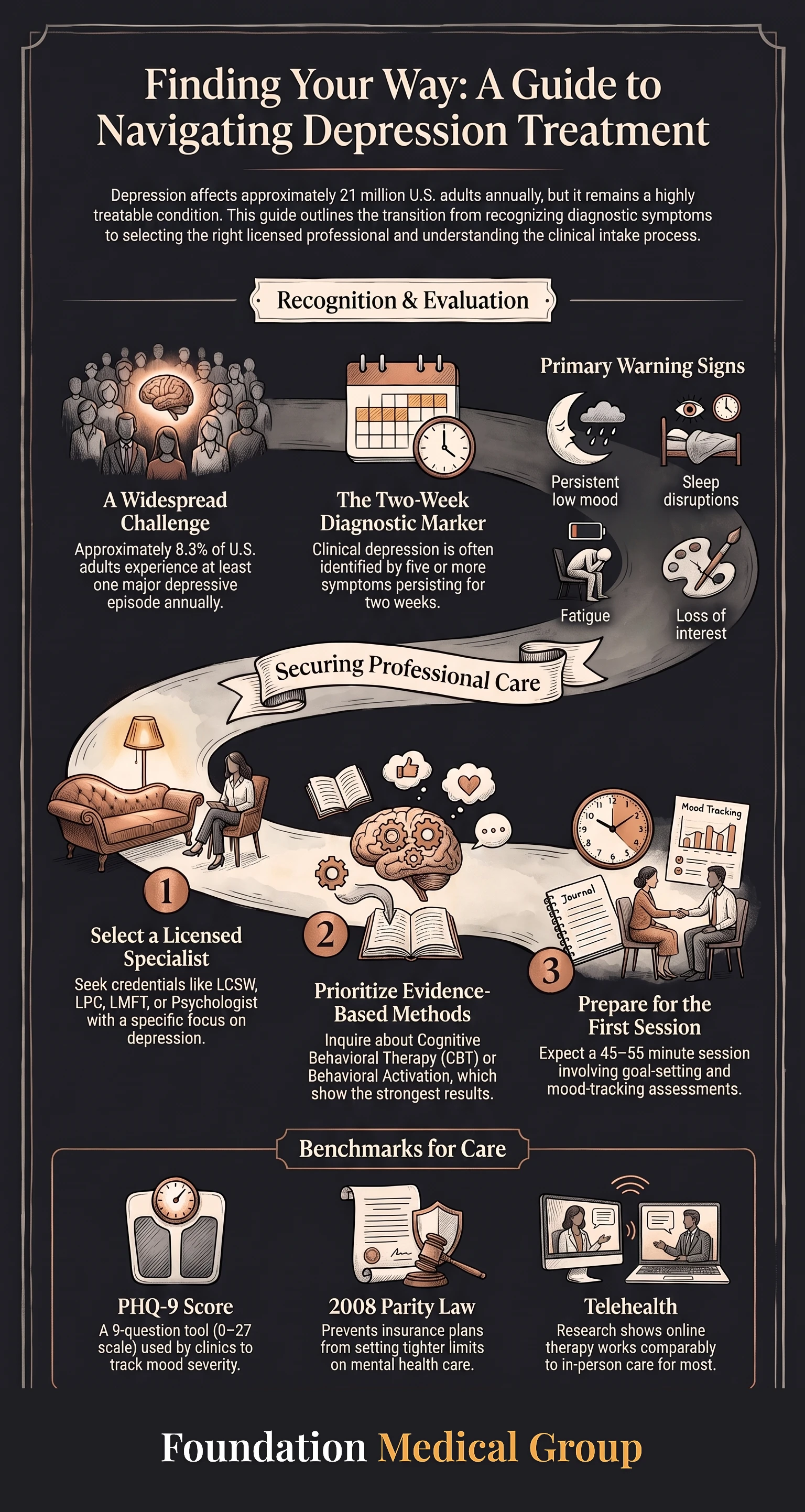
According to the National Institute of Mental Health, an estimated 21 million U.S. adults have had at least one major depressive episode in a single year, or about 8.3% of adults. That’s a lot of people quietly carrying the same weight you are. Depression responds well to treatment. The hard part is usually not the therapy itself, but finding the right therapist and getting through the first door.
What Does a Depression Therapist Do?
A depression therapist is a licensed mental health professional trained to treat low mood and the thought patterns that keep it locked in place. Most use talk therapy, sometimes called psychotherapy. You describe what your days feel like, and your therapist helps you spot what feeds the heaviness.
Good therapy for depression is practical. Your therapist may ask you to track your sleep, your energy, and the moments when your mood dips. Then you work out small changes together. Someone who has stopped seeing friends might start with one 20-minute coffee, not a full weekend of plans.
There’s one line worth knowing. A therapist provides counseling, but they don’t prescribe medicine. That job belongs to psychiatric providers such as a doctor or a psychiatric nurse practitioner. Some clinics keep both under one roof, which saves you from repeating your story twice.
Depression rarely travels alone. Anxiety shows up alongside it for many patients, and so do grief, trauma, and heavy drinking. A skilled therapist screens for all of it, because treating only the low mood can leave the rest untouched.
How Do I Know If It’s Depression?
Rough patches pass. Depression digs in. It lasts at least two weeks, and it changes how you sleep, eat, and think. The National Institute of Mental Health lists the signs that doctors look for.
- A low, flat, or empty mood most of the day, most days.
- Losing interest in things you used to enjoy.
- Sleeping far too much, or barely at all.
- Eating much more or much less than usual.
- Feeling drained even after a full night of rest.
- Guilt, or a harsh inner voice that calls you a burden.
- Trouble focusing on work, a book, or a show.
- Thoughts of death or of hurting yourself.
You don’t need all eight. Five or more symptoms, most of the day, for two weeks or longer points to a mental health condition called major depressive disorder. That last sign is the one to act on today. If it shows up, call 988 rather than waiting for an open slot.
Anxiety often rides along. Racing thoughts at 2am, a tight chest, and dread about small tasks show up in both. Anxiety disorders and low mood share many of the same treatments, so anxiety therapy and mood work often happen in the same room.
Which Types of Therapy Work Best for Depression?
There isn’t one single approach that fits every person. Cognitive behavioral therapy has the deepest research base here, and the American Psychological Association lists it among the treatments with strong support. Other methods help too, especially when low mood is tangled up with grief, trauma, or a strained relationship.
| Therapy type | How it works | Often a good fit for |
|---|---|---|
| Cognitive behavioral therapy | Teaches you to catch harsh thoughts and test them against the facts | Most adults with low mood, including online therapy formats |
| Behavioral activation | Rebuilds daily activity first, so mood follows action | People who have withdrawn from work, friends, or hobbies |
| Interpersonal therapy | Works on grief, role changes, and conflict with people close to you | Low mood after a loss, a divorce, or a new baby |
| Acceptance and commitment therapy | Builds room for hard feelings while you act on your values | Long-running low mood that has not shifted with other methods |
| Solution focused therapy | Sets small, concrete goals over a short run of visits | People who want a brief, focused plan |
| EMDR therapy | Processes distressing memories that keep pulling mood down | Low mood tied to trauma or an old injury |
| Group therapy | Shared sessions with people facing similar struggles | Isolation, and lower cost than individual therapy |
| Family therapy and couples therapy | Brings partners or relatives into the room | A mood dip that strains a household |
Most people start with individual therapy. From there, your therapist may add couples counseling or family therapy if the strain at home is part of the picture. Grief counseling fits when a loss sits underneath the sadness.
Ask any clinic whether they practice evidence based therapy. A straight answer means they can name the method and explain why it suits your symptoms.
How Do I Choose the Right Therapist Near Me?

Start with the license. In most states, several credentials qualify someone to provide mental health counseling, and each involves supervised clinical hours plus a state exam.
- Licensed clinical social worker (LCSW). Trained in therapy plus the practical side, such as benefits, housing, and work stress.
- Licensed professional counselor (LPC). Focused on counseling for mood, anxiety, and life transitions.
- Licensed marriage and family therapist (LMFT). This clinician treats the relationships around the person.
- Psychologist (PhD or PsyD). Doctoral training in psychology, plus testing.
- Psychiatric providers. A physician or nurse practitioner who can prescribe when medicine belongs in the plan.
Any of these can treat depression well. What matters more is how often they treat it and whether they use methods with real evidence behind them.
Then ask a few blunt questions on the phone. Most offices will answer them in five minutes.
- Do you treat depression as a main focus, or only now and then?
- Which methods do you use, and why that one for me?
- Are you in network with my plan, and what’s my copay?
- What’s your therapist availability, and how soon is a first visit?
- Can I switch to telehealth on weeks when I can’t drive in?
That fourth question is the one people skip, and it’s the one that saves a frustrating month. Wait times vary a lot between clinics, and a therapist you can see in ten days often beats a highly rated one who’s booked out three months.
Fit matters as much as credentials. You should feel heard rather than rushed. If two or three sessions in it still feels off, say so. A good clinician takes that well and will help you find a better match, because the therapist you trust is the one you’ll keep seeing.
Is Online Therapy as Effective as In-Person Care?
For depression, research supports online therapy as a strong option. Video sessions work especially well with cognitive behavioral therapy, since much of the work is talking, practicing skills, and reviewing what you tried between visits.
Virtual therapy also removes the barriers low mood is good at building. Getting dressed, driving across town, and sitting in a waiting room can feel like too much on a low week. A video visit shrinks that to one click, and people miss fewer appointments as a result.
Traditional therapy still has real strengths. In-person sessions give you a separate space away from the house, which helps if home is loud or short on privacy. Couples therapy and family therapy are often easier face to face, and some people simply read a room better than a screen.
You don’t have to choose once and forever. Many of our patients mix the two, coming in monthly and meeting by video the rest of the time. Ask whether a clinic offers both before you commit.
What Happens in Your First Therapy Session?
Your first therapy session is mostly a conversation. Your therapist asks about your mood, sleep, appetite, energy, and how long the symptoms have lasted. They also ask about past treatment and any thoughts of self-harm, which is a routine safety question rather than a sign of alarm.
Many clinics use a short questionnaire called the PHQ-9 to track your mood. It asks 9 questions and takes about 2 minutes, and scores range from 0 to 27. Repeating it every few weeks shows whether you’re actually improving or just having a better day.
Sessions usually run 45 to 55 minutes, and most people start weekly. After the first visit, you’ll set two or three goals together. Then you build coping skills: rebuilding a routine, challenging harsh self-talk, and planning for the days when motivation is gone.
Saying it out loud to someone neutral brings a surprising amount of relief. In our experience, the people who improve fastest are the ones who book that second visit before they leave the first.
Progress rarely runs in a straight line. Some weeks feel lighter and some feel like sliding backward, which is normal rather than proof that the plan failed. What counts is the direction over a few months.
Will Insurance Cover Depression Therapy?

Cost is a real worry, and it’s fair to ask before you book. Most plans cover mental health services today. The Mental Health Parity and Addiction Equity Act of 2008 changed the rules. It stops many plans from setting tighter limits on mental health care than on other medical care. Your out-of-pocket cost still depends on your specific plan.
Call the number on your insurance card and ask these questions.
- Is this therapist in network for outpatient mental health treatment?
- What’s my copay or coinsurance per visit?
- Do I need a referral or prior authorization first?
- Is online therapy covered at the same rate as an office visit?
- Does my plan cap the number of visits per year?
Write the answers down, then ask the clinic’s front desk the same questions. If the two answers don’t match, call your insurer again before you book. Ten minutes on the phone beats a surprise bill six weeks later.
No insurance? Ask about sliding-scale fees based on income, which many practices offer. Community mental health centers and university training clinics usually charge far less than private practices. Cost should shape how you get care, not whether you get it.
When Is Therapy Alone Not Enough?
Therapy handles mild to moderate cases well on its own. For moderate to severe depression, the combination of therapy and medication tends to work better than either one by itself. That’s a medical decision, so it belongs with a doctor rather than a counselor.
Some mental health conditions also need a broader plan than weekly counseling. Bipolar disorder calls for careful medication management, since antidepressants alone can trigger mania. A personality disorder often responds better to a longer, structured program. Mood disorders that return each winter may respond to a light box.
If two or more antidepressants haven’t helped enough, ask about other options. TMS for depression uses gentle magnetic pulses and is FDA-cleared for major depressive disorder when medication hasn’t worked well. A psychiatrist near me search makes sense at that point, since these treatments need medical supervision.
None of this means therapy failed. It means this is a real mental illness with several levers, and you’re pulling more than one.
What If You Need Help Today?
Some moments can’t wait for an opening next month. If you’re having suicidal thoughts, call or text 988 to reach the Suicide and Crisis Lifeline. It’s free, confidential, and staffed 24 hours a day.
SAMHSA also runs a free national helpline at 1-800-662-4357, open 365 days a year. Trained staff can point you toward local treatment, and you don’t need insurance to call. For immediate danger, call 911 or go to the nearest emergency room.
Depression Care at Foundation Medical Group
Foundation Medical Group is a physician-led outpatient clinic treating depression, anxiety, and related conditions. Our therapy services and our medical care sit in the same practice, so your therapist and your prescriber actually talk to each other.
That matters more than it sounds. When therapy alone isn’t moving the needle, we don’t send you off to find a new office and start over. A physician reviews the plan, discusses medication if it fits, and your counseling continues without a gap.
We treat patients in Richmond, Virginia, Dallas, Texas, American Fork, Utah, and Atlanta, Georgia, with telehealth across the states we’re licensed in. Our Dallas office answers at 469-909-1312, and Dr. Justin Thompson leads our Texas team. If anxiety is riding alongside your low mood, our guide to finding an anxiety therapist near me covers that side of the picture.
Reaching out is the hardest part, and we try to keep it simple. One call, plain answers about cost, and a first visit scheduled without a long wait.
Key Takeaways
- Depression is treatable. Cognitive behavioral therapy has the strongest evidence, with behavioral activation and interpersonal therapy close behind.
- Check the license. A licensed clinical social worker, licensed professional counselor, family therapist, or psychologist can all treat it.
- Ask about availability early. A therapist you can see in ten days often helps more than one booked three months out.
- Online therapy works. Video sessions suit low mood well, and you can mix them with in-person visits.
- Insurance usually covers it. Verify benefits with both your insurer and the clinic before your first visit.
- Therapy plus medicine is an option. For severe depression, a physician-led team can offer both without splitting your care.
You Don’t Have to Sort This Out Alone
Depression narrows your world and then tells you that’s just how things are. It’s lying. With steady support, the right therapist, and a plan built around your life, most people feel meaningfully better.
If you’ve been putting off that search for a depression therapist near me, let today be the day. Foundation Medical Group offers warm, physician-led mental health care in Richmond, Dallas, American Fork, and Atlanta. Contact us and we’ll take the first step with you.
Sources
- National Institute of Mental Health (NIMH), Major Depression.
- National Institute of Mental Health (NIMH), Depression.
- American Psychological Association (APA), Depression.
- Substance Abuse and Mental Health Services Administration (SAMHSA), 988 Suicide and Crisis Lifeline.
- Centers for Medicare & Medicaid Services (CMS), Mental Health Parity and Addiction Equity Act.