
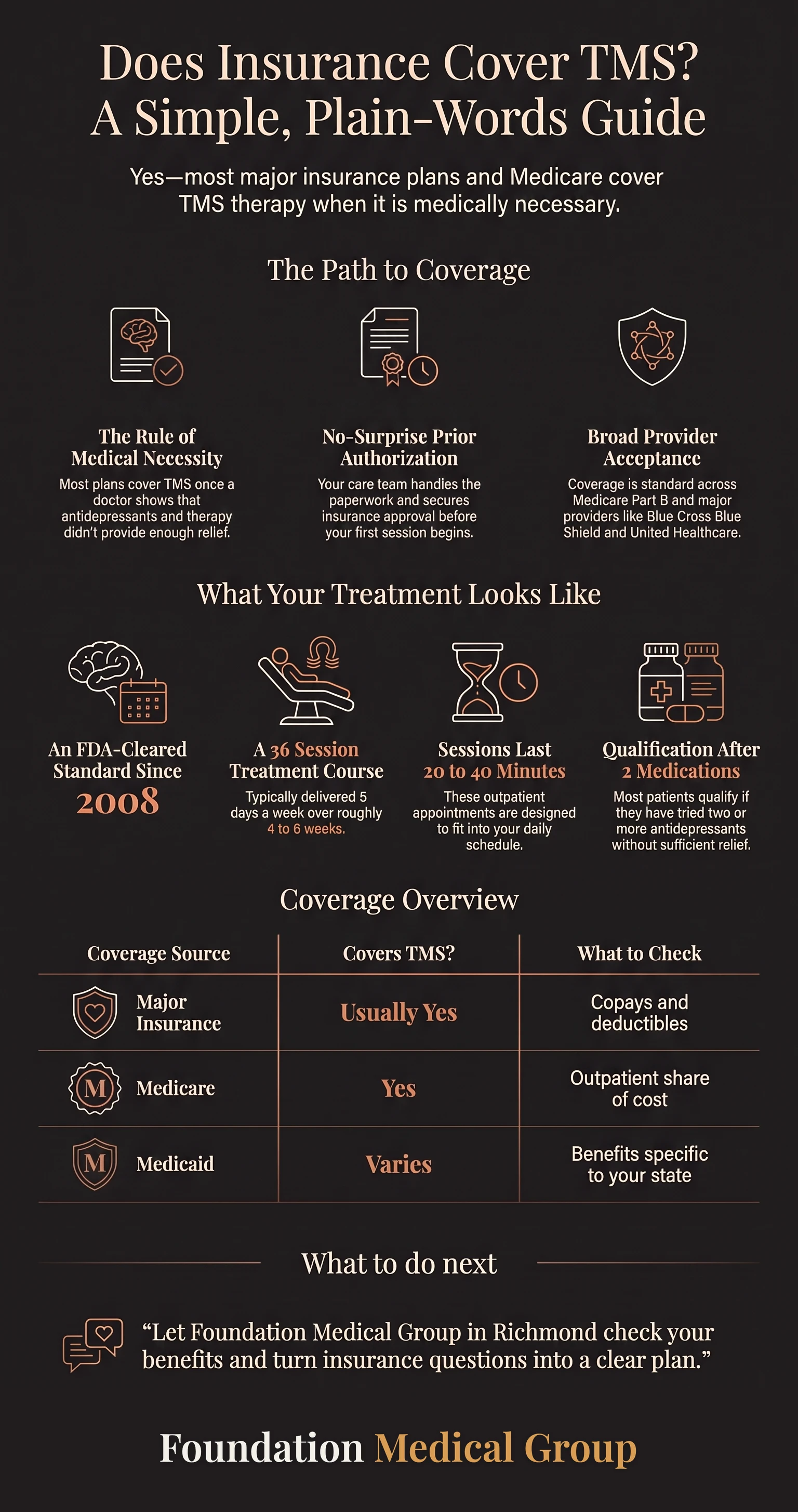
Does insurance cover TMS? In most cases, yes, for adults with major depression that hasn’t improved with antidepressants. Medicare, most commercial insurance companies and many Virginia Medicaid (Cardinal Care) plans cover TMS therapy when the criteria are met, and almost all of them want prior authorization first.
At Foundation Medical Group in Richmond, VA, we work with Medicaid, Aetna, Cigna, Anthem, Blue Cross Blue Shield, UnitedHealthcare, Humana, TRICARE and Optum Behavioral Health. We do not accept Medicare at this time. Coverage varies by plan and state. Call our office to confirm your plan before your first visit.
TMS is short for transcranial magnetic stimulation. It’s a non-invasive, effective treatment option for many patients with depression, a treatment that sends magnetic pulses to the part of the brain tied to mood. According to the FDA, the first TMS device for depression was cleared in 2008, for adults who didn’t get enough relief from antidepressant medicine. Hold on to that line. It’s close to word for word what your insurance company will ask about.
What do insurers typically require before covering TMS?
Here’s the thing most people don’t expect. The rules insurance companies use for TMS therapy insurance coverage look a lot alike, because most of them grew out of the same Medicare criteria. Not identical. Close, though. This table pulls together what a TMS coverage policy usually asks for, with the Medicare version spelled out because it’s the one that’s public.
| Requirement | What it usually means | Medicare in Virginia (LCD L34869) |
|---|---|---|
| Diagnosis | Major depressive disorder, documented by your doctor | Severe major depressive disorder, single or recurrent episode |
| Failed medication trials | Antidepressants that didn’t work well enough, at a proper dose and length | 2 trials from different drug classes, failed or not tolerated |
| Psychotherapy trial | Talk therapy tried without enough improvement | Required, evidence-based, adequate frequency and duration |
| Who orders it | A treating provider who knows your history | A psychiatrist (MD or DO) who examined you and reviewed records |
| Prior authorization | Insurer approval before session one | Medical necessity documented in the record |
| Course length | Usually around 30 to 36 sessions | 20 sessions over 4 weeks, up to 10 more if improving, plus taper sessions |
| Safety screening | Check for metal implants, seizure risk | Part of the physician’s review |
The phrase that ties all of this together is medical necessity. It simply means your records show a clear medical reason for the treatment. When your treatment history checks those boxes, insurance approval for TMS therapy is usually much easier. When one piece is missing, say no therapy trial on record, that’s often the exact reason a request stalls. Which is maddening when you’ve been struggling for months, but it’s fixable.
Does Medicare cover TMS in Virginia?
Yes. Medicare coverage for TMS treatment of major depression runs through Medicare Part B, the outpatient side, when you meet the local criteria. Virginia’s Medicare contractor is Palmetto GBA, and its local coverage determination is LCD L34869 on the CMS Medicare Coverage Database. Palmetto GBA’s policy is the one that applies to Medicare patients treated in Virginia. Our Richmond clinic does not accept Medicare at this time, so if Medicare is your main coverage, ask us first and we’ll talk through your options.
That LCD covers an initial course of up to 20 sessions over 4 weeks, then up to 10 more over 2 weeks if your depression scores have improved by at least 25 percent, plus tapering sessions. It also allows a repeat course if you responded well the first time (more than 50 percent improvement) and then relapsed. Retreatment rules matter more than people think. Depression comes back for some patients, and it’s good to know the door isn’t shut.
Medicare.gov explains that Medicare Part B covers outpatient mental health care from qualified providers. After the Part B deductible, you generally pay 20 percent of the Medicare-approved amount, unless a Medicare supplement or Medicaid picks that up. Medicare Advantage plans (Aetna, Humana, UnitedHealthcare and others sell them) must cover what original Medicare covers, though they can add their own prior authorization steps.
Does Virginia Medicaid (Cardinal Care) cover TMS?
Virginia Medicaid is called Cardinal Care. It’s run by the Virginia Department of Medical Assistance Services (DMAS), and on October 1, 2023 it combined the Medallion 4.0 and CCC Plus programs into one. According to DMAS, managed care serves over 90 percent of members through five accredited health plans, and those plans cover behavioral health services.
So does Medicaid cover TMS therapy in Virginia? Honestly, Medicaid coverage for TMS comes down to which managed care plan is printed on your card. Each plan writes its own medical policy and prior authorization rules for TMS, and we can’t promise one answer for all of them. What we can do is check your specific plan with you before you book anything. If you’re not sure which plan you have, the DMAS Managed Care Helpline is 1-800-643-2273.
Coverage varies by plan and state. Call our office to confirm your plan before your first visit.
How do Anthem, Aetna, Cigna and other carriers handle TMS?
Most large insurance companies publish a medical policy for TMS therapy, and their insurance coverage tends to follow the pattern in the table above. That includes Anthem, which sells Blue Cross Blue Shield plans in Virginia, along with Aetna, Cigna, UnitedHealthcare and Humana. TRICARE and behavioral health carve-outs such as Optum Behavioral Health review TMS through their own authorization process.
What differs from one insurance company to the next is usually the fine print:
- How many failed antidepressants they want, and whether augmentation counts.
- Whether a specific depression rating scale has to be on file.
- How many TMS treatment sessions get approved up front, versus after a progress check.
- Whether accelerated TMS or deep TMS gets TMS therapy coverage at all (often it’s reviewed separately).
- Your share: copay per TMS session, deductible, and coinsurance. That’s where the real TMS therapy cost shows up.
Employer plans and Marketplace plans sit under these same carriers, so the same medical policy usually applies. Our TMS cost guide explains how to turn your per-session copay into a total for the full course. Short version: ask for the per-session amount in writing and multiply it by 36.
How does prior authorization for TMS work?

Prior authorization is your insurer saying yes before TMS treatment starts. Your TMS provider gathers the records, sends them, and waits. You don’t have to do it alone, and honestly you shouldn’t, because the clinic knows what each insurance provider tends to ask for, and patients who try to file it themselves often get stuck on a missing form.
At our Richmond clinic, we check your benefits before anything else, and the process usually runs like this:
- A no cost consultation, where we review your diagnosis and every antidepressant you’ve tried.
- A benefits check, so you know your expected share before anything is booked.
- The prior authorization request, built from your pharmacy history, therapy notes and our psychiatrist’s evaluation.
- Follow-up with the plan until there’s an answer, and an appeal if the first answer is no.
Consultations usually happen within 3 to 5 business days, and treatment can often begin within about two weeks of that. Some plans move slower. That’s the honest picture.
What if insurance says no to TMS?

A denial stings. It’s fair to feel let down. But a no from insurance companies is often a missing record rather than a final answer, and plenty of patients get a yes on the second try.
First, ask exactly why the request was denied, in writing. Second, ask whether the missing piece can be added, such as a therapy trial or a medication record from a past doctor. An appeal can change the outcome, and you have the right to file one. Third, if coverage really isn’t there, ask the clinic for a written self-pay price for the full course and any financing options. Some patients also look at other treatment options, such as Spravato, which has its own coverage rules covered in our guide to whether Spravato is covered by insurance.
Questions to ask your insurance company about TMS
Write these down before you call. It turns a vague worry into real numbers.
- Is TMS therapy covered under my insurance plan, and what’s the policy called?
- Do I need prior authorization, and who files it?
- How many sessions are approved at first?
- What’s my cost per session after the deductible?
- Is Foundation Medical Group in network, and is it listed as a TMS clinic for my plan?
- Is accelerated or deep TMS treated differently?
Keep notes: the date, the name of the person you spoke with, and a reference number. If a claim goes sideways later, those notes are gold.
Key Takeaways
- Does insurance cover TMS? Usually yes, insurance covers TMS therapy for major depression that hasn’t responded to antidepressants, with prior authorization.
- Medicare in Virginia follows Palmetto GBA’s LCD L34869: severe major depression, 2 failed antidepressant classes, a psychotherapy trial, and a psychiatrist’s order.
- Virginia Medicaid (Cardinal Care) is delivered through five managed care plans, and each sets its own TMS policy.
- We work with Medicaid and the major commercial carriers named above. We do not accept Medicare at this time. Coverage varies by plan and state, so call to confirm your insurance coverage.
- A denial isn’t the end. Appeals, added records, or a written self-pay price can still open the door.
Let’s Check Your Coverage Together
You don’t have to guess whether your insurance covers TMS therapy for you. That’s our job, and we’re glad to do it. Foundation Medical Group offers NeuroStar TMS at our Richmond, Virginia clinic, and our TMS in Richmond page explains what treatment looks like week by week. Call (804) 506-0526, and we’ll read your plan with you, explain your benefits in plain words, and handle the approval steps.
If depression hasn’t eased with other treatments, TMS therapy may be a hopeful next step for patients who’ve run out of easy answers. Our guide to TMS for depression covers how it works, and the page on TMS therapy near you explains how to compare clinics.
Sources
- Centers for Medicare and Medicaid Services, Medicare Coverage Database, LCD L34869: Repetitive Transcranial Magnetic Stimulation (rTMS) in Adults, Palmetto GBA.
- Medicare.gov, Mental health care (outpatient).
- Virginia Department of Medical Assistance Services, Cardinal Care Managed Care.
- Virginia Department of Medical Assistance Services, Cardinal Care Managed Care program change, October 1, 2023.
- U.S. Food and Drug Administration, 510(k) summary for the NeuroStar TMS Therapy System, K083538.
- National Institute of Mental Health, Brain Stimulation Therapies.