
Yes, Medicaid covers Suboxone. Every state Medicaid program pays for buprenorphine medications like Suboxone to treat opioid use disorder. This is because federal law now requires it, and because the science backing this treatment is strong. So if you have Medicaid, your medication is very likely covered.
That’s the short answer. The longer answer has a few moving parts, because Medicaid runs a bit differently in each state. Below we walk through what’s usually covered, how coverage can vary, what prior authorization means, and what to do if a claim gets denied. We’ll keep it plain and calm, so you know exactly what to expect.
Does Medicaid Cover Suboxone?
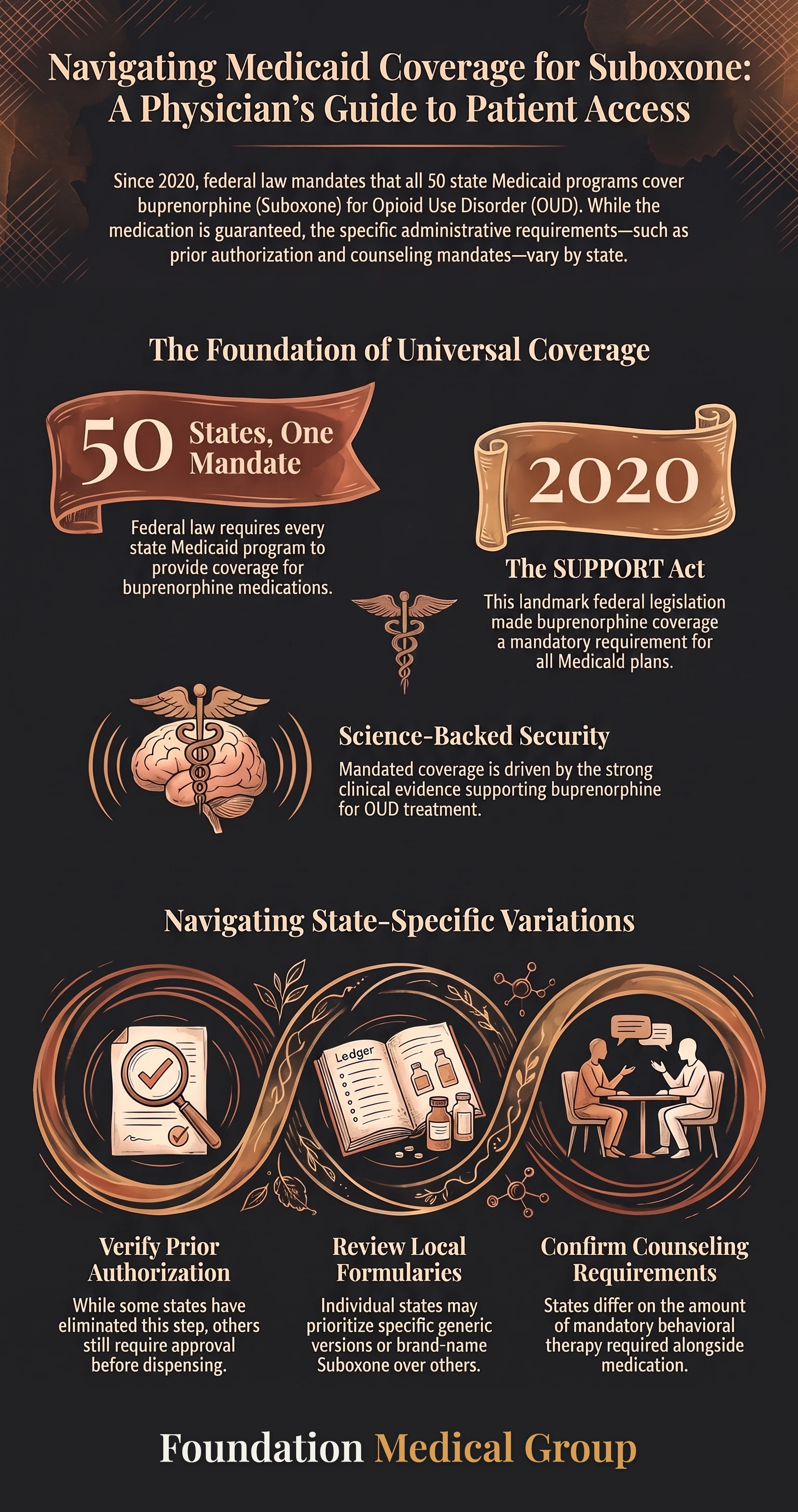
Yes, and this isn’t a maybe. As of 2020, all 50 state Medicaid programs cover buprenorphine, the main ingredient in Suboxone. Federal rules under the SUPPORT Act made this coverage mandatory. So no matter which state you live in, your Medicaid plan includes this medicine for opioid use disorder.
According to the Substance Abuse and Mental Health Services Administration (SAMHSA), these medications are the gold standard for treating opioid use disorder. That’s a big reason Medicaid pays for them. The goal is simple. Get people safe, effective care without a huge bill in the way.
What Medicaid Usually Covers for MAT

Suboxone is part of a bigger plan called Medication-Assisted Treatment, or MAT. Medicaid doesn’t just pay for the pill or film. It usually covers the whole package of care around it.
Here’s what most state Medicaid plans cover for MAT:
| What you get | Usually covered by Medicaid? | Why it matters |
|---|---|---|
| The medication (buprenorphine or Suboxone) | Yes | This is the core of your treatment |
| Doctor and provider visits | Yes | Your provider checks your progress and adjusts care |
| Counseling and behavioral therapy | Yes, in most states | Support that helps you stay steady |
| Lab and drug screening tests | Usually | Simple checks that keep care safe |
| Care coordination or case management | Often | Someone helps connect the pieces of your care |
The exact mix can shift by state. Still, the pattern holds. Medicaid tries to cover the full path, not just the prescription. That way cost doesn’t force you to skip the parts that help most.
How Coverage Can Vary by State
Medicaid is one program with fifty faces. The federal government sets the floor, and each state builds on top. So while every state covers buprenorphine, the details around it can look different.
Here are a few things that can vary:
- Which exact medications are on the list. Some states prefer certain brands or generic versions first.
- How much counseling is included. One state may cover weekly therapy, another may cover less.
- Whether prior authorization is needed. Some states have dropped this step, others still ask for it.
- How many refills you can get before you see your provider again.
Research from the National Institute on Drug Abuse (NIDA) shows that easy, steady access to these medications keeps people in treatment longer. Many states have used that finding to remove roadblocks. When in doubt, check your state’s Medicaid website or call the number on your card.
Prior Authorization Basics
Prior authorization sounds scary, but it’s really just a form. It’s when your Medicaid plan wants your provider to confirm that the medicine fits your diagnosis before it’s paid for. Think of it as a quick sign-off, not a wall.
Many states have removed prior authorization for buprenorphine, since it slowed people down. Where it still exists, your provider’s office usually handles the paperwork for you. You often don’t have to do a thing. If you’re not sure, just ask your clinic one question. Do I need prior authorization for this medicine?
What to Do If a Claim Is Denied

A denied claim isn’t the end of the road. It’s often a small paperwork issue, and it can be fixed. Don’t panic, and don’t stop your treatment. Take these steps instead.
- Read the denial letter. It tells you the reason, which points you to the fix.
- Call your Medicaid plan. Ask what’s missing, and write down who you spoke with.
- Loop in your provider’s office. They can send records or file the prior authorization.
- File an appeal if needed. You have the right to appeal, and the letter explains how.
Most denials come from a missing form or a coding slip, not a real “no.” A quick call usually clears it up. If money’s tight while you sort it out, our guide on Suboxone cost without insurance covers low-cost options to bridge the gap.
How to Find a Medicaid-Accepting Provider
Coverage only helps if you can find a provider who takes Medicaid. The good news is that more clinics accept it every year. You just need to know where to look.
Start with your Medicaid plan’s provider directory, either online or by phone. You can also use SAMHSA’s free treatment locator to find nearby options. When you call a clinic, ask two quick questions. Do you take my Medicaid plan, and can you prescribe buprenorphine? For a curated list, see our hub on Suboxone clinics near me accepting Medicaid. If you’re in Texas, our Suboxone clinic Dallas Medicaid options page can help too.
Infographic: How Medicaid Covers Suboxone
Frequently Asked Questions
Does Medicaid cover Suboxone in every state?
Yes. As of 2020, all 50 state Medicaid programs cover buprenorphine, the main ingredient in Suboxone. Federal law made this coverage mandatory. The details around it can vary, but the medicine itself is covered everywhere.
Does Medicaid cover the counseling that goes with Suboxone?
In most states, yes. Medicaid usually covers counseling and behavioral therapy as part of MAT. Coverage details vary by state, so check your plan for how many sessions are included and any requirements.
Do I need prior authorization for Suboxone under Medicaid?
It depends on your state. Many states have removed prior authorization for buprenorphine. Where it’s still required, your provider’s office usually handles the paperwork, so you rarely have to do anything yourself.
What if my Medicaid claim for Suboxone is denied?
Don’t panic. Most denials come from a missing form, not a real refusal. Read the letter, call your plan, and ask your provider to help. You also have the right to file an appeal.
How do I find a doctor who takes Medicaid for Suboxone?
Start with your Medicaid plan’s provider directory or SAMHSA’s free treatment locator. Then call the clinic and ask if they take your plan and can prescribe buprenorphine. More providers accept Medicaid every year.
Key Takeaways and Next Steps
Here’s what to hold on to. Medicaid covers Suboxone in every state, because federal law now requires it and the science is strong. Coverage usually includes the medication, your visits, and counseling. The details can vary by state, and a denied claim is almost always a fixable paperwork issue.
- Remember that all 50 state Medicaid programs cover buprenorphine for opioid use disorder.
- Ask your clinic one question up front: do I need prior authorization for this medicine?
- If a claim is denied, read the letter, call your plan, and lean on your provider’s office.
- Use a provider directory or SAMHSA’s locator to find a Medicaid-accepting clinic near you.
Ready to take the next step? Reach out to Foundation Medical Group and ask how your Medicaid coverage works with our care. One call can turn a confusing question into a clear, covered plan.
Sources
- Substance Abuse and Mental Health Services Administration (SAMHSA), Medications for Substance Use Disorders
- National Institute on Drug Abuse (NIDA), Medications to Treat Opioid Use Disorder