
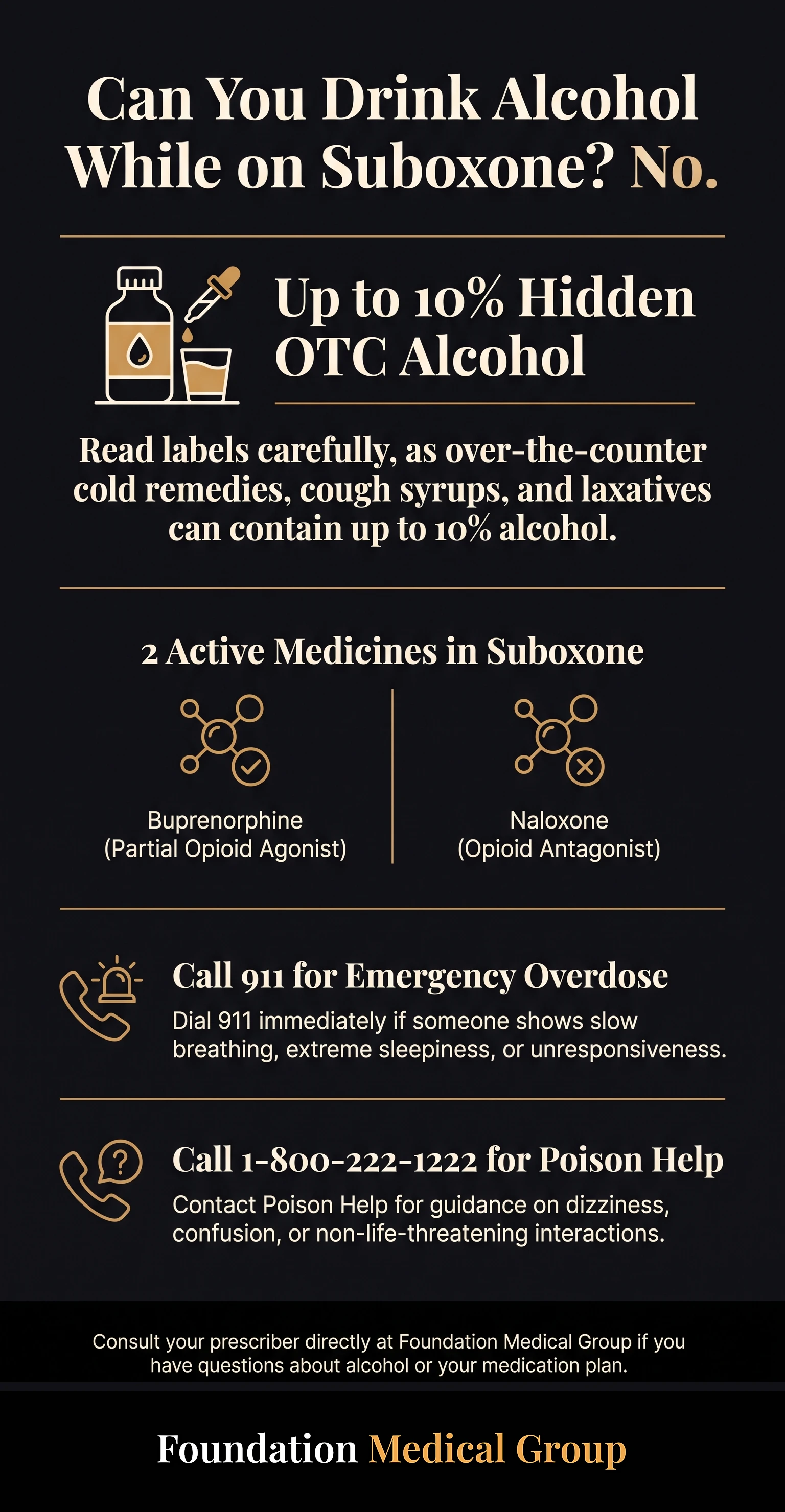
Drinking while on Suboxone isn’t safe, so you shouldn’t drink alcohol while you take it. Its main medicine, buprenorphine, makes you drowsy and slows your breathing. Alcohol? It dulls your brain and your breathing in much the same way. Together they raise the risk of overdose, coma and death. If someone on Suboxone has been drinking and is very sleepy, breathing slowly or cannot wake up, call 911 right away.
What Does Drinking on Suboxone Do to Your Body?
Suboxone contains two medicines. Buprenorphine is a partial opioid agonist, and naloxone is an opioid antagonist, which means it blocks opioid effects. Buprenorphine can make you drowsy, dizzy or lightheaded on its own, according to MedlinePlus. Alcohol also dampens brain activity and slows each breath. So when you take the two together, the effects pile up.
SAMHSA explains that because buprenorphine is a partial agonist, its opioid effects are weaker than those of full opioid agonists. Naloxone is added to lower the chance of misuse. But a milder opioid effect doesn’t make drinking safe with buprenorphine. It’s an easy mistake to make, and an understandable one. Think of it as two brakes pressed at once (the slowing effect of each one still stacks on top of the other).
What can it feel like? Here’s what NIAAA lists when alcohol is mixed with opioid pain medicines or sedatives.
- Drowsiness and dizziness
- Slowed or difficult breathing
- Impaired motor control, such as trouble walking or using your hands
- Unusual behavior
- Memory problems
- A higher risk of overdose
Buprenorphine is an opioid medication too, so take this list seriously. To understand the medicine itself better, read our guide on how Suboxone works.
Can You Drink Alcohol While on Suboxone?
No. MedlinePlus says you shouldn’t drink while taking buprenorphine. SAMHSA gives the same advice: do not drink alcohol or take sedatives, tranquilizers or other drugs that slow your breathing while you are on buprenorphine.
There’s no safe number of drinks to give, and this page won’t give one. That may not be the answer you hoped for, and it can feel unfair if you’ve got a wedding or a birthday dinner coming up. But beer, wine and liquor all count as alcohol consumption. Even a “light” drink is included.
Watch for Hidden Alcohol
Alcohol use isn’t only about drinks. MedlinePlus also says not to take prescription or nonprescription medicines that contain alcohol while you take buprenorphine. NIAAA notes that certain medicines contain up to 10 percent alcohol, and cough syrups and laxatives can be among the highest. Surprising, right? In practice, that means you read the label before any cold remedy or other over-the-counter product, and you ask your pharmacist if you’re not sure.
Timing Does Not Make It Safe
Some people plan to have a drink a few hours after a dose. It sounds like a reasonable workaround. It isn’t. NIAAA says alcohol and medicines can interact harmfully even when they are not taken at the same time. So spacing them out won’t protect you. Are you on Suboxone therapy and have questions about drinking alcohol? Put them straight to the clinician who prescribes it.
Why Is Combining Suboxone and Alcohol Dangerous?
Buprenorphine and alcohol both slow down your central nervous system (CNS). The FDA prescribing information, published on DailyMed, says that using buprenorphine with benzodiazepines or other CNS depressants, including alcohol, increases the risk of respiratory depression (slowed breathing), profound sedation, coma and death. These effects add up because each substance pushes your body in the same direction.
The label also says coma and death have been reported with these combinations. That’s a sobering line to find in a drug label. And it’s the reason this mix is never a safe plan.
A Third Substance Makes It Worse
Drinking on buprenorphine is risky enough on its own. Adding sleep pills, anxiety pills or other opioid drugs raises the risk even more. SAMHSA warns that mixing large amounts of other medications with buprenorphine can lead to overdose or death. Do you have a history of substance use with more than one substance? Give your prescriber the whole rundown, including anything you pick up without a prescription. At FMG, we check for medication interactions at the first visit, so a full list really helps.
Suboxone Does Not Block Alcohol
Your medicine doesn’t block alcohol or make drinking any safer. It’s a common assumption, and a wrong one. Naloxone has a reputation as a rescue drug, so it’s tempting to assume it shields you. It doesn’t. The naloxone part works on opioids. It does nothing to cancel out the effects of a drink.
Some people face even higher risk. NIAAA notes that older people are at particularly high risk of harmful interactions when they drink while taking medicines, and that women are more likely to suffer alcohol-related organ damage. For broader safety tips, see our Suboxone clinic guide for Texas.
Warning Signs of an Overdose After Drinking Alcohol on Suboxone
Know these signs before you ever need them. Honestly, this is the part most worth reading twice. MedlinePlus lists symptoms of a buprenorphine overdose and says to call 911 if a person has collapsed, had a seizure, has trouble breathing or cannot be awakened.
| Warning sign | Why it matters | What to do |
|---|---|---|
| Slow or shallow breathing, trouble breathing | Possible overdose | Call 911; give naloxone if you have it |
| Extreme sleepiness, cannot respond or wake up | Possible overdose | Call 911; give naloxone if you have it |
| Narrowed (pinpoint) pupils | Possible overdose | Call 911 |
| Collapse or seizure | Emergency | Call 911 |
| Dizziness, fainting, confusion, unusual behavior | Dangerous sedation | Stop drinking, take no more medicine, stay with the person, and call Poison Help (1-800-222-1222), or 911 if it gets worse |
If you see any sign in the first four rows, call 911 now. Do not wait to see if it passes.
Keep Naloxone at Home
MedlinePlus suggests you talk to your doctor about keeping a naloxone rescue medication at home, and show your family where it is. Naloxone works by blocking the effects of opioids. That’s why it can help in an opioid overdose, whether the cause is a prescription, opioid misuse or an accident. That reversal effect is limited to opioids, though, and naloxone does nothing for alcohol. So even after you give naloxone, call 911.
Alcohol poisoning on its own is also an emergency. If someone has had too much to drink, do not let them try to “sleep it off” alone. It’s tempting to tuck them into bed and hope it passes. Don’t. Call 911.
What Should You Do If You Drank Alcohol on Suboxone?
Already had a drink? Maybe you’re scared. Maybe you’re furious with yourself. Both reactions are normal, and neither one helps right now as much as a clear next step. Take a breath and work through these in order.
- Check for the warning signs above. If you or someone with you has any of them, call 911.
- Stop drinking alcohol. Do not take extra Suboxone, sleep pills, anxiety pills, other opioids or any other medication to “even things out.” Do not drive. MedlinePlus says not to drive until you know how this medication affects you, and drinking makes that harder to judge.
- Do not stay alone. Ask someone you trust to stay with you or check on you.
- Tell your prescriber, honestly. Do this at the next chance you get. The label tells providers to teach patients about the risks of alcohol and to work out a plan for managing it. Your prescriber is there to keep you safe, not to scold you. Talking openly about drinking and other substance abuse is part of good care.
- Do not stop Suboxone on your own. MedlinePlus says stopping suddenly can cause opioid withdrawal. Symptoms can include hot or cold flushes, restlessness, teary eyes, runny nose, sweating, chills, muscle pain, vomiting and diarrhea. Your prescriber decides any change to your plan.
Not sure whether something is an emergency? Treat it like one. You can also call Poison Help at 1-800-222-1222 for advice.
Does Drinking Affect Suboxone Treatment for Opioid Use Disorder?
Suboxone has one job. MedlinePlus says buprenorphine is used to treat opioid dependence, which means addiction to opioid drugs. It’s a treatment for opioid use disorder, sometimes called opioid addiction or opiate addiction. It isn’t a treatment for alcohol problems.
Even so, drinking matters to your opioid use disorder care. The FDA label lists treatment goals for buprenorphine, and those goals include stopping illicit drug use and problematic alcohol and benzodiazepine use. The label says that if the goals aren’t being met, your provider should re-evaluate the plan. So alcohol misuse, from a single heavy night to ongoing alcohol abuse, is part of the conversation with your prescriber, not something to hide.
Be Honest About Cravings
Cravings can show up for more than one substance. Opioid cravings, cravings to drink, or both: bring all of it to your prescriber. Awkward to admit out loud? Sure. Plenty of things in recovery are. Still, your answers help them adjust your care for the substance use disorder you’re being treated for.
The label also warns that the risk of overdose and death goes up when buprenorphine is misused together with alcohol and other substances. Substance abuse on top of buprenorphine is a safety problem first, not a character flaw. Concealing it rarely helps. Talking about it early is usually one of the best ways to protect your recovery from opioid use.
What If You Think You Have an Alcohol Use Disorder While on Suboxone?
This section is general information about alcohol abuse. It is not a diagnosis, and Foundation Medical Group does not offer alcohol treatment.
Signs Worth Raising With Your Doctor
Talk to your own doctor if you notice that you drink more than you planned, you cannot cut down when you try, or you need a drink to feel normal. These can point to alcohol abuse or alcohol dependence. They’re not easy things to admit, even privately. Only a medical professional can tell you whether you have an alcohol addiction, so treat these signs as a reason to ask, not as a label.
Alcohol Withdrawal Can Be Dangerous
If your body has come to depend on drinking, do not stop suddenly on your own. Alcohol withdrawal syndrome can be dangerous. Get medical help first. For severe alcohol withdrawal symptoms or any emergency, call 911 or go to emergency care. FMG does not offer detox, withdrawal care for alcohol or 24/7 supervision.
Medicines for Alcohol
Medicines for alcohol problems exist, for example naltrexone. Do not start any of them without telling your Suboxone prescriber first.
If Alcohol Is Mixing With Your Suboxone
Taking more than your prescribed dose, or mixing your dose with a drink to feel a stronger effect, is a form of Suboxone abuse. If this is happening, or you worry about Suboxone addiction, tell your prescriber now. For alcohol abuse, ask your own doctor about substance abuse treatment, and keep your prescriber in the loop about any drinking or other drug abuse. People with both alcohol and drug addiction deserve care for each one, with every doctor seeing the full picture.
Where Can You Get Suboxone Treatment for Opioid Use Disorder at FMG?
Foundation Medical Group (FMG) offers medication-assisted treatment (MAT) for opioid use disorder in all four of its states. FMG’s addiction care is for opioid use disorder, not every kind of substance abuse. It does not treat alcohol use disorder, and it does not offer detox, IOP, PHP, residential care or 24/7 supervision.
Here’s how that care is set up. You start with a longer intake visit, then move to shorter follow-ups. At FMG, Suboxone is paired with counseling and steady follow-up, not handed over as a prescription and left at that. Those follow-ups are the natural place to bring up drinking, a slip, or a craving you didn’t see coming. You don’t have to save it for a crisis.
Dallas, TX
Our Dallas clinic is at 8390 Lyndon B Johnson Freeway, Suite 500, Dallas, TX 75243. That’s our North Dallas office on LBJ Freeway. Justin Thompson, MD, is the medical director there. It offers MAT with Suboxone and Vivitrol for opioid addiction. Visit our Texas location page or read about seeing a Suboxone doctor in Dallas.
Texas plans to ask about include Medicare, Medicaid, Aetna, Cigna, Blue Cross Blue Shield, UnitedHealthcare, TRICARE, Humana, Molina Healthcare of Texas, Wellpoint and Superior. Coverage varies, so please call to confirm coverage before your visit.
Our Other Clinics
- Richmond, VA: 11600 Busy Street, Suite 203, Richmond, VA 23236. It sits just off Midlothian Turnpike. Our flagship, with Vincent Nardone, MD, as medical director. MAT for opioid addiction. Medicare is not accepted in Virginia.
- American Fork, UT: 456 E State Street, Suite 1400, American Fork, UT 84003. Our Wasatch Front home, sharing a wall with Foundation Wellness, our sister clinic. Paul Frandsen, MD, is medical director. Suboxone and Vivitrol.
- Decatur, GA: 160 Clairemont Ave, Suite 200, Decatur, GA 30030. It’s a few blocks from downtown Decatur, serving metro Atlanta. William Epps, MD, is medical director. Suboxone and Subutex, and same-day new-patient appointments are often available.
Each location page lists the plans common in that state, and each one also needs a call to confirm coverage. To learn more about our opioid addiction treatment, see our MAT and Suboxone services. If you need addiction treatment for opioids, call the clinic nearest you.
Key Takeaways
- Do not drink alcohol while you take Suboxone. There is no safe amount to give.
- Alcohol and buprenorphine together can slow your breathing and lead to overdose, coma or death.
- Slow breathing, extreme sleepiness or not waking up means you call 911 right away.
- If you drank, tell your prescriber, and do not stop Suboxone on your own.
- Be honest with your prescriber about drinking and any other substance abuse.
- Withdrawal from alcohol can be dangerous. Get medical help, and call 911 in an emergency.
FAQ
Is it bad to drink beer on Suboxone?
Yes. Beer is alcohol, and the safety warnings make no exception for beer, wine or any other drink. Any alcohol adds to the sleepy, slowing effect of buprenorphine, the main medicine in Suboxone. MedlinePlus says to avoid alcohol completely while you take it.
Does drinking on Suboxone make you sick?
It can make you feel very unwell. Mixing alcohol with opioid medicines can cause drowsiness, dizziness, fainting and slowed breathing. Suboxone is not designed to make you sick when you drink, so feeling fine is not a sign that it is safe. The danger is the slowed breathing, not an upset stomach.
How long after taking Suboxone can you drink?
No trusted source gives a safe waiting time, and we will not guess at one. NIAAA notes that alcohol and medicines can interact harmfully even when they are not taken at the same time. The safest plan is not to drink while you take Suboxone, and to ask your prescriber any questions.
Does Suboxone help with alcohol cravings?
Suboxone is approved to treat opioid dependence, not alcohol problems. If you have alcohol cravings, talk to your own doctor about them. Tell your Suboxone prescriber before you start any medicine for alcohol, including naltrexone, so the two plans stay safe together.
Should you skip your Suboxone dose if you drank?
Do not skip, stop or change your doses on your own. Call your prescriber or pharmacist for advice about your next dose. If anyone shows warning signs such as slow breathing or cannot wake up, call 911 right away.
Sources
- DailyMed (NIH/NLM), SUBOXONE (buprenorphine and naloxone) sublingual film prescribing information.
- MedlinePlus, Buprenorphine Sublingual and Buccal (opioid dependence).
- SAMHSA, Buprenorphine.
- NIAAA, Harmful Interactions: Mixing Alcohol With Medicines.