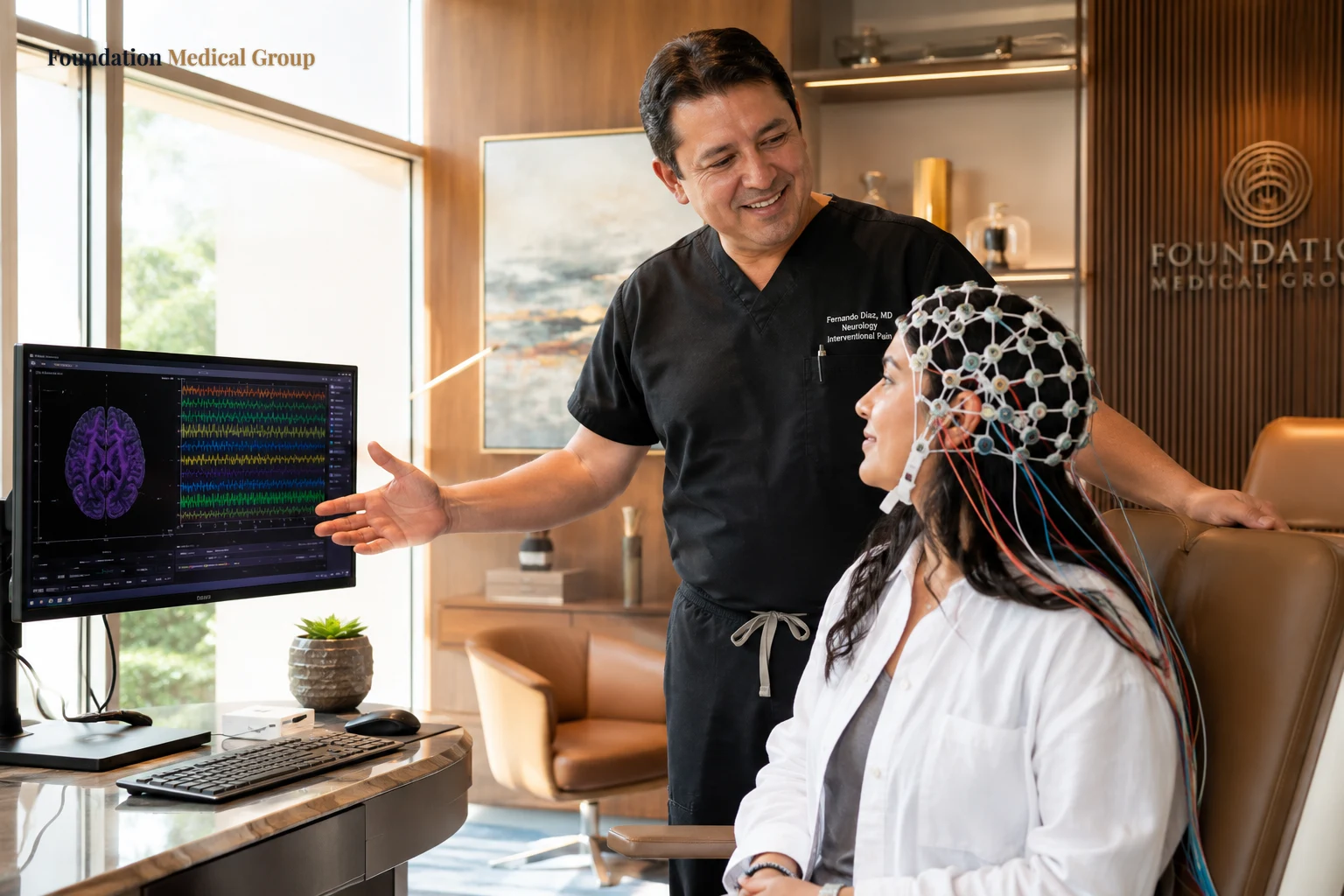
EEG brain mapping is a simple, painless test that records your brainwaves. Small sensors sit on your scalp and pick up the tiny electrical signals your brain makes. A computer turns those signals into a picture, or map, that shows how different parts of your brain are working. For people in Texas, it’s a tool that helps a doctor plan care with real data instead of guesswork.
If that sounds a little technical, don’t worry. Below we walk through what EEG brain mapping measures, how doctors use it in mental health and addiction recovery, and what a visit feels like. We’ll also be honest about what it can and can’t do. It’s a helpful tool, not a cure, and it works best as part of full, caring, doctor-led treatment.
What EEG Brain Mapping Actually Measures
Your brain runs on electricity. Cells send tiny signals back and forth all day, and an EEG listens in on those signals.
The test picks up brainwaves, and each type of wave tells a small story. Some show rest. Some show focus. Some show stress or a busy mind. When a doctor sees the whole pattern, it helps explain what you’re feeling.
Doctors have used EEG since 1924, when Hans Berger made the first human recording. The groundwork was older still: the English scientist Richard Caton described the brain’s electrical properties back in 1875, roughly 50 years earlier.
A standard adult setup follows the international 10-20 system and places at least 21 sensors across your scalp, counting the reference and ground. Before recording starts, the technician checks that each one reads under 5 kilohms of impedance, which is why clean, product-free hair matters. Modern clinical systems can pull from 128 channels or more, sampling above 10 kHz with 24-bit resolution. That’s a lot of data from a test that feels like nothing.
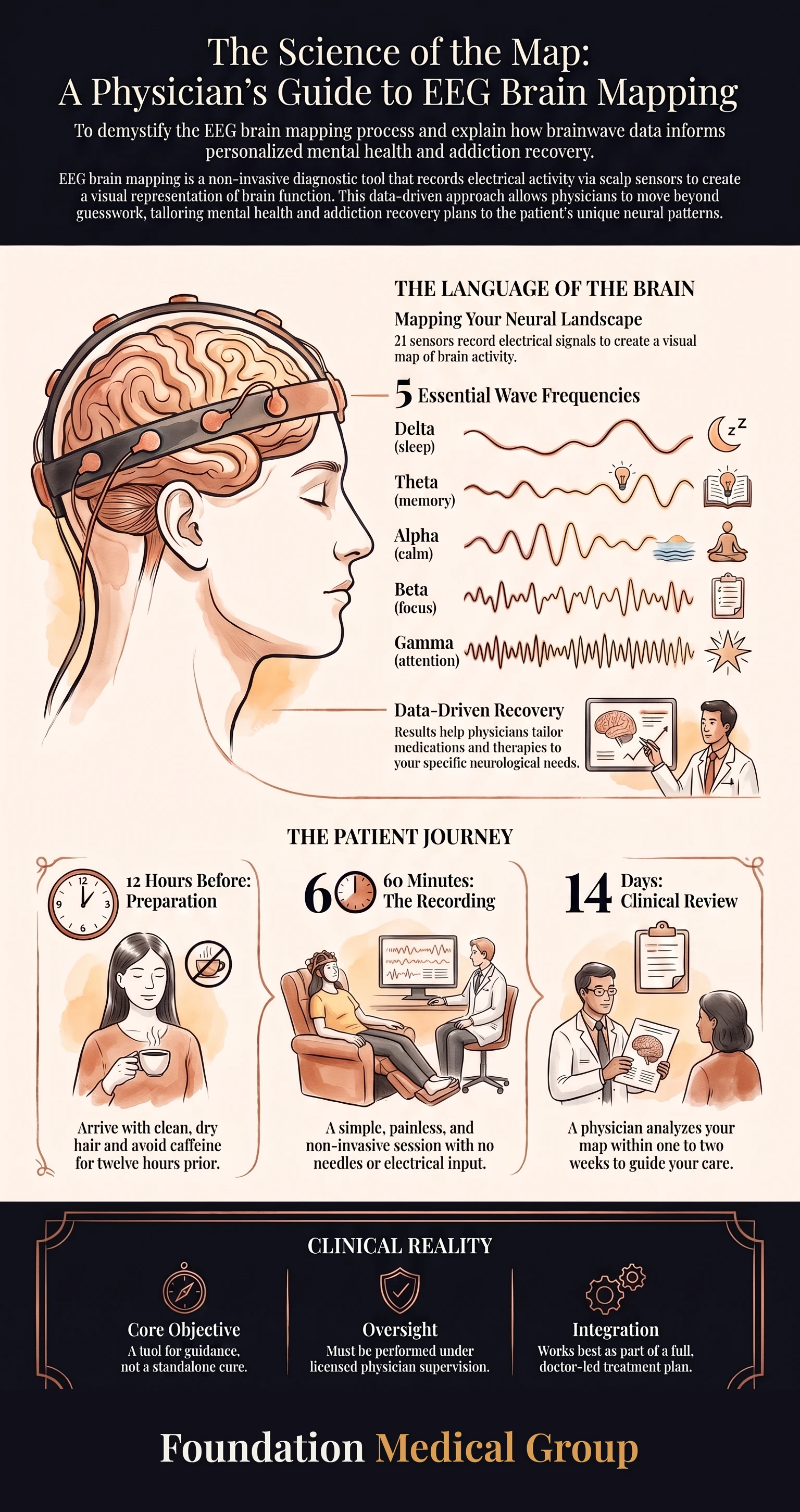
Here are the 5 main brainwaves an EEG records, with the frequency ranges clinicians actually use:
- Delta waves, below 4 Hz. These show up in deep sleep and rest.
- Theta waves, 4 to 7 Hz. Linked to daydreaming, memory, and light sleep.
- Alpha waves, 8 to 12 Hz. A sign of a calm, relaxed, awake brain.
- Beta waves, 13 to 30 Hz. Tied to active thinking and focus.
- Gamma waves, faster than that 30 Hz ceiling. Linked to sharp attention.
One detail that surprises people: a scalp EEG can’t hear a single neuron. It takes roughly 10 square centimetres of cortex firing in sync to produce a visible deflection on the recording. So the map shows crowds, not individuals.
You may also hear the word qEEG. That’s a fancier version, short for quantitative EEG. It uses software to compare your patterns to a large group of people around your age. We cover qEEG in depth on our qEEG brain mapping cost and insurance page.
How Doctors Use Brain Mapping in Mental Health
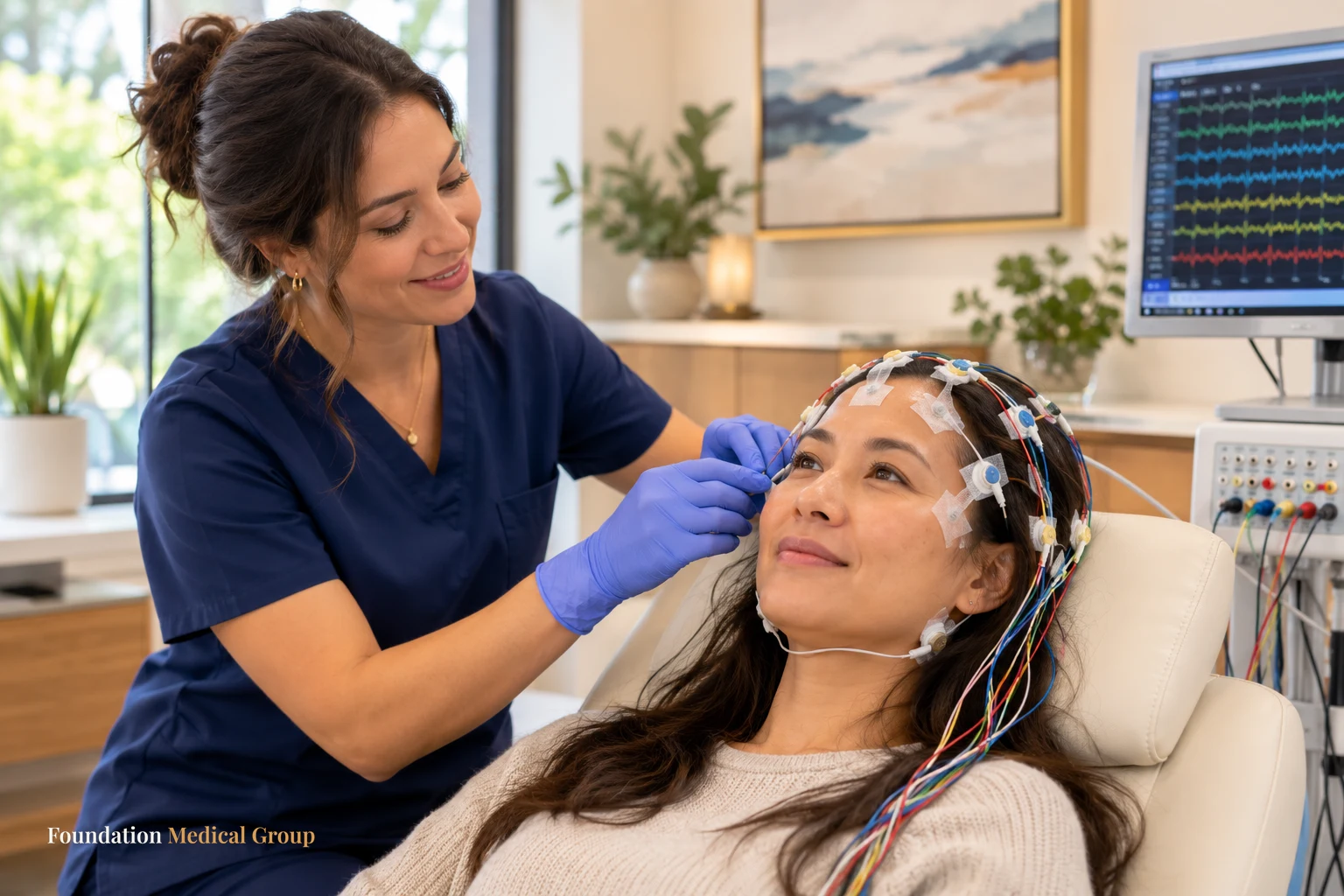
A brain map doesn’t diagnose you on its own. Think of it as one more clue that helps a doctor see the fuller picture.
Patients often ask for it when they’re dealing with worry, low mood, poor focus, or brain fog. The map can show which areas seem overactive or sluggish. Paired with your story and a real exam, that data helps guide next steps.
According to the Substance Abuse and Mental Health Services Administration (SAMHSA), care works best when it treats the whole person, not just one symptom. A brain map fits that idea. It gives your doctor objective information to shape a plan built around you.
There’s a good example of how narrowly that’s meant to work. FDA granted a de novo classification for the Neuropsychiatric EEG-Based Assessment Aid, or NEBA, under regulation 21 CFR 882.1440. It reads the theta/beta ratio at a single electrode, Cz, in patients aged 6 to 17, and it is cleared only to support a clinician’s ADHD evaluation. The FDA summary says plainly that the device is not to be used as a stand-alone. That’s the honest ceiling for every EEG-derived tool, including this one.
How EEG Brain Mapping Supports Addiction Recovery
Addiction changes the brain. It affects the parts that handle reward, stress, and self-control. That’s not a moral failing. It’s a medical condition, and it can be treated.
This is where a brain map can help. It shows how those regions are firing, so your care team can tailor your plan. Some patients use these results alongside medication for opioid use disorder, sometimes called MAT.
A lot of people in recovery also struggle with worry or low mood at the same time, and the two feed each other. Treating both together is standard practice for that reason, not an upsell. A brain map can support that combined care. Our guide on Suboxone and co-occurring depression and anxiety explains this link in plain terms.
What to Expect During Your Appointment
Good news: there are no needles and no pain. You stay awake the whole time, and you go home right after.
Most clinics ask you to skip caffeine for about 12 hours before the test and show up with clean, dry hair. Skip conditioner and styling product that day too, since anything on the scalp pushes electrode impedance above that 5 kilohm target and muddies the recording. The recording itself often takes 30 to 60 minutes, and a doctor usually reviews your map within 1 to 2 weeks.
Here’s how a typical visit flows:
| Step | What happens | About how long |
|---|---|---|
| Prep | A technician places small sensors on your scalp | A short setup |
| Recording | You rest quietly while the EEG records your waves | The main part of the visit |
| Simple tasks | You may open and close your eyes or focus briefly | A few short minutes |
| Review | A doctor reads your map and explains it clearly | A follow-up talk |
You feel nothing during the recording. The sensors only listen. They don’t send any current into your head, so there’s nothing to fear.
How Accurate Is EEG Brain Mapping?
Let’s be honest here, because you deserve the full truth. EEG brain mapping is helpful, but it isn’t magic.
The test is safe and well studied. It uses no radiation, and doctors have relied on EEG for roughly 100 years. But a brain map is only as good as the person reading it. The technical standards behind a good recording are real, too. The American Clinical Neurophysiology Society publishes minimum technical requirements for clinical EEG, covering electrode count, impedance and calibration. Skilled interpretation matters just as much.
A map also can’t diagnose a condition by itself. It adds objective data to your story, your history, and a real medical exam. Used that way, it makes care sharper. Used alone, it can mislead. Which is why a good clinic pairs it with careful, physician-led review as a matter of course.
Where to Get EEG Brain Mapping in Texas
Across Texas, EEG brain mapping is offered in licensed medical settings under a doctor’s supervision. That oversight matters, because it keeps the test safe and the results meaningful.
At Foundation Medical Group, care is led by a physician and built for the long run. Brain mapping is one tool we use to make your plan more personal, not a stand-in for real, human support. To see how it all fits together, visit our brain mapping Texas hub.
The goal is simple. We want care that treats you with respect, meets you where you are, and helps you move forward one steady step at a time.
Infographic: How EEG Brain Mapping Works, Step by Step
Frequently Asked Questions
What is EEG brain mapping used for?
It’s used to measure brain activity and spot patterns tied to mood, focus, and addiction recovery. Doctors pair the map with your story and exam to plan care that fits you. On its own, it doesn’t diagnose anything.
Does EEG brain mapping hurt?
No, it doesn’t hurt at all. Small sensors rest on your scalp and simply listen to your brainwaves. There are no needles, no current, and no pain, and you go home right away.
Can brain mapping help with addiction recovery in Texas?
Yes, it can support your care. A map shows how substance use affects certain brain regions, which helps your team tailor medication and therapy. It works best beside caring, doctor-led treatment, not by itself.
What’s the difference between EEG and qEEG brain mapping?
EEG records your live brainwaves. qEEG takes that data and compares it to a large group of people your age using software. Both are noninvasive, and your doctor uses them together to add helpful detail.
Is EEG brain mapping a cure for mental health or addiction?
No, it isn’t a cure. It’s a tool that gives your doctor better information. Real recovery comes from a full plan that includes medical care, support, and time, with the map helping guide the way.
Key Takeaways and Next Steps
Here’s what to hold on to. EEG brain mapping is a safe, painless test that records your brainwaves and turns them into a map. In Texas, doctors use it to add real data to mental health and addiction care. It’s a supportive tool, not a cure, and it works best inside full, caring treatment.
- The test is quick and painless, with no needles and nothing sent into your brain.
- A map guides care. It doesn’t replace your story, your exam, or a caring doctor.
- For addiction recovery, it can help tailor medication and therapy to your needs.
- Get it done in a licensed setting under real physician oversight.
Ready to learn more? Reach out to Foundation Medical Group and ask if brain mapping could help your plan. One kind conversation is often the first step toward care that truly fits you.