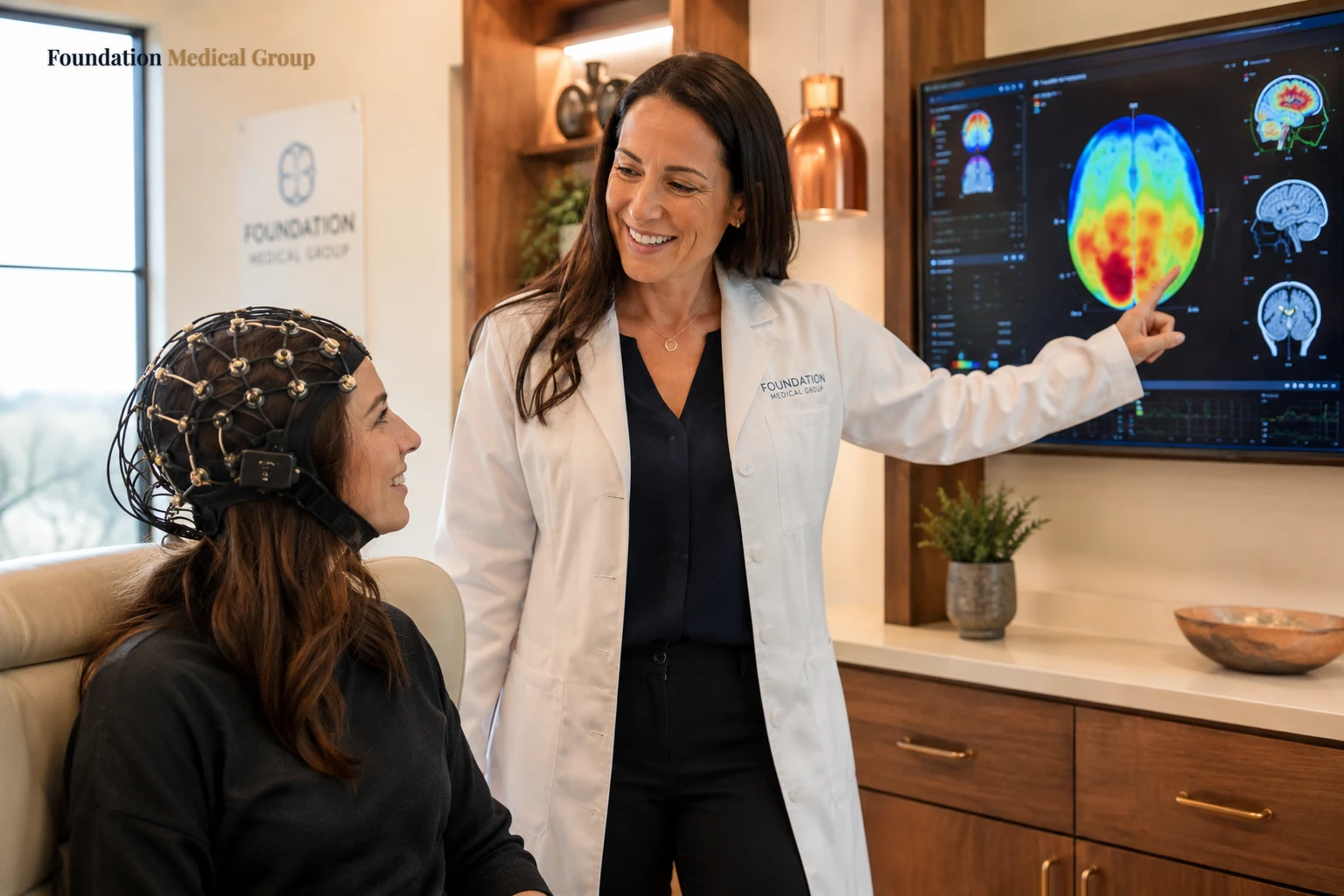
If you’re curious about EEG brain mapping in Virginia, here’s the short answer. EEG brain mapping is a safe, painless test that records your brain’s electrical activity through small sensors on the scalp. It shows how your brain is working, not just how it looks. Doctors use those patterns to guide mental health care and addiction recovery.
The idea can sound high-tech and a little scary. It isn’t. Nothing goes into your brain, and there are no needles. Below, we explain what EEG measures, how doctors in Virginia use it, and what to expect on the day. We’ll also be honest about what it can and can’t do.
What EEG Brain Mapping Measures
Your brain cells talk to each other using tiny electrical signals. An EEG picks up those signals from the surface of your scalp. Think of it as listening in, gently, from the outside.
The test tracks brain waves that rise and fall as you rest, focus, or relax. These waves come in different speeds. Some are linked to calm, others to alert focus or deep sleep.
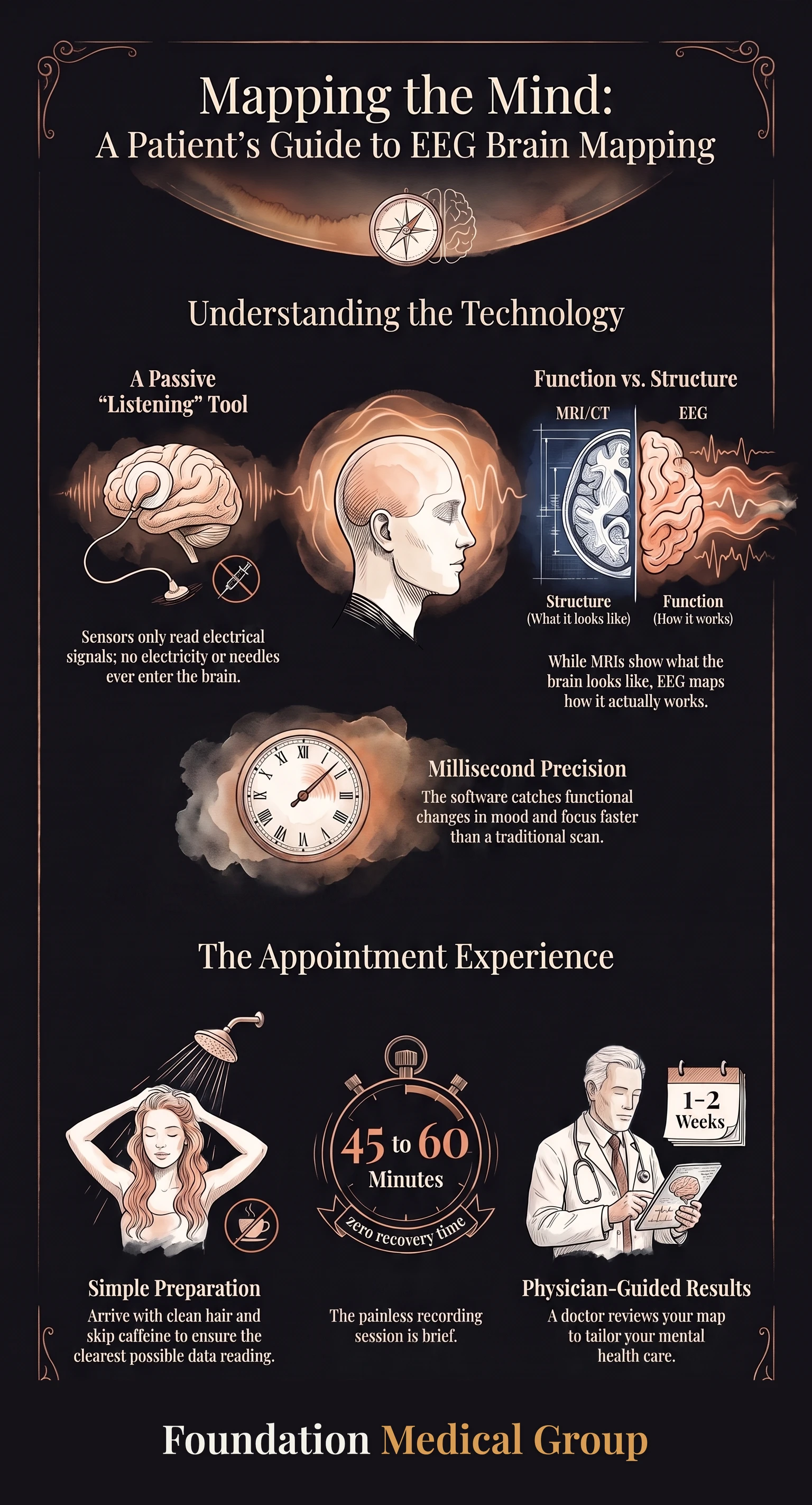
- The sensors only listen. They read signals rather than sending any electricity into your brain.
- It’s fast. EEG catches changes in brain activity within milliseconds, while an MRI resolves activity over seconds.
- It shows function. You learn how your brain is regulating mood, focus, and attention.
- It creates a map. Software turns the raw signals into a picture of activity across regions.
A clinical recording uses at least 21 sensors on an adult scalp, including a reference and a ground, positioned by the international 10-20 system. The signal then gets sorted into bands: delta below 4 Hz, theta at 4 to 7 Hz, alpha at 8 to 12 Hz, and beta at 13 to 30 Hz. Alpha tends to rise when you close your eyes and settle. Beta climbs when you concentrate. Reading which band sits where, and how much of it there is, is the whole job.
None of this is new technology, by the way. Richard Caton found electrical activity in animal brains in 1875, and Hans Berger recorded the first human EEG roughly 50 years later. According to the National Institute on Drug Abuse (NIDA), addiction changes how the brain handles reward and self-control, and tools that reveal brain function help doctors see those changes.
EEG Compared With qEEG and Brain Scans

People often mix up EEG with an MRI or CT scan. They do very different jobs. One reads activity, the others show shape and structure.
qEEG is simply a deeper reading of the same EEG signals. It compares your results against a large database to spot patterns that stand out. We cover that method in detail on our qEEG brain mapping cost and insurance page.
| Test | Reads brain activity | Shows structure | Common use |
|---|---|---|---|
| EEG | Yes | No | Brain waves, seizures, function |
| qEEG | Yes, with a database | No | Mental health, neurofeedback plans |
| MRI | No | Yes | Tumors, stroke, injury |
| CT | No | Yes | Bleeding, fractures |
So when symptoms come from how the brain regulates itself, EEG often fits better. When a doctor needs to see a physical problem, a scan is the right call.
How Virginia Doctors Use It for Mental Health
Plenty of Virginians ask about EEG after other treatments haven’t helped enough. It’s common with anxiety, depression, ADHD, PTSD, and sleep trouble. Those pairings are not unusual: per the 2023 National Survey on Drug Use and Health, 35 percent of US adults with a mental disorder also have a substance use disorder.
The goal is personal care. When a doctor can see how your brain manages focus and mood, they can adjust your plan with more confidence. That might mean a change in therapy, a different medication, or a neurofeedback plan.
EEG also helps track progress. A second test months later can show whether things are shifting in the right direction. According to the Substance Abuse and Mental Health Services Administration (SAMHSA), care works best when it fits the whole person, rather than a one-size approach.
It’s worth setting expectations on the neurofeedback that often follows a map, because the trial evidence is mixed rather than glowing. A 2014 meta-analysis in Frontiers in Human Neuroscience pooled 5 randomized trials covering 263 children, 146 of them trained with EEG neurofeedback. Parents scored total ADHD symptoms 0.49 better on a standardized mean difference, and inattention 0.46 better. Teachers, blinded to who trained, still found inattention 0.30 better, but their totals and their hyperactivity scores did not reach significance. Useful for attention. Thinner elsewhere. Which is a more honest pitch than most clinics give you.
How It Supports Addiction Recovery
Addiction is a brain condition, not a lack of willpower. It changes reward pathways and makes impulse control harder. EEG brain mapping gives doctors objective data about that dysregulation.
For someone in recovery, that data can support medication-assisted treatment. It helps a physician see how the brain is settling as treatment continues. The test doesn’t replace medicine or counseling. It works alongside them.
The medicine is the part with the hard numbers behind it. A 2017 meta-analysis in The BMJ pooled 3 buprenorphine cohorts covering 15,831 people and found all-cause mortality of 4.3 deaths per 1,000 person-years during treatment, compared with 9.5 after people left. Virginia has leaned into that. The state’s Addiction and Recovery Treatment Services benefit, ARTS, launched in April 2017. In its first 15 months the number of Medicaid members treated for opioid addiction rose 80 percent, from about 9,000 to nearly 16,400. Opioid prescriptions for members fell 28 percent over the same stretch.
This matters when depression or anxiety rides along with a substance use disorder, which happens often. Our guide on Suboxone and co-occurring depression and anxiety explains how those conditions get treated together. EEG can add one more clear signal to that plan.
What to Expect at Your Appointment
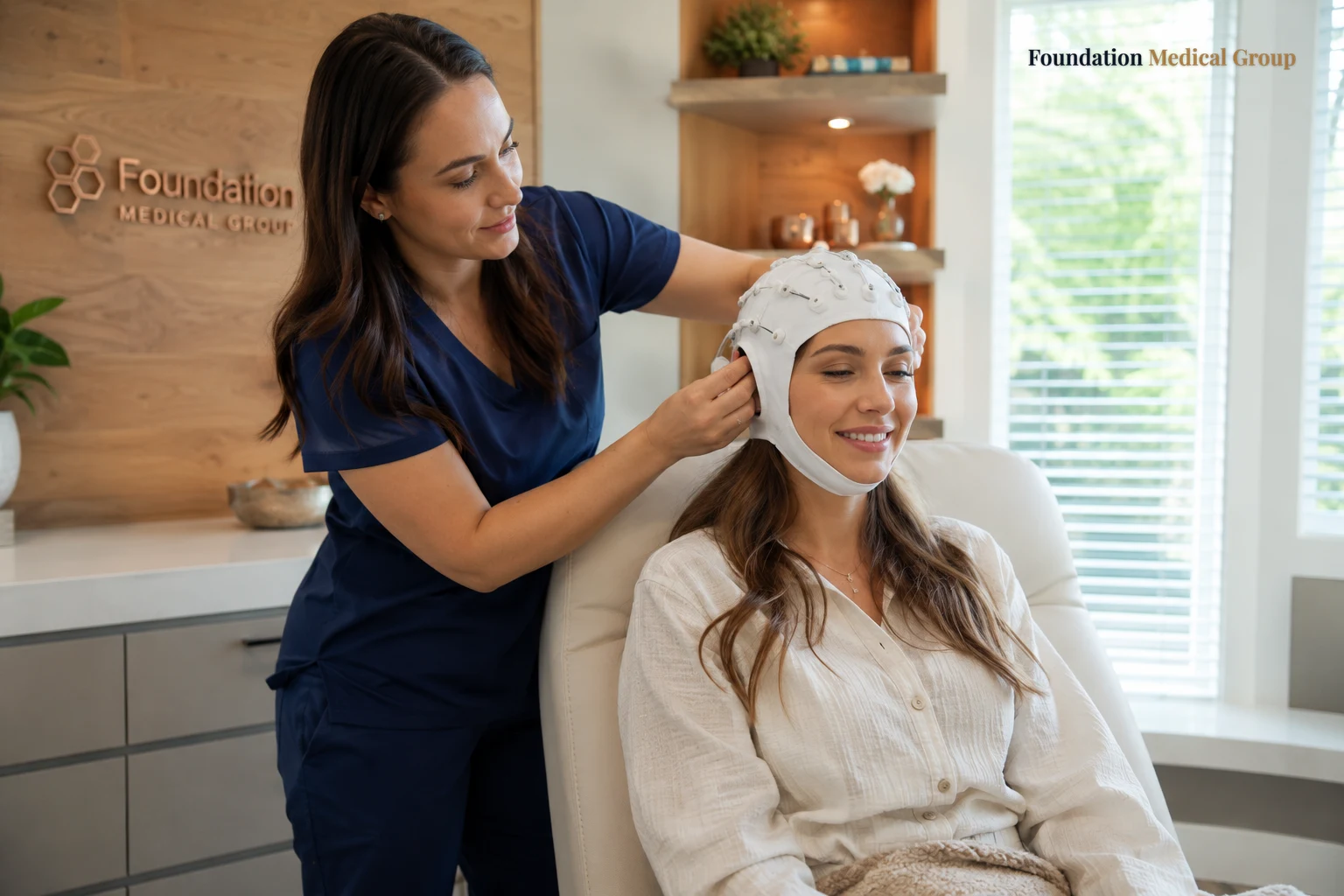
The visit is simple and calm. Most people are surprised by how easy it feels.
- Before. Wash your hair and skip caffeine that morning. That gives a cleaner reading, since caffeine shifts alpha and beta activity.
- During. A technician places soft sensors on your scalp. You sit quietly, usually with eyes closed for part of it and open for the rest, and sometimes do a small task.
- How long. Setup runs 15 to 20 minutes, and the recording itself usually takes about 45 to 60 minutes.
- After. There’s no recovery period. You drive home and carry on with your day.
A physician reviews the results later. At most Virginia clinics, that review takes about one to two weeks. Then they walk you through the map and your next steps.
What EEG Can and Can’t Do
Here’s the honest part, because you deserve it. EEG brain mapping is a helpful tool, not a crystal ball. It doesn’t diagnose a condition by itself, and it isn’t a cure.
Reading these maps takes skill, and results can vary between clinics, partly because normative databases differ in size and in who they sampled. That’s why a physician pairs the map with your history and your symptoms rather than reading it cold. The test adds information. Your doctor adds the judgment.
Used this way, EEG earns its place. It’s one clear, useful piece of a bigger picture, guiding care that’s built around you.
Infographic: How EEG Brain Mapping Works in Virginia
Frequently Asked Questions
What conditions can EEG brain mapping help with in Virginia?
Doctors use EEG brain mapping to support care for anxiety, depression, ADHD, PTSD, sleep problems, and addiction-related dysregulation. It doesn’t diagnose these on its own. It gives your physician extra data to plan more personal care.
Is EEG brain mapping safe and painful?
It’s very safe and not painful at all. The sensors only read signals from your scalp. Nothing enters your brain, and there are no needles or injections involved.
How is EEG different from qEEG brain mapping?
EEG records your raw brain wave activity. qEEG takes that same data and compares it against a large database to highlight unusual patterns. Both read function, and your doctor decides which one fits your case.
Can EEG brain mapping support Suboxone or addiction treatment?
Yes, it can support that care. The map gives your physician objective data about brain regulation, which helps guide medication-assisted treatment and neurofeedback. It works alongside medicine and counseling, never as a replacement.
How long does an EEG brain mapping session take?
The recording usually runs about 45 to 60 minutes. There’s no recovery time afterward. A physician reviews your results later, often within one to two weeks, and then explains them to you.
Key Takeaways and Next Steps
Let’s pull it together. EEG brain mapping in Virginia is a safe, painless way to see how your brain is working. It reads electrical activity, turns it into a map, and helps your doctor plan care for mental health and addiction recovery. It’s a supportive tool, not a cure, and it works best in a physician’s hands.
- EEG reads brain function, while an MRI or CT shows structure instead.
- The session is quick, around 45 to 60 minutes of recording, with no recovery period.
- Results guide therapy, medication, and neurofeedback, though a physician interprets them.
- EEG adds clear data to addiction care, especially when depression or anxiety comes along too.
Want to know if EEG brain mapping is right for you? Start with our brain mapping in Virginia hub, then talk with a physician at Foundation Medical Group. One conversation can turn a puzzling symptom into a plan you understand.
Sources
- StatPearls, Electroencephalogram.
- Micoulaud-Franchi and colleagues, EEG neurofeedback treatments in children with ADHD, Frontiers in Human Neuroscience (2014).
- National Institute on Drug Abuse (NIDA), Comorbidity.
- Sordo and colleagues, Mortality risk during and after opioid substitution treatment, The BMJ (2017).
- Virginia Department of Medical Assistance Services, Addiction and Recovery Treatment Services.
- Virginia Medicaid, Increasing access to opioid addiction treatment (March 2019).