
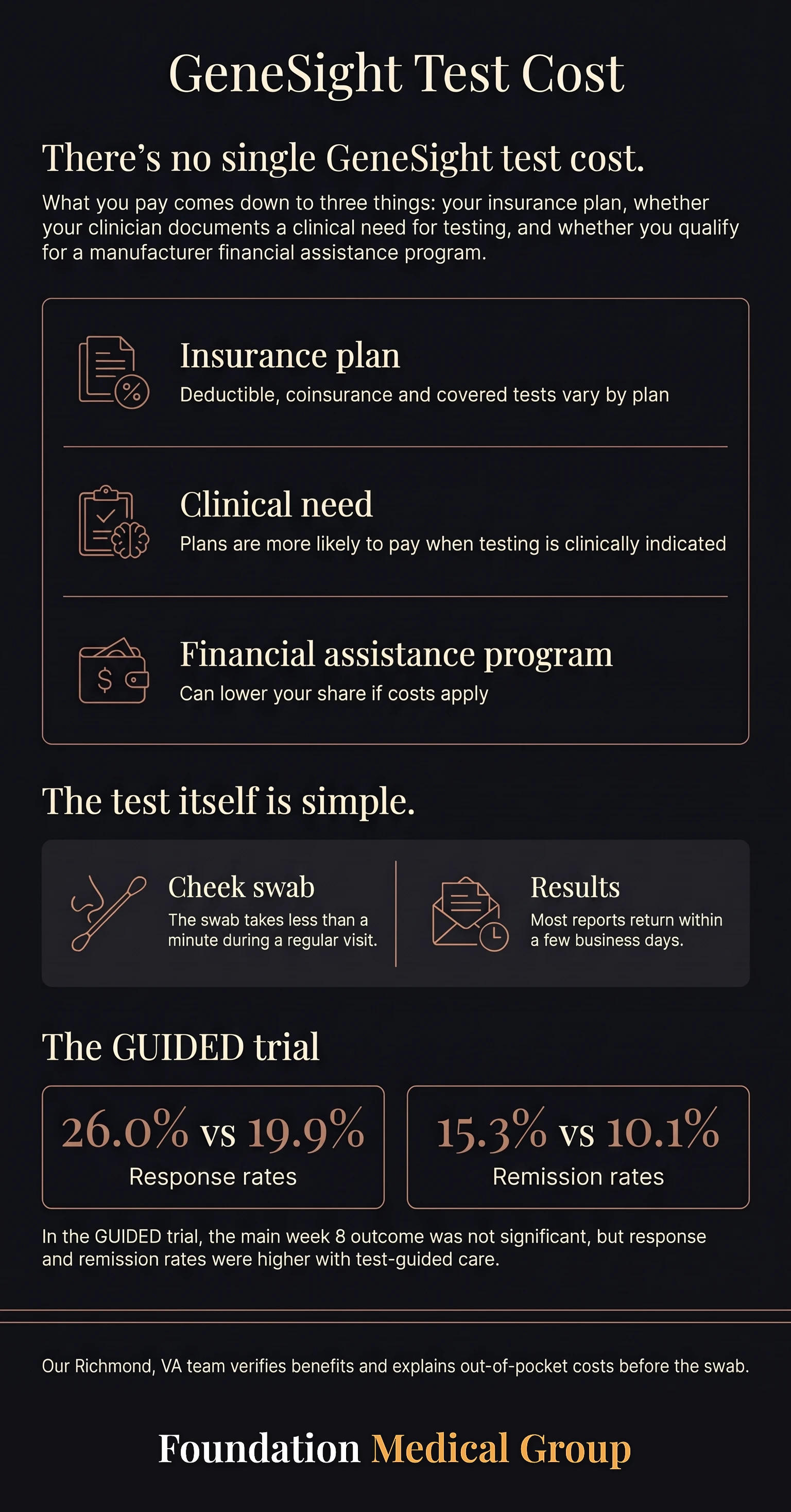
There’s no single GeneSight test cost. What you pay comes down to three things: your insurance plan, whether your clinician documents a clinical need for testing, and whether you qualify for a manufacturer financial assistance program. Foundation Medical Group doesn’t publish a GeneSight price. Instead, our Richmond, VA team checks your benefits and explains any out-of-pocket cost before the cheek swab.
That’s the short version. Below, we cover what the test is, what moves the price up or down, and what the research says it can and can’t do. No one wants a surprise bill for a lab test, so that part comes first.
How Much Does a GeneSight Test Cost?
It varies from patient to patient. Two people can take the exact same test and pay different amounts, because the cost follows the coverage each person has, not one fixed price. Which is frustrating if you just want a number. Honestly, we get it.
These are the three main factors:
- Your insurance plan. Each plan sets its own rules for genetic testing, including deductibles, coinsurance and whether prior authorization is needed.
- Clinical need. Plans are more likely to pay when testing is clinically indicated, for example after several medications haven’t helped.
- Financial help. If costs apply, there may be a manufacturer financial assistance program you can apply for (worth asking about, since people tend to skip it).
Because these details differ so much, we check them for you. Our GeneSight testing in Richmond, VA page lays out how it works. Our team verifies benefits, secures authorizations and communicates any out-of-pocket responsibilities before we proceed. If costs apply, we review manufacturer financial assistance programs and other options with you. So you know your share before you decide whether to go ahead.
What Is GeneSight Testing?
GeneSight testing is a type of pharmacogenomic test. MedlinePlus defines pharmacogenomics as the study of how genes affect a person’s response to drugs. Plenty of medicines are made as “one size fits all.” But they don’t work the same way for everyone. Some people break a drug down quickly, others slowly, and that can change both how well it works and how many side effects it causes.
The FDA keeps a public list of these gene and drug links. Take the antidepressant citalopram. For people who are CYP2C19 poor metabolizers, the FDA table notes higher drug levels, a QT prolongation risk and a maximum recommended dose of 20 mg. The same FDA page also stresses that a patient’s genetic makeup is only one of many factors that affect drug levels and response. That caveat matters more than people expect.
The test itself is simple. At our clinic it’s a cheek swab that takes less than a minute during a regular visit. No needles, no blood draw. The lab sends the report back to our team, and most reports return within a few business days. Now, GeneSight doesn’t diagnose depression or any other condition, and it doesn’t pick a single “perfect” medication. It adds genetic information to the medication decision. That’s all, really, though that can still be a lot.
Do Insurance Companies Cover GeneSight Testing?

Many do. On our service page we state that most plans cover GeneSight when testing is clinically indicated. Still, coverage depends on your plan. Commercial plans differ in what they require: a documented history of medications that didn’t work, a prior authorization, or a deductible that has to be met first. That’s why our team checks your coverage before testing instead of after.
Medicare has its own rules for this kind of test. A Medicare coverage policy from CMS says pharmacogenomic testing is reasonable and necessary in limited circumstances, once a treating clinician has narrowed treatment to specific medications under consideration. Put another way, a diagnosis alone isn’t enough. We mention this only as background, because our Richmond, VA clinic doesn’t accept Medicare. That includes Medicare Advantage and Medicare Part B, so a Medicare route isn’t available for GeneSight at our clinic.
At Richmond, common plans include the ones below. Each one is listed as call to confirm coverage:
- Aetna (call to confirm coverage).
- Anthem (call to confirm coverage).
- Cigna (call to confirm coverage).
- UnitedHealthcare (call to confirm coverage).
- TRICARE (call to confirm coverage).
- Virginia Medicaid (call to confirm coverage).
- Sentara Health Plans (call to confirm coverage).
Medicaid and commercial benefits can change, so call (800) 983-1974 before your visit and we’ll check your specific plan.
What Affects What You Pay for GeneSight?
This comparison table sums up the cost factors and how each one changes your out-of-pocket amount.
| Cost factor | What it means | How it changes what you pay | What our team does |
|---|---|---|---|
| Insurance plan | Your plan’s rules for genetic tests | Deductible, coinsurance and covered tests vary by plan | Verifies your benefits before testing |
| Clinical need | A documented reason to test, such as past medications that did not help | Plans are more likely to pay when testing is clinically indicated | Documents your medication history at the evaluation |
| Prior authorization | Some plans want approval first | Some plans want it before they will pay | Secures authorizations before the swab |
| Financial assistance program | Help from the test maker for people who qualify | Can lower your share if costs apply | Reviews programs with you |
| Office visits | The evaluation and the results visit | Separate from the lab test itself | Explains visit coverage when you book |
The part people miss is the visits. The test is one piece of a wider treatment plan, and you’ll also have a visit to order it and a follow-up visit to review results. Ask about coverage for both when you call, so you see the full picture.
Does a GeneSight Test Tell You Which Medication Will Work?
No test can promise that. The best known study is the GUIDED trial, which included 1,167 outpatients with depression. In GUIDED, symptom improvement at week 8 was 27.2% with test-guided care vs 24.4% with usual care, a difference that was not statistically significant. However, response rates were 26.0% vs 19.9%, and remission rates were 15.3% vs 10.1%, both in favor of test-guided care.
So what does that mean for you? The main measure didn’t clearly improve. The share of people who responded or reached remission was higher, though. Mixed result. We’d rather tell you that plainly than oversell it.
That fits a wider problem in depression treatment. The National Institute of Mental Health says it may take several tries to find the medication that works best with the fewest side effects, and that antidepressants usually take 4 to 8 weeks to work. With several tries, that can add up to months. And that’s the painful part for a lot of patients. NIMH also notes that researchers are still looking for ways to identify which depression treatment will work best for a specific person.
GeneSight can help your clinician avoid some medications that may cause problems for your genes, or adjust a dose. It can’t replace a careful history. If you’ve tried several medicines already, read our guide to treatment resistant depression. For anxiety, our anxiety medication guide covers the main options.
Who Might Consider GeneSight Testing?

GeneSight testing isn’t for everyone. On our service page we list the patients most likely to benefit:
- You’ve had limited benefit from two or more medications.
- Troublesome side effects or medication sensitivity.
- You have a complex medication history, or you’re worried about drug interactions.
- You want a data-guided, personalized approach to depression treatment.
Sound like you? Start with a psychiatric evaluation. Your clinician will decide whether testing is likely to change your treatment plan. If you go ahead, the results feed into ongoing medication management, where we adjust or start medications and watch for side effects over time.
Can I Order GeneSight Without a Doctor?
Not with us. At Foundation Medical Group, GeneSight is ordered by your treating clinician as part of your care, not as a standalone purchase. The value comes from someone reading it alongside your history, your other medications and your goals. A report on its own is just a report. That’s why we schedule a follow-up visit to go through the results with you and turn them into a clear medication plan.
How Do You Get GeneSight Testing in Richmond, VA?
GeneSight testing is offered only at our Richmond, Virginia clinic. Our Utah, Georgia and Texas clinics don’t offer it.
Here’s how it works, step by step:
- Evaluation. You meet with a psychiatric clinician, who reviews your history and decides whether testing makes sense.
- Benefits check. Our team verifies your insurance coverage and explains any out-of-pocket cost.
- Cheek swab. The swab takes less than a minute during a regular visit.
- Results. Most reports return within a few business days.
- Follow-up visit. Your clinician walks you through the report and what it means for your medications.
Call (800) 983-1974 or the Richmond office at (804) 506-0526 to book. Remember, our Richmond clinic doesn’t accept Medicare, and every plan is listed as call to confirm coverage. In most cases a quick call up front saves the guesswork. You’ll know what you’ll pay before you decide.
Key Takeaways
- There’s no single GeneSight test cost, and Foundation Medical Group doesn’t publish a price.
- Your insurance plan, a documented clinical need and any financial assistance program set what you pay.
- Our Richmond, VA team verifies benefits and explains out-of-pocket costs before the swab.
- In the GUIDED trial, the main week 8 outcome was not significant, but response and remission rates were higher with test-guided care.
- GeneSight is offered only at Richmond, VA, and that clinic doesn’t accept Medicare.
Sources
- MedlinePlus Genetics, What is pharmacogenomics?.
- FDA, Table of Pharmacogenetic Associations.
- CMS, LCD MolDX: Pharmacogenomics Testing (L38294).
- Journal of Psychiatric Research, Impact of pharmacogenomics on clinical outcomes in major depressive disorder in the GUIDED trial.
- National Institute of Mental Health, Depression.
- National Institute of Mental Health, Mental Health Medications.