
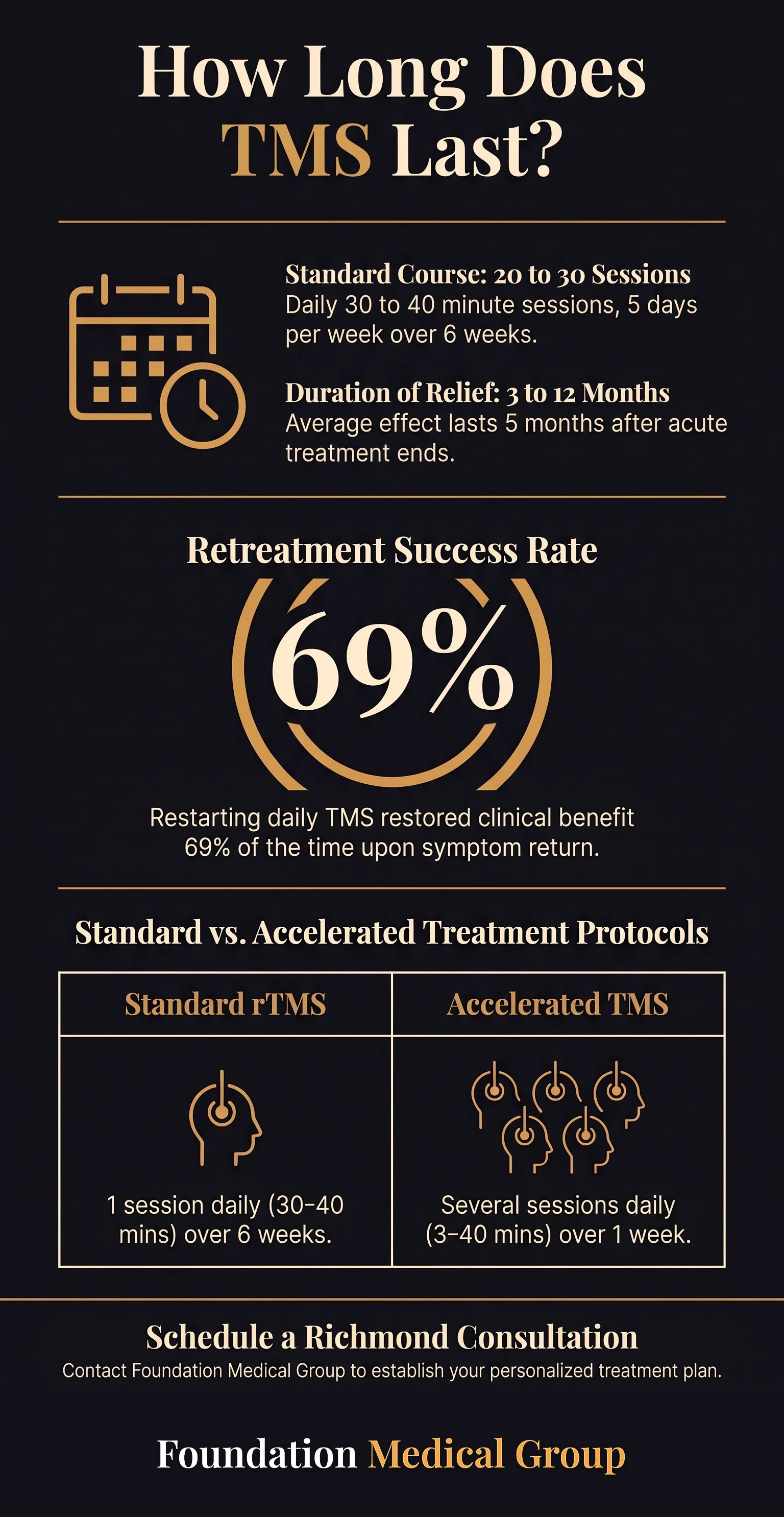
How long does TMS last? That depends on what you mean. One TMS therapy session usually lasts about 30 to 40 minutes in standard protocols. A full course of treatment is usually 20 to 30 daily sessions over about 6 weeks. In studies, relief after a course has lasted about 3 to 12 months, and maintenance sessions may help it last longer.
What Is TMS Therapy, and What Does “Last” Mean Here?
Repetitive transcranial magnetic stimulation (rTMS), also called repetitive TMS, is a noninvasive treatment for depression. According to the National Institute of Mental Health (NIMH), an electromagnetic coil is held against the head, near brain areas tied to mood. The magnetic coil sends magnetic pulses to those areas. NIMH notes that the FDA cleared the first transcranial magnetic stimulation device for depression in 2008.
When people ask “how long does TMS therapy last?”, they usually mean one of three things:
- How long one session takes
- How long the full course takes
- How long the results last
Let’s take them one at a time. If you want the full story of how this TMS depression treatment works, read our guide to TMS for depression.
How Long Does a TMS Session Last?

In large research trials, each TMS session lasted about 30 to 40 minutes, according to a 2018 consensus paper on transcranial magnetic stimulation for depression. NIMH gives a wider range, from about 3 to 40 minutes, because some newer protocols are much shorter. The exact time depends on the protocol your prescriber chooses for each patient. So don’t be surprised if your sessions differ from what you’ve read online.
During a session, the patient sits in a chair, awake. The coil rests against your head and sends magnetic pulses in short bursts.
Curious what TMS treatment sessions feel like? See our page on TMS therapy side effects.
How Long Does a Full Course of TMS Treatment Take?
The consensus paper describes the standard initial treatment course as 20 to 30 sessions. You go once a day, 5 days a week, over about 6 weeks. NIMH describes a similar course of 4 to 6 weeks.
Some people start to feel better within 2 to 3 weeks. Even so, the full course is usually needed to match the results seen in research. At our Richmond clinic, we check each patient’s progress with validated depression scales along the way.
What if you don’t respond after 20 to 30 TMS treatments? That’s a frustrating spot to be in. But the same paper reports that some patients who hadn’t responded did respond when daily treatment continued. Whether to add additional sessions is a decision your prescriber makes as part of your treatment plan.
TMS therapy duration matters for daily life. Daily visits for several weeks take time, so plan around work, school and travel before you start TMS treatment. That’s a real commitment, honestly.
How Long Do TMS Results Last After Treatment Ends?

How long does TMS therapy last once the course ends? The short answer: TMS results can last for months.
The 2018 consensus paper reports that the benefits of an acute course of transcranial magnetic stimulation have lasted up to 3 months and up to 12 months in research. A systematic review of TMS maintenance protocols adds more detail. It estimates that in people who responded, the effect lasts about 5 months. Around that point, the relapse rate rises to about 20 percent.
These numbers are research averages, not promises. Your TMS therapy results may last longer or shorter. Remission, when symptoms ease to a very low level, is the goal of treatment. But no one can promise how long remission will last, and studies on TMS durability vary.
Foundation Medical Group does not publish its own remission or durability rates, so we don’t give any here. Your prescriber can explain the TMS benefits and limits that apply to you, and how to aim for lasting relief.
Is TMS Permanent, or Can Depression Relapse?
TMS isn’t a permanent cure. Depression can come back after a good response, or even after remission. That’s hard to hear, especially if TMS finally gave you some relief.
Still, there’s hopeful news about TMS retreatment. The consensus paper cites a study where daily TMS was restarted when symptoms returned. Restarting treatment restored clinical benefit in 69 percent of the times it was used. The paper also says there’s no single recommended way to prevent relapse.
Watch for early signs, and tell your prescriber about them quickly:
- Low mood coming back
- Changes in sleep
- Less energy or interest in things you enjoy
Don’t sit on these. Early contact gives you time to talk about additional treatment, whether that’s more TMS, medication, therapy or a mix. Never change a medicine on your own.
What Are Maintenance TMS and Booster Sessions?
Maintenance TMS therapy means planned sessions after the first course, to help prevent relapse. Some people call these booster sessions. The goal is to help your improvement hold after you start to feel better.
In the MAINT-R trial, adults who had responded to TMS then came back for one session a week. Over 24 weeks, 7 of 38 people (18.4 percent) relapsed. That was close to the lithium group, where 7 of 37 people (18.9 percent) relapsed. So in that trial, results with weekly rTMS were similar to lithium.
Schedules differ widely across studies, and there’s no one standard. One patient may benefit from maintenance TMS sessions, while another won’t need them at all. You and your prescriber decide together, and maintenance may sit alongside medication management.
Standard, Accelerated, and Maintenance TMS Protocols Compared
The three protocols differ in how often you go and why.
| Protocol | How often | Session length | Typical length of course | Main goal | Source |
|---|---|---|---|---|---|
| Standard daily rTMS | 1 session a day, 5 days a week | About 30 to 40 minutes in trials | 20 to 30 sessions over about 6 weeks | Treat the current episode | PMC consensus paper (2018) |
| Accelerated TMS | Several sessions in one day with short breaks | Varies by protocol (NIMH range 3 to 40 minutes) | Often works within about a week | Faster response | NIMH brain stimulation page |
| Maintenance rTMS (MAINT-R example) | Weekly | 15 minutes per session in that trial | 24 weekly sessions | Prevent relapse after response | MAINT-R trial (2025) |
NIMH says accelerated TMS protocols deliver several sessions a day and often work within a week. Your prescriber picks the protocol that fits you.
How Long Do TMS Results Last for OCD and Anxiety?
According to NIMH, rTMS is FDA-cleared for treatment-resistant depression, OCD, migraine, anxiety with depression, and smoking. In 2018, the FDA permitted marketing of a deep transcranial magnetic stimulation (deep TMS) system for OCD in patients who had not responded to traditional treatments.
For OCD and anxiety, research on how long results last is less clear, and we found no reliable number. If you’re thinking about deep TMS treatment for OCD or anxiety, ask a specialist what results to expect.
At Foundation Medical Group, our TMS therapy is focused on depression treatment.
TMS Therapy in Richmond, VA at Foundation Medical Group
Foundation Medical Group offers TMS therapy at our Richmond, Virginia clinic only: 11600 Busy Street, Suite 203, Richmond, VA 23236. Richmond is our full-team flagship clinic, with TMS, Spravato, psychiatry, MAT and brain mapping. TMS is not offered at our Utah, Georgia or Texas clinics.
Your course length, in sessions and weeks, is set at your consultation and becomes part of your treatment plan. See our TMS therapy in Richmond, VA page for details.
Common Virginia plans for TMS treatment include Aetna, Anthem, Cigna, UnitedHealthcare, TRICARE, Sentara Health Plans and Virginia Medicaid (Cardinal Care). For each one, call to confirm coverage. Medicare is not accepted at our Virginia clinic. Learn more in does insurance cover TMS? or visit our Virginia clinic page.
Key Takeaways
- One session lasts about 30 to 40 minutes in standard protocols.
- A full course is usually 20 to 30 sessions over about 6 weeks.
- In studies, TMS results lasted about 3 to 12 months, and symptoms can return.
- Maintenance sessions may help some people stay well. Your prescriber decides.
- At Foundation Medical Group, TMS is offered in Richmond, VA only.
FAQ
How long does TMS last for depression?
One session lasts about 30 to 40 minutes, and a full course is 20 to 30 sessions over about 6 weeks. In studies, benefits lasted about 3 to 12 months, and maintenance may help after remission.
Is TMS long lasting?
For many people who respond, TMS results last for months. One review puts the effect near 5 months, when the relapse rate rises to about 20 percent.
Is TMS permanent?
No. TMS is a treatment, not a cure. If symptoms return, ask your prescriber about retreatment. In one study, restarting daily sessions restored benefit 69 percent of the time.
How long does TMS last for anxiety?
rTMS is FDA-cleared for anxiety with depression, but we found no clear research figure for how long results last for anxiety. Ask a specialist what to expect.
Sources
- National Institute of Mental Health (NIH), Brain Stimulation Therapies.
- PubMed Central (NIH), Consensus Recommendations for the Clinical Application of rTMS in the Treatment of Depression.
- PubMed Central (NIH), Investigating the Role of Maintenance TMS Protocols for Major Depression: Systematic Review.
- PubMed Central (NIH), rTMS as Maintenance Treatment of Depression: The MAINT-R Randomized Clinical Trial.
- U.S. Food and Drug Administration, FDA permits marketing of transcranial magnetic stimulation for treatment of obsessive compulsive disorder.