
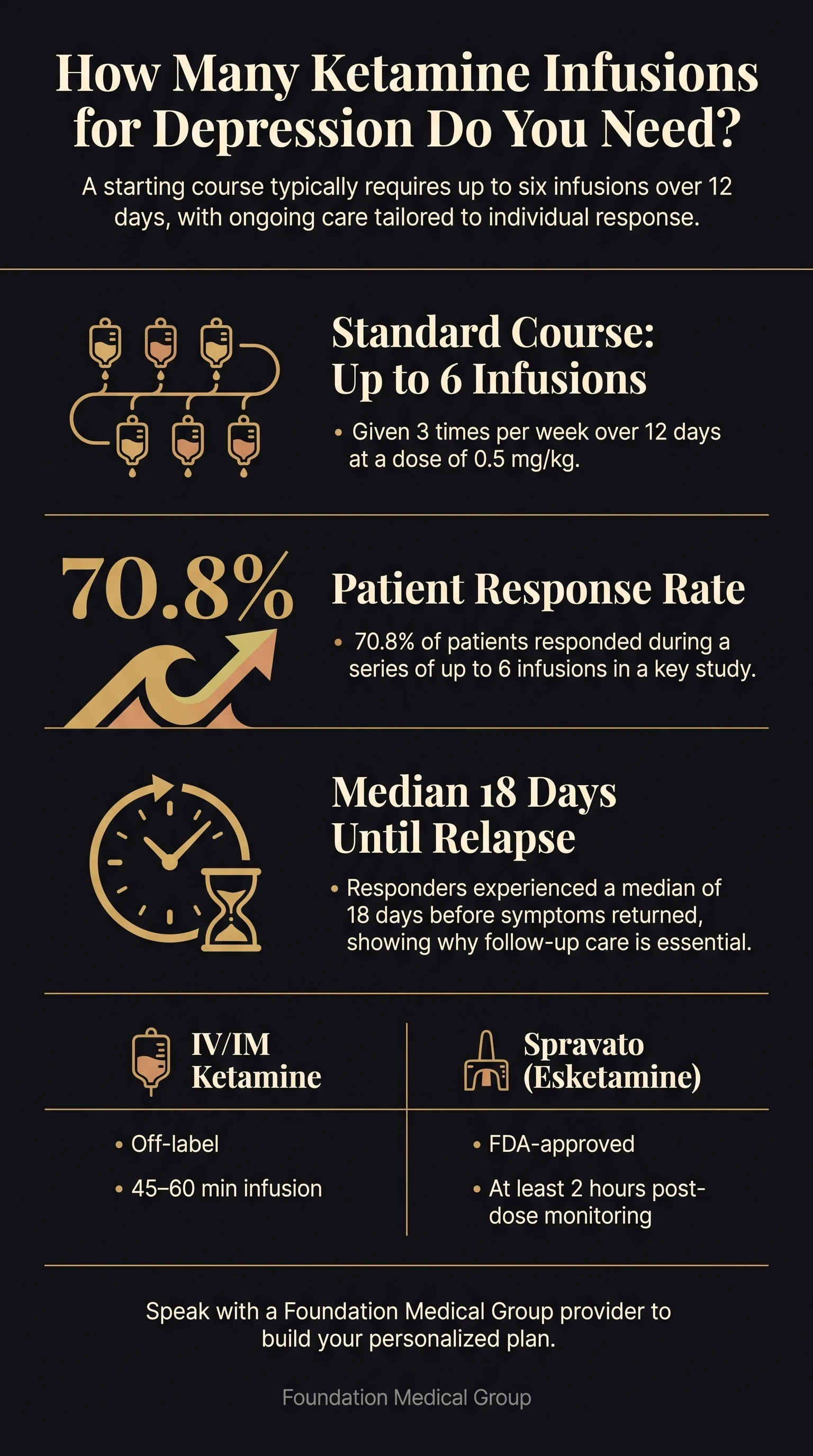
How many ketamine treatments for depression do you need? In research, a first course is usually up to six ketamine infusions, given three times a week over about 12 days. After that, the plan depends on how you respond, and some people need maintenance sessions later. So there’s no single number that fits everyone. That can feel frustrating when you just want a clear answer, but it’s the honest one.
What Is a Typical Course of Ketamine Infusions for Depression?
Think of a typical research course as a short series of IV infusions: up to six sessions, given about three times a week for two weeks. Each infusion uses a set dose based on your body weight.
In a study published in Biological Psychiatry, people with treatment resistant depression received up to six IV infusions of 0.5 mg/kg, three times a week over 12 days. A randomized trial in Translational Psychiatry used much the same pattern (six infusions on a Monday, Wednesday and Friday schedule, again over 12 days).
As for ketamine use for depression, the FDA has said ketamine isn’t FDA-approved for any psychiatric disorder, so this kind of depression treatment is off-label. In practice, it’s mostly used when other mental health treatments haven’t helped enough.
At Foundation Medical Group (FMG), ketamine therapy is given as an IV ketamine infusion or an intramuscular (IM) injection for treatment-resistant depression, at the Richmond, VA clinic.
How Many Ketamine Treatments for Depression Do Most People Need?
Here’s the honest answer: it depends on you. Research gives a starting point. Not a promise.
In the Biological Psychiatry study, 70.8% of people responded during a series of up to six infusions. That’s encouraging news if you’re living with severe depression that hasn’t lifted with other care.
But more ketamine treatments aren’t always better. In the randomized trial mentioned above, response after six infusions was not significantly different from response after a single infusion. A bit surprising, honestly. Still, that’s one study, and it doesn’t mean one infusion is right for you. It does mean the number of treatment sessions should be based on how you respond, rather than on a fixed package.
Your depression symptoms, your history and how you feel after each visit all guide the plan. At FMG, your provider sets the number of ketamine sessions with you and reviews it as you go. Nobody can promise a fixed number of sessions for every patient. Be wary of any plan that does.
How Does Ketamine Treatment for Depression Work?
Ketamine therapy works on a different timeline from most depression medicines. According to the National Institute of Mental Health (NIMH), ketamine can lift depression in many patients within hours. Those fast antidepressant effects are a big part of why researchers study it so closely.
It’s a very different pace from the slower pattern a lot of people know from traditional antidepressants, where the waiting is often the hardest part. Our guide on how long antidepressants take to work explains that pattern.
Dosing matters too. NIMH reports that the standard 0.5 mg/kg dose was effective, while low doses below that weren’t. That’s one reason your provider sets your dose carefully.
You may also see the term racemic ketamine. It’s just standard ketamine (the kind given by IV or IM injection), as opposed to esketamine, the nasal spray sold as Spravato. They’re easy to mix up. But the two have different rules, schedules and approvals.
What Is Each Ketamine Infusion Session Like?

At FMG, each ketamine therapy infusion takes about 45 to 60 minutes. Your session happens in a calm, monitored clinical setting, with dedicated recovery time after each dose.
There are two ways the medicine can be given. Intravenous ketamine goes in through a small line in your arm. Intramuscular ketamine is an injection into a muscle. A scoping review on ketamine for depression found that IV is the most common route, while IM is an emerging option. Your provider will explain which route fits your plan.
During IV ketamine therapy, or IM treatment, your care team stays close and watches how you’re doing. They check for adverse effects and help you feel settled as the medicine wears off. If you feel nervous before the first one, that’s understandable, and it’s fine to say so.
At your first visit, our team explains the day-of rules for ketamine infusion therapy, including what to do before and after your visit. Ask any question you have. Nothing is too small to ask.
What Should You Expect After Ketamine Treatment for Depression?
How can you tell it’s working? Signs often include fewer symptoms: your mood lifting, your energy coming back, and interest returning in things you used to enjoy. Your provider tracks these symptoms with you across your sessions.
Symptom relief can come fast. NIMH notes that ketamine can lift depression within hours. But relief can also fade, and that’s the hard part people don’t always hear about up front. In the Biological Psychiatry study, people who responded had a median of 18 days before their depressive symptoms came back. That’s why your plan is reviewed after the first series.
You may read about integration therapy or ketamine assisted psychotherapy. These are general terms from research and other settings. They aren’t packaged services at FMG.
What FMG does offer is talk therapy, such as cognitive behavioral therapy (CBT). At FMG, a therapy session is 50 minutes. Therapy is available in person at the Richmond, VA clinic and by secure video in Virginia, Utah, Georgia and Texas. Learn more on our talk therapy page. And ask your provider whether therapy alongside ketamine makes sense for your mental health goals.
Do You Need Maintenance Ketamine Sessions After the First Series?

You might. Unfortunately, relapse after a course of ketamine therapy is common in research. As we saw earlier, people who responded in one study had a median of 18 days before relapse. So many plans include a check-in after the first series and, for some people, maintenance treatment.
There’s no single agreed maintenance schedule in the research we cite. Some people may need more sessions, some fewer, and some may move on to other care. At FMG, your provider decides the spacing of any further ketamine therapy sessions based on how you responded and whether symptoms return.
Ketamine can bring fast relief, but in the research we cite, that relief often doesn’t last on its own. Treat the first series as a starting point, not the finish line. Your provider will help you build a plan for what comes next, which may include ketamine, medicine, therapy or a mix of these.
Ketamine Infusions vs Spravato: Sessions and Schedule Compared
Ketamine infusions and Spravato aren’t the same treatment. Here’s how ketamine therapy by IV or IM injection compares with Spravato, the esketamine nasal spray.
| IV/IM ketamine | Spravato (esketamine) | |
|---|---|---|
| How it is given | IV infusion or IM injection | Nasal spray |
| FDA status | Not FDA-approved for depression (off-label) | FDA-approved for treatment-resistant depression in adults, alone or with an oral antidepressant |
| First course (from sources) | Up to six infusions over 12 days in research | Set by the label; see FMG Spravato pages |
| Time per visit | About 45 to 60 minute infusion at FMG, then recovery time | At least 2 hours of monitoring after each dose |
| Insurance picture | Limited; at FMG, self-pay, and some plans cover a portion | Better coverage than off-label IV use |
| Where at FMG | Richmond, VA clinic only | Richmond, VA clinic only |
You may also read about oral ketamine or sublingual ketamine, which is placed under the tongue. FMG doesn’t offer these forms.
Spravato has its own treatment schedule, set by its label. Our page on Spravato in Richmond explains how it works and what each visit involves.
Is Ketamine Treatment for Depression FDA Approved?
No. The FDA has stated that ketamine is not FDA-approved for any psychiatric disorder. That includes major depressive disorder, anxiety and PTSD. So when a clinic uses ketamine treatment for depression, it’s using the medicine off-label.
Esketamine is different. According to its FDA prescribing information, Spravato is approved for treatment resistant depression in adults, used alone or with an oral antidepressant. After each dose, patients are monitored for at least 2 hours.
That’s why the two aren’t interchangeable. They’re related medicines, but they have different approvals, different routes and different rules. Your provider can explain which one fits your situation.
Is Ketamine Treatment for Depression Covered by Insurance?
Coverage for ketamine therapy is limited, which is hard to hear when you’re already struggling. A scoping review on ketamine in mental health care found that limited insurance coverage is a real financial barrier. It also found that FDA-approved esketamine tends to have better coverage than off-label IV ketamine.
At FMG, ketamine is self-pay, and some plans cover a portion. Call to confirm coverage with your plan before you start. In Virginia, FMG does not accept Medicare.
If insurance is a big factor in your depression treatment, ask about Spravato as well. Our Spravato treatment page explains coverage for that option in more detail.
Where Can You Get Ketamine Therapy for Depression in Richmond, VA?
FMG offers IV and IM ketamine therapy for treatment-resistant depression, chronic PTSD and severe anxiety at one clinic only: 11600 Busy Street, Suite 203, Richmond, VA 23236. Spravato and TMS are offered at the same Richmond clinic. You can read more on our Virginia clinic page and our treatments page.
Before you start, our psychiatric team checks whether ketamine is a good fit for your mental health needs. Tell your provider about your current symptoms, any history of bipolar disorder or bipolar depression, and any suicidal thoughts you’ve had. Some of this can feel scary to say out loud. Please say it anyway, because your provider needs the full picture.
If you are having suicidal ideation right now, do not wait for an appointment. Call 911 or go to the nearest emergency room.
Some ketamine clinics also talk about chronic pain. At FMG, ketamine is used for mental health conditions, not chronic pain care. When you compare ketamine clinics, ask how they decide the number of sessions.
FMG does not offer detox, IOP, PHP, residential care or 24/7 supervision. To ask about ketamine, call the Richmond office.
Key Takeaways
- A research course is up to six ketamine infusions over about 12 days.
- One trial found six infusions no better than one, so your number of sessions is personal.
- Depression can lift within hours, but relief often fades (median 18 days to relapse in one study).
- Ketamine is off-label for depression; Spravato is FDA-approved.
- FMG offers ketamine therapy in Richmond, VA only.
FAQ
How many ketamine infusions for depression are typical?
In research, a first course is up to six ketamine infusions, given three times a week over about 12 days. Then your provider reviews your response and plans next steps.
Does one ketamine infusion work as well as six?
In one randomized trial, response after six infusions was not significantly different from response after a single infusion. It is one study, so your provider decides how many sessions make sense for you.
How fast will I know if ketamine is working for my depression?
NIMH says ketamine can lift depression in many people within hours. Your provider checks in on your mood and energy across the series.
Does a lower dose of ketamine work for depression?
Not in the research NIMH describes: the standard 0.5 mg/kg dose was effective, while lower doses were not. Your provider sets your dose based on your body weight.
How long is each ketamine session at Foundation Medical Group?
Each infusion takes about 45 to 60 minutes, with recovery time after each dose. Ketamine therapy at Foundation Medical Group is offered only at the Richmond, VA clinic.
Sources
- Biological Psychiatry via PMC (NIH), Rapid and Longer-Term Antidepressant Effects of Repeated Ketamine Infusions in Treatment-Resistant Major Depression.
- Translational Psychiatry via PMC (NIH), A randomized, double-blind, active placebo-controlled study of efficacy, safety, and durability of repeated vs single subanesthetic ketamine for treatment-resistant depression.
- National Institute of Mental Health, Rapidly-Acting Treatments for Treatment-Resistant Depression (RAPID).
- U.S. Food and Drug Administration, FDA Warning Letter: Ketamine Store, 06/23/2026.
- U.S. Food and Drug Administration (Drugs@FDA), SPRAVATO (esketamine) nasal spray prescribing information.
- PMC (NIH), Mapping the Use of Ketamine in Treatment-Resistant Depression and Other Psychiatric Disorders: A Scoping Review.