
Here’s how to find a good psychiatrist: start with your health plan, your primary care provider or a trusted directory. Then check training and board certification, match the psychiatrist to your mental health conditions, ask a few questions before you book, and judge the first visit. A good psychiatrist listens, explains a clear treatment plan and answers your questions. And if the fit is wrong, you can switch.
What Does a Good Psychiatrist Do Differently?

A psychiatrist is a medical doctor (an M.D. or D.O.) who finished medical school and a psychiatry residency. Psychiatrists can provide psychotherapy and prescribe medication, and they often combine the two, according to the American Psychiatric Association. For the full scope of the job, see what a psychiatrist does.
Training is the floor, not the whole story. But a good psychiatrist does a few things you can notice from the first visit:
- Takes a full history before naming a diagnosis.
- Explains the working diagnosis and the treatment in plain words.
- Invites your questions and answers them.
- Plans follow-up. Patients on long-term medication meet their psychiatrist from time to time so the doctor can check how well the medicine works and watch for side effects.
Fit is personal, too, and it’s the part people tend to skip. The National Institute of Mental Health says a list of questions can help you decide whether a potential provider is a good fit for you. The rest of this guide shows you what to look for and what to ask.
How Do I Find a Good Psychiatrist?
The right psychiatrist is often one search away if you know where to look. The National Institute of Mental Health lists several routes:
- Your insurance company. A plan representative knows which local mental health providers your plan covers. Many plans also have an app or online list of participating providers.
- Your primary care provider. They can do an initial mental health screening and refer you to a mental health professional, such as a psychologist or psychiatrist.
- Your employer. An employee assistance program (EAP) is a free and confidential service that your company pays for.
- The APA directory. The American Psychiatric Association runs a Find a Psychiatrist search.
- SAMHSA tools. SAMHSA’s National Helpline, 1-800-662-HELP (4357), is a free, confidential, 24/7, 365-day-a-year treatment referral and information service. If you have no insurance or are underinsured, the helpline refers you to your state office for state-funded programs. You can also search FindTreatment.gov.
So, from those routes, make a shortlist of two or three potential psychiatrists before you call anyone. That way you can compare answers instead of grabbing the first opening (tempting, we know, when you’re struggling and just want help).
If you want to search close to home, our guide to finding a psychiatrist near you covers local search and referrals. At our clinics, new patients don’t need a referral to book a psychiatric evaluation.
How Do I Know if a Psychiatrist Is Board Certified?
Every psychiatrist goes through the same long path. To become a psychiatrist, a person completes medical school, passes exams for a license to practice medicine, and then completes four years of psychiatry residency.
Board certification comes after that. Most psychiatrists take a voluntary written and oral examination given by the American Board of Psychiatry and Neurology to become board certified. They then keep up with continuing education to maintain it.
Some psychiatrists also complete extra specialized training after the four years of general psychiatry. That matters if you need a focus such as adult psychiatry, child and adolescent psychiatry, or addiction psychiatry.
How to check, in practice:
- Ask the office which board certified the psychiatrist and when.
- Ask which states the psychiatrist is licensed in.
- For video visits, make sure the license covers the state you’ll be in. At our practice, telehealth requires you to be physically located in a state we’re licensed in at the time of the visit.
Psychiatrist, Psychologist or Psychiatric Nurse Practitioner: Who Fits Your Mental Health Care?
You might not need a psychiatrist for every part of your mental health care. Three kinds of clinicians come up most often in a search. Here’s how they compare.
| Clinician | Training | Prescribes medication? | Best fit when |
|---|---|---|---|
| Psychiatrist | Medical doctor: medical school plus four years of psychiatry residency | Yes | You need a diagnosis and medication, or your conditions are complex or combined |
| Psychiatric nurse practitioner | Registered nurse license plus a master’s (MSN) or doctoral (DNP) degree in advanced practice psychiatric nursing | Yes, at our practice (prescriptive authority) | You want an evaluation and ongoing medication management |
| Psychologist | Doctoral degree, typically a Ph.D. or Psy.D. | No (treats with psychotherapy) | You want talk therapy or psychological testing |
The training details come from the American Psychiatric Association, which says psychiatric mental health nurse practitioners are trained to diagnose and treat mental health conditions, including counseling and medication management.
A common setup is a psychiatrist or a psychiatric nurse practitioner for medication, plus a therapist for talk therapy. For a closer look at the first two, read psychiatric nurse practitioner vs psychiatrist.
At our clinics, a board-certified psychiatrist or a psychiatric nurse practitioner with prescriptive authority does each evaluation.
How Do You Match a Psychiatrist to Your Mental Health Conditions?
Experience with your condition matters more than a long list of credentials. We’d put that above almost anything else. Before you book, ask which mental health issues the psychiatrist treats most often. Common ones are mood disorders such as depression and bipolar disorder, anxiety disorder and ADHD. Treatment resistant depression is another, for when several medications haven’t helped.
Next, decide the scope you want:
- Medication management only. You see a prescriber for diagnosis, prescriptions and dose changes.
- Talk therapy only. You see a therapist or psychologist.
- Both. Psychiatrists often prescribe medication in combination with psychotherapy, so plenty of treatment approaches mix the two.
Here are the mental health services we offer:
- Medication management: in person at our Richmond, Virginia and Dallas, Texas clinics, and by secure video in all four states we serve (Virginia, Utah, Georgia and Texas).
- Psychiatric evaluation in Utah and Georgia: by secure video. Our American Fork and Decatur clinics don’t offer in-person psychiatric evaluation or medication management yet.
- Talk therapy: by secure video with licensed therapists in all four states, and in person at our Richmond clinic only.
If a practice doesn’t list a program for your condition, ask before you book. Why guess?
What Should I Check Before Booking a Psychiatrist?
A short call before you book saves time later. According to the National Institute of Mental Health, useful questions include what experience the provider has with your issue, how they usually treat it, how long treatment may last, whether they accept your insurance and what it will cost. Add a few practical ones:
- Are you taking new patients?
- How soon are appointments available?
- Are appointments in person, by video, or both?
- Is my plan accepted? Call your plan as well to confirm coverage.
- Will I see a psychiatrist or a psychiatric nurse practitioner?
- How are refills and follow-up visits handled?
Online psychiatry is a real option if travel is hard, and for a lot of people that’s a relief. Our telehealth visits use the same board-certified psychiatrists, psychiatric nurse practitioners and licensed therapists you’d see in person, just on video. Read more about seeing an online psychiatrist.
Cost and coverage matter too. If you need an affordable psychiatrist near you, or one who takes Medicaid, ask about both on that first call.
What Should a First Psychiatric Evaluation Feel Like?

A first psychiatric evaluation should feel like a careful conversation, not a rushed form. It’s normal to feel a bit nervous going in. Preparation helps. The NIMH suggests you bring a list of all the medications you take, including over-the-counter drugs, herbal remedies, vitamins and supplements. It also suggests you:
- Write down your questions before the visit.
- Review your family history, since some mental illnesses run in families.
- Consider bringing a friend or relative.
- Be honest about your symptoms.
Bring your treatment history too: past medications, what helped, what didn’t, and any side effects.
Signs of a good first visit:
- The psychiatrist asks about your symptoms, your history and your goals.
- You hear a working diagnosis and the treatment options in plain words.
- You leave with a treatment plan you helped shape.
- Your questions get real answers. The NIMH notes you can ask the provider for more information about a diagnosis or treatment, and ask about other options if you are not comfortable with one.
At our clinics, a first evaluation runs up to 60 minutes. New patients are often seen within 3 to 5 business days. In Virginia and Texas you can come in person or join by video; in Utah and Georgia, evaluations are by secure video. This article is general information, though, not medical advice for your situation.
When Should You Switch Psychiatrists?
Psychiatrists aren’t interchangeable. A poor fit can slow your mental health treatment, which is frustrating when you’re the one waiting to feel better. Consider a change if:
- You often feel rushed or not heard.
- Nobody walks you through your treatment plan or the side effects to watch for.
- Your questions go unanswered.
- Follow-up visits or refills are hard to get.
Before you switch, give a new medication a fair trial and raise your concerns at the next visit. Don’t stop a medication on your own. Talk to your doctor or prescriber first.
If the fit is still wrong, it’s fine to look again. Or rather, it’s sensible, because NIMH notes that treatment works best when you have a good relationship with your mental health provider. Finding the right psychiatrist can take more than one try. Ask your current office to send your records to the new one so your mental health history and therapy notes move with you.
How Do You Get Psychiatric Care at Foundation Medical Group?
Getting psychiatric care with us takes a few steps, and our team checks your insurance benefits before the first visit so cost isn’t a guessing game:
- Call (800) 983-1974 or book online. You don’t need a referral.
- Our team checks your insurance benefits before the visit.
- Meet a psychiatrist or psychiatric nurse practitioner for an evaluation of up to 60 minutes.
- Leave with a working diagnosis and a treatment plan.
- Continue with follow-up visits in person at Richmond or Dallas, or by secure video in all four states.
We see patients in Richmond, VA, American Fork, UT, Dallas, TX and the Atlanta area, GA. In Utah and Georgia, psychiatry is by secure video.
If you’re in crisis, call or text 988 to reach the 988 Suicide and Crisis Lifeline, which offers 24-hour, confidential support. In a life-threatening situation, call 911 or go to the nearest emergency room.
Key Takeaways
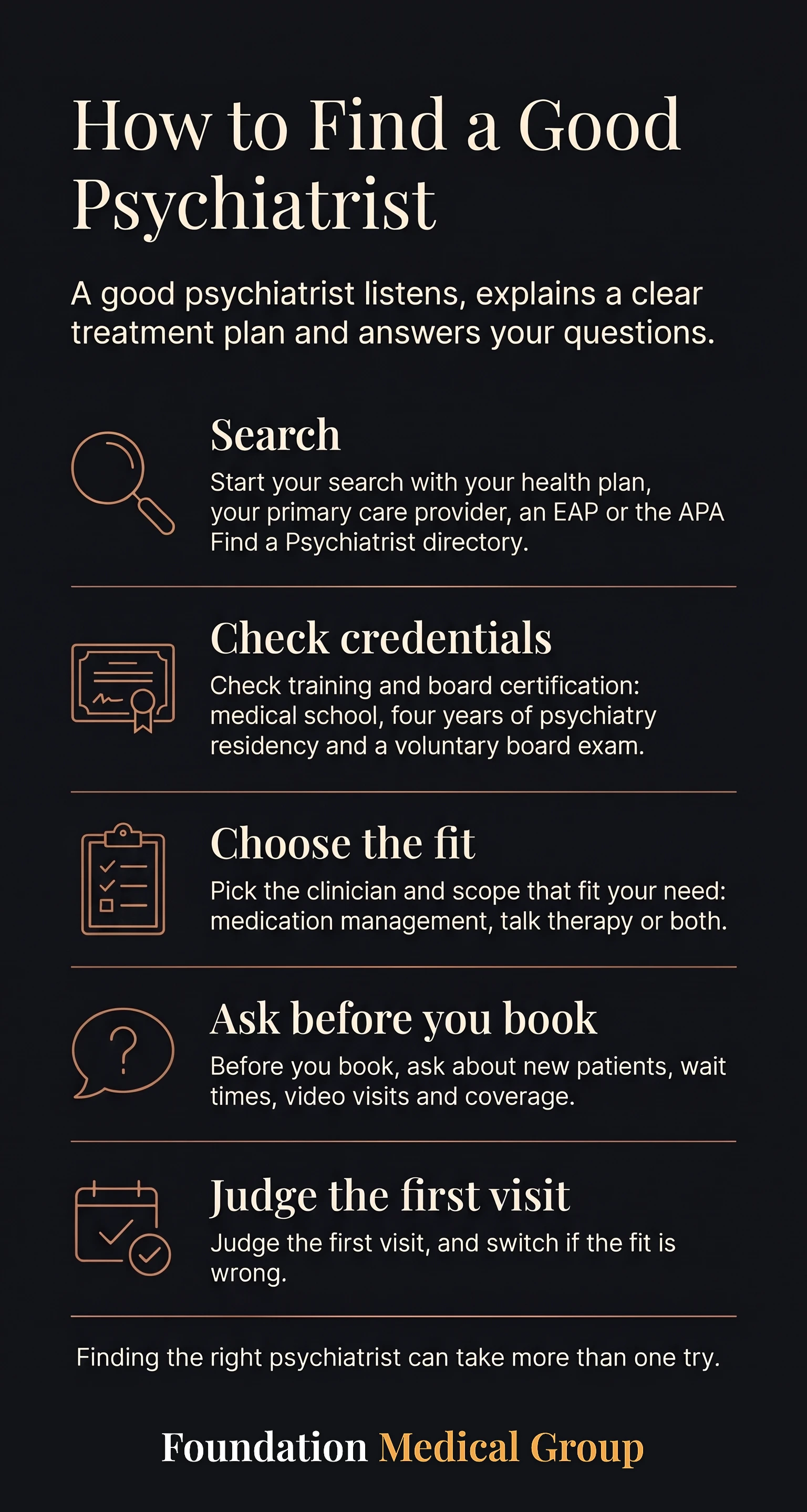
- Start your search with your health plan, your primary care provider, an EAP or the APA Find a Psychiatrist directory.
- Check training and board certification: medical school, four years of psychiatry residency and a voluntary board exam.
- Pick the clinician and scope that fit your need: medication management, talk therapy or both.
- Before you book, ask about new patients, wait times, video visits and coverage.
- Judge the first visit, and switch if the fit is wrong.
Sources
- National Institute of Mental Health, Help for Mental Illnesses.
- American Psychiatric Association, Find a Psychiatrist.
- American Psychiatric Association, What Is Psychiatry?.
- SAMHSA, National Helpline.
- SAMHSA, FindTreatment.gov.
- National Institute of Mental Health, Tips for Talking With a Health Care Provider About Your Mental Health.
- SAMHSA, 988 Suicide and Crisis Lifeline.