
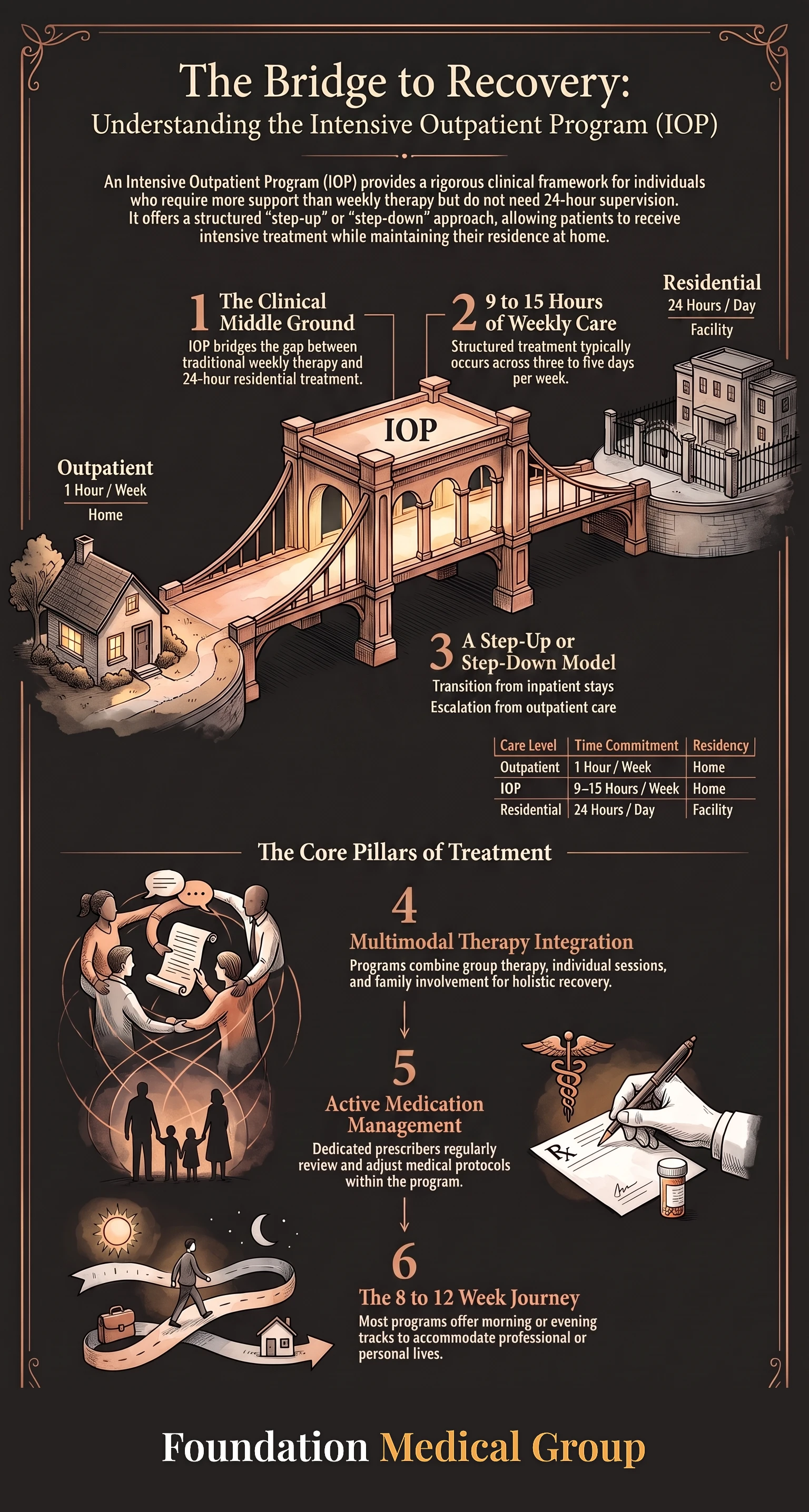
An intensive outpatient program, usually shortened to IOP, is structured treatment you attend about 9 to 15 hours a week while you keep sleeping at home. You come in several days a week for group therapy, individual therapy, and medication management, then go back to your job and your family. It sits between weekly therapy and a residential stay.
Picking a level of care is hard when you’re already worn down, so this guide keeps it plain. Foundation Medical Group is a physician-led clinic treating addiction and mental health conditions in Richmond, Virginia. We also see people in Dallas, Texas, American Fork, Utah, and Atlanta, Georgia. Below is how these programs run, who they suit, and where they fit in a recovery plan.
What Is an Intensive Outpatient Program?
An intensive outpatient program is a level of outpatient care that gives you real clinical hours without an overnight stay. According to the American Society of Addiction Medicine, an adult intensive outpatient program provides 9 or more hours of scheduled care each week. Those hours are usually spread across three to five days.
The word intensive describes the schedule, not how sick you are. You get intensive treatment in a shape that still leaves room for a shift, a class, or a school run. The hours are heavy enough to change something and light enough to keep your recovery inside your real week. That’s the design of this outpatient program.
A typical intensive outpatient program blends four pieces:
- Group therapy. The core of most intensive outpatient programs. Groups of roughly 8 to 12 clients meet with a therapist to practice coping skills out loud. The peer support in that room is part of the treatment, not a bonus.
- Individual therapy. A private hour with your own therapist, focused on your history and your goals.
- Medication management. A prescriber reviews any medicine you take for a mental health condition or a substance use disorder, then adjusts the dose.
- Family therapy. Sessions that bring in a partner, a parent, or an adult child. Recovery rarely holds up without support at home.
You’ll see this care under a few labels. Some clinics say IOP program, others say IOP treatment, and older directories list it as intensive outpatient treatment. They all point to the same level of care.
How Is IOP Different From Partial Hospitalization or Residential Treatment?
Hours, and where you sleep. Those are the two dials.
A partial hospitalization program, or PHP, runs 20 or more hours a week. You spend most of the day at the clinic, then drive home at night. Residential treatment is different again. You live at the facility around the clock and hand over your daily routine for a while.
Both IOP and partial hospitalization count as outpatient treatment, since your bed stays yours. Intensive outpatient programs sit in the middle of that range, and most clients land there. Inpatient care is the level that takes the bed with it. Plenty of people walk down this ladder in order, from inpatient treatment to PHP to an intensive outpatient program to a monthly check-in.
Levels of Care Compared
| Level of care | Hours per week | Where you sleep | Often a good fit for |
|---|---|---|---|
| Standard outpatient therapy | Under 9 | Home | Steady symptoms and solid support at home |
| Intensive outpatient program (IOP) | 9 or more | Home | Real structure while keeping work or school |
| Partial hospitalization program (PHP) | 20 or more | Home | Near-daily care without an overnight stay |
| Residential or inpatient program | 24 hours a day | At the facility | An unsafe home, or withdrawal that needs monitoring |
Read that table sideways rather than up and down. The question isn’t which row ranks highest. It’s which row matches your week, your safety, and the support around you.
Compared with traditional outpatient therapy, an IOP gives you more hours, more accountability, and a group that notices when you go quiet. Compared with a residential stay, it costs less and keeps your life running.
What Does a Week in an Adult IOP Look Like?
Most adult IOP schedules run three days a week, three hours a day, for 8 to 12 weeks. Clinics usually offer a morning track and an evening track, so clients who work nights aren’t shut out.
A single day often runs like this:
- Check in, plus a quick rating of mood, sleep, and cravings.
- Group therapy for about 90 minutes, built around one skill.
- A short break, coffee, and a chance to breathe.
- A second group, or an individual therapy session with your therapist.
Every therapy session has a topic. One day it’s handling a craving without acting on it. Another day it’s telling your boss something true without telling them everything. Skills you can use that night, not lectures about recovery.
The first day feels awkward, and that’s normal. Most of our patients say they walk in nervous and walk out lighter.
Groups are where the work usually lands. You hear your own thinking come out of someone else’s mouth, and it stops sounding so reasonable. There’s real relief in that. Clients often say the first group is the hardest hour of the whole treatment, and the one they’d keep. Individual counseling then takes what surfaced in group and fits it to your actual life.
Medication management runs alongside all of it. If you take an antidepressant, or buprenorphine for opioid use disorder, your prescriber tracks how it’s working. When it isn’t working, the treatment plan changes.
Some intensive outpatient programs add a weekend support group or a peer support meeting between scheduled days. Ask about that early, because the gap between Friday and Monday is where support tends to thin out.
Which Conditions Do Intensive Outpatient Programs Treat?

Both sides of behavioral health. Mental health treatment tracks and substance use tracks often run in the same building, and sometimes in the same room. Ask whether the mental health team and the addiction team share one chart, because repeating your story to two sets of strangers wears people out.
Common reasons adults start this level of care:
- Depression or an anxiety disorder that once-a-week therapy hasn’t shifted.
- Post traumatic stress disorder, where a mental health issue and avoidance feed each other.
- Bipolar disorder that needs closer medication management for a stretch.
- Alcohol or opioid use disorder, usually paired with medicine.
- A mental health disorder and substance use together, which clinicians call co-occurring disorders.
According to the National Institute of Mental Health, more than one in five adults in the United States lives with a mental illness in a given year. Most never reach this level of mental health treatment. Some would do better if they did.
If substance use is part of the picture, ask whether the program pairs therapy with medicine. Our guide to medication assisted treatment explains buprenorphine, naltrexone, and Vivitrol in plain terms. Our MAT clinic page covers how prescribing and counseling sit in one place.
Who Is a Good Fit for This Level of Care?
Two groups, mostly.
The first group is stepping up. Weekly therapy stopped being enough, symptoms are louder, and a mental health concern is starting to cost you work or sleep. You’re safe at home, though, so a residential bed would be more than you need.
The second group is stepping down. Clients often move here straight from detox, a hospital stay, or a residential stay. Going back to one hour a fortnight feels like walking off a cliff. An intensive outpatient program catches that drop and protects the recovery you built. Clients in this group usually need less therapy over time and more support outside the clinic.
This level fits best when three things are true. You have somewhere safe to sleep, you’re medically stable, and you can reach the clinic on the days you’re booked. In our experience, the people who do best are the ones who name what’s in the way early, whether that’s childcare, a night shift, or a ride. Where any of those wobble, say so. Your care team would rather redesign the treatment plan than watch you vanish from it.
Some clients also need a slower on-ramp. Mental health challenges rarely arrive on a tidy schedule. Starting with two days a week beats promising five and managing none.
Does Insurance Cover an Intensive Outpatient Program?
Usually, yes. Most private plans and Medicaid cover this level of mental health care. The Mental Health Parity and Addiction Equity Act of 2008 requires many plans to cover mental health and substance use treatment on terms similar to other medical care.
Coverage still comes with fine print, and mental health benefits are where the fine print hides. Call the number on the back of your card and ask four things:
- Is this clinic in network for intensive outpatient treatment?
- What’s my copay per day of programming?
- How many days are authorized before someone reviews the case?
- Does my deductible apply to therapy and to medication visits?
Then ask the clinic the same questions. If you have no insurance, ask about sliding scale fees before you rule a place out. Cost stops more people from starting treatment than fear does, and cost is the part a clinic can often solve.
How Long Does an Intensive Outpatient Program Last?

Most adults attend for 8 to 12 weeks, then step down to lighter outpatient care and a medication review. Some stay longer. Length should track how you’re doing, not a number on a brochure.
Stepping down isn’t the end of care. According to the National Institute on Drug Abuse, 40 to 60 percent of people treated for a substance use disorder return to use at some point. That’s close to the relapse rates for asthma and high blood pressure. Doctors respond to those illnesses by changing the plan, and the same response belongs here. A return to use is information, not a verdict.
Long term recovery usually rests on a few plain habits. Stay on medicine while it helps. Keep one therapy appointment on the calendar in the good months. Tell somebody the truth early. Sobriety built that way tends to hold, because it doesn’t run on willpower alone.
Your recovery journey after the program is quieter, and that’s the point. Lasting recovery gets measured in seasons, not in one clean week.
How Do I Find an Intensive Outpatient Program Near Me?
Start with two moves.
First, call a nearby clinic and ask what levels they run. One phone call tells you whether they offer IOP, whether they take your insurance, and how soon you could start. Our page on outpatient addiction treatment walks through the wider set of options if you’re unsure which level fits.
Second, use the public tools. The federal locator at FindTreatment.gov searches by ZIP code and filters programs by the services they list. You can also call the SAMHSA National Helpline at 1-800-662-4357. It’s free, confidential, and staffed 24 hours a day, 365 days a year.
Intensive outpatient programs vary more than the brochures suggest, so compare two or three before you commit. These questions separate the solid from the vague:
- Do you run both mental health and substance use tracks?
- Who leads group therapy, and what are their credentials?
- Do you offer family therapy and individual counseling?
- Can I mix in-person sessions with virtual ones?
- What happens to my place if I miss a week?
Key Takeaways
- An intensive outpatient program means 9 or more hours of treatment a week while you sleep at home.
- A partial hospitalization program runs 20 or more hours, and residential care keeps you on site.
- A normal week is around three days of group therapy, individual therapy, and medication management.
- Programs treat depression, anxiety, post traumatic stress disorder, substance use, and co-occurring disorders.
- Most adults attend 8 to 12 weeks, then step down to lighter care and ongoing support.
- Support at home and support in the group both protect recovery once the program ends.
- Most insurance plans and Medicaid cover this care, so ask about copays and authorized days first.
Starting Close to Home
You don’t have to leave your whole life behind to get serious help. That’s the point of this middle level of care. Real clinical hours, your own bed, your own people, and a recovery plan that survives contact with a Tuesday.
Your mental health notes and your recovery notes belong in one chart, with one team reading both. Foundation Medical Group is a physician-led practice offering addiction treatment and mental health care in Richmond, Virginia. We also have clinics in Dallas, Texas, American Fork, Utah, and Atlanta, Georgia. Call us and describe your week. If an intensive outpatient program is the right fit, we’ll say so, and if a lighter or heavier level suits you better, we’ll say that instead. Every patient starts somewhere, and one phone call is a fair place.
Sources
- American Society of Addiction Medicine (ASAM) - The ASAM Criteria, the levels-of-care standard that defines Level 2.1 intensive outpatient and Level 2.5 partial hospitalization.
- Substance Abuse and Mental Health Services Administration (SAMHSA) - National Helpline, 1-800-662-4357, free and confidential, 24 hours a day, 365 days a year.
- National Institute on Drug Abuse (NIDA) - Drugs, Brains, and Behavior: The Science of Addiction, on relapse rates and continuing care.
- National Institute of Mental Health (NIMH) - Mental Illness statistics for adults in the United States.
- FindTreatment.gov - Federal locator for mental health and substance use services by ZIP code.