
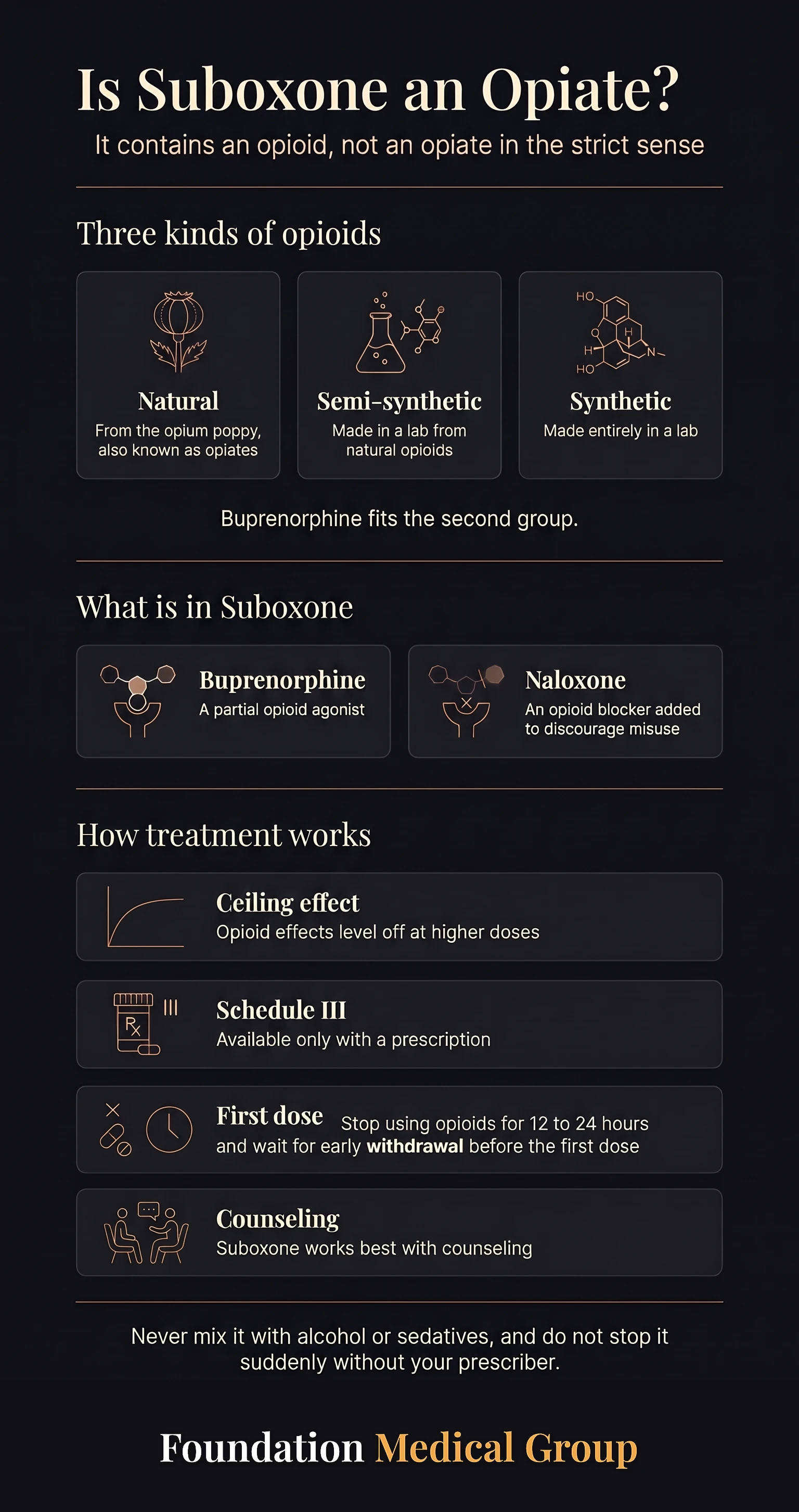
Is Suboxone an opiate? Not exactly, but it does contain an opioid. Its main ingredient, buprenorphine, is a partial opioid agonist. Strictly speaking that makes it an opioid rather than an opiate, because opiates come straight from the opium poppy and buprenorphine is semi-synthetic. The second ingredient, naloxone, is an opioid blocker added to discourage misuse. Suboxone is a prescription medicine used to treat opioid use disorder. And it tends to work best alongside counseling.
Is Suboxone an Opioid?
Yes. The FDA label for Suboxone describes it as a combination of two medicines. Buprenorphine is a partial opioid agonist, which means it switches on the same brain receptors as other opioids, but only part of the way. Naloxone is an opioid antagonist, which means it blocks those receptors. The label says Suboxone is indicated for the treatment of opioid dependence.
SAMHSA explains what “partial” means in practice. At low to moderate doses, buprenorphine can produce opioid effects such as euphoria or slowed breathing, but these effects are weaker than those of full agonists such as methadone and heroin. That weaker pull is the point. It’s strong enough to settle withdrawal symptoms and cravings, and mild enough to lower the risk of misuse.
MedlinePlus puts it simply: together, buprenorphine and naloxone prevent withdrawal symptoms in people who are stopping opioid drugs. If you’re weighing this medicine for yourself or a family member, our page on Suboxone treatment explains how care works at Foundation Medical Group, from the first visit to long-term follow-up.
What Is the Difference Between an Opiate and an Opioid?
The two words are often used as if they mean the same thing, but they don’t. Honestly, the mix-up is understandable. According to the National Institute on Drug Abuse (NIDA), opioids are a broad class of drugs that come in three kinds:
- Natural opioids, such as morphine and codeine, come from the opium poppy. These are the ones also known as opiates.
- Semi-synthetic opioids, such as heroin, oxycodone and hydrocodone, are made in a lab from natural opioids.
- Synthetic opioids, such as fentanyl, are made entirely in a lab. NIDA notes that fentanyl is 50 to 100 times more potent than morphine.
Buprenorphine fits the second group. A 2026 review in Pharmaceuticals describes it as a semi-synthetic opioid and a thebaine derivative. Thebaine is one of the natural compounds in the opium poppy, so buprenorphine starts from the plant but is changed in a lab. That’s why “opioid” is the accurate word and “opiate” is not.
In everyday speech, though, people use “opiate” loosely for any of these drugs. MedlinePlus also notes that opioids are sometimes called narcotics. The label matters less than how the drug acts on the body. Full agonists such as oxycodone and morphine can keep increasing their effects as the dose rises, which is part of what makes them dangerous. Buprenorphine behaves differently, and that’s what the next sections explain. The same review notes that buprenorphine is also used for pain, though at Foundation Medical Group it is prescribed for opioid use disorder.
Buprenorphine vs Suboxone vs Methadone: Comparison Table
The FDA groups medicines for opioid use disorder into three types: agonists, partial agonists and antagonists. This table shows where Suboxone sits.
| Buprenorphine alone | Suboxone | Methadone | Naltrexone | |
|---|---|---|---|---|
| FDA type | Partial agonist | Partial agonist plus antagonist | Full agonist | Antagonist |
| What it contains | Buprenorphine | Buprenorphine and naloxone | Methadone | Naltrexone |
| Is it an opioid? | Yes, semi-synthetic | Yes, through buprenorphine | Yes, synthetic | No, it blocks opioids |
| Effect on opioid receptors | Activates them partly | Activates them partly | Activates them fully | Blocks them |
| Misuse safeguard | Ceiling effect | Ceiling effect plus naloxone | None built in | Not an agonist |
Buprenorphine also comes in other forms, including tablets, injections and implants, according to NIDA. Weighing the two most common brand choices? Our Suboxone vs Subutex page puts them side by side.
What Is Suboxone Used For?

Suboxone treats opioid use disorder, also called opioid addiction. MedlinePlus lists it as a medicine for people addicted to opioid drugs, taken once a day as a film or tablet placed under the tongue or against the cheek.
NIDA explains how it helps. Buprenorphine activates the brain’s mu opioid receptors to a lesser degree than methadone. In people with opioid use disorder, that’s enough to reduce cravings and withdrawal symptoms without producing an intense high. It can also block the effects of other opioids taken on top of it. NIDA reports that methadone and buprenorphine can be equally effective at reducing opioid use.
Unfortunately, few people get this care. NIDA notes that fewer than 1 in 5 people with opioid use disorder receive these medications.
Medicine is one part of the plan. SAMHSA says buprenorphine should be prescribed together with counseling and other support, and the Suboxone label calls for a complete treatment plan that includes counseling and psychosocial support. Recovery tends to involve both: the medicine steadies the body while counseling helps with the patterns and stress around drug use.
Starting also takes timing, and this is the part people miss. SAMHSA says a person needs to stop using opioids for 12 to 24 hours and be in the early stage of withdrawal before the first dose. Starting too soon can bring on withdrawal faster, which is why the first days happen under a prescriber’s guidance. How long treatment lasts is tailored to each person, and SAMHSA notes it can continue indefinitely.
How Does the Ceiling Effect Make Buprenorphine Different?
The ceiling effect is the main reason buprenorphine is used the way it is. With a full agonist, a higher dose keeps producing a stronger effect, including slower breathing. With buprenorphine, the effect levels off.
The Suboxone label reports that its opioid effects reached a maximum between 8 mg/2 mg and 16 mg/4 mg in studies. Above that range, taking more did not add much effect. That’s a label finding, not a dosing guide, and your prescriber sets your dose.
This plateau makes buprenorphine safer in overdose than full agonists, according to SAMHSA. The 2026 review in Pharmaceuticals adds an important limit: the protection is conditional and incomplete. Slowed breathing can still become dangerous, especially when buprenorphine is mixed with other substances that slow breathing.
Can Suboxone Get You High?
It can produce some euphoria, especially in people who don’t use opioids regularly, but the effect is weaker than with full agonists. SAMHSA lists euphoria among the opioid effects buprenorphine can cause at low to moderate doses, while noting those effects are milder than with methadone or heroin.
For people with opioid use disorder who take it as prescribed, NIDA says buprenorphine reduces cravings and withdrawal without producing intense pleasure.
Naloxone adds a second safeguard. SAMHSA explains that it is included in the combination to decrease the chance of diversion and misuse. Taking Suboxone any way other than prescribed, or taking someone else’s medicine, carries real risks, including overdose when combined with other drugs.
Is Suboxone a Controlled Substance?
Yes. The FDA label lists Suboxone as a Schedule III controlled substance under the DEA. So it’s available only with a prescription, and you should take it exactly as prescribed.
Only a licensed prescriber can write a Suboxone prescription. Our guide on how to get a Suboxone prescription online covers that path. If you’re worried about testing at work or in court, read does Suboxone show up on a drug test and tell the testing site about any medicine you are prescribed.
Suboxone Side Effects and Safety Rules

Like other medications, Suboxone has side effects. SAMHSA lists common ones such as constipation, headache, nausea, vomiting, dizziness, drowsiness, sweating, dry mouth and trouble sleeping. Annoying, sure. But tell your prescriber about them rather than quietly putting up with them.
Look, the safety rules matter more than the side effects:
- Avoid alcohol and sedatives. SAMHSA warns against drinking alcohol or taking sedatives, tranquilizers or other drugs that slow breathing while on buprenorphine. Mixing them can lead to overdose or death. The label carries a specific warning about benzodiazepines.
- Do not stop suddenly. The label says stopping abruptly can cause withdrawal, usually milder than with full agonists. Tapering should be gradual and planned with your prescriber.
- Keep a rescue medicine nearby. MedlinePlus advises talking to your doctor about having naloxone or nalmefene on hand. The FDA notes that naloxone nasal spray is available without a prescription.
- Know who to call. If someone collapses, has a seizure, has trouble breathing or cannot be woken, call 911. For questions about an accidental dose, Poison Control is at 1-800-222-1222.
Suboxone Treatment and Recovery at Foundation Medical Group
Foundation Medical Group offers Suboxone care at its clinics in American Fork, Utah, Decatur, Georgia and Dallas, Texas, and medication-assisted treatment at its Richmond, Virginia clinic. Patients in Utah can also read about our Suboxone doctors in Utah. FMG doesn’t offer detox, residential or alcohol use disorder programs.
Our buprenorphine treatment follows clear steps:
- Intake. We start with a first visit of about 60 minutes. It covers your history, your goals and any other conditions.
- Induction. Over days 1 to 3, once withdrawal has started, you begin the medicine, with a check-in within 24 hours.
- Stabilization. For 4 to 8 weeks, weekly visits fine-tune the plan.
- Maintenance. Visits move to every 4 to 12 weeks once you’re steady. Any taper is slow and led by you.
Our team pairs buprenorphine with counseling or peer support. Talk therapy is available by secure video in all four states, and in person at Richmond.
Insurance. Common plans by state, each one call to confirm coverage:
- Virginia: Aetna, Anthem, Cigna, UnitedHealthcare, TRICARE, Virginia Medicaid and Sentara Health Plans. Richmond does not accept Medicare.
- Texas: Aetna, Blue Cross Blue Shield, Cigna, UnitedHealthcare, Humana, TRICARE, Medicare and Texas Medicaid.
- Utah: Aetna, Blue Cross Blue Shield and SelectHealth.
- Georgia: Cigna.
Coverage depends on your specific plan, so call us at (800) 983-1974 before your visit.
Key Takeaways
- Suboxone contains an opioid. Buprenorphine is a semi-synthetic partial opioid agonist, so it is an opioid, not an opiate in the strict sense.
- Naloxone, the second ingredient, is an opioid blocker added to discourage misuse.
- The ceiling effect means opioid effects level off at higher doses. This lowers, but does not remove, the risk of dangerously slowed breathing.
- Suboxone is a Schedule III controlled substance approved to treat opioid dependence, and it works best with counseling.
- Never mix it with alcohol or sedatives, and do not stop it suddenly without your prescriber.
Sources
- SAMHSA, What is Buprenorphine? Side Effects, Treatment & Use
- MedlinePlus, Buprenorphine and Naloxone Sublingual and Buccal (opioid dependence)
- DailyMed, SUBOXONE (buprenorphine hydrochloride, naloxone hydrochloride) film, soluble
- National Institute on Drug Abuse, Opioids
- Pharmaceuticals (Basel), Can Buprenorphine Be Overdosed? The Ceiling Effect and Its Clinical Implications
- National Institute on Drug Abuse, Medications for Opioid Use Disorder
- FDA, Medications for Opioid Use Disorder (MOUD)
- MedlinePlus, Opioids and Opioid Use Disorder (OUD)
- FDA, Opioid Overdose Reversal Medications