
Ketamine therapy for anxiety is an off-label treatment. That means ketamine isn’t FDA-approved for this use. Small trials suggest it may help some people whose symptoms are hard to treat. But the evidence is still early. At Foundation Medical Group (FMG), IV and IM ketamine is offered for severe cases at our Richmond, VA clinic only.
What Is Ketamine Therapy for Anxiety?
Ketamine therapy means giving low doses of ketamine in a medical setting to people whose anxiety symptoms haven’t improved with standard care. It’s used off-label. And the research is still small. In psychiatry, it’s usually an option to talk through after other care, not a first step.
According to the National Institute of Mental Health (NIMH), anxiety disorders are mental health conditions in which worry and fear don’t go away. They can get worse over time. Common types include generalized anxiety disorder, panic disorder, social anxiety disorder and phobias. If that sounds like your everyday life, it’s exhausting. And it’s not a personal failing.
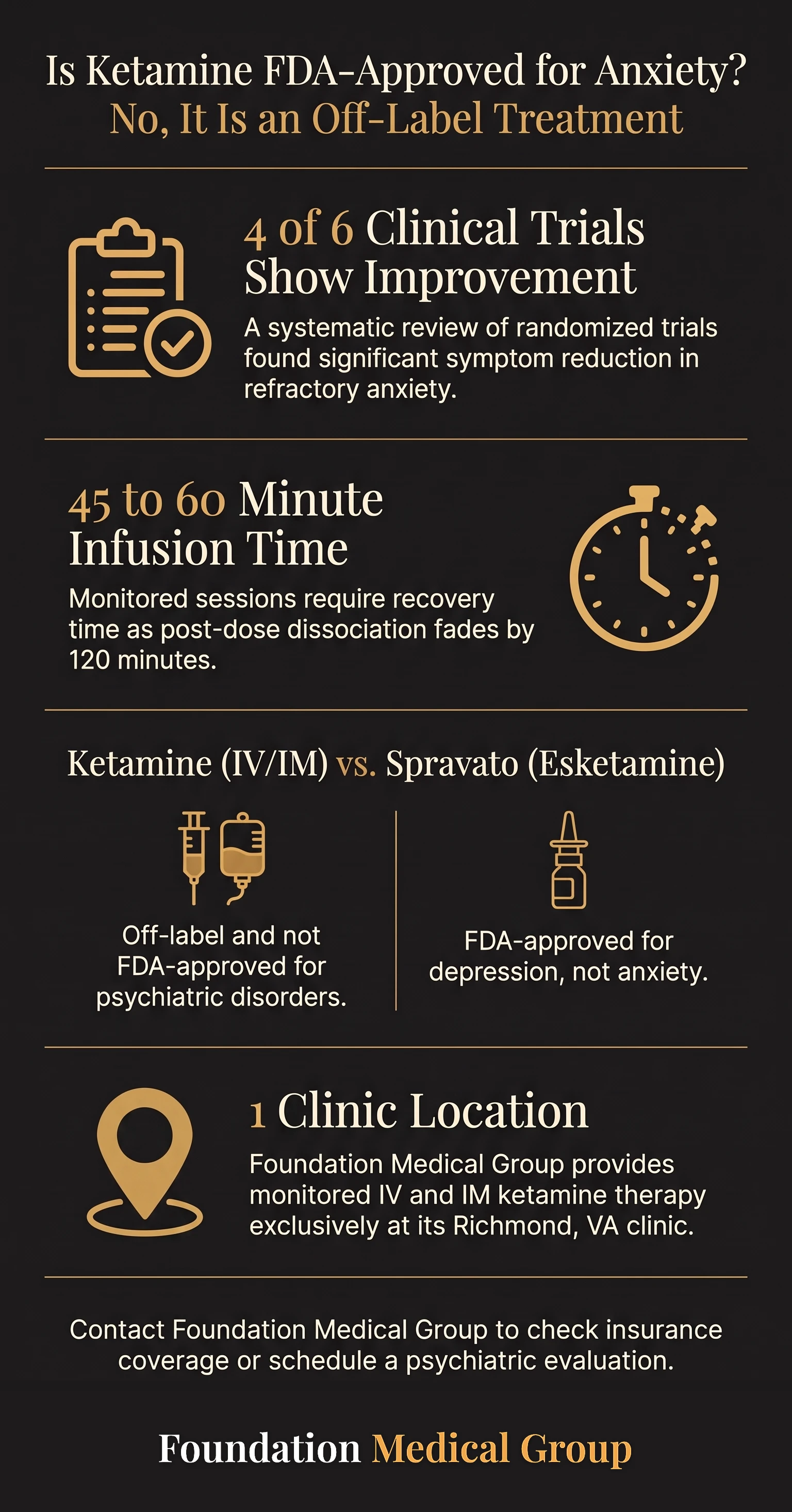
Ketamine treatment by IV or injection uses racemic ketamine. That’s not the same medicine as esketamine (Spravato), which is a nasal spray. The FDA states that ketamine is not approved for any psychiatric disorder. Esketamine, on the other hand, is the FDA-approved nasal spray for treatment-resistant depression.
How Does Ketamine Therapy Work?

Here’s what the research used. A trial published in Neuropsychopharmacology gave intravenous ketamine at 0.5 mg/kg over 40 minutes to adults with social anxiety disorder. A review in the British Journal of Clinical Pharmacology found that many studies of this treatment used weekly doses, given as a small injection under the skin. Most of those studies looked at generalized and social anxiety.
At FMG, IV ketamine therapy and IM (intramuscular) ketamine are given in a monitored setting. An infusion takes about 45 to 60 minutes. Then you stay for recovery time after each dose before you go home.
Some trials have seen anxiolytic effects after dosing. That’s just a medical way to say a drop in anxiety. How exactly ketamine brings that drop about is still being studied. The full answer isn’t in yet.
How Effective Is Ketamine for Anxiety Disorders?
The clearest summary so far comes from a systematic review and meta-analysis in Therapeutic Advances in Psychopharmacology. It looked at randomized controlled trials of ketamine for refractory anxiety. That means symptoms that haven’t responded well to usual care. The authors found six trials, covering social anxiety, post traumatic stress disorder (PTSD) and obsessive-compulsive disorder (OCD). Four of the six showed significant improvement compared with a control.
That’s hopeful. Still, the authors called the evidence preliminary. The trials were small, and they mixed different conditions. So it’s hard to say how well ketamine works for any one kind of treatment resistant anxiety.
Longer use is only starting to be studied. The British Journal of Clinical Pharmacology review notes that most studies of ketamine treatment were small. It points to one 3-month open-label maintenance study. Open-label means everyone knew they were getting ketamine. So a study like this can’t prove the drug caused the change.
What does this mean for anxiety patients? If you live with chronic anxiety, ketamine may bring some symptom relief for some people. That possible anxiety relief isn’t a promise. It isn’t a cure, either. Your anxiety symptoms, mental health history and past care shape whether it makes sense for you.
Does Ketamine Therapy Work for Social Anxiety?
Social anxiety was among the six randomized trials in the meta-analysis above. A separate study in Neuropsychopharmacology used a crossover design with 18 adults. Each person received IV ketamine at one point and a placebo at another. That way, researchers could compare the two in the same people. Other studies of this condition used weekly dosing.
Still, ketamine isn’t standard care here. According to NIMH, the usual treatments for anxiety disorders are psychotherapy, such as cognitive behavioral therapy, and medication. These come first.
If you’re looking for that kind of support, our guide to finding an anxiety therapist near me is a good next step.
Can Ketamine Help With Anxiety and Post Traumatic Stress Disorder?
PTSD was also among the six trials in the meta-analysis. That puts PTSD in the early research too. Anxiety, trauma and depression can overlap, and that matters when you choose care.
At FMG, ketamine is offered for treatment resistant depression, chronic PTSD and severe anxiety. So if you have anxiety along with depressive symptoms or a trauma history, it’s fair to ask whether you might be a fit. Ketamine’s antidepressant effects are the main reason it’s used off-label for depression that hasn’t improved with other care.
Mood disorders and anxiety can be hard to untangle on your own. That’s normal. A full psychiatric evaluation usually comes first, so your provider sees the whole picture of your depression, anxiety and trauma before suggesting a plan. At that evaluation, our clinicians ask about your mood, sleep, trauma history and the medicines you’ve already tried.
Is Ketamine Treatment Safe?

Ketamine treatment is given in a clinic for good reason. The meta-analysis found that dissociation rose after dosing. Dissociation is a feeling of being detached from your body or surroundings. It returned to baseline by 120 minutes. That’s why, at FMG, each IV ketamine infusion or IM dose is given in a monitored setting with recovery time after each dose, not at home.
Where the ketamine comes from matters too. The FDA sent a warning letter to an online ketamine seller. In it, the agency states that ketamine is not FDA-approved for any psychiatric disorder. Getting ketamine through a licensed psychiatry practice, with a prescriber who knows your history, is part of safe mental health treatment.
Most important: if you are having suicidal thoughts, do not wait for a ketamine appointment. Call 911 or go to the nearest emergency room now.
Can Ketamine Therapy Make Anxiety Worse?
The main short-term concern is the dissociation described above. During a session it can feel strange or unsettling, and that can be scary if you already feel anxious. It’s one reason monitoring matters. Staff are with you while it happens. And in the trials, it faded within about 2 hours.
Could ketamine make your symptoms worse over the long term? The current evidence doesn’t show that. But the trials are small, so the question isn’t settled.
Tell your provider about every medicine you take, any past bad reactions, and your anxiety symptoms over time. If you also live with depression, share that too. It helps them decide if ketamine makes sense for you, or if another path fits better.
How Many Ketamine Treatments for Anxiety Are Usually Needed?
There’s no fixed number of ketamine treatments for anxiety. Research hasn’t settled on one. The British Journal of Clinical Pharmacology review found that most studies of this treatment used weekly dosing. Only one study looked at 3 months of maintenance treatment.
At FMG, your plan is set after an evaluation and reviewed as you go. Each ketamine infusion therapy visit takes about 45 to 60 minutes, plus recovery time in the clinic.
If anyone promises a set number of sessions, ask what that promise is based on. You deserve a clear answer.
Ketamine Therapy vs Traditional Anxiety Treatments
In most cases, standard care comes first. NIMH describes talk therapy and medicines as the usual anxiety treatment. Ketamine is something to consider when traditional treatments haven’t helped enough. Those might be cognitive behavioral therapy, a selective serotonin reuptake inhibitor (SSRI) or another traditional anti anxiety medication. Here’s how the options compare, using only the sources and FMG’s service details.
| Talk therapy (such as CBT) | Prescription medicine (such as an SSRI) | Ketamine (IV/IM) | Spravato (esketamine) | |
|---|---|---|---|---|
| Role in care | Standard treatment | Standard treatment | Off-label option for severe or refractory cases | Not approved for this use |
| FDA status | Not a drug | Prescription medications used as standard care (per NIMH) | Not FDA-approved for any psychiatric disorder | FDA-approved for treatment-resistant depression in adults |
| Evidence for anxiety | Standard care per NIMH | Standard care per NIMH | Small, preliminary trials | Not indicated for anxiety |
| Where at FMG | Secure video in VA, UT, GA, TX; in person in Richmond VA | Medication management by FMG prescribers | Richmond VA clinic only | Richmond VA clinic only |
We don’t rank these by how well they work, because there isn’t enough head-to-head research to do that honestly. Traditional anxiety treatments and traditional antidepressants are still the usual starting point for anxiety and depression. Ketamine doesn’t replace them. You can read more about talk therapy at FMG and medication management.
Ketamine Therapy in Richmond, VA
Foundation Medical Group’s psychiatry team offers IV and IM ketamine therapy for treatment-resistant depression, chronic PTSD and severe anxiety at one clinic: 11600 Busy Street, Suite 203, Richmond, VA 23236. Ketamine is not offered at our Utah, Georgia or Texas clinics. A psychiatry provider decides at a visit whether ketamine fits your needs. See our Virginia clinic page and our treatments page for details.
Ketamine is self-pay, and some plans cover a portion, so call to confirm coverage. In Virginia, Medicare is not accepted. Spravato is also offered at the Richmond clinic, but it is approved for depression, not anxiety. Learn more about Spravato in Richmond.
If you’re comparing ketamine clinics, ask how patients are monitored and how payment works. You may see the term ketamine assisted psychotherapy in research. FMG doesn’t offer it as a packaged program, though talk therapy is available separately. FMG does not offer detox, IOP, PHP, residential care or 24/7 supervision.
Key Takeaways
- Ketamine is used off-label for anxiety. It is not FDA-approved for any psychiatric disorder, including depression.
- The research is small and early: four of six randomized trials showed improvement.
- Dissociation is common right after a dose and faded by about 2 hours in trials.
- Standard mental health care, such as therapy and medication, comes first.
- At FMG, ketamine is offered in Richmond, VA only. It is self-pay, and some plans cover a portion.
FAQ
Is ketamine FDA-approved for anxiety?
No. The FDA states that ketamine is not approved for any psychiatric disorder, and that includes anxiety and depression. When a clinic uses ketamine for anxiety, it is an off-label use that your prescriber should explain to you clearly.
Is Spravato used for anxiety?
Spravato (esketamine) is an FDA-approved nasal spray for treatment-resistant depression in adults. It is not approved for anxiety. Foundation Medical Group offers Spravato at the Richmond, VA clinic only.
Does insurance cover ketamine therapy for anxiety?
At Foundation Medical Group, ketamine is self-pay, and some plans cover a portion. Call the Richmond office to confirm coverage for your plan. In Virginia, Medicare is not accepted.
How long is a ketamine session for anxiety?
At Foundation Medical Group, a ketamine infusion takes about 45 to 60 minutes. You then stay in the clinic for recovery time before you head home.
Can I get ketamine for anxiety at an FMG clinic outside Virginia?
No. Foundation Medical Group offers ketamine only at its Richmond, VA clinic. The clinics in Utah, Georgia and Texas do not offer ketamine.
Sources
- U.S. Food and Drug Administration, Warning Letter: Ketamine Store (www.ketaminestore.org), 06/23/2026.
- Therapeutic Advances in Psychopharmacology via PMC, Systematic review and meta-analysis of randomized controlled trials of ketamine in the treatment of refractory anxiety spectrum disorders.
- Neuropsychopharmacology via PMC, Ketamine for Social Anxiety Disorder: A Randomized, Placebo-Controlled Crossover Trial.
- British Journal of Clinical Pharmacology via PMC, Ketamine treatment for refractory anxiety: A systematic review.
- National Institute of Mental Health, Anxiety Disorders.