
Most ketamine therapy side effects happen during or soon after a dose. The common ones are feeling detached or dreamlike (dissociation), dizziness, drowsiness, nausea, headache, blurred vision and a short rise in blood pressure. For most patients, these adverse effects fade within one to two hours. The serious long-term problems people read about, such as bladder damage, memory trouble and addiction, are linked mostly to heavy recreational ketamine use. In monitored medical treatment, they’re rare.
What Is Ketamine Therapy?
Ketamine therapy is the use of low-dose ketamine, given through an IV or as an IM (intramuscular) injection, in a monitored medical setting. It’s mostly used for treatment resistant depression and other mental health conditions. The usual reason is that traditional antidepressants and talk therapy haven’t brought enough relief.
Ketamine itself is FDA-approved as an anesthetic (it was first developed as a less toxic alternative to PCP, which surprises some people). It isn’t FDA-approved for any mental health disorder. So IV ketamine therapy for depression is off-label, as both NIDA and a 2026 FDA warning letter state. A related drug, esketamine (Spravato), is the FDA-approved nasal spray for treatment-resistant depression in adults.
At Foundation Medical Group, we offer IV and IM ketamine therapy in Richmond, VA for treatment-resistant depression, chronic PTSD and severe anxiety. Richmond is the only FMG location that offers ketamine, and treatment starts with a psychiatric evaluation.
What Are the Most Common Side Effects of Ketamine Therapy?
Most potential side effects show up while the medicine is working. NIDA lists headache, dizziness, sleepiness, feeling strange or “loopy,” difficulty speaking, numbness, blurred vision and nausea. Ketamine can also change blood pressure and heart rate.
The effect people ask about most is dissociation. Ketamine can change how you take in sights and sounds, and you may feel like you are dreaming, floating, or a little outside your own body. That can feel odd. It’s also an expected part of the treatment, and staff are with you while it happens.
A systematic review of 60 articles looked at people with depression. After a dose, mental, reality-bending (psychotomimetic), heart and nerve side effects were reported more often with ketamine than with placebo. The same review noted that long-term and repeated-dose safety had been studied far less, which is why newer reviews matter (see below).
Feeling nervous before your first session is normal. Tell our team. They’d rather know.
Ketamine therapy side effects at a glance
| Side effect | When it happens | How long it lasts | What the care team does |
|---|---|---|---|
| Dissociation, feeling “loopy” | During the dose | Usually gone within 1 to 2 hours | Stays with you in a calm, monitored room |
| Dizziness, drowsiness, nausea | During or soon after | Usually gone within 1 to 2 hours | Recovery time before you leave |
| Headache | During or after | Transient in trials | Ask about it at your next visit |
| Blurred vision, numbness | During the dose | Short-lived | Monitoring during the session |
| Higher blood pressure and heart rate | Peaks during the dose | Back to baseline after | Checks vital signs |
| Urinary symptoms | Mostly with heavy, long-term use | Usually improve when ketamine stops | Ask about urinary symptoms over time |
| Low mood or suicidal thoughts | Any time, especially early | Needs care right away | Call your prescriber, or 988 |
How Long Do Ketamine Infusion Side Effects Last?
In most cases, not long. A 2026 systematic review of long-term ketamine and esketamine safety reports that “Thirty-two studies (11 RCTs, 21 nonrandomized) met inclusion criteria, with follow-up ranging from 3 months to 9 years.” RCTs are randomized controlled trials. The review found that dissociative and sedative effects were common but resolved within 1 to 2 hours of each dose. A 2026 meta-analysis of 26 randomized trials with 1,166 patients found that adverse events such as headache were transient and resolved during the trials.
At FMG, each ketamine infusion takes about 45 to 60 minutes. You then have recovery time in the clinic before you go home. Our team explains the day-of rules at your first visit, including how you’ll get home.
For Spravato, the rules are written into the label. MedlinePlus says your doctor will monitor you for at least 2 hours after each treatment. A caregiver or family member should drive you home. And you shouldn’t drive until the next day, after a restful night’s sleep.
Mood needs its own note. MedlinePlus warns that people on esketamine and other antidepressants may have suicidal thoughts, especially early in treatment or after a dose change. If your depressive symptoms get worse, call your prescriber right away. In a crisis, call or text 988.
Why Does a Ketamine Infusion Raise Blood Pressure?
NIDA notes that ketamine can change blood pressure and heart rate. In practice, both tend to rise for a short time during a dose, and for most patients the rise is small. Smaller than you might expect, honestly.
One study tracked 684 ketamine infusions in 66 patients and found the biggest average rise was about 3 mmHg. That was true for both the top and bottom numbers, at the 30-minute mark of a 40-minute infusion. Blood pressure went back to baseline during monitoring afterward. No infusion was stopped because of unstable vital signs. Patients who already had high blood pressure had higher peaks, and the effect did not grow between the first and sixth infusion.
That study looked back at records from one site, so it has limits. Still, it shows why clinics check blood pressure before and during IV ketamine therapy. If you have high blood pressure or heart disease, tell your provider.
Can Ketamine Therapy Damage Your Bladder?
Ketamine bladder syndrome (doctors call it ketamine-associated uropathy) is real. But it’s linked mainly to chronic recreational ketamine use. A meta-analysis of 45 studies and 4,921 patients found the most common signs were needing to urinate often, urgency and pain above the pubic bone. Stopping ketamine was needed for things to improve. NIDA describes the condition as treatable but potentially serious, with symptoms like those of a urinary tract infection.
Medical treatment looks different. A 2025 systematic review of ketamine for psychiatric disorders reports that “Twenty-seven studies were included, mostly in depressive disorders.” It found urinary symptoms in 0% to 24.5% of patients receiving ketamine for psychiatric disorders, and they were mostly mild or moderate. The authors concluded that ketamine treatment does not appear to raise the risk of urinary symptoms, but they also said most studies did not follow people long term.
So the honest answer? Low risk in treatment, probably, with more data needed. Tell your care team if you have pain or burning when you urinate, or need to go much more often than usual.
Is Ketamine Treatment Safe Long Term?
The newest evidence is reassuring. Not perfect, though, and it has limits. The 2026 long-term review looked at heart, liver, urinary, memory, misuse and other outcomes. Neither drug showed signs of organ damage building up in the heart, liver or urinary tract during long-term treatment. The authors found no new memory or thinking problems caused by treatment, and urinary complications were rare and resolved when treatment stopped. Suicidal thinking scores fell from baseline, although suicide attempts still occurred during follow-up.
A 2022 review of ongoing ketamine treatment for depression reached a similar view. It found that cognitive impairment, addiction and serious kidney and urinary problems seem uncommon.
That’s very different from long term side effects of heavy recreational use. NIDA links long-term, heavy ketamine use to memory problems, depression and anxiety.
Two cautions. In the 2026 review, follow-up durations were typically 3 to 12 months, and safety monitoring varied from study to study. How many sessions you have also matters; see how many ketamine treatments for depression for how a course is planned.
Can You Get Addicted to Ketamine Therapy?
It’s a fair question, and you’re right to ask it. NIDA says that in lab studies, ketamine caused brain changes typical of a drug with addictive potential. In people, regular ketamine abuse is linked to signs of addiction, including tolerance, and NIDA says more research is needed on how addictive ketamine is.
In treatment, the picture is different. The 2026 long-term review documented no cases of addiction, drug-seeking or withdrawal caused by ketamine or esketamine treatment. Spravato is only given through a restricted program (a REMS) because of its potential for abuse and misuse. Patients use it in a medical facility, not at home. The same caution applies to ketamine misuse outside a clinic.
At FMG, ketamine is given only in the clinic, by IV or IM injection. Nothing is sent home with you.
If you have a history of substance misuse or ketamine addiction, say so at your evaluation so your prescriber can weigh it in your plan. FMG does not offer detox or residential care.
Who Is Not a Good Candidate for Ketamine Treatment?

Fit is decided at your psychiatric evaluation, where your provider reviews your health history, past treatments and goals. A few things get a closer look.
The Spravato label is the closest FDA-reviewed guide for this drug family. It says esketamine shouldn’t be used by people with:
- An aneurysm or other aneurysmal blood vessel disease, or an arteriovenous malformation.
- A history of bleeding in the brain.
- An allergy to esketamine or ketamine.
MedlinePlus also asks patients to tell their doctor about high blood pressure, heart disease, liver disease and pregnancy. Mention any history of heavy drinking, street drugs or overused prescription medicines, too. NIDA notes that high doses of ketamine may cause psychosis, so a history of psychosis is something your prescriber will want to discuss.
None of this is a do-it-yourself checklist for mental health treatment. Bring your questions and your medication list, and your prescriber will weigh them with you.
Ketamine Infusion Therapy vs Spravato: How Do Side Effects Compare?
Ketamine and esketamine are close relatives, so the side effects overlap. That’s not surprising. The Spravato label names its most common reactions in treatment-resistant depression. They include dissociation, dizziness, nausea, sedation, vertigo, numbness and anxiety. Others are low energy, higher blood pressure, vomiting, feeling drunk and headache. The main differences are approval status, how it’s given and the monitoring rules.
| IV or IM ketamine at FMG | Spravato (esketamine) at FMG | |
|---|---|---|
| FDA status | Not approved for any psychiatric disorder (off-label) | FDA-approved for treatment-resistant depression in adults |
| How it is given | IV infusion or IM injection | Nasal spray, used in the clinic |
| Common side effects | Dissociation, dizziness, drowsiness, nausea, headache, blood pressure rise | Dissociation, dizziness, nausea, sedation, vertigo, blood pressure rise |
| Time in clinic | About 45 to 60 minutes, then recovery time | Monitored at least 2 hours |
| Where at FMG | Richmond, VA clinic only | Richmond, VA clinic only |
For the nasal spray in detail, read Spravato side effects.
How We Monitor Ketamine Treatment in Richmond, VA

Our ketamine treatment happens at our Richmond flagship, 11600 Busy Street, Suite 203, Richmond, VA 23236. It starts with a psychiatric evaluation. Your provider reviews your health history and past treatments, then asks what you want from treatment.
On treatment days, you check in and receive ketamine by IV or IM injection in a calm, monitored clinical room. The infusion takes about 45 to 60 minutes, and you have recovery time before you go home. The number of treatments is set for each person after evaluation. At FMG, ketamine is used for mental health, not chronic pain.
The same office offers Spravato and TMS, so if ketamine is not the right fit, other options for treatment-resistant depression are under one roof. Ketamine therapy for severe anxiety is offered at the same clinic.
Cost and coverage are on our ketamine therapy cost page. Coverage depends on your plan, so call to confirm coverage. FMG does not accept Medicare in Virginia. Questions? Call (800) 983-1974.
Key Takeaways
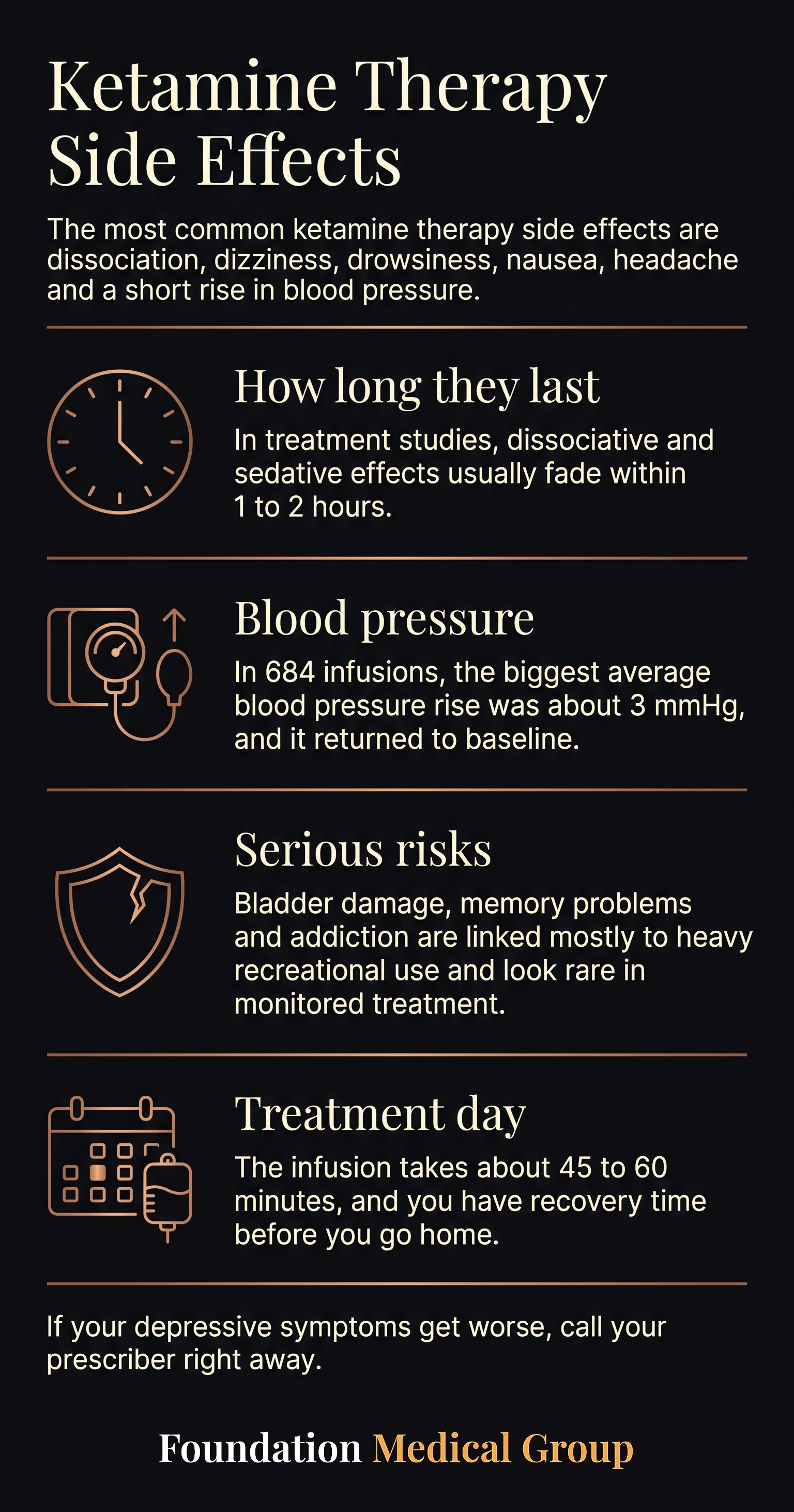
- The most common ketamine therapy side effects are dissociation, dizziness, drowsiness, nausea, headache and a short rise in blood pressure.
- In treatment studies, dissociative and sedative effects usually fade within 1 to 2 hours.
- In 684 infusions, the biggest average blood pressure rise was about 3 mmHg, and it returned to baseline.
- Bladder damage, memory problems and addiction are linked mostly to heavy recreational use and look rare in monitored treatment.
- At FMG, ketamine is given by IV or IM injection only at the Richmond, VA clinic, after a psychiatric evaluation.
Sources
- National Institute on Drug Abuse, Ketamine.
- U.S. Food and Drug Administration, Warning letter on ketamine products, June 23, 2026.
- U.S. Food and Drug Administration, SPRAVATO (esketamine) nasal spray prescribing information.
- DailyMed, SPRAVATO label.
- MedlinePlus, Esketamine Nasal Spray.
- PubMed, Side-effects associated with ketamine use in depression: a systematic review.
- PubMed, Blood pressure safety of subanesthetic ketamine for depression: a report on 684 infusions.
- PubMed, Systematic review and meta-analysis of ketamine-associated uropathy.
- PubMed, Urological symptoms following ketamine treatment for psychiatric disorders: a systematic review.
- PubMed, A systematic review of long-term safety outcomes of ketamine and esketamine in patients with treatment-resistant depression.
- PubMed, Maintenance ketamine treatment for depression: a systematic review of efficacy, safety, and tolerability.
- PubMed, Ketamine infusions and rapid reduction of suicidal and depressive symptoms in major depressive episode: a systematic review and meta-analysis.