
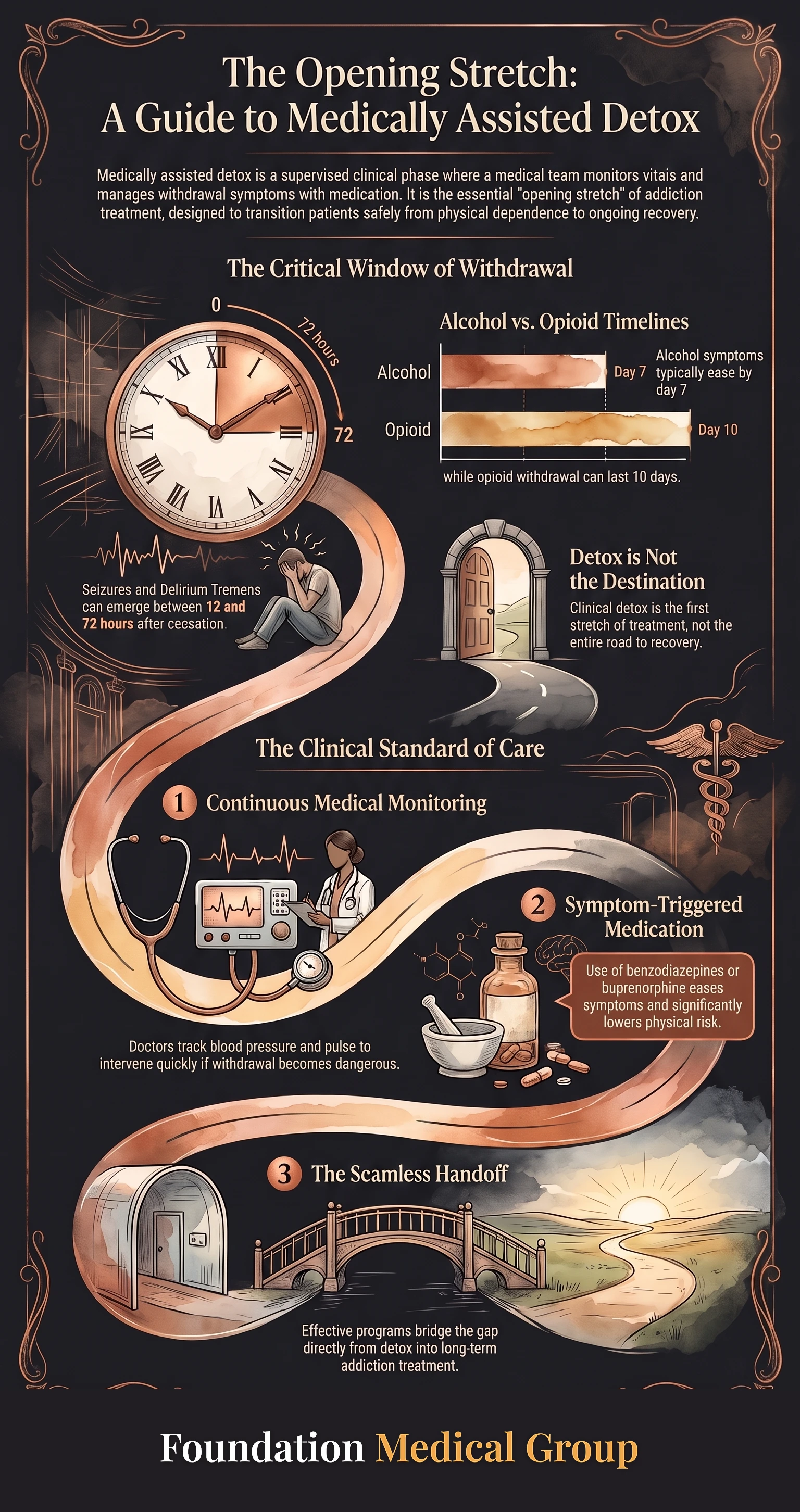
Medically assisted detox means a medical team looks after you while alcohol or another drug leaves your body. Doctors track your blood pressure and pulse, treat withdrawal symptoms with medication, and step in quickly if something turns dangerous. Detox is the opening stretch of addiction treatment, not the whole road.
Reading this for yourself takes something. Reading it for a son, a partner, or a friend counts too. What follows is plain language. Here’s what a medical detox program does, how long withdrawal lasts, when quitting alone gets dangerous, and what happens after. Foundation Medical Group is a physician-led clinic for addiction medicine and mental health care. Our home base is Richmond, Virginia, with offices in Dallas, Texas, American Fork, Utah, and Atlanta, Georgia.
What Is Medically Assisted Detox?
Detox is short for detoxification. Clinicians tend to say withdrawal management now, because nothing is being scrubbed clean. Your liver handles that part. The real work is keeping you safe while your body adjusts to life without a substance it leaned on. Comfort matters too, as much as the situation allows.
The Substance Abuse and Mental Health Services Administration splits medical detoxification into three parts.
- Evaluation. Lab work, a review of your health history, and a frank talk about what you use, how much, and when you last used. Mental health gets screened here as well.
- Stabilization. Close monitoring plus medication to blunt acute withdrawal. Fluids, sleep, and somewhere calm to ride it out.
- Entry into care. A plan for the weeks ahead, arranged before you walk out the door.
That third part is what separates a detox program from simply drying out at home. Detox settles the body. The cravings, the triggers, and the reasons underneath need continued treatment.
You’ll see this same care called a few different names. Medical detox, medically supervised detox, drug detox, alcohol detox, withdrawal management. They point at one thing: withdrawal handled under medical supervision instead of on your own.
Why Does Detox Need Medical Supervision?
Because some withdrawal can kill you, and the substances folks assume are gentle are often the risky ones.
Alcohol sits at the top of that list. Alcohol withdrawal usually begins 6 to 24 hours after the last drink. Seizures tend to appear between 12 and 48 hours. Delirium tremens, the severe form, generally starts 48 to 72 hours in, with confusion, a racing heart, fever, and heavy sweating. That’s a medical emergency, and it’s the reason alcohol detox belongs in a clinical setting rather than a spare bedroom.
Benzodiazepines carry the same seizure risk. Drugs like Xanax, Klonopin, and Valium need a slow taper, sometimes stretched over months. Stopping one of them cold is what hurts people.
Opioid withdrawal rarely kills on its own, though it feels brutal while it lasts. Vomiting and diarrhea can dehydrate you fast. The bigger danger shows up afterward, because tolerance falls within days. Going back to a familiar dose after a few clean days can end in overdose. According to the National Institute on Drug Abuse, medication for opioid use disorder cuts the risk of overdose death. That’s why opioid withdrawal should flow straight into ongoing care.
Stimulant withdrawal from cocaine or methamphetamine looks different again. The body stays fairly steady while mood crashes hard. Depression and thoughts of suicide are the risk here, so medical staff watch mental health closely through those first days.
How Long Does Withdrawal Last?
Timelines shift with the substance, the dose, how long you used, and your own health. Here’s the pattern clinicians plan around.
| Substance | Withdrawal usually starts | Hardest stretch | Usually eases by | What the team watches for |
|---|---|---|---|---|
| Alcohol | 6 to 24 hours after the last drink | 24 to 72 hours | Day 5 to 7 | Seizures, delirium tremens, blood pressure |
| Short-acting opioids such as heroin or oxycodone | 8 to 24 hours | Day 1 to 3 | Day 4 to 10 | Dehydration, vomiting, cravings |
| Methadone | 12 to 48 hours | Day 3 to 5 | Day 10 to 20 | A long, dragging tail of symptoms |
| Benzodiazepines | 1 to 4 days, depending on the drug | First 2 weeks | Weeks to months on a taper | Seizures, panic, sleep loss |
| Stimulants such as cocaine or methamphetamine | Within a day | Day 2 to 4 | Day 7 to 14 | Depression, suicidal thoughts, exhaustion |
Sleep and mood settle slower than the physical stuff. Plenty of our patients feel steady inside a week and still sleep badly for a month. That’s ordinary, and it isn’t a sign the detox process failed.
What Happens Day to Day in a Medical Detox Program?

Day one is mostly questions and measurements. A doctor or nurse takes your history, orders labs, and asks about every substance in the picture, including prescriptions and alcohol. Honesty here is what keeps you safe. Nothing you say is new to the people in that room.
From there, scoring tools guide the medication. For alcohol, teams use a scale called CIWA-Ar to rate tremor, sweating, agitation, and nausea. For opioids, the equivalent is COWS. Instead of a fixed dose on a fixed clock, your medicine follows your score. The dose stays matched to what your body is doing.
Here’s what that looks like in practice.
- Alcohol withdrawal. A benzodiazepine given on a symptom-triggered schedule, along with thiamine and fluids to protect the brain and correct what heavy drinking depletes.
- Opioid withdrawal. Buprenorphine or methadone to settle symptoms, sometimes with lofexidine or clonidine for the sweats and restlessness. This is often where medication assisted treatment begins.
- Everything else. Anti-nausea medicine, something for sleep, and treatment for the medical problems that surface once the substance is gone.
Vitals get rechecked through the day and often overnight. Blood pressure that climbs. A pulse that won’t settle. Confusion that comes and goes. Those are the signals a medical professional acts on early, well before an emergency.
By the middle of the stay, most people start eating and sleeping again. That’s usually when the conversation turns to what comes next. Leaving a detox treatment bed without a follow-up appointment is how good weeks get lost.
Inpatient Detox or Outpatient Detox: Which One Fits?
Both exist for good reasons. According to the American Society of Addiction Medicine, withdrawal management comes in levels. They run from ambulatory care at the light end up to hospital care. Your own risk decides which one fits.
| Setting | Where you sleep | Often a fit when | What it looks like |
|---|---|---|---|
| Ambulatory outpatient detox | Home | Mild to moderate risk, stable housing, someone with you | Clinic visits daily or every other day, medicine dispensed or prescribed |
| Residential treatment with on-site withdrawal care | Treatment center | Moderate risk, or a home that makes stopping hard | Nurses on site around the clock, doctor rounds, structured days |
| Medically managed inpatient detox | Hospital | Seizure history, delirium tremens, pregnancy, serious other illness | Hospital ward, continuous monitoring, rapid response |
Your history usually points at the answer. Past withdrawal seizures, a benzodiazepine habit, heavy daily drinking, or a pregnancy push toward inpatient treatment. Steady housing and a supportive household make outpatient treatment reasonable.
Cost and life logistics matter too, and pretending otherwise helps nobody. Inpatient care means time away from work and childcare gaps. Ask the treatment center what a normal day involves, then ask what happens if you need to step up or down a level midway. A place that answers both plainly is worth more than a glossy brochure.
One honest note about our own scope. Foundation Medical Group runs outpatient addiction care rather than an inpatient rehab unit. We start office-based buprenorphine, manage medication, and treat mental health conditions alongside it. When your history calls for a hospital or residential bed, we help you get one.
Is Detox the Same as Addiction Treatment?

No, and this is the piece that gets missed most often. According to the National Institute on Drug Abuse, medically assisted detoxification is “only the first stage of addiction treatment,” and by itself it does little to change long term drug use.
Think of it as the difference between putting out the fire and rebuilding the room. Detox clears the substance. Substance abuse treatment deals with why the substance was there.
What ongoing care usually includes:
- Medication. Buprenorphine, methadone, or naltrexone for opioid use disorder. Naltrexone or acamprosate for alcohol. These aren’t a swap of one addictive substance for another. They’re treatment, and for opioids they lower overdose risk.
- Counseling. Cognitive behavioral therapy, group work, or family sessions to build skills for the moments that used to end in use.
- Mental health care. Depression, anxiety, PTSD, and bipolar disorder ride along with substance use for a large share of our patients. Treating one and skipping the other leaves you half well.
- Follow-up. Regular visits that taper off as things hold. An outpatient addiction treatment schedule fits around work and family.
If opioids are the issue, a certified opioid treatment program can dispense methadone on site and pair it with counseling. If cravings are the main problem, ask about a monthly naltrexone shot. Different treatment options, same goal: keeping you well past the first hard month.
Setbacks happen along the way. A return to use isn’t proof that treatment failed, and it isn’t a reason to give up on the plan. Doctors adjust the plan, the same as they would for asthma or high blood pressure. Lasting recovery gets measured in years, not clean weeks.
Does Insurance Cover a Medical Detox Program?
Usually, yes. Most private plans and Medicaid cover substance use and mental health services. Federal parity rules require many plans to cover them on terms similar to other medical care.
Three questions get you a real answer. Is this treatment center in network? What’s my share of the cost per day or per visit? Do I need prior authorization before I start? Ask the clinic the same questions and compare the answers, because the clinic bills these codes every week and often knows the shortcuts.
If you have no coverage at all, ask about sliding scale fees and state-funded programs before you rule a place out. Money stops more people from starting than fear does, and money is the part a good clinic can usually help with.
How Do I Find Medically Assisted Detox Near Me?
Two routes work well.
Call a nearby clinic first. One phone call tells you what they run on site, whether they take your insurance, and how soon you can be seen. If they don’t provide detox themselves, a decent clinic will name someone who does.
Then use the free public tools. FindTreatment.gov searches by ZIP code and filters by the services a program offers, including detox and rehab. The SAMHSA National Helpline at 1-800-662-4357 is free, confidential, and staffed 24 hours a day, 365 days a year.
Worth asking any medically assisted detox program:
- Is a physician on site, and how often will one see me?
- How do you decide my medication, and do you use CIWA-Ar or COWS scoring?
- What happens if my withdrawal turns severe overnight?
- Do you start medication for opioid or alcohol use disorder before I leave?
- What does my follow-up look like, and is that appointment booked before discharge?
That last question matters more than the decor. A medically assisted detox program that hands you a phone number and wishes you luck has done half the job.
If you’re in danger right now, don’t wait for an appointment. Seizures, chest pain, a fever with confusion, or thoughts of hurting yourself mean calling 911 or going to the nearest emergency room. You can also reach the Suicide and Crisis Lifeline by dialing 988.
Key Takeaways
- Medically assisted detox is withdrawal handled by a medical team, with monitoring and medicine to keep you safe.
- Alcohol and benzodiazepine withdrawal can cause seizures and can be fatal, so stopping those on your own is the dangerous option.
- Most alcohol symptoms ease by day 5 to 7 and short-acting opioids by day 4 to 10. Benzodiazepines need a taper over weeks or months.
- The medical detox process runs on symptom scoring, not a fixed dose on a fixed clock.
- Detox alone changes little without treatment afterward, which is where medication and counseling do their work.
- Call a clinic, use FindTreatment.gov, or dial 1-800-662-4357 to find help near you.
You Don’t Have to White-Knuckle This
Most people who reach this page have already tried to stop on their own, more than once. That isn’t weakness. Withdrawal is a medical event, and it responds to medical care.
Foundation Medical Group treats addiction and mental health under one roof. You’ll find us in Richmond, Virginia, Dallas, Texas, American Fork, Utah, and Atlanta, Georgia, plus telehealth visits. Call us and we’ll say honestly whether outpatient care fits. If it doesn’t, we’ll help you reach the right level of care. You don’t need a plan before you pick up the phone. Showing up is enough for day one.
Sources
- Substance Abuse and Mental Health Services Administration (SAMHSA) - National Helpline, 1-800-662-4357, free and confidential, 24 hours a day, 365 days a year.
- National Institute on Drug Abuse (NIDA) - Principles of Effective Treatment, on detoxification as the first stage of care.
- American Society of Addiction Medicine (ASAM) - The ASAM Criteria, the levels-of-care standard used for withdrawal management.
- FindTreatment.gov - Federal locator for substance use and mental health services by ZIP code.