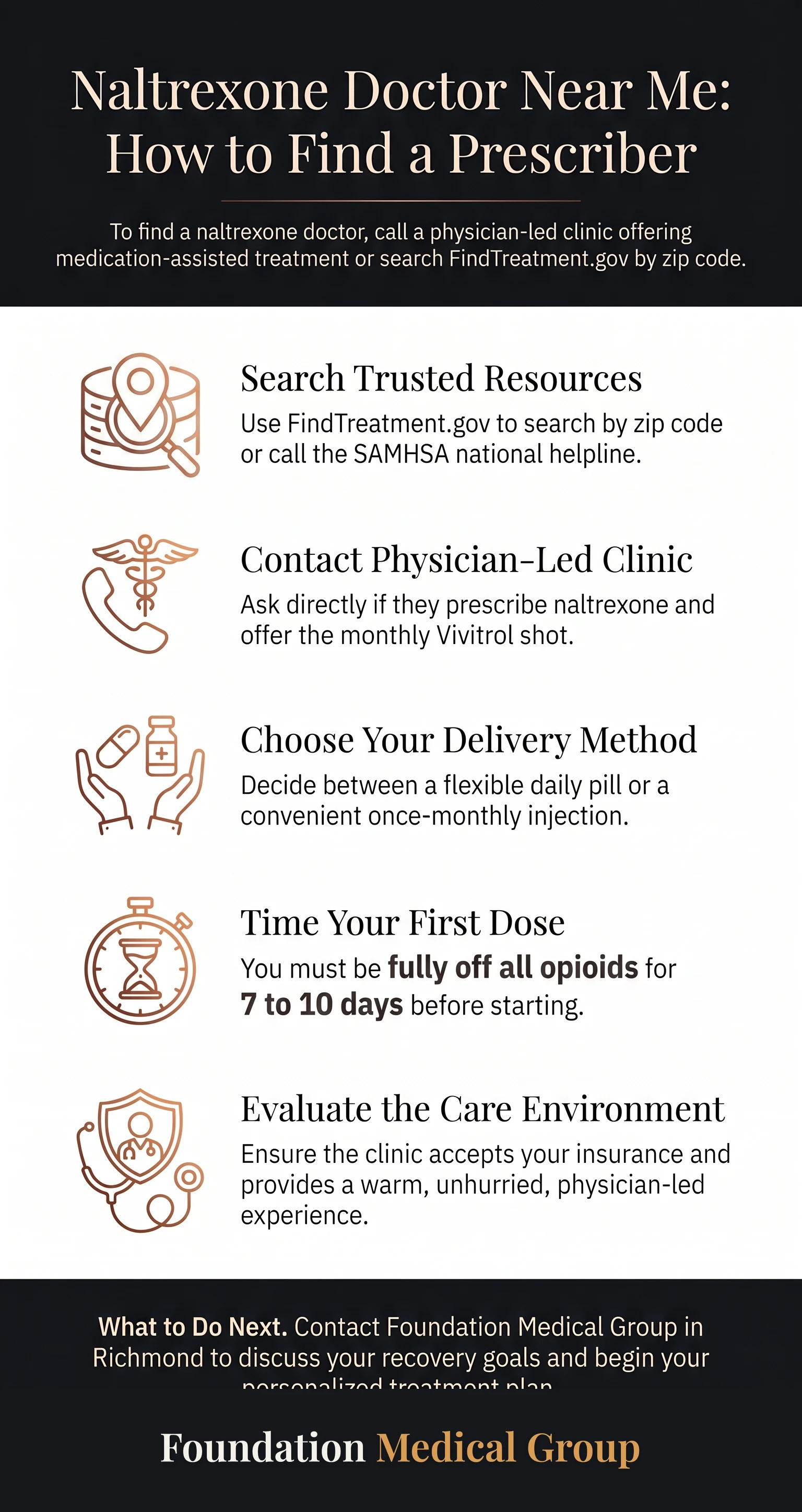
To find a naltrexone doctor near you, call a physician-led clinic that offers medication-assisted treatment and ask if they prescribe naltrexone. You can also search FindTreatment.gov by zip code. In Richmond, VA, Foundation Medical Group prescribes both the daily pill and the monthly Vivitrol shot.
If you’re searching for this, you have already taken a real step. It’s honest work to look for help, and we know it can feel scary. Below we explain what naltrexone is, how the pill and the shot differ, when it is safe to start, and how to find a prescriber you trust. We keep the words plain and the pressure off. Foundation Medical Group is a physician-led clinic in Richmond, Virginia, and we also serve Dallas, Texas.
What Is Naltrexone?
Naltrexone is a medicine that blocks the effects of opioids. It sits on your opioid receptors, the spots in your brain that opioids normally lock onto, and it keeps those drugs from working. If you use an opioid while taking naltrexone, you feel little or nothing. Over time, this helps break the cycle of opioid addiction.
Here’s the part that surprises many patients. Naltrexone is not an opioid. Unlike buprenorphine or methadone, it doesn’t cause a high and it doesn’t cause dependence. Instead of activating your receptors the way those medicines do, it simply blocks them. This makes it a good fit for people who want a medication treatment with no opioid in it at all.
According to the Substance Abuse and Mental Health Services Administration (SAMHSA), naltrexone is one of three medicines approved to treat opioid use disorder. The other two are buprenorphine and methadone. All three are real medicine, not a crutch. Anyone who tells you otherwise is repeating an old myth.
Naltrexone also treats alcohol use disorder. According to the U.S. Food and Drug Administration (FDA), it is approved for both opioid use disorder and alcohol use disorder. For example, a patient in our Richmond clinic might use the same medicine to stay off opioids and to cut back on heavy drinking days. So one medicine can support two different recovery journeys.
Pill or Shot: What Are My Options?
Naltrexone comes two ways, and both hold the same medicine. The first is a daily pill you take by mouth. The second is a once-monthly injection called Vivitrol, which a nurse gives you in the office.
Many patients prefer the shot, and the relief of skipping a daily pill is real. One dose lasts about a month, compared to 30 separate pill doses. Others like the pill because it’s flexible and easy to stop if a plan changes. Neither choice is wrong. Your doctor helps you pick the option that fits your life and your treatment plan.
Here is a simple side-by-side look at your treatment options.
| What to consider | Naltrexone pill | Vivitrol (monthly shot) |
|---|---|---|
| How you take it | By mouth, every day | One injection in the office |
| How often | Daily | Once a month |
| Good for | People who want daily control | People who want to skip the daily pill |
| Missed dose risk | Higher, since it is daily | Lower, since it lasts a month |
| Also treats alcohol use disorder | Yes | Yes |
Both forms work best as part of a full plan. Research from the National Institute on Drug Abuse (NIDA) shows that medicines for opioid use disorder work best when they’re paired with counseling and ongoing support. That’s why our MAT and Suboxone program pairs the prescription with regular check-ins. The medicine steadies your brain so you can do the deeper healing work.
When Is It Safe to Start Naltrexone?

Timing matters more with naltrexone than with most medicines. You must be fully off opioids before your first dose, usually about 7 to 10 days. This includes prescription medication like pain pills as well as street opioids.
Why the wait? Naltrexone pushes opioids off your receptors fast. If any opioid is still in your body, that sudden shove can cause severe opioid withdrawal all at once. It isn’t dangerous in a life-threatening way, but it feels awful, and thankfully careful timing prevents it. For instance, we ask about your last use, review your history, and may run a simple urine test before your first dose. This careful timing is a core part of good addiction medicine.
If you’re still using opioids and not ready for that 7 to 10 day gap, that’s okay. Other medicines, such as buprenorphine, can be started right away in early opioid withdrawal, rather than after a wait. Your doctor walks you through which path fits your body and your goals. There is no single right answer for each person living with opioid dependence.
How Do I Find a Naltrexone Doctor Near Me?
Finding the right prescriber doesn’t have to be hard. Here are simple steps that work.
- Look for a physician-led clinic. A clinic with doctors on staff can handle both the medical check and the prescription in one place. This matters because naltrexone needs careful timing.
- Ask the direct question. When you call, ask, “Do you prescribe naltrexone, and do you offer the Vivitrol shot?” A good clinic answers plainly.
- Use trusted search tools. The federal site FindTreatment.gov lets you search by zip code for clinics that treat substance use disorder. SAMHSA also runs a free, confidential national helpline at 1-800-662-HELP.
- Check insurance early. Ask if the clinic takes your health insurance or Medicaid, and ask about cost on the first call. Don’t let money stop you from reaching out.
- Notice how they treat you. The right treatment center meets you where you are. If a first call feels warm and unhurried, that is a good sign for your care.
In our experience, many clinics that offer naltrexone also treat mental health conditions like depression or anxiety at the same time. That combined care matters, because addiction and mental illness often travel together. Treating both works far better than treating one alone.
What Happens at Your First Visit?
Knowing what’s coming can take some of the fear out of it. Your first visit is mostly a conversation. Nobody is there to judge you.
A doctor asks about your health history and your last opioid use. You talk about what you’ve tried before and what you want now. If you drink alcohol, say so. Naltrexone treats alcohol use disorder too, so that detail shapes your plan.
Expect a short physical check and simple lab work. Your liver gets checked, because that’s where your body processes this medicine. A urine test may be used to confirm you’re clear of opioids.
Then you and your doctor choose a form. Pill or shot. If the timing isn’t right yet, you’ll leave with a safe plan to get there, not a lecture. Bring your insurance card, a list of your current medications, and any questions you wrote down. No question is too small to ask.
Key Takeaways
- Naltrexone is a medicine that blocks the effects of opioids and also treats alcohol use disorder. It is not an opioid.
- It comes as a daily pill or a once-monthly injection called Vivitrol. Both hold the same medicine.
- You must be fully off opioids, about 7 to 10 days, before your first dose, so you avoid sudden withdrawal.
- To find a prescriber, call a physician-led clinic, ask directly, and use FindTreatment.gov or the SAMHSA helpline.
- The medicine works best with counseling and regular check-ins as part of a full treatment plan.
Talk With Us in Richmond
You don’t have to sort this out alone. If you live in Richmond, Midlothian, or the wider Central Virginia area, Foundation Medical Group can help you decide whether the naltrexone pill or the Vivitrol shot fits your recovery. We’re a physician-led clinic, and we take the time to explain each step in plain words.
Reach out when you’re ready. One calm phone call is enough to begin. We check your history, answer your questions, and build a treatment plan around you, not a fixed script. Your care is private, and your next step can start today.
Sources
- Substance Abuse and Mental Health Services Administration (SAMHSA), Medications for Substance Use Disorders: samhsa.gov.
- National Institute on Drug Abuse (NIDA), Medications to Treat Opioid Use Disorder: nida.nih.gov.
- U.S. Food and Drug Administration (FDA), Information about Medications for Opioid Use Disorder: fda.gov.
- American Society of Addiction Medicine (ASAM), National Practice Guideline for the Treatment of Opioid Use Disorder: asam.org.