
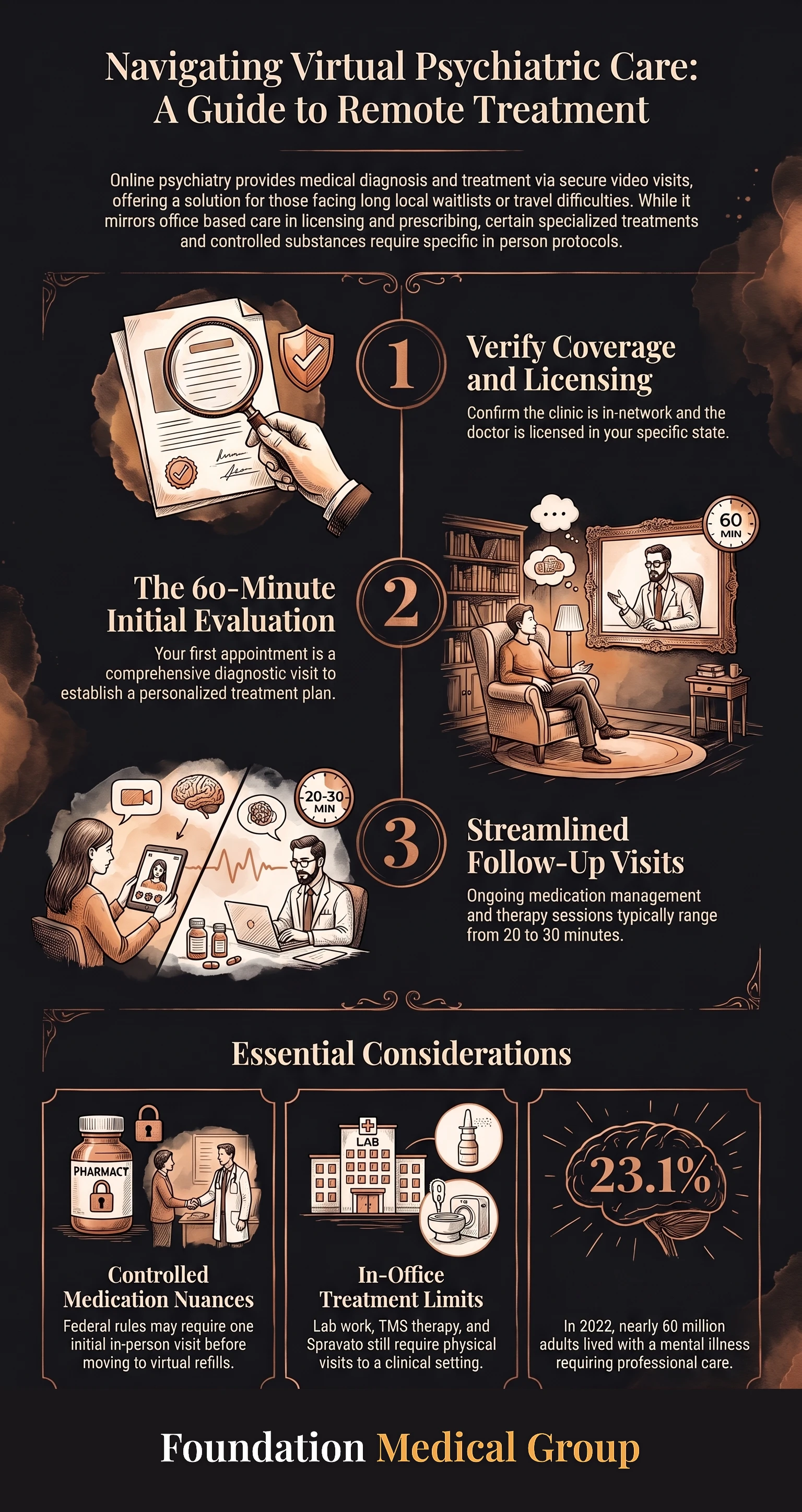
An online psychiatrist is a medical doctor who diagnoses and treats mental health conditions through secure video visits. You book a psychiatric evaluation, meet on screen, and leave with a plan that may include medication, therapy, or both. To find one close to home, check your insurance list first, then confirm the doctor holds a license in your state.
People search for an online psychiatrist near me for two plain reasons. The local wait list is long, or getting to a clinic is hard. Both problems have answers. Here is how virtual psychiatric care actually runs, what it costs, and when you still need to be in the room.
What does an online psychiatrist do?
The same job as one down the street. The visit simply happens on a screen.
A psychiatrist is a physician. Training runs four years of medical school, then roughly four more years of residency in psychiatry. The American Psychiatric Association describes psychiatrists as medical doctors who specialize in mental health, including substance use. That medical background is why a psychiatrist can order lab work, name a mental health condition, and prescribe medication.
Day to day, the work looks like this:
- Listening to your history and your symptoms, without a stopwatch running.
- Ruling out physical causes, such as a thyroid problem or untreated sleep apnea.
- Naming what is going on, so it stops feeling like a mystery.
- Starting medication, then adjusting the dose based on how your body responds.
- Talking with your therapist and your family doctor so the plan holds together.
Your first appointment is a psychiatric evaluation. At Foundation Medical Group it runs up to 60 minutes, whether you drive to our Richmond office or join from your kitchen table. Later psychiatry visits are shorter, usually 20 to 30 minutes.
Is online psychiatry as good as an in-person visit?
For routine psychiatric care, yes for most patients. Video removes the drive, the parking garage, and the half day off work. What it can’t do is take your blood pressure or run a machine.
Here is the split we found across our own clinics.
| What you need | Video visit | In-person visit |
|---|---|---|
| First psychiatric evaluation | Works well | Works well |
| Medication follow up and dose changes | Strong fit | Fine, rarely necessary |
| Talk therapy sessions | Strong fit | Better if home is not private |
| Blood pressure, weight, blood draws | Not possible | Required |
| TMS therapy or Spravato | Not possible | Required |
| Some controlled medication starts | Limited by rule | Usually required |
| Openings this week | Often sooner | Depends on the office |
Notice the pattern. Talking care travels well over video. Hands-on care does not.
One thing surprised us when we started offering telehealth. Our patients showed up more often. A 9 a.m. slot is easy to keep when the commute is a hallway, and steady follow ups matter more for better mental health than any single appointment does.
Which conditions does telehealth psychiatry treat?
Most of them. According to the National Institute of Mental Health, an estimated 59.3 million U.S. adults were living with a mental illness in 2022, which works out to 23.1% of adults.
Video suits major depressive disorder, generalized anxiety disorder, panic disorder, bipolar disorder, obsessive compulsive disorder, post traumatic stress, and adult attention problems. It also suits substance use disorder, which so often travels beside a mood disorder.
Some situations still call for the office. Active psychosis, a severe eating disorder, or a medication that needs close physical monitoring belong in a room with a clinician. If your mental health issue sits in that group, our team will say so early rather than let you find out three visits in.
How do I find an online psychiatrist near me?
Five steps, in this order.
- Call your insurance first. Ask which online psychiatry services are in network for your plan. That single call is the difference between a copay and a bill you did not expect.
- Check the state license. A psychiatrist must hold a license where you are physically sitting during the visit. Foundation Medical Group is licensed in Virginia, Utah, Georgia, and Texas, so patients in Richmond, Midlothian, Dallas, American Fork, and Atlanta can all be seen by video.
- Use the free federal directory. FindTreatment.gov, run by the Substance Abuse and Mental Health Services Administration, lists mental health services by zip code and shows which ones take your coverage.
- Decide who you need. Some patients want a prescriber only. Others want counseling too. If you are unsure, our guide to finding a psychiatrist near me walks through the difference.
- Ask what happens between visits. Find out who answers the phone on a Tuesday afternoon when a side effect worries you.
If you already have a diagnosis and only need refills and check ins, ongoing medication management is usually faster to start than a full new-patient workup.
Can an online psychiatrist prescribe medication?
Yes, and this is the part people most often doubt.
After a video evaluation, a psychiatric provider can prescribe antidepressants, mood stabilizers, sleep aids, and most other psychiatric medication straight to your pharmacy. The prescription is identical to the one you would get in the office. Your doctor watches for side effects at follow ups and adjusts from there.
Controlled medication is the exception. Stimulants for attention problems and certain other drugs sit under stricter federal and state rules, and those rules have shifted several times since 2020. Some starts need one in-person visit before refills can move to video. Ask the clinic to spell out what applies to your specific medication before your first appointment, rather than after.
Two more honest limits. An online psychiatrist cannot draw the blood needed to check a lithium level, so you will visit a lab. And treatments delivered in a chair, such as TMS therapy or Spravato, are office work by definition.
What does online psychiatry cost?
Less than people assume, usually.
With insurance, you pay a copay per visit, or the full contracted rate until your deductible is met. First evaluations cost more than follow ups because they take longer. Most commercial plans, Medicare, and the Medicaid programs we take pay for telehealth on par with office visits, though your specific benefit is worth confirming by phone.
Without insurance, ask three questions:
- Do you have a self pay rate for a psychiatry appointment?
- Do you offer a sliding scale based on income?
- Can the cost be spread across visits?
Community mental health centers and federally qualified health centers set fees by income, and FindTreatment.gov lists both. Virginia routes that support through its Community Services Boards. Texas uses Local Mental Health Authorities. Utah and Georgia run county-level programs of their own, and your local health department can point you to the right one.
Do you need an online psychiatrist or a therapist?
This trips up a lot of first-time callers. The dividing line is medication.
| Provider | Training | Prescribes? | Main focus |
|---|---|---|---|
| Psychiatrist | Medical doctor, MD or DO | Yes | Diagnosis and psychiatric medication |
| Psychiatric nurse practitioner | Advanced nursing degree | Yes | Prescribing and psychiatric services |
| Psychologist | Doctoral degree, PhD or PsyD | No | Testing and psychotherapy |
| Licensed professional counselor | Master’s degree | No | Online therapy and counseling |
Plenty of patients work with two people at once. A licensed therapist every week or two, a prescriber every month or three. Cognitive behavioral therapy teaches you to catch a thought, test it, and choose what you do next. Medicine can turn the volume down far enough that those skills stick.
At our clinics, psychiatric nurse practitioners often carry the follow up schedule alongside our physicians. Both are trained mental health professionals with the same prescribing authority in the states we serve. If the wait to see a psychiatrist is three weeks and a nurse practitioner has Thursday open, take Thursday.
Finding the right therapist takes a couple of tries sometimes, and that’s normal rather than a failure.
What happens at your first video visit?
Nothing frightening. There is no test to pass.
The doctor asks about your symptoms, your sleep, your work, your history, and the people around you. Some questions feel personal. You can say you’d rather not answer yet. By the end you will have a treatment plan, a list of what to watch for, and a date to come back.
Have these ready before you click the link:
- Every medication and supplement you take, including doses.
- Your insurance card and a photo ID.
- Notes on when symptoms started and what makes them worse.
- Your pharmacy name and address.
- The questions you don’t want to forget in the moment.
Confirm the address you are calling from, too. Clinics are required to check which state you are in at each telehealth appointment, and it saves an awkward pause mid-visit.
How do you make a video visit work well?
Small things change how much you get out of the hour.
- Sit somewhere private. A parked car works better than a shared kitchen.
- Use headphones. Sound quality shapes how well you are understood.
- Test the link 10 minutes early instead of at the start time.
- Put your face in decent light, with the window in front of you.
- Keep a notepad open. You will forget the dose change otherwise.
If your connection drops, most psychiatric clinicians will finish the appointment by phone. Ask about that backup when you book, because it happens more than you would think.
When should you skip video and be seen sooner?
Some things should not wait for the next open slot. Ask for an urgent appointment if you can’t work or care for your family, if panic keeps hitting you out of nowhere, or if a medication is causing side effects you cannot live with.
If you are thinking about hurting yourself, don’t wait for an appointment at all. Call or text 988 to reach the Suicide and Crisis Lifeline, any hour of any day. The free SAMHSA National Helpline at 1-800-662-4357 is also staffed around the clock. An urgent care clinic can look at a physical side effect quickly, though it isn’t the place for mental health support of the ongoing kind.
Key Takeaways
- An online psychiatrist holds the same medical license as an office-based one and can prescribe medication after a video psychiatric evaluation.
- Check two things before booking: whether the clinic is in network, and whether the doctor is licensed in the state you will be sitting in.
- Telehealth psychiatry fits evaluations, medication follow ups, and therapy. Lab work, TMS therapy, and Spravato still need the office.
- Controlled medication follows stricter rules, so ask whether your first visit must be in person.
- Most commercial plans, Medicare, and participating Medicaid programs cover video visits at office rates.
- A telehealth psychiatrist prescribes, while a counselor or psychologist provides therapy. Working with both is common.
- FindTreatment.gov and your insurer’s directory are the two fastest free tools for finding care nearby.
Foundation Medical Group is a physician-led practice offering psychiatry, therapy, and addiction care in Richmond and Midlothian, Virginia, Dallas, Texas, American Fork, Utah, and Atlanta, Georgia. Our telepsychiatry services reach patients anywhere in those four states, and our telehealth page explains how visits run. Whether you need one evaluation or comprehensive care over years, we would be glad to help you take the next step toward steady mental wellness.
Sources
- National Institute of Mental Health, Mental Illness Statistics, the 2022 prevalence figures for U.S. adults.
- American Psychiatric Association, What Is Psychiatry, how psychiatrists train and what they treat.
- SAMHSA National Helpline, free and confidential help, 24 hours a day.
- FindTreatment.gov, the federal directory for mental health and substance use care.