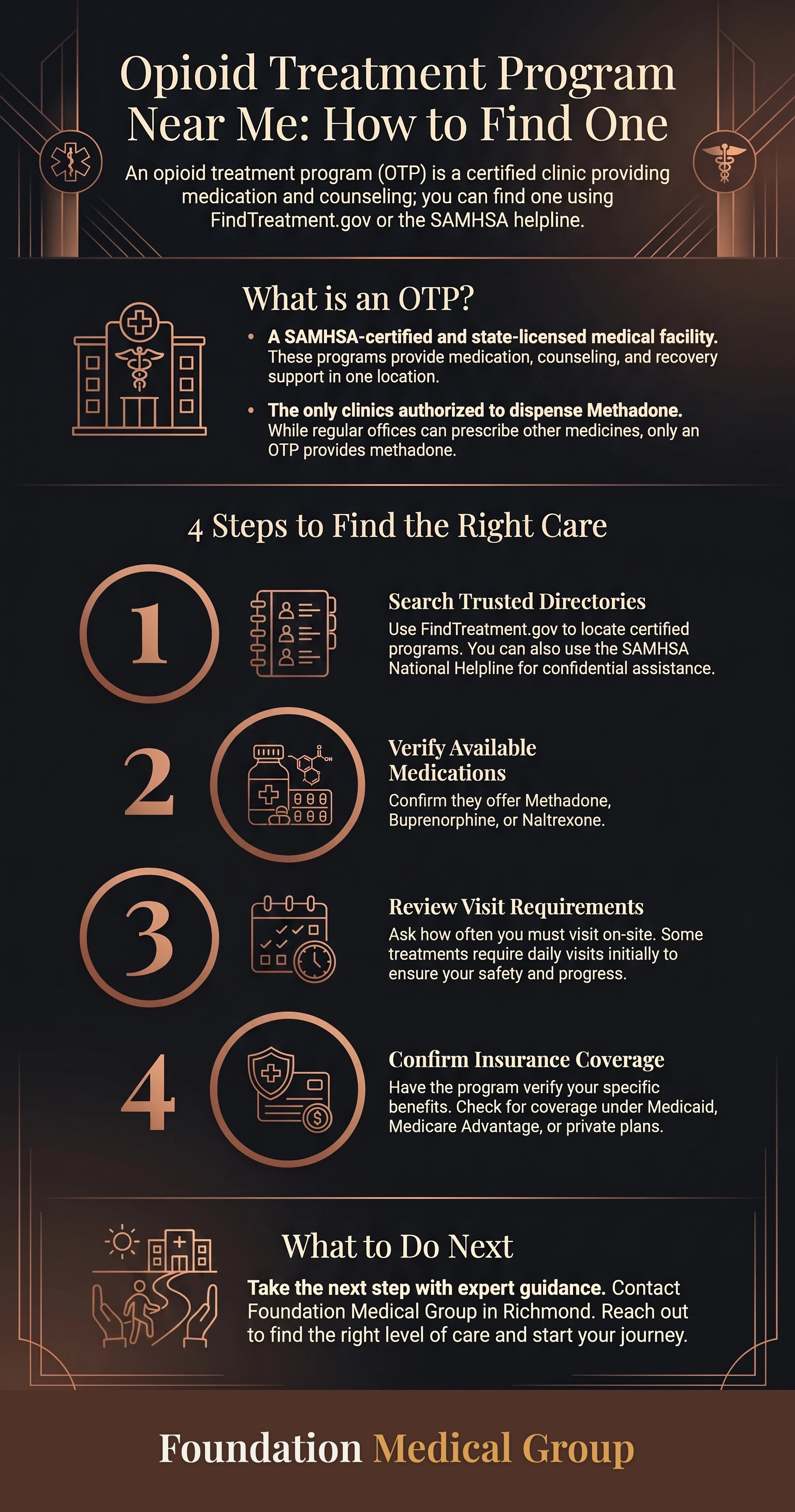
Typing “opioid treatment program near me” into a search bar takes courage, so here’s the short answer. An OTP is a clinic that SAMHSA certifies and your state licenses. It offers medicine for opioid addiction, counseling, and support in one place. Start your search at FindTreatment.gov, or call 1-800-662-HELP (4357) any time.
Maybe you’re looking for yourself. Maybe you’re looking for a son, a sister, or a friend you’ve been worried about for months. Either way, this page keeps things plain. Here’s what these clinics do, how they compare with a regular doctor’s office, and what to ask before you walk in.
What Is an OTP, and Why Does Certification Matter?
Opioid treatment programs, or OTPs, are clinics that carry two stamps of approval. The first comes from the Substance Abuse and Mental Health Services Administration, better known as SAMHSA. The second comes from your state, usually through a state opioid treatment authority.
Why all the paperwork? Methadone treatment for opioid addiction happens at a certified clinic, not at your corner pharmacy. Doctors in the US have used this medicine since the 1970s, so it carries more than 50 years of research behind it. This is settled care, not an experiment.
Some people still say methadone clinic. The name is dated. A good clinic looks after the whole person: your medicine, your mental health care, and the parts of life that got hard along the way.
This is one form of medication assisted treatment. According to SAMHSA, pairing medicine with counseling is the standard of care for opioid addiction. It isn’t a crutch, and it isn’t trading one drug for another. It’s treatment.
Which Medicines Does an OTP Offer?
Three medicines are FDA-approved for opioid use disorder. That’s the clinical name for this condition, and it sits inside a wider group called substance use disorder. Your care team helps you pick the treatment option that fits your health, your job, and your goals.
- Methadone. It eases cravings and withdrawal symptoms so the day feels workable again. It acts on the same opioid receptors that other opioids do, but slowly and steadily. At first you come in each morning. Federal rules updated in 2024 made take-home doses easier to earn once you’re stable.
- Buprenorphine. Often sold as Suboxone, it calms cravings and withdrawal too. The FDA approved it for opioid dependence in 2002. Here’s the part many folks miss: a regular office can prescribe it, and you fill it at a pharmacy.
- Naltrexone. This one blocks the effect of opioids instead of easing withdrawal. The shot lasts about 4 weeks, so some patients come in 13 times a year and that’s it.
Research from the National Institute on Drug Abuse (NIDA) shows that medication cuts the risk of dying from an opioid overdose. Keep naloxone at home as well. That nasal spray reverses an opioid overdose while you wait for help, and it has been sold over the counter since 2023.
OTP or Office-Based Care: Which One Fits You?
Both settings treat opioid addiction. What changes is which medicine you get, where you get it, and how often you show up.
An OTP dispenses methadone on site. An office-based provider writes a prescription for buprenorphine that you fill at your pharmacy. Compared with daily clinic visits, that route asks a lot less of your week. Neither path is a lesser path.
| What to compare | Certified OTP | Office-based provider |
|---|---|---|
| SAMHSA certification | Required | Not required |
| Dispenses methadone | Yes | No |
| Offers buprenorphine | Yes | Yes |
| Where you get medicine | On site at the clinic | Your own pharmacy |
| Visits in month one | Often daily | Usually weekly or less |
| Counseling on site | Yes | Sometimes, or by referral |
| Best fit when | You want daily structure | You need to work around a job |
Some people start at an OTP for the daily rhythm, then step down to office care once life steadies. Others do fine in an office from day one. A MAT clinic near you can help you sort out which one fits.
What Level of Care Do You Need?
Not every person needs the same intensity of treatment, and you can move between levels as things change.
- Outpatient treatment. You live at home and come in for visits. Most people start here, and plenty stay here for good.
- Intensive outpatient program. An IOP adds more hours each week, often 9 or more, with group work and individual therapy.
- Residential treatment. You stay at a facility for a stretch of time. This helps when home isn’t safe or steady yet.
A health care provider can also screen you for alcohol use disorder or other drug use at the same visit. Substance use rarely travels alone. Plenty of patients carry a second substance use disorder, plus anxiety, depression, or old trauma underneath. Good treatment services look at all of it together instead of one piece at a time. Ask any clinic whether they handle substance use and mental health under one roof.
How Do I Find an Opioid Treatment Program Near Me?
Here’s a calm way to start. One step at a time, and you can stop at any point and pick it up tomorrow.
- Search a trusted directory. FindTreatment.gov lists certified clinics by ZIP code. The SAMHSA National Helpline is free and confidential at 1-800-662-HELP (4357), open 24 hours a day, 365 days a year, in English and Spanish.
- Ask which medicine they offer. Not every clinic carries all three, and the right treatment depends on your history.
- Ask about visits. Find out how often you’d come in during month one, and whether they open early enough for your shift.
- Check insurance. Ask whether they take Medicaid, Medicare Advantage, or United Healthcare, and have them run your benefits before you start.
- Notice how they treat you. Respect matters. If the first call feels cold, call the next clinic on your list.
Wait times are real, so ask to be put on a waiting list while you keep calling. If a daily program is more than you need, physician-led addiction treatment in an office setting may suit you better. Steady outpatient care you can actually keep up with beats intense care you quit in three weeks.
What Happens at Your First Visit?
Mostly listening. Your provider asks about your health, your history with opioids and other substance use, and what you want your life to look like a year from now. Bring your insurance card and a list of every medicine you take.
Then you build a personalized treatment plan together. That plan pairs medication with behavioral therapy, individual therapy, or a group, depending on what you need. Recovery support such as peer coaching may sit alongside it. You leave with a written plan and one clear next step.
Many of our patients say the first phone call was the hardest part. After that, it’s paperwork and a conversation. Thankfully, you don’t need every answer on day one. Bring your questions, and bring the messy parts too. Your team has heard them before.
How Long Will You Stay on Medication?
As long as it helps. Treatment length is a personal call, not a fixed sentence. The American Society of Addiction Medicine sets no time limit on opioid use disorder treatment, and stopping early raises the risk of return to use. Some patients stay on medication for a year. Others stay for many years, the same way someone stays on medication for blood pressure.
That choice belongs to you and your provider. A good clinic won’t push you off medicine before you’re ready, and it won’t keep you on it without a plan you understand.
Key Takeaways
- An OTP is certified by SAMHSA and licensed by your state, and it offers medication, counseling, and recovery support in one place.
- Methadone is dispensed at a certified clinic, usually daily at first, while an office-based provider can prescribe buprenorphine you fill at a pharmacy.
- Naltrexone, a monthly shot, blocks the effect of opioids and suits people who are already off them.
- Opioid addiction treatment lowers the risk of overdose death, and there’s no set finish line for how long you stay on it.
- To find care, use FindTreatment.gov or the SAMHSA helpline, then ask about medicine, visits, insurance, and how the staff treat you.
You Don’t Have to Do This Alone
Reaching out takes more courage than most people realize, and you’ve already started. Whether you need a certified clinic for daily dosing or an office setting for buprenorphine, the goal stays the same: steady, respectful care that fits your real life.
Foundation Medical Group is a physician-led outpatient clinic in Richmond, Virginia. Our team handles addiction care and mental health care together, without judgment and without lectures. If you’re ready to talk, or you just have questions, call us. We’ll help you find the right level of opioid addiction treatment and take the next step with you.
Sources
- Substance Abuse and Mental Health Services Administration (SAMHSA), National Helpline and FindTreatment.gov: samhsa.gov.
- National Institute on Drug Abuse (NIDA), Medications to Treat Opioid Use Disorder: nida.nih.gov.
- American Society of Addiction Medicine (ASAM), National Practice Guideline for the Treatment of Opioid Use Disorder: asam.org.
- U.S. Food and Drug Administration (FDA), Information about Medication-Assisted Treatment: fda.gov.