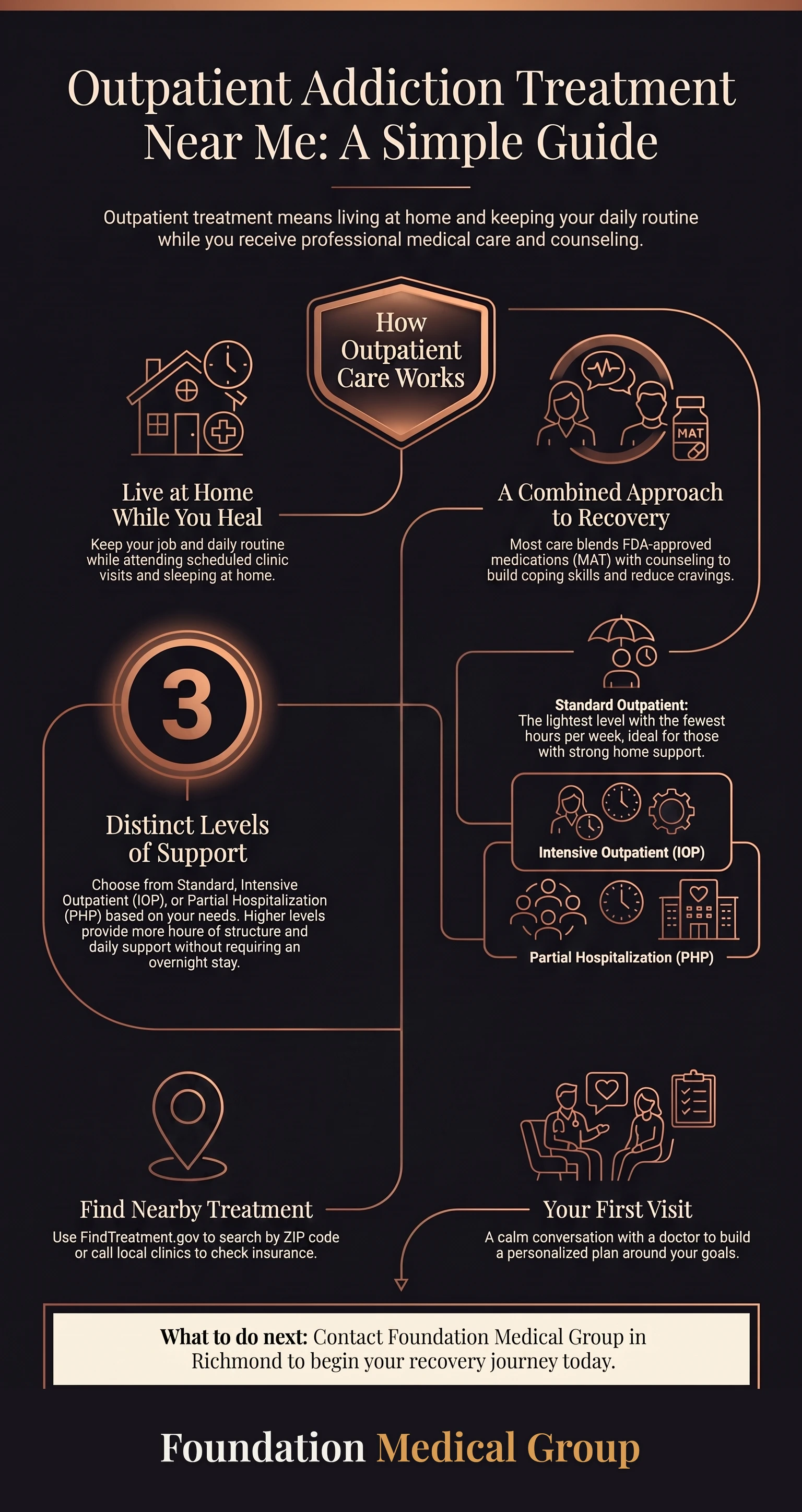
If you’re searching for outpatient addiction treatment near me, here’s the short answer. You live at home, come to a clinic for scheduled visits, and keep your job and your routine while you heal. Care usually blends medicine with counseling. Call a local clinic or search the free federal tool at FindTreatment.gov to find a program close by.
Looking for help isn’t a small thing, and reaching this page means you’ve already started. Below we walk through how these programs work, the levels of care, what a first visit feels like, and how to pick a place you can trust with your recovery. Plain words, no pressure. Foundation Medical Group is a physician-led addiction treatment center in Richmond, Virginia, serving Richmond, Midlothian, and Central Virginia, and we also see people in Dallas, Texas.
What Does Outpatient Treatment Actually Mean?
Outpatient treatment is care you attend while you keep living at home. There’s no overnight stay. You come in for set visits, then head back to your own bed, your own kitchen, and your own people.
Addiction is a health condition, not a failure of willpower. Doctors call it a substance use disorder. According to the National Institute on Drug Abuse, it’s a treatable medical illness that changes how the brain handles reward and stress. Like asthma or high blood pressure, it responds to treatment and it needs follow-up.
Most programs blend two main parts:
- Medicine. For opioid or alcohol use disorder, a doctor may prescribe an FDA-approved medicine such as buprenorphine, naltrexone, or Vivitrol. This is called medication assisted treatment, often shortened to MAT. A buprenorphine or naltrexone pill is taken daily, while Vivitrol is a long-acting shot given about once a month. The medicine quiets cravings so your mind is free for the harder work.
- Counseling. You meet a therapist for talk therapy, often cognitive behavioral therapy. Sessions help you spot triggers, build coping skills, and hold on to lasting recovery.
Used together, medicine and counseling give steadier footing than either one alone.
You’ll also run into older language in this field. Some clinics still say substance abuse treatment or drug addiction on their signs, and older directories still list programs under those names. Clinicians now say substance use disorder, because the word abuse blames the person instead of naming the illness. If substance abuse is the phrase that brought you here, you’re in the right place either way. What’s written on the door matters far less than the care behind it.
How Is Outpatient Rehab Different From Inpatient Drug Rehab?
The difference is where you sleep. In inpatient treatment, sometimes called residential drug rehab, you live at the treatment center for a stretch of weeks. In outpatient rehab, you go home at the end of every visit.
One isn’t ranked above the other. Inpatient rehab suits people who need to step fully away for a while, or whose home isn’t safe or steady right now. Staying home suits people who have a safe place to sleep and want to keep working, studying, or parenting while they get well.
There’s a practical difference too. Residential drug rehab often means unpaid time off and a childcare gap. Outpatient programs are built around your week instead of replacing it. For plenty of families that’s the deciding factor, and it’s a fair one. Money and childcare are real.
Plenty of people type drug rehab into a search bar when what they want is help, any kind of help. Drug rehab is a broad word. It covers residential stays, outpatient programs, detox units, and long-term recovery housing. So when you compare drug rehab options, ask what level of care a place actually provides rather than what it calls itself. Rehab isn’t one building or one schedule. Ask a treatment center what a normal week looks like, then ask the next treatment center the same question and compare the two answers.
Some people do both. They finish a residential drug rehab stay, then step straight into a clinic schedule to protect what they built there.
What Are the Levels of Outpatient Care?
This kind of care isn’t one single thing. It comes in levels, and the difference between them is how many hours you spend at the clinic each week. Higher levels add more hours and more support.
The ASAM Criteria, the standard framework used across addiction medicine in the United States, sorts them like this:
- Standard outpatient. The lightest level, under 9 hours of scheduled care a week for adults. Usually counseling plus a medication check. It fits people with steady support at home.
- Intensive outpatient program (IOP). A step up, at 9 or more hours a week. An intensive outpatient program adds group sessions and more structure while you still sleep in your own bed.
- Partial hospitalization (PHP). The heaviest of the three, at 20 or more hours a week. You spend most of the day at the clinic, then go home at night.
How the Levels Compare
The table below shows how the three levels differ. Use it as a rough guide. Your doctor tunes the plan to you, not to a chart.
| Level of care | Hours per week | Where you sleep | Often a good fit for |
|---|---|---|---|
| Standard outpatient | Under 9 | Home | Steady support at home, keeping a full work schedule |
| Intensive outpatient (IOP) | 9 or more | Home | Needing real structure while staying at work or school |
| Partial hospitalization (PHP) | 20 or more | Home | Close daily support without an overnight stay |
Notice what every row shares. You sleep at home. That’s the heart of this model, even at the heaviest level.
Your care team helps you pick. The choice rests on your health, your history, and how much support you have around you. It’s common to start at one level and step down as your recovery gets steadier. One patient might begin in PHP after a rough stretch, move to intensive outpatient a few weeks later, then settle into short weekly visits. That isn’t sliding backwards. That’s progress.
What Should I Expect at My First Visit?

Your first visit is a conversation, not a test. A doctor or a member of the care team sits with you and asks about your history, your health, and what you want your life in recovery to look like. Walking in that first day can feel scary. That’s normal, and we’d rather you arrive nervous than not arrive at all.
From there the team builds a treatment plan around you. That’s what personalized treatment planning means in practice. Your treatment plan may include:
- A medical check to see whether medicine fits, such as buprenorphine for opioid use disorder or naltrexone for alcohol use disorder.
- A counseling schedule matched to the level you start at.
- A look at sleep, any prescription drugs you already take, and other health conditions.
- A role for family or a trusted friend, if that’s something you want.
Bring a photo ID, your insurance card, and a list of prescription drugs and doses if you have one. If you don’t have any of that, come anyway. Showing up matters more than the paperwork, and our team can sort the rest out with you.
What If I’m Facing Addiction and a Mental Health Condition?
This happens often, and it has a name: co-occurring disorders, sometimes called dual diagnosis. Anxiety, depression, PTSD, and bipolar disorder sit alongside substance use for a large share of our patients. Treating one and ignoring the other tends to leave you half-well.
Strong behavioral health programs handle both at once. Your mental health team and your addiction team talk to each other, or better still, they’re the same team. Mental health treatment might mean therapy, psychiatric medicine, or both together with your recovery plan.
Mental illness carries its own weight of shame, and stacking it on top of drug use can feel like too much to say out loud. You don’t have to explain it perfectly. Say what you can, and the mental health side of your care team will ask the rest. Nothing you describe in that room is new to us.
Foundation Medical Group offers addiction care and mental health care under one roof, so your mental health notes and your recovery notes sit in the same chart. Behavioral health and addiction medicine work better in one building than in two. If depression or anxiety is part of your story, our guide on Suboxone with depression and anxiety goes deeper into how the two are treated side by side.
Where Does Sober Living Fit In?
Sober living homes are shared houses where residents stay substance free, split the chores, and keep each other honest. They aren’t treatment. There’s no doctor on staff and no therapy group in the living room.
Sober living pairs well with a clinic schedule. You attend visits by day and go back to a steady, drug free house at night. For someone whose home life makes early recovery hard, sober living can be the piece that holds everything else up.
Ask about house rules, weekly cost, and whether the home works with your program. A sober living house that talks to your clinic is worth more than one that doesn’t.
Will Insurance Cover Outpatient Treatment?
Usually, yes. Most private plans and Medicaid cover substance use disorder treatment and mental health care, and federal parity rules require many plans to cover them on terms similar to other medical care.
Call the number on the back of your insurance card and ask three things: is this clinic in network, what’s my copay per visit, and do I need a referral. Then call the clinic and ask the same questions, including whether mental health visits and substance use visits share one deductible. If you have no insurance, ask about sliding scale fees before you rule a place out. Cost stops more people from starting recovery than fear does, and cost is the part a clinic can usually help with.
How Do People Stay in Recovery After a Program Ends?
Recovery doesn’t stop on your last scheduled visit. Most people step down slowly. Heavier hours, then lighter ones, then a monthly medication check and a therapist they can call when things wobble.
Setbacks happen, and a return to drug use isn’t proof that treatment failed. According to the National Institute on Drug Abuse, 40 to 60 percent of people in recovery from a substance use disorder return to use at some point, close to the relapse rates reported for asthma and high blood pressure. Doctors treat those illnesses by adjusting the plan, not by giving up on the patient. Drug addiction deserves the same response. Recovery gets measured in months and years, not in one clean week.
A few plain habits protect lasting sobriety:
- Staying on medicine for as long as it helps, instead of stopping the week you feel fine.
- Keeping one counseling appointment on the calendar even in good months.
- A short list of people who know the real story.
- A written plan for hard days, made before the hard day arrives.
Sobriety built this way tends to hold, because it doesn’t depend on willpower alone.
How Do I Find Outpatient Addiction Treatment Options Near Me?
There are two simple routes.
First, call a nearby clinic. One phone call tells you which treatment programs they run, whether they take your insurance, and how soon you can start. If medicine is part of what you need, ask whether they operate a MAT clinic on site or send you elsewhere for it. Our broader addiction treatment guide covers what else to look for.
Second, use public tools. The federal FindTreatment.gov locator searches by ZIP code and filters nearby treatment centers by the substance use and mental health services they list. You can also call the Substance Abuse and Mental Health Services Administration (SAMHSA) National Helpline at 1-800-662-4357, which is free, confidential, and staffed 24 hours a day, 365 days a year.
When you compare treatment programs, these questions sort the solid from the vague:
- Do you offer standard outpatient, IOP, and PHP levels?
- Do you provide medicine along with counseling?
- Do you take my insurance or Medicaid?
- How soon can I book a first visit?
- What happens if I miss a week?
If opioids are the issue, an opioid treatment program may be the cleanest fit.
Key Takeaways
- Outpatient treatment lets you live at home and keep your job while you get real medical care.
- Care usually pairs medicine, such as buprenorphine, naltrexone, or Vivitrol, with counseling.
- The three levels are standard outpatient (under 9 hours a week), IOP (9 or more), and PHP (20 or more).
- Addiction and a mental health condition are treated together, not one after the other.
- Sober living and family support hold up your recovery alongside treatment, not in place of it.
- Call a clinic or search FindTreatment.gov to find a program near your home.
You Can Start Close to Home
Recovery doesn’t mean leaving your whole life behind. That’s the point of this model. Real treatment, your own bed, your own routine, your own people.
If you’re in Richmond, Midlothian, or anywhere in Central Virginia, Foundation Medical Group is here. We’re a physician-led clinic offering addiction treatment and mental health support in Richmond, VA, and we also serve Dallas, Texas. Call us to book a first visit. You don’t need to have it all figured out before you pick up the phone. Showing up is enough, and we’ll walk the rest of it with you.
Sources
- Substance Abuse and Mental Health Services Administration (SAMHSA) - National Helpline, 1-800-662-4357, free and confidential, 24 hours a day, 365 days a year.
- National Institute on Drug Abuse (NIDA) - Drugs, Brains, and Behavior: The Science of Addiction, on relapse rates and long-term care.
- American Society of Addiction Medicine (ASAM) - The ASAM Criteria, the levels-of-care standard used in addiction treatment.
- FindTreatment.gov - Federal locator for substance use and mental health services by ZIP code.