
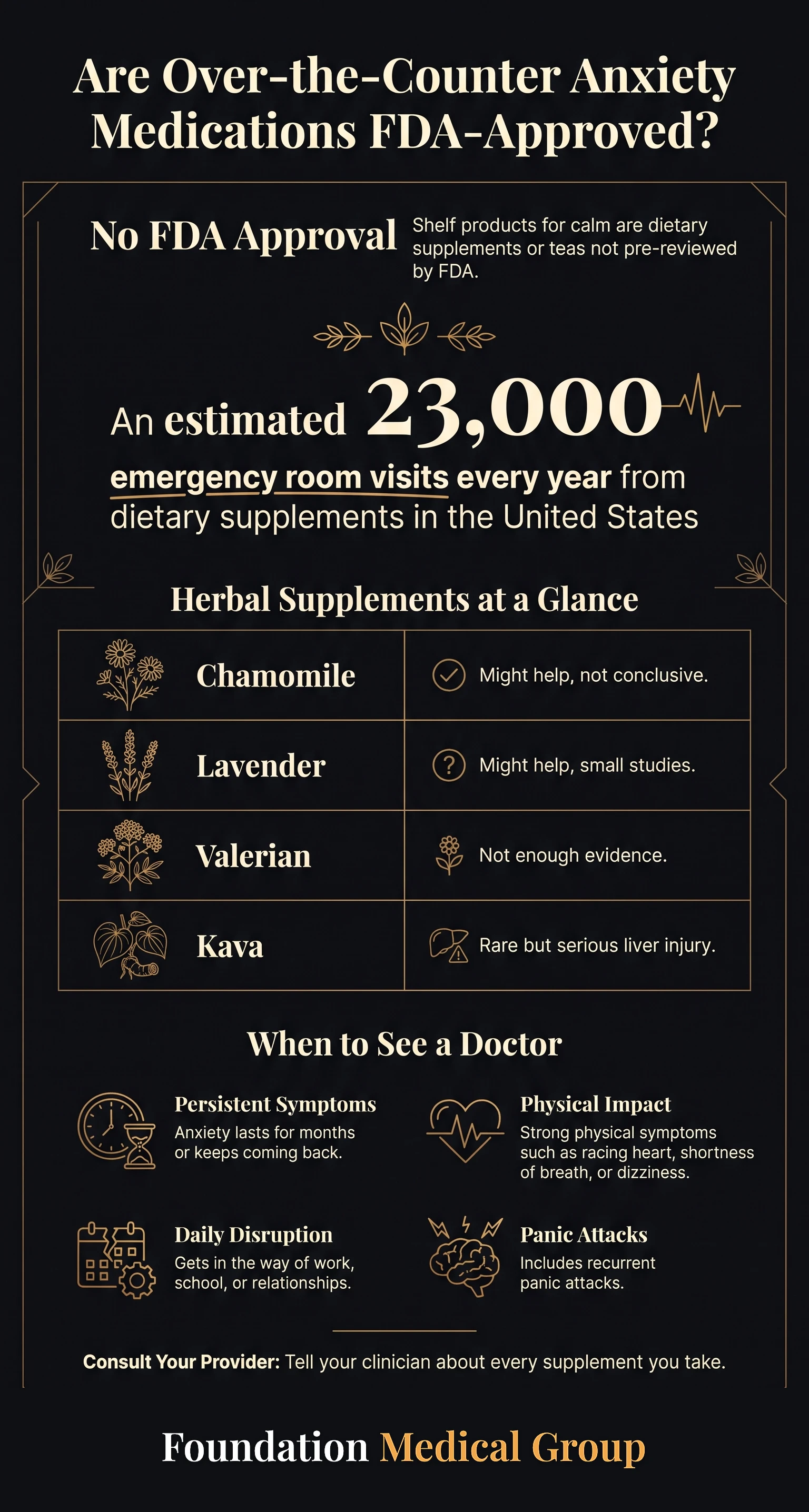
There’s no over the counter anxiety medication approved by the FDA. What you find on the shelf for stress or calm is a dietary supplement or a tea. And the FDA is not authorized to review dietary supplements for safety and effectiveness before they are marketed. A few have early evidence. Some carry real risks. None replaces treatment for an anxiety disorder.
What Is Over the Counter Anxiety Medication?
People use the phrase “over the counter anxiety medication” for anything sold without a prescription that promises calm. Think herbal supplements, amino acids such as L-theanine, teas and blends. None of these is an approved OTC anxiety medication. They’re sold as foods or dietary supplements, not as anxiety medications.
The medicines used to treat anxiety disorders are prescription medicines. For generalized anxiety disorder, health care providers may prescribe antidepressants such as SSRIs and SNRIs. They may also prescribe anti-anxiety medications such as benzodiazepines and buspirone, according to the National Institute of Mental Health. Each needs an evaluation first and follow-up after.
Been trying products on your own and still feel anxious most days? That’s frustrating, we know. A psychiatric evaluation is a good place to start. You can bring the bottles with you. The whole grocery bag of them, if that’s what it takes.
Why Are Supplements Not Regulated Like Drugs?
Dietary supplements follow a different set of rules. Under the Dietary Supplement Health and Education Act of 1994, the FDA doesn’t have the authority to approve dietary supplements before they’re marketed. A firm generally doesn’t have to show the FDA its safety evidence, either (FDA). The companies are responsible for the safety and labeling of their own products. The FDA can take action against an adulterated or misbranded supplement after it reaches the market (FDA).
Prescription medication works the other way. Companies must show the FDA evidence that prescription and over-the-counter drugs are safe and effective before they’re marketed. Supplement labels can’t claim to diagnose, treat, cure or prevent a disease. Claims like that are only permitted for drugs. That’s why many herbal supplements carry the line “This statement has not been evaluated by the Food and Drug Administration.”
Look, easy to grab off a shelf at a CVS in Richmond or a Smith’s in American Fork doesn’t mean harmless. Dietary supplements result in an estimated 23,000 emergency room visits every year in the United States. That’s not a small number.
Do Supplements for Anxiety Work?
For most supplements, the honest answer is that we don’t know yet. The National Center for Complementary and Integrative Health (NCCIH) describes a growing body of research here. Some complementary approaches may help reduce anxiety, or help people cope with it. It also says more high-quality research is needed.
Plenty of people try them. About 19 percent of U.S. adults had an anxiety disorder in the previous year, and nearly 43 percent of people diagnosed with anxiety disorders use complementary and integrative approaches. That’s a lot of people looking for something that helps. Anxiety disorders themselves are usually treated with psychotherapy, medication or both.
Two cautions apply to every product. First, NCCIH notes that “natural” doesn’t always mean safe. A label saying “standardized” or “verified” doesn’t guarantee quality, either. Second, herbal medicines do not have to go through the testing that drugs do. Some can interact with prescription or over-the-counter medicines. Supplements may help some people with anxiety symptoms. But the evidence is thin, and generalized anxiety disorder deserves a real evaluation.
Herbal Supplements for Anxiety at a Glance
Here’s what federal health sources say about the herbal supplements and other products people most often ask us about. “Might help” means early or limited evidence. Not proof.
| Supplement | What research says about anxiety | Main safety notes |
|---|---|---|
| Chamomile | Preliminary studies suggest it might help generalized anxiety disorder; not conclusive | Allergic reactions, more likely with ragweed or daisy allergies; reported interactions with warfarin |
| Lavender (oral oil product) | Might help anxiety; studies are small with several limitations | Diarrhea, headache, nausea; may interact with sedatives |
| Ashwagandha | May help insomnia and stress; evidence on anxiety is unclear | Rare liver injury; avoid in pregnancy and with thyroid or autoimmune disorders |
| Valerian | Not enough evidence to draw conclusions for anxiety | Headache, stomach upset; not with alcohol or sedatives |
| Kava | May have a small effect on anxiety | Rare but serious liver injury; not with benzodiazepines or alcohol |
| L-theanine | Small trials with mixed results | Good safety profile in toxicology studies |
Sources: NCCIH pages on chamomile, lavender, ashwagandha, valerian and kava, and a 2025 review of L-theanine. Magnesium and lemon balm are also sold for calm. Ask us before you add them.
What Is the Best Tea to Drink for Anxiety?
No tea has been shown to treat an anxiety disorder. Not the answer you wanted, maybe. For mild anxiety, though, a warm cup can be part of a calming routine. (A glass of sweet tea on a Georgia porch counts as a routine too, though that’s usually black tea, which matters for the reason below.) Some choices are safer than others.
Chamomile is likely safe in the amounts commonly found in teas and other foods. Some preliminary studies suggest a chamomile supplement might help generalized anxiety disorder. But that research used supplements, not a cup of tea. Lavender is likely safe in the amounts typically used in foods.
Green and black tea are the natural source of L-theanine. The authors of the 2025 L-theanine review draw a line here. L-theanine as part of tea should be kept separate from L-theanine sold as a supplement at higher amounts. Tea also has caffeine. The NIMH notes that healthy choices, such as cutting back on caffeine and getting enough sleep, can reduce anxiety symptoms when paired with standard care. So a caffeine-free tea is a sensible pick when you’re managing anxiety in the evening.
Does L-Theanine Offer Anxiety Relief?
L-theanine is an amino acid found in tea leaves. It’s sold as a supplement for relaxation. The evidence for anxiety relief is limited.
In one randomized, placebo-controlled trial, 30 healthy adults took L-theanine or placebo for four weeks. Scores for stress-related symptoms went down after L-theanine, including trait anxiety and sleep problems. The catch? The participants had no major psychiatric illness. So the trial doesn’t tell us how L-theanine works for anxiety disorders.
The 2025 review is more cautious. It reports that findings are often inconsistent. In some studies, only people with high baseline anxiety noticed benefits for relaxation. It also cites a systematic review and network meta-analysis of herbal treatments in which L-theanine did not outperform placebo. On safety, the review describes a good profile in toxicology studies, with no adverse effects reported even at high doses in those studies. Still, it says caution is warranted about health claims until stronger evidence emerges.
Is Kava Safe for Anxiety?
Kava is the supplement we worry about most. NCCIH says kava supplements may be helpful for anxiety, but they may need to be taken for several weeks. And kava doesn’t appear to be helpful for symptoms of generalized anxiety disorder.
The safety record is the problem. Kava products have been linked to rare cases of liver injury. Some were serious or even fatal. Early cases involved extracts made with alcohol or acetone. Other cases involved kava drinks prepared with water. A review of kava liver toxicity concluded that traditional water extracts may also harm the liver. It suggested that poor quality raw material, possibly with mold toxins, may be the cause. The authors urged rigorous testing of kava raw material.
NCCIH also says kava shouldn’t be used with other sedating substances, such as benzodiazepines or alcohol. Thinking about kava? Please talk with us first. We’d hate to see a liver problem come out of something bought to help you relax.
What Are Some Natural Remedies for Anxiety?
Here’s the part people don’t expect. Some of the best-studied natural options for anxiety are practices, not pills. NCCIH reviews several:
- Mindfulness. A 2023 randomized trial of 208 people with anxiety disorders found mindfulness-based stress reduction was not less effective than escitalopram. That’s a commonly prescribed anxiety medication.
- Yoga. Some studies have found that yoga helps manage anxiety symptoms. Evidence for anxiety disorders is inconclusive, though. A study of Kundalini yoga for generalized anxiety disorder found it improved symptoms but was less helpful than cognitive behavioral therapy.
- Relaxation techniques. These may reduce anxiety for people with chronic medical problems or people facing procedures. Cognitive behavioral therapy may be more helpful for at least some anxiety disorders.
The NIMH adds that exercise, mindfulness and meditation can reduce anxiety symptoms and boost the effects of psychotherapy. But a healthy lifestyle alone can’t replace treatment. For chronic anxiety, these habits tend to work best alongside care for your mental health. Learn how cognitive behavioral therapy works.
Is Hydroxyzine an OTC Anxiety Medication?
No. Hydroxyzine sometimes shows up in searches for an OTC anxiety medication, but it’s a prescribed medicine. It’s an antihistamine that doctors prescribe to relieve anxiety and tension. It’s also prescribed to relieve itching from allergic skin reactions, and as a sedative before and after general anesthesia.
Because it’s a prescription medication, your prescriber checks whether it suits you. MedlinePlus tells patients to let their doctor know about a prolonged QT interval, a rare heart rhythm problem. In that case, a doctor will probably advise against hydroxyzine. Side effects can include dry mouth, dizziness, headache and confusion, especially in older adults.
Please don’t swap in an allergy or sleep product from the pharmacy shelf in its place without asking your prescriber.
What Are Fast-Acting Medications for Panic Attacks?
None is sold over the counter. The anxiety meds that work quickly are prescription only.
According to the NIMH, benzodiazepines are anti-anxiety sedative medications that can be very effective in rapidly decreasing anxiety. But some people build up a tolerance and need increasing doses to get the same effect. Some become dependent. So a provider may prescribe them only for brief periods.
Panic attacks can feel like a medical emergency. Scary, honestly. The American Psychiatric Association lists chest pain, shortness of breath, dizziness, shaking and a pounding heart among panic symptoms. It notes that some people think they’re having a heart attack. If you’re not sure, get emergency care. If attacks keep coming back, panic disorder is treatable. Our anxiety medication guide explains the prescription options.
Where Does Prescription Anxiety Medication Fit In?
When anxiety lasts, prescription anxiety medication is one of the treatments with real evidence behind it. The American Psychiatric Association says medications won’t cure anxiety disorders, but they can provide significant relief from symptoms. First-line medications for many anxiety disorders are selective serotonin reuptake inhibitors (SSRIs) and serotonin-norepinephrine reuptake inhibitors (SNRIs). They’re used alone or with psychotherapy. Therapy alone can be an effective treatment for mild cases.
These medicines take time. Weeks, not days. The NIMH says SSRIs and SNRIs may take several weeks to start working. Buspirone needs 3 to 4 weeks to be fully effective for generalized anxiety.
We won’t repeat the full tour of anxiety medication classes here. Our anxiety medication guide covers them. If you start one, medication management visits let us track how it works and adjust the plan with you.
What Are the Symptoms of an Anxiety Disorder?
Feeling anxious is a normal part of life. An anxiety disorder is different. The anxiety doesn’t go away, shows up in many situations, and can get worse over time. About a third of U.S. adolescents and adults experience an anxiety disorder at some point in their lives, according to the NIMH.
The American Psychiatric Association groups common anxiety symptoms this way:
- Emotional: persistent worry or fear, feeling on edge or restless, trouble concentrating.
- Physical: rapid heartbeat or shortness of breath, muscle tension, fatigue, sleep problems.
- Behavioral: avoiding feared situations, seeking reassurance, trouble finishing daily tasks.
Types include generalized anxiety disorder, panic disorder, social anxiety disorder and phobias. To be diagnosed with generalized anxiety disorder, a person must find it difficult to control worry on most days for at least 6 months. They also need at least three symptoms, such as restlessness, fatigue, trouble concentrating, irritability, muscle tension or sleep problems. Anxiety can also overlap with depression; see anxiety vs depression.
When Should You See a Doctor About Anxiety Symptoms?

The American Psychiatric Association draws a useful line. Normal stress is occasional and tied to a situation. It goes away after the stress passes. A possible anxiety disorder looks different. It:
- Lasts for months, or keeps coming back.
- Brings strong physical symptoms, such as a racing heart, shortness of breath or dizziness.
- Gets in the way of work, school or relationships.
- Feels overwhelming and hard to control.
- Includes recurrent panic attacks.
If your anxiety symptoms won’t go away, NCCIH says it may be time to talk to a professional. Even mild anxiety symptoms are worth raising if you’ve been treating them yourself for a while, whether you’re in Chesterfield, Decatur, Plano or down the road from Provo. Bring a list of everything you take, including supplements and teas. The FDA advises talking to a doctor, pharmacist or other health care professional before using a dietary supplement. Our anxiety therapist near me page explains how to get started.
If you’re in crisis or thinking about hurting yourself, call or text 988. In a life-threatening situation, call 911.
How Does Our Team Approach Anxiety Treatment?
At Foundation Medical Group, anxiety treatment starts with a psychiatric evaluation of up to 60 minutes with a psychiatrist or psychiatric nurse practitioner. In most cases, you leave with a working diagnosis and a plan. We serve four states: Virginia, Utah, Georgia and Texas. In all four, we offer psychiatric evaluation and medication management in person and by video, plus talk therapy by video. In-person talk therapy is offered only at our Richmond, Virginia clinic, just off Midlothian Turnpike.
We ask about every supplement and tea you use, because interactions matter when we plan treatment. No judgment, either. We’d much rather know about the ashwagandha in your kitchen cabinet than have to guess. Your plan may include cognitive behavioral therapy, medication, or both.
Some patients ask about TMS. We offer TMS and Spravato only at our Richmond, Virginia clinic. No Utah, Georgia or Texas clinic offers them. We know that’s a real haul from the Wasatch Front or Dallas, and we’d rather say so up front. Read more about TMS therapy for anxiety.
Key Takeaways
- No over the counter anxiety medication is FDA approved; shelf products for calm are supplements or teas.
- The FDA does not review supplements for safety and effectiveness before they are sold.
- Chamomile, lavender and L-theanine have early, limited evidence; valerian has too little to judge.
- Kava has been linked to rare but serious liver injury.
- Tell your clinician about every supplement, and see a doctor if anxiety lasts or disrupts your life.
FAQ
Can I take supplements with my anxiety medication?
Ask your prescriber first. Some supplements interact with medicines. St. John’s wort, for example, makes many medications less effective, and kava should not be combined with benzodiazepines or alcohol.
Is ashwagandha good for anxiety?
Some ashwagandha preparations may help with insomnia and stress, but the evidence on anxiety is unclear. Rare cases of liver injury have been linked to ashwagandha supplements.
Are natural remedies for anxiety always safe?
No. Herbal medicines don’t go through the testing that drugs do, and some can interact with prescription or over-the-counter medicines. Tell your clinician about any herbal product you take.
Does valerian help with anxiety?
There isn’t enough evidence to say whether valerian helps anxiety. It should not be taken with alcohol or sedatives.
Sources
- FDA, Questions and Answers on Dietary Supplements.
- FDA, Dietary Supplements.
- NCCIH, Anxiety and Complementary Health Approaches.
- Hidese S, et al. Effects of L-Theanine Administration on Stress-Related Symptoms and Cognitive Functions in Healthy Adults: A Randomized Controlled Trial. Nutrients, 2019.
- L-theanine: From tea leaf to trending supplement. Nutrition Research, 2025.
- NCCIH, Ashwagandha: Usefulness and Safety.
- NCCIH, Chamomile: Usefulness and Safety.
- NCCIH, Lavender: Usefulness and Safety.
- NCCIH, Valerian: Usefulness and Safety.
- NCCIH, Kava: Usefulness and Safety.
- Teschke R, Sarris J, Schweitzer I. Kava hepatotoxicity in traditional and modern use. British Journal of Clinical Pharmacology.
- NCCIH, Using Dietary Supplements Wisely.
- MedlinePlus, Herbal Medicine.
- MedlinePlus, Hydroxyzine.
- NIMH, Anxiety Disorders.
- NIMH, Generalized Anxiety Disorder: What You Need to Know.
- American Psychiatric Association, What Are Anxiety Disorders?.