
Postpartum depression (PPD) is treatable. Postpartum depression treatment usually means talk therapy, such as cognitive behavioral therapy (CBT) or interpersonal psychotherapy (IPT), an antidepressant, or both, according to NIMH. There’s also one pill, zuranolone, that’s FDA-approved for PPD itself. If low mood lasts more than 2 weeks after birth, don’t wait. Call your doctor. In a crisis, call or text 988.
What Is Postpartum Depression, and How Is It Different From the Baby Blues?
Postpartum depression, also called postnatal depression, is a mood disorder that starts after you give birth. It’s more than feeling tired or teary. It’s a real illness that can make it hard to care for yourself and your baby. And it isn’t caused by anything you did wrong.
You’ll also see the term perinatal depression. The National Institute of Mental Health (NIMH) uses it as the wider name for depression during pregnancy or after childbirth. So that wider label covers both the months of pregnancy and the months after, while PPD is the part that begins after birth. When symptoms meet the full picture of a major depressive disorder, you may also hear the name postpartum major depression. And you may see the phrase postpartum mood disorders, a general name for mood problems after birth. That’s a pile of labels. You don’t have to memorize them. Your care team will sort out which one fits.
When does it start? ACOG, the American College of Obstetricians and Gynecologists, says PPD can happen any time up to 1 year after birth, and it most often starts 1 to 3 weeks after. NIMH says most episodes begin within 4 to 8 weeks after birth. Two sources, two slightly different windows. The takeaway doesn’t change, though: the risk doesn’t end once you’re past the first few days home. So keep an eye on your mood through the whole postpartum period.
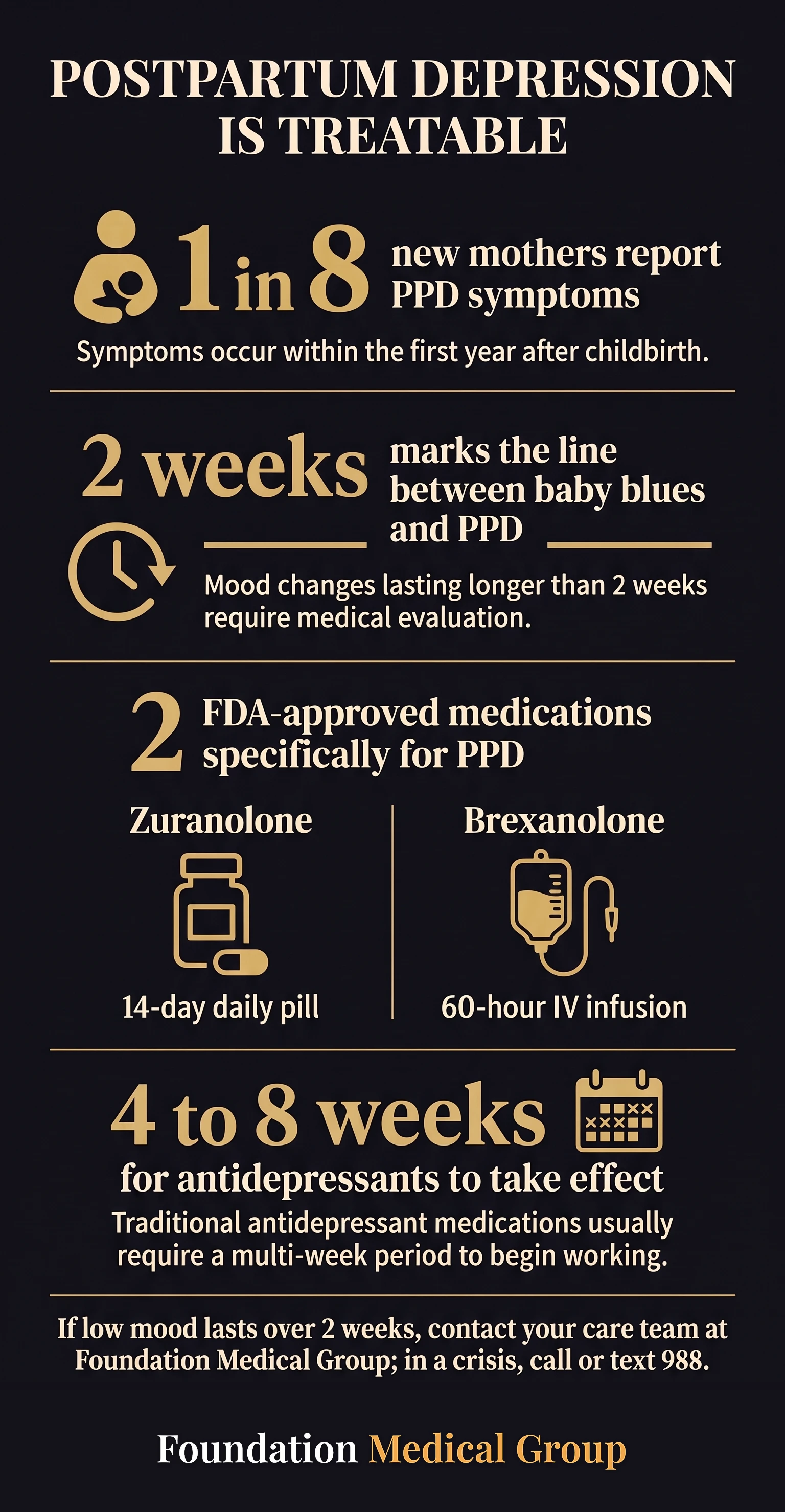
The baby blues are different. NIMH describes them as mild mood changes that are short-lasting and happen in the first 2 weeks after birth. ACOG notes the baby blues usually get better within a few days to 1 or 2 weeks, without treatment.
PPD is also common. The Office on Women’s Health (OWH) says about 1 in 8 new mothers report symptoms of PPD in the year after childbirth. A CDC report on 2018 survey data found 13.2% of women with a recent live birth across 31 sites reported postpartum depressive symptoms. Closer to home? The same report showed 13.5% in Virginia, 14.7% in Utah and 13.6% in Georgia, the states where FMG has clinics. (Texas wasn’t part of that report, so there’s no Lone Star figure to share.) So whether you’re outside Richmond, in metro Atlanta, along the Wasatch Front or in North Dallas, the numbers point the same way: this is not rare.
Here’s a simple rule from NIMH. If your mood changes are severe, or they last longer than 2 weeks, they may point to PPD, and it’s time to call your doctor.
What Are the Signs of Postpartum Depression?
Postpartum depression symptoms can look different from person to person, and some can start during pregnancy. Side note, since the two words get mixed up: postnatal depression is the term you’ll often see in British sources, while postpartum is more common in the US. Same illness, same signs. Anyway, NIMH lists common signs, including:
- A sad, anxious, or “empty” mood that does not go away.
- Trouble sleeping, even when your baby is sleeping.
- Changes in appetite, eating much more or much less than usual.
- Trouble bonding with your baby.
- Doubts about your ability to care for your baby.
- Thoughts of death, or of harming yourself or your baby.
Low mood and anxiety can show up together. Many of these are depression symptoms you’d see at any time of life. What makes postpartum depressive symptoms hard to spot is that new parenthood already brings poor sleep and big feelings. Of course you’re tired. Of course you’re emotional. So pay attention to how long the depressive symptoms last and how heavy they feel.
OWH points out that the baby blues can include mood swings, anxiety, and crying spells. Those pass. But postpartum anxiety, severe mood swings, or anxiety symptoms that stay past 2 weeks are a reason to call your doctor, just like low mood.
Thoughts of hurting yourself, sometimes called suicidal ideation, or thoughts of hurting your baby need help right now, not at your next visit. These thoughts can feel scary to admit. Say them anyway. See the urgent help section below for who to call.
OWH also notes that some mothers feel embarrassed, ashamed, or guilty about these feelings, so they don’t tell anyone. That silence makes sense. It’s also lonely, and it can keep you from care that could help. So, plainly: PPD is common, it’s a medical condition, and it isn’t your fault.
What Are the Treatment Options for Postpartum Depression?
Broadly, there are three main treatment options. Talk therapy. Antidepressant medicine. And the newer route: zuranolone, which is currently the one medicine approved for PPD itself. NIMH explains psychotherapy and antidepressants can treat perinatal depression alone or together, and ACOG’s patient guide lists zuranolone, antidepressants, and talk therapy as treatments for PPD.
What does PPD treatment look like in real life? OWH explains that your doctor, nurse, or midwife can ask you questions to test for depression. Often this is a short questionnaire about your mood, sleep, and feelings. Your doctor may also check your thyroid levels, because thyroid problems can cause symptoms that look like depression. Then you and your care team make a plan, which may involve your ob-gyn, a therapist, or a psychiatry provider.
Medicine is one part of many plans (not all of them). When doctors talk about pharmacologic treatment, that’s just a formal way to say treatment with medicine. ACOG published a clinical practice guideline in 2023 on treating mental health conditions during pregnancy and after birth, with a focus on medication. So your doctor isn’t improvising; there’s published guidance behind the choices.
Support groups are worth a look too. NIMH and OWH both point to support groups as a way to connect with other parents who understand. A group adds to treatment, but it doesn’t replace it.
Which path is right for you? That depends on how severe your symptoms are, whether you’re breastfeeding, and what you prefer. A plan to treat postpartum depression is something you decide with your doctor, not alone. It’s fine to ask questions. Ask about other choices too, and take a day to think it over if you need one (you shouldn’t feel rushed on this). You don’t need it all figured out at the first visit.
How Does Talk Therapy Treat Postpartum Depression?

Talk therapy, also called psychotherapy, means meeting with a trained mental health professional to talk through what you’re feeling and learn new skills. NIMH reports two approaches are evidence-based for perinatal depression, which includes postnatal depression: cognitive behavioral therapy and interpersonal therapy.
Cognitive behavioral therapy (CBT)
CBT helps you notice unhelpful thoughts and habits and change them. For example, a new mother might think, “I am failing my baby,” every time the baby cries. In CBT, you learn to catch a thought like that, check it against the facts, and swap it for something fairer and more helpful. You also practice small, real-life steps that ease depressive symptoms a little at a time. Small is the point.
Interpersonal therapy (IPT)
IPT focuses on your relationships. NIMH describes it as a way to understand and work through problems in your relationships and changes in your roles, such as becoming a parent. And a new baby changes a lot: how you relate to your partner, your family, your friends, and your work. IPT gives you a safe place to sort through those changes.
How sessions are offered
ACOG explains sessions can be one-on-one, in a group, with family, or with your partner as a couple. Many postpartum women like having their partner join a session or two, so they can learn how to help at home.
Getting to appointments can be hard in the postpartum period, when you’re healing from birth and caring for a newborn. Honestly, some days just getting out the door feels like too much. Video sessions can help when leaving home is difficult. You can talk with a therapist from your couch while the baby naps (assuming the baby cooperates), with no car seat and no waiting room. At FMG, most therapy is available that way, by secure video across Virginia, Utah, Georgia and Texas. Outside Richmond, in metro Atlanta, in Utah County, in North Dallas: same setup. In-person sessions happen only at our Richmond clinic.
Psychotherapy can also help with anxiety, which often shows up next to PPD. For many mothers, talking with a therapist is the first step, and some add medicine later. You can learn more about how sessions work on our talk therapy page. And if you start sessions with us and the fit doesn’t feel right, tell us. We’ll switch you to a different clinician.
What Medications Are Used for PPD?
Medicine can help, on its own or together with psychotherapy. A primary care doctor, an ob-gyn, or a psychiatry provider can prescribe it. Here are the main choices, as general facts.
Antidepressants
Antidepressant medications are the most common medicines for PPD. According to NIMH, an antidepressant usually takes 4 to 8 weeks to work on depressive symptoms. That wait can feel endless when you’re running on broken sleep. You may need to try more than one before you find the right antidepressant medication for you. That’s normal, and it doesn’t mean treatment is failing. ACOG adds that most side effects of antidepressants are temporary and often fade as your body adjusts.
Zuranolone
The FDA approved zuranolone on August 4, 2023, as the first oral medicine (a pill) for PPD. According to the FDA, it is taken as 50 mg once a day in the evening with fatty food, for 14 days. It carries a boxed warning: don’t drive or do other risky activities for at least 12 hours after each dose. NIMH notes that in clinical trials, zuranolone worked faster than traditional antidepressants.
Brexanolone (no longer sold)
You may still come across brexanolone (Zulresso) in older articles. That can be confusing, especially when you’re reading up late at night between feeds. Here’s the short version. It was an IV medicine for severe postpartum depression, given under medical care. It is no longer sold in the US, and the FDA withdrew its approval as of April 14, 2025, according to the Federal Register. So today, zuranolone is the one medicine with FDA approval specifically for PPD.
Who prescribes these medicines
These are general facts about pharmacologic treatment, not a promise that any one clinic offers every option. Talk with your prescriber about which medicine fits your symptoms, your health history, and whether you’re breastfeeding or planning another pregnancy. A psychiatry visit can be a good place to review your options, and our medication management page explains how ongoing medicine care works. If you see our team for medication management, the follow-ups are fairly short: 20 to 30 minutes, monthly at first. That’s where we check symptoms and side effects. Something not working? We adjust the plan.
Don’t start, stop, or change the dose of any medicine on your own. If a side effect worries you, call the doctor who prescribed it. They can help you decide what to do safely.
Antidepressants and Breastfeeding: What New Mothers Should Know

Many mothers worry about medicine and breastfeeding. The worry makes sense. And the honest answer is often “it depends,” which isn’t satisfying, but it’s true.
Antidepressants
OWH reports some antidepressants can be taken while breastfeeding. ACOG explains that antidepressants pass into breast milk. Both things are true at once. It can feel frustrating when you just want a simple yes or no. That’s why the choice of an antidepressant during breastfeeding is one you make with your doctor, weighing how you feel against what’s known about each medicine.
Zuranolone
ACOG states zuranolone passes into breast milk, and its effects on breastfed babies aren’t clear. ACOG notes that one option is to pause breastfeeding during the 14 days of treatment. If you want to keep feeding your baby breast milk, ask your doctor how to plan for that.
Who to ask
Bring these questions to your ob-gyn or reproductive health provider and to your psychiatry provider. If you have more than one doctor, ask them to talk to each other so your plan fits together. (With your permission, our team does this with outside therapists and primary care.) If worry about medicine adds to your anxiety, write your questions down before the visit. It also helps to share your full medicine list, including vitamins and anything you took during pregnancy.
No one can honestly tell you a medicine has zero risk. What your doctor can do is help you compare the risks of a medicine with the risks of leaving your illness untreated. For a lot of people in the postpartum period, getting well matters for their baby too. Not only for them.
PPD Treatment Options Compared
Here’s a side-by-side look at the main choices, based on the cited sources.
| Option | How it is given | How long it takes or lasts | Breastfeeding notes | Source |
|---|---|---|---|---|
| Talk therapy (CBT, IPT) | Weekly sessions; one-on-one, group, family or couples | A few weeks to a few months or longer | No medicine involved | NIMH; ACOG FAQ |
| Antidepressants | Daily pills | Usually 4-8 weeks to start working | Some can be taken while breastfeeding; ask your doctor | NIMH; OWH |
| Zuranolone | Pill once daily in the evening with fatty food | 14 days | Passes into breast milk; effects unclear | FDA; ACOG FAQ |
| Support groups | In person or online | Ongoing | Not a replacement for treatment | NIMH; OWH |
A couple of notes on reading this table. Psychotherapy involves no medicine at all, which some parents prefer, and it can be combined with any medicine in the table. Support groups belong next to treatment, not in place of it.
Your doctor will help you choose. Plenty of people use more than one.
How Long Does Treatment for PPD Last?
There’s no single answer, because each person’s recovery is different. Not the tidy answer you wanted, probably. Still, the sources give some helpful markers.
For psychotherapy, ACOG notes you may need only a few weeks of sessions, or you may need a few months or longer.
For medicine, NIMH explains antidepressants usually take 4 to 8 weeks to start working. So plan for follow-up visits in the first couple of months while your prescriber, often a primary care or psychiatry provider, checks how you are doing and adjusts the plan if needed. Our guide on how long it takes antidepressants to work explains what those first weeks can feel like.
Zuranolone is different. According to the FDA, it is a 14-day course.
Your depressive symptoms may ease slowly, with better weeks and worse ones mixed together. That’s normal, even when it’s frustrating. Track how you feel and share it at each visit. Your mental health counts here, not just the baby’s, so give treatment a fair run before you judge it.
When you feel better, don’t stop a medicine on your own. Talk with your prescriber first. They can tell you when and how to make a change safely. No one can promise a set end date, so think of treatment as something you and your care team adjust together.
Does Postpartum Depression Go Away on Its Own?
The baby blues usually go away on their own. PPD, or postnatal depression, is different. NIMH notes that women with perinatal depression generally won’t feel better without treatment.
Untreated postpartum depression doesn’t only affect the mother. NIMH says it can affect the mother, the child, and the whole family. OWH lists effects such as not being able to care for your baby and a higher risk of attempting suicide. This illness can also make it harder to bond, to rest, and to enjoy the early months with your baby.
So don’t try to wait it out. ACOG advises calling your ob-gyn right away if you think you have PPD, rather than waiting for your postpartum checkup. You don’t need to be sure. “I haven’t felt like myself since the birth” is enough to start the conversation.
PPD is a real mental illness, not a weakness or a sign that you’re a bad parent. With treatment, you can feel like yourself again.
Postpartum Psychosis and Other Emergencies: When to Get Urgent Help
Some symptoms can’t wait. If you or someone you love is in danger, get help now.
Postpartum psychosis
NIMH describes postpartum psychosis as a serious mental illness and a psychiatric emergency that needs hospitalization. If you think someone has this condition, call 911 or go to the nearest emergency room. NIMH also notes that recovery is possible with professional help.
Thoughts of hurting yourself or your baby
If you have thoughts of harming yourself or your baby, call or text 988, the Suicide and Crisis Lifeline listed by SAMHSA. Call 911 if a life is in danger. OWH suggests that if you can’t make the call yourself, ask your partner or a loved one to call for you. Severe anxiety or panic that makes you feel unsafe is also a reason to get help.
Other places to call
- National Maternal Mental Health Hotline: call or text 1-833-852-6262. NIMH says it’s free, open 24 hours a day, 7 days a week, and staffed by English- and Spanish-speaking counselors.
- Postpartum Support International helpline: call or text “Help” to 1-800-944-4773.
Foundation Medical Group is an outpatient practice. We do not offer emergency care, detox, IOP, PHP, residential care, or 24/7 supervision. In an emergency, call 988 or 911.
Who Is at Higher Risk for Perinatal Depression?
Anyone can develop it. But some things raise the risk.
NIMH points out that the risk is higher if you have a personal or family history of depression or bipolar disorder. Depression during a past pregnancy is also a reason to plan ahead.
OWH lists other risk factors, such as stressful life events, a hard pregnancy or birth, problems in a past pregnancy, and little support from a partner, family, or friends. ACOG adds that hormone levels drop sharply after childbirth, which may play a part.
If you have a history of a depressive disorder or bipolar disorder, NIMH suggests talking with a provider, such as your ob-gyn or a psychiatry provider, during pregnancy to make a plan. That way, you know who to call and what to watch for in the postpartum period, before you need it. Think of it as a backup plan you hope sits unused.
How Partners and Family Can Support Postpartum Mothers
NIMH notes that spouses, partners, family members, and friends may be the first to notice the warning signs. You see the new parent every day, so you may spot changes before she does.
Here are practical ways to help:
- Gently encourage her to talk with her doctor, and offer to help make the call.
- Help with baby care, meals, and chores so she can rest and get to appointments.
- Listen without judging when she shares sadness or anxiety, and do not try to fix everything at once.
- Remind her that maternal depression is a medical condition, not a failure.
And you? Your own mental health counts too. Caring for a new baby and a partner who’s struggling is exhausting, and feeling worn out doesn’t make you a bad supporter. OWH notes that the Postpartum Support International helpline supports women, partners, and other supporters, so you can call for yourself as well.
How Long Does Medicaid Cover You After Birth?
Here’s a question few new parents think to ask. PPD can start any time in the first year, so how long does your coverage actually last? CMS explains that states may extend Medicaid and CHIP postpartum coverage from the required 60 days to 12 months. Some welcome news for our four states: as of March 2024, CMS listed Virginia, Utah, Georgia and Texas among those offering the full 12 months.
- Virginia: Virginia’s Medicaid agency says Medicaid and FAMIS MOMS members now get guaranteed health coverage for 12 months after pregnancy. In Virginia, Medicaid goes by the name Cardinal Care.
- Utah: CMS approved Utah’s extension to 12 months in March 2024. That applies statewide, Utah County included.
- Georgia: Georgia’s Department of Community Health says postpartum coverage for Medicaid and PeachCare for Kids members went from six months to 12 months, effective Nov. 1, 2022.
- Texas: The Texas governor’s office says House Bill 12 extended Medicaid and CHIP postpartum coverage from two months to 12 months, effective March 1, 2024.
One honest caveat: rules and plan details change. If you’re on Medicaid, call the number on your card and ask what mental health care is covered after birth. Tedious, yes. But it’s a single call, and it can head off a nasty surprise later.
Postpartum Depression Care With Foundation Medical Group in Virginia, Utah, Georgia, and Texas
Foundation Medical Group offers psychiatry and talk therapy, which can be part of care for depression and anxiety during or after pregnancy. We don’t run a postpartum-specific program. Here’s where our care is offered.
Psychiatry (evaluation and medication management):
- Richmond, VA: 11600 Busy Street, Suite 203, Richmond, VA 23236, on the second floor, just off Midlothian Turnpike, with a free lot. Call (804) 506-0526. The medical director there is Vincent Nardone, MD. See our Virginia page.
- American Fork, UT: 456 E State Street, Suite 1400, American Fork, UT 84003, on the Wasatch Front, in person and by telehealth. Call (801) 876-5998. Paul Frandsen, MD, is the medical director. See our Utah page.
- Dallas, TX: 8390 Lyndon B Johnson Freeway, Suite 500, Dallas, TX 75243, our North Dallas office on LBJ Freeway. Call (469) 909-1312. Justin Thompson, MD, is the medical director. See our Texas page.
Georgia: our Decatur clinic (160 Clairemont Ave, Suite 200, Decatur, GA 30030), a few blocks from downtown Decatur, offers psychiatric evaluation. William Epps, MD, is the medical director. Call (706) 534-8574.
Talk therapy: you can meet a therapist by secure video in Virginia, Utah, Georgia, and Texas. In-person visits happen only at our Richmond, VA clinic. Sessions are 50 minutes.
Insurance: coverage depends on your plan, and we do not list prices. Common plans to ask about, each one call to confirm coverage:
- Virginia: Aetna, Anthem, Cigna, UnitedHealthcare, TRICARE, Sentara Health Plans, and Virginia Medicaid (Cardinal Care). Medicare is not accepted in Virginia. Call to confirm coverage.
- Texas: Aetna, Cigna, Blue Cross Blue Shield, UnitedHealthcare, Humana, TRICARE, Medicare, and Texas Medicaid. Call to confirm coverage.
- Utah: Aetna and Blue Cross Blue Shield. Call to confirm coverage.
- Georgia: Cigna. Call to confirm coverage.
A first psychiatric evaluation lasts up to 60 minutes, with a board-certified physician or a psychiatric nurse practitioner. Expect questions about your mood, your sleep (or lack of it), anxiety, your medical history, and any medicines you’ve already tried. Then we talk through options, and you have a real say in the plan.
Medicine choices are made with your prescriber after an evaluation. We do not offer detox, IOP, PHP, residential care, or 24/7 supervision. If you are in crisis, call or text 988, or call 911.
Ready to talk? Call the clinic nearest you and ask about a visit with our psychiatry team, or about video sessions. Same-day new-patient video slots are often available, which matters when your energy is in short supply.
Key Takeaways
- PPD is common and treatable. About 1 in 8 new mothers report symptoms in the year after birth.
- The baby blues pass within about 2 weeks. Symptoms that last longer or feel severe mean it is time to call your doctor.
- Psychotherapy and antidepressants work alone or together, and zuranolone is the one medicine FDA-approved for PPD itself.
- Some antidepressants can be used while breastfeeding. Decide with your doctor.
- If you had depression before or during pregnancy, make a plan with your provider early.
- On Medicaid in Virginia, Utah, Georgia, or Texas? Postpartum coverage now runs 12 months after pregnancy.
- Postpartum psychosis is an emergency: call 911. For thoughts of self-harm, call or text 988.
- Foundation Medical Group offers psychiatry in Richmond, American Fork, and Dallas, and video sessions with a therapist in all four states.
FAQ
Does postpartum depression need medication?
Not always. NIMH says talk therapy and antidepressants can each be used alone or together. Therapy alone can help many people, and medicine is often added when depressive symptoms are more severe. You and your doctor decide together, based on how you feel, whether you are breastfeeding, and what you prefer.
Is postpartum depression curable?
Postpartum depression is treatable, and most people feel better with the right care. NIMH says recovery is possible with professional help. No one can promise a set date, so the best step is to start treatment early and keep your follow-up visits with your care team.
What does postpartum depression treatment look like?
It usually starts with a visit where your doctor, nurse, or midwife asks questions to test for depression and may check your thyroid. Then you agree on a plan, often therapy, medicine, or both. Follow-up visits let your care team see how you are doing and adjust the plan.
What medications are used for postpartum depression?
Antidepressants are the most common choice. Just one medicine is FDA-approved for postpartum depression itself: zuranolone, a pill you take once a day for 14 days. You might see brexanolone, an IV medicine, in older articles, but its approval was withdrawn and it isn’t sold in the US anymore. Your prescriber helps you weigh the options.
How long does postpartum depression treatment last?
It depends on you. ACOG says therapy may be needed for a few weeks, or for a few months or longer. NIMH says antidepressants usually take 4 to 8 weeks to start working, so plan for several follow-up visits. Never stop a medicine on your own.
Sources
- National Institute of Mental Health, Perinatal Depression.
- U.S. Food and Drug Administration, FDA Approves First Oral Treatment for Postpartum Depression.
- American College of Obstetricians and Gynecologists, Postpartum Depression (FAQ).
- American College of Obstetricians and Gynecologists, Treatment and Management of Mental Health Conditions During Pregnancy and Postpartum (Clinical Practice Guideline No. 5).
- Office on Women’s Health (HHS), Postpartum depression.
- Food and Drug Administration (Federal Register), Sage Therapeutics, Inc.; Withdrawal of Approval of a New Drug Application for ZULRESSO (Brexanolone).
- SAMHSA, 988 Suicide and Crisis Lifeline.
- Centers for Disease Control and Prevention, Vital Signs: Postpartum Depressive Symptoms and Provider Discussions About Perinatal Depression, United States, 2018 (MMWR).
- Centers for Medicare & Medicaid Services, Utah’s Medicaid and CHIP Postpartum Coverage Expansion; 45 States Now Offer Full Year of Coverage After Pregnancy.
- Virginia Department of Medical Assistance Services, Maternal and Child Health.
- Georgia Department of Community Health, Medicaid, PeachCare for Kids Postpartum Medical Services Extended.
- Office of the Texas Governor, Governor Abbott, HHSC Announce Medicaid, CHIP Postpartum Coverage Extension to 12 Months.