
Searching for psychiatric evaluation Decatur GA options? Foundation Medical Group (FMG) offers a full psychiatric evaluation for Georgia adults by secure video. Our Decatur clinic at 160 Clairemont Ave, Suite 200 doesn’t offer in-person psychiatric evaluations yet. In person, it treats opioid use disorder with Suboxone and Subutex. The evaluation itself runs up to 60 minutes and ends with a diagnosis and a mental health treatment plan. Call (706) 534-8574 or book an appointment.
We’d rather say that up front. Driving across town for a visit the clinic can’t do yet would be frustrating, and nobody needs that on top of everything else.
What Is a Psychiatric Evaluation in Mental Health Care?
So what is it, exactly? A psychiatric evaluation is a full mental health assessment. Your clinician asks about your current symptoms, how they affect work, sleep and relationships, past treatment, the medicines you take, substance use and family history.
In psychiatry, the person leading this is often a psychiatrist. According to the American Psychiatric Association, a psychiatrist is a medical doctor (an M.D. or D.O.) who specializes in mental health, including substance use disorders. Psychiatrists can diagnose mental disorders and prescribe medicine after a thorough evaluation.
That’s different from a short screening at a primary care visit. A screening is a standard set of questions. Useful, but narrow, and it can point to the need for a full evaluation. A psychiatric evaluation goes a lot further than that, and every patient gets the same careful history, whether they’re in Decatur or across the state.
Does the Decatur Clinic Offer In-Person Psychiatric Evaluations?
Not yet. Today the Decatur clinic offers medication-assisted treatment with Suboxone and Subutex for opioid use disorder. Read more about our Suboxone clinic if substance abuse and recovery are part of why you’re looking for care.
In-person psychiatric evaluation, medication management and talk therapy are planned for the clinic. But it doesn’t offer them yet, and we’d rather not guess at a date.
| Service | At the clinic, in person | By secure video, statewide |
|---|---|---|
| Psychiatric evaluation | Not yet, planned | Yes |
| Medication management | Not yet, planned | Yes |
| Talk therapy | Not yet, planned | Yes, by secure video |
| Suboxone and Subutex | Yes | Yes, with in-person visits as rules require |
Dr. William Epps is medical director of the Decatur office. He’s board certified in Anesthesiology with subspecialty certification in Pain Medicine. He isn’t a psychiatrist, so psychiatric evaluations come through our telehealth team instead. The clinic is open Monday to Friday, 8am to 6pm. See the clinic page for directions.
How Does a Telehealth Psychiatric Evaluation Work in GA?
Here’s how it works. You join a secure video visit from a phone, laptop or tablet, and most patients don’t need an app. It’s the same psychiatrists, psychiatric nurse practitioners and therapists, just on video. Our telehealth page covers the setup.
The state has rules for this. The Georgia Composite Medical Board licenses physicians here and publishes the board rules they practice under. In practice, that means you must be physically in the state during each visit, and we confirm your location at every one of your appointments.
Some care still needs an office, though. Certain controlled medication starts require an in-person visit first. If that applies to your patient care plan, we’ll explain it before anything is prescribed.
A few practical steps make the video visit smoother:
- Find a private room where you can talk freely.
- Check your internet connection and camera.
- Keep your photo ID nearby.
- Give us a phone number in case the call drops (it happens, usually at the worst moment).
What Happens During a Psychiatric Evaluation for Mental Health?

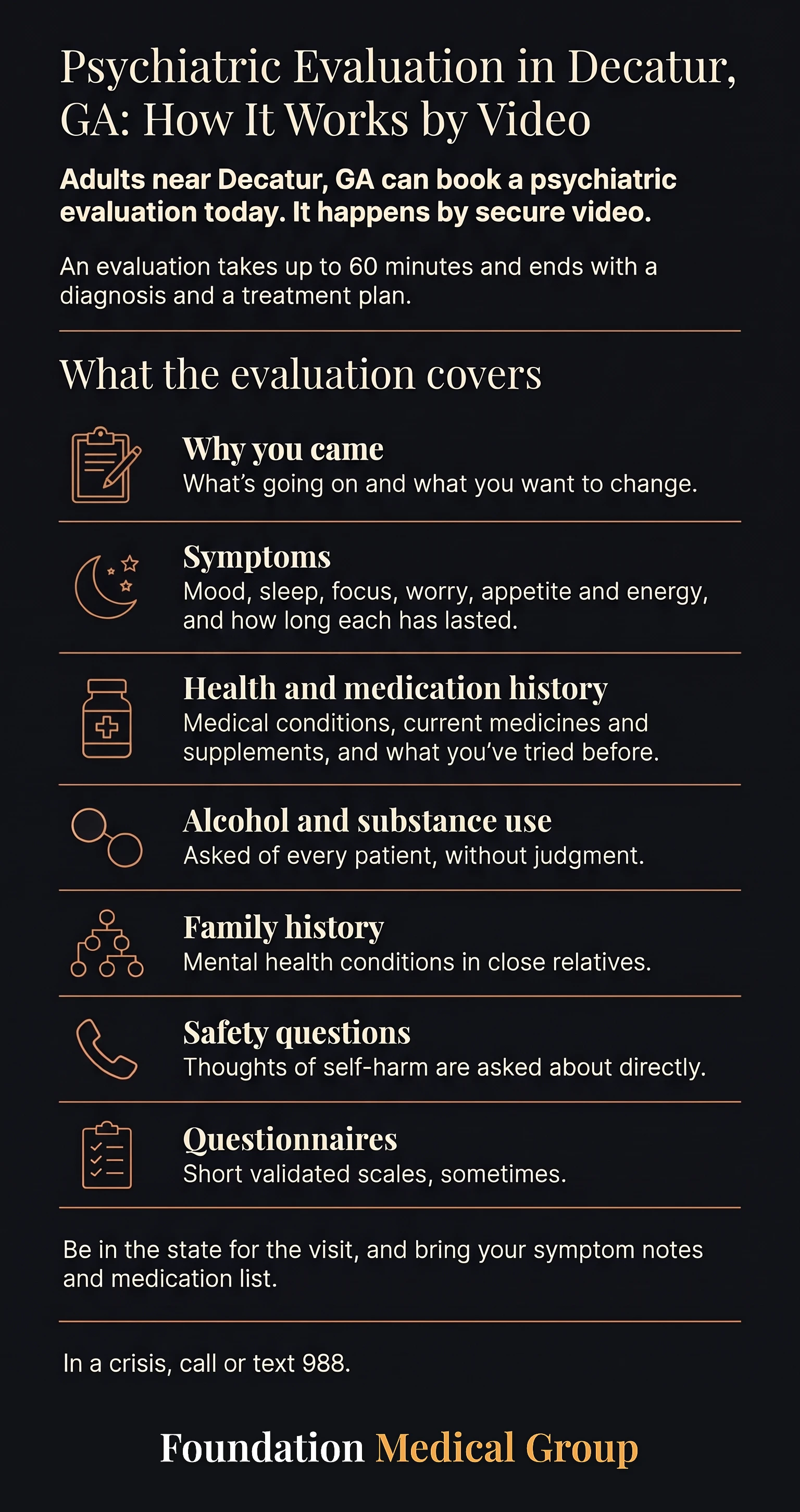
Plan for up to 60 minutes, the same on video as in person. Feeling a bit nervous beforehand is normal. Most evaluations cover these parts:
- Why you came. What’s going on and what you want to change.
- Symptoms. Mood, sleep, focus, worry, appetite and energy, and how long each has lasted.
- Health and medication history. Medical conditions, current medicines and supplements, and what you’ve tried before.
- Alcohol and substance use. Asked of every patient, without judgment.
- Family history. Mental health conditions in close relatives.
- Safety questions. Thoughts of self-harm are asked about directly.
- Questionnaires. Short validated scales, sometimes.
According to MedlinePlus, no medical test can diagnose a mental health disorder. But a blood test can show whether a physical problem, such as thyroid disease, is causing symptoms, so your clinician may suggest labs through your primary care doctor.
You leave with a working diagnosis and a treatment plan you agree on together. Honest, complete answers help most. Nothing you say is graded. Really.
Which Mental Health Conditions Can an Evaluation Look At?
You don’t need a diagnosis before you call. Adults often book an evaluation for:
- Depression, including a persistent sad or empty mood, loss of interest, low energy or trouble concentrating.
- Anxiety and panic.
- Bipolar disorder, a mental illness that causes clear shifts in mood, energy, activity levels and concentration.
- ADHD in adults.
- Personality disorders and other long-standing patterns that keep causing problems.
- Mood symptoms alongside opioid or alcohol use.
Two of these tend to show up together. If opioid use sits beside depression or anxiety, the clinic’s in-person Suboxone care and a video evaluation can run side by side.
How Do I Prepare for My Psychiatric Evaluation Appointments?
Does preparing actually matter? A little, yes. It makes the hour count.
- Write down your symptoms, when they started and what makes them better or worse.
- Prepare a list of every medication you take, including over-the-counter medicines and supplements, with doses. Our team asks about each one, so a written list saves time on the call.
- Note any family history of mental illness.
- Bring your questions. It’s easy to forget them once the call starts.
- Consider having a friend or relative join, if that helps. Some people prefer to start alone.
- Have your insurance card, member ID and pharmacy name ready.
Be honest, even about the hard parts. The hard parts are often the ones that shape the plan most.
What Treatment Comes After a Psychiatric Evaluation?

Treatment for mental illness usually includes therapy, medication or a combination of the two. Which one? That depends on what the evaluation finds.
Medication. If medicine is part of the plan, our team handles medication management by video. Follow-up visits are usually 20 to 30 minutes, as our psychiatrist in Atlanta guide explains, every few weeks at first and then spaced out once you’re stable.
Psychotherapy. Psychotherapy, or talk therapy, comes in many forms. Cognitive behavioral therapy helps people see how their thoughts affect their emotions and behavior, and change unhelpful patterns. Our licensed therapists offer therapy sessions by secure video across the state, so living in Decatur rather than Atlanta changes nothing about access. Ask whether family therapy or another approach fits your situation. There’s no single right answer here.
| What to expect | Evaluation visit | Follow-up visit |
|---|---|---|
| Length | Up to 60 minutes | Usually 20 to 30 minutes |
| Main focus | Full history and diagnosis | Progress and medication management |
| What you leave with | A treatment plan | Adjustments to that plan |
All of this is outpatient treatment. FMG doesn’t offer detox, intensive outpatient, partial hospitalization or residential care.
Does Insurance Cover a Psychiatric Evaluation in Georgia?
Coverage depends on your plan, so check before your first visit. A surprise bill is the last thing you want to worry about.
- Cigna is listed as accepted now on our clinic page. Call to confirm coverage.
- Amerigroup Community Care, CareSource Georgia and Peach State Health Plan are listed as other common plans in the state. Call to confirm coverage.
- Medicare, Georgia Medicaid, Aetna, Anthem, Blue Cross Blue Shield, UnitedHealthcare, Humana, TRICARE and Optum Behavioral Health are listed there as not accepted yet. Call to confirm coverage.
Georgia Families, the state’s Medicaid program, is a partnership between the state’s Department of Community Health and private care management organizations. So your card may show a health plan name rather than “Medicaid.” Which is confusing, honestly, when you’re just trying to book a visit.
When you call, ask about mental health treatment by video specifically. Coverage for telehealth psychiatry can differ from Suboxone care.
When Do You Need Urgent Care Instead of an Evaluation?
A scheduled evaluation isn’t emergency care, and FMG isn’t a 24/7 crisis service. If you’re thinking about suicide or you’re in emotional distress, call or text 988 for free, confidential support any time.
In a life-threatening situation, call 911 or go to the nearest emergency room.
Looking for other ways to find mental health care? NIMH keeps a help page for people and families looking for support.
How to Book a Psychiatric Evaluation With FMG From Decatur
Call (706) 534-8574 or our toll-free line at (800) 983-1974, or use our appointment page. Say you’d like a telehealth psychiatric evaluation.
We see adults 18 and over. You’ll need to be in the state for the visit, as covered above. Our care team verifies your insurance and sends the secure video link, so you don’t have to travel. Still comparing options in metro Atlanta? Our psychiatrist in Atlanta guide walks through how to choose.
Key Takeaways
- Adults near Decatur, GA can book a psychiatric evaluation today. It happens by secure video.
- The Decatur clinic offers Suboxone and Subutex in person, not psychiatric evaluations yet.
- An evaluation takes up to 60 minutes and ends with a diagnosis and a treatment plan.
- Be in the state for the visit, and bring your symptom notes and medication list.
- Every insurance plan is call to confirm coverage. In a crisis, call or text 988.
Sources
- American Psychiatric Association, What Is Psychiatry?.
- MedlinePlus, Mental Health Screening.
- Georgia Composite Medical Board, Rules & Laws.
- National Institute of Mental Health, Tips for Talking With a Health Care Provider About Your Mental Health.
- National Institute of Mental Health, Depression.
- National Institute of Mental Health, Bipolar Disorder.
- National Institute of Mental Health, Mental Health Medications.
- National Institute of Mental Health, Psychotherapies.
- Georgia Department of Community Health, Georgia Families.
- SAMHSA, 988 Suicide & Crisis Lifeline.
- National Institute of Mental Health, Help for Mental Illnesses.