
A psychiatric evaluation is a detailed conversation with a psychiatrist or psychiatric nurse practitioner about your symptoms, history and goals. It may also include a questionnaire, a physical exam or lab tests. The goal is a clear picture of your mental health and a treatment plan. At Foundation Medical Group, a first visit runs up to 60 minutes.
If you’re ready to book, go to our psychiatric evaluation service page.
What Is a Psychiatric Evaluation?
A psychiatric evaluation, often called a psych eval or psych evaluation, is an assessment of your mental health by a trained clinician. Its purpose is to understand what’s going on and what treatment may help. You may also hear it called a psychiatric assessment or a mental health assessment.
The American Psychiatric Association (APA) describes a general psychiatric evaluation, sometimes called a comprehensive psychiatric evaluation, as centered on an interview with you. Depending on your needs, a comprehensive evaluation can also include medical records, a physical exam, diagnostic tests and information from people who know you well.
MedlinePlus lists “psychological evaluation” and “psychiatric evaluation” among the other names for mental health screening. Mental health assessments range from a short screening to a full evaluation, as the table below shows.
When Is a Psychiatric Evaluation Needed?
You might consider an evaluation when mental health symptoms start to affect your daily life. MedlinePlus points to changes in mood, sleep, appetite, energy or concentration, ongoing worries or fears, and alcohol or drug use. Mental health conditions that screening can point to include depression, bipolar disorder, anxiety disorders and ADHD.
Not sure where to start? That’s okay. The NIMH guide to help for mental illness notes that, for mental health concerns or mental health issues of any kind, your primary care provider can do a first screening and refer you.
An emergency evaluation is different. If your life or someone else’s life is in danger, call 911 or go to the nearest emergency room. In a mental health crisis, call or text 988. FMG does not offer emergency care, detox, IOP, PHP, residential care or 24/7 supervision.
Who Does a Psychiatric Assessment: Psychiatrists and Psychiatric Nurse Practitioners
Two kinds of clinicians usually lead this assessment. A psychiatrist is a medical doctor (MD or DO) who specializes in mental health conditions. According to the APA, psychiatrists can order lab tests and psychological tests and can prescribe medicine.
Psychiatric mental health nurse practitioners hold a registered nurse (RN) license plus a master’s or doctoral degree. They also assess and treat patients.
Other mental health professionals, such as psychologists and social workers, may do screening or psychological testing. NIMH notes that a primary care provider can refer you to a social worker, psychologist or psychiatrist. To learn more about the doctor’s role in psychiatric treatment, read what a psychiatrist does.
Inside the Evaluation Process: The Psychiatric Interview, Step by Step

The APA guideline lists the main areas a clinician covers in the evaluation process. Here’s what an initial evaluation usually looks like.
- Why you came. You talk about the reason for the visit and what you hope to get from treatment.
- Your symptoms now. Expect questions about mood, sleep, appetite and concentration. You will also be asked about any thoughts of harming yourself or others. These questions are routine.
- Your history. This covers your psychiatric history and mental health history, past treatment, alcohol and drug use, medical history, family history, and your life and work.
- Mental status examination. This sounds formal, but it simply means the clinician notices how you look, speak, think and feel during the visit.
- Extra steps if needed. Some evaluations add rating scales, a physical exam or lab tests.
If you need an interpreter, that’s checked early. A full assessment can take more than one meeting. With your permission, family members may also be invited to share what they have noticed.
What Does a Psychiatric Evaluation Consist Of?
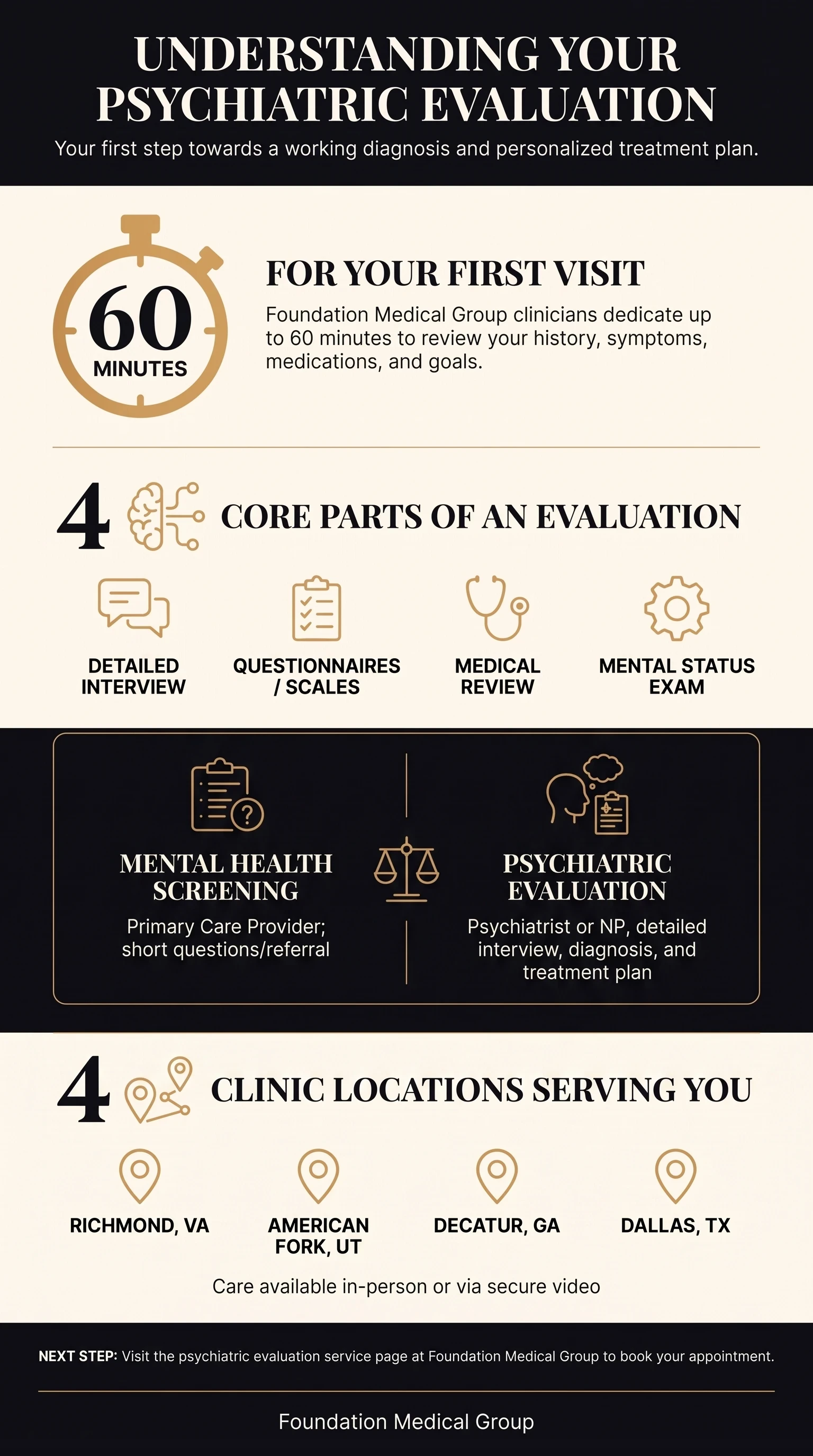
Put simply, most evaluations have up to four parts: an interview, a questionnaire or rating scales, a medical review such as a physical exam or blood tests, and sometimes psychological testing.
According to MedlinePlus, no medical test can diagnose mental health disorders. But blood tests can show a physical cause for your symptoms, such as thyroid disease or an electrolyte imbalance.
During the mental status examination, the clinician may also look at your cognitive functioning, such as memory and attention. If more detail is needed, a psychological assessment or formal psychological evaluations may be suggested.
No single test diagnoses psychiatric disorders. The APA explains that psychiatrists base a diagnosis on the criteria in the Diagnostic and Statistical Manual of Mental Disorders (DSM-5), together with what they learn from talking with you. That can feel frustrating if you were hoping for a quick answer. But it’s also why the conversation matters so much.
How Long Does a Psychiatric Evaluation Take?
The APA guideline says a general evaluation is usually time intensive. How long it takes depends on how complex your situation is, and some psychiatric evaluations need more than one meeting.
At Foundation Medical Group, a first visit runs up to 60 minutes, in person or by secure video, depending on your state. That time is deliberate. Our clinicians use it to review your history, your current symptoms, the medicines you’ve already tried and what you want out of treatment. If a video visit suits you better, read about seeing an online psychiatrist.
Comprehensive evaluations elsewhere may be set up differently. So ask about timing when you book.
Psychiatric Evaluation vs. Psychological Evaluation vs. Mental Health Screening
These three terms often get mixed up. Here’s how they compare.
| Type | Who usually does it | What it involves | What you get | Source |
|---|---|---|---|---|
| Mental health screening | Primary care provider or other clinician | Short questions or a questionnaire; sometimes a physical exam and blood tests | Signs that need a closer look; a referral | MedlinePlus; NIMH |
| Psychiatric evaluation | Psychiatrist or nurse practitioner | Detailed interview, history, mental status exam, possible lab tests | Diagnosis and treatment recommendations, including medicine if needed | APA guideline; APA |
| Psychological evaluation (psychological testing) | Usually a psychologist | Standardized psychological tests | Detailed test results to support diagnosis | APA |
Many people start with a screening and are referred for a full evaluation. A psychiatric evaluation is where a diagnosis and a plan for mental health care come together.
How to Prepare for a Psychiatric Evaluation

Feeling nervous before a first visit? That’s normal, and a little preparation can help. NIMH suggests a few simple steps:
- Write down your symptoms, when they started and any questions you want to ask.
- List every medicine you take, including over-the-counter drugs, herbal remedies, vitamins and supplements. Include any psychiatric medication you take now or have taken before.
- Learn your family’s mental health history, if you can.
- Think about bringing a friend or relative for support.
- Be honest and complete, even about things that feel hard to say.
MedlinePlus notes that you usually don’t need any special preparation for a mental health screening. Honest, complete answers matter most.
After the Evaluation: Diagnosis and Treatment Recommendations
At the end, you should leave with a working diagnosis, or a plan to learn more, and recommendations for care. According to the APA, psychiatrists work with patients to develop treatment plans, and prescribing follows a thorough evaluation. Your treatment options for mental health conditions may include therapy, medicine or both.
At FMG, our clinicians share the working diagnosis before you leave, talk through options and build the plan with you. Next steps can include medication management or talk therapy, depending on your clinic. Talk therapy is offered by secure video in Virginia, Utah, Georgia and Texas, and in person only in Richmond, VA. The aim is appropriate treatment that fits your life: effective treatment you can stay with, and mental health treatment built on a clear plan.
Psychiatric Evaluations at Foundation Medical Group
Foundation Medical Group offers psychiatric evaluations at four clinics. You’ll find us in Richmond, VA (11600 Busy Street, Suite 203, Richmond, VA 23236) and American Fork, UT (456 E State Street, Suite 1400, American Fork, UT 84003). We’re also in Decatur, GA (160 Clairemont Ave, Suite 200, Decatur, GA 30030) and Dallas, TX (8390 Lyndon B Johnson Freeway, Suite 500, Dallas, TX 75243). Visits are in person or by secure video, depending on the state, and a first visit runs up to 60 minutes. For Decatur, see our Georgia clinic page.
For insurance, call to confirm coverage before your visit. In Virginia, Medicare is not accepted; Virginia Medicaid (Cardinal Care) is one plan to ask about, so call to confirm coverage. In Georgia, Cigna is one plan to ask about; call to confirm coverage. To book, use the psychiatric evaluation service page linked near the top of this guide.
Key Takeaways
- A psychiatric evaluation is a detailed talk about your symptoms, history and goals.
- It may include a questionnaire, a physical exam or lab tests, but no single test diagnoses mental health conditions.
- It is done by a psychiatrist or psychiatric nurse practitioner.
- Bring a full medicine list and your questions, and be honest.
- At FMG, a first visit runs up to 60 minutes.
FAQ
What happens at a psychiatric evaluation?
A clinician talks with you about why you came, your current symptoms and your history, including past treatment, substance use and family history. They also do a mental status examination, which means noticing how you think, speak and feel during the visit. Some evaluations add rating scales or lab tests. At the end, you talk through a plan together.
What should I expect from an initial psychiatric evaluation?
Expect many questions about your mood, sleep, appetite, concentration, alcohol or drug use and family history. Answer as honestly and completely as you can. You should leave with clear next steps. At Foundation Medical Group, an initial evaluation runs up to 60 minutes.
Who can do psychiatric evaluations?
Psychiatrists, who are medical doctors (MD or DO), and psychiatric mental health nurse practitioners both do psychiatric evaluations. A primary care provider can also do a first screening and refer you to a psychiatrist or another mental health professional for a full assessment.
Can a psychiatric evaluation diagnose ADHD?
ADHD is one of the conditions a psychiatrist can diagnose after a full evaluation, using the criteria in the DSM-5. No single test diagnoses it. Instead, the clinician looks at the whole picture from the assessment.
Sources
- American Psychiatric Association, Practice Guideline for the Psychiatric Evaluation of Adults, Second Edition.
- American Psychiatric Association, What is Psychiatry?.
- MedlinePlus (NLM/NIH), Mental Health Screening.
- National Institute of Mental Health, Tips for Talking With a Health Care Provider About Your Mental Health.
- National Institute of Mental Health, Help for Mental Illnesses.