
Psychiatric medication management is ongoing care in which a prescriber chooses, starts, adjusts and monitors medicine for a mental health condition. Foundation Medical Group (FMG) offers psychiatric medication management for Utah adults from our American Fork team, by secure video. You get a full first visit, a written plan and regular follow-ups until the medication works for you.
What Is Psychiatric Medication Management?
Psychiatric medication management means a licensed prescriber evaluates you, picks a medicine, then checks how it works and adjusts it over time. It’s more than prescription refill requests. Each visit looks at your symptoms, side effects and dose. And when something isn’t working, the treatment plan changes. We don’t leave you on a medicine that isn’t helping. Our medication management service page explains the full approach.
Psychiatrists are medical doctors. According to the American Psychiatric Association, after completing thorough evaluations, psychiatrists can prescribe medications to help treat mental disorders. Here’s the part people miss: psychiatric medication doesn’t act the same way in everyone. NIMH says it may take several tries to find the medication that works best with the fewest side effects. That’s frustrating, honestly. You finally work up the energy to get help, and the first try misses? Maddening. It’s also exactly why steady follow-up matters for mental health disorders. For a general overview, see our guide to psychiatric medication management near you.
How Does Medication Management Work With Our American Fork Team?

Utah care runs from our American Fork clinic at 456 E State Street, Suite 1400, American Fork, UT 84003, (801) 876-5998. Psychiatric medication management for Utah adults is by secure video through our telehealth service. You need to be in Utah, or another state where we’re licensed, during each visit. Our Utah home page has hours and directions. American Fork is our Utah home base, open on weekdays, with Saturdays by appointment. Online medication management by video is available in every state we serve.
Your psychiatric care starts with a psychiatric evaluation by video. It lasts 60 to 90 minutes. We go over your mental health concerns, history and current medicines before anything changes. For some controlled prescriptions, the first visit needs to be in person. So before you book, ask the front desk: can your medicine be started by video? A bit of a hassle, we know. Asking first beats a rescheduled visit.
Patients already seen at the American Fork clinic for Suboxone care or Vivitrol can have their mental health care built into the same care plan. Our Utah clinical work is led by Paul Frandsen, MD, Medical Director for Utah, who is board-certified in addiction medicine and emergency medicine and is based in American Fork. Jonathan Guenter, MD, sees Utah patients for medication management and substance use treatment, and works closely with the Foundation Wellness team next door. If you’re still choosing a prescriber, our guide to finding a psychiatrist in American Fork can help.
How Often Are Medication Management Follow-Up Visits?
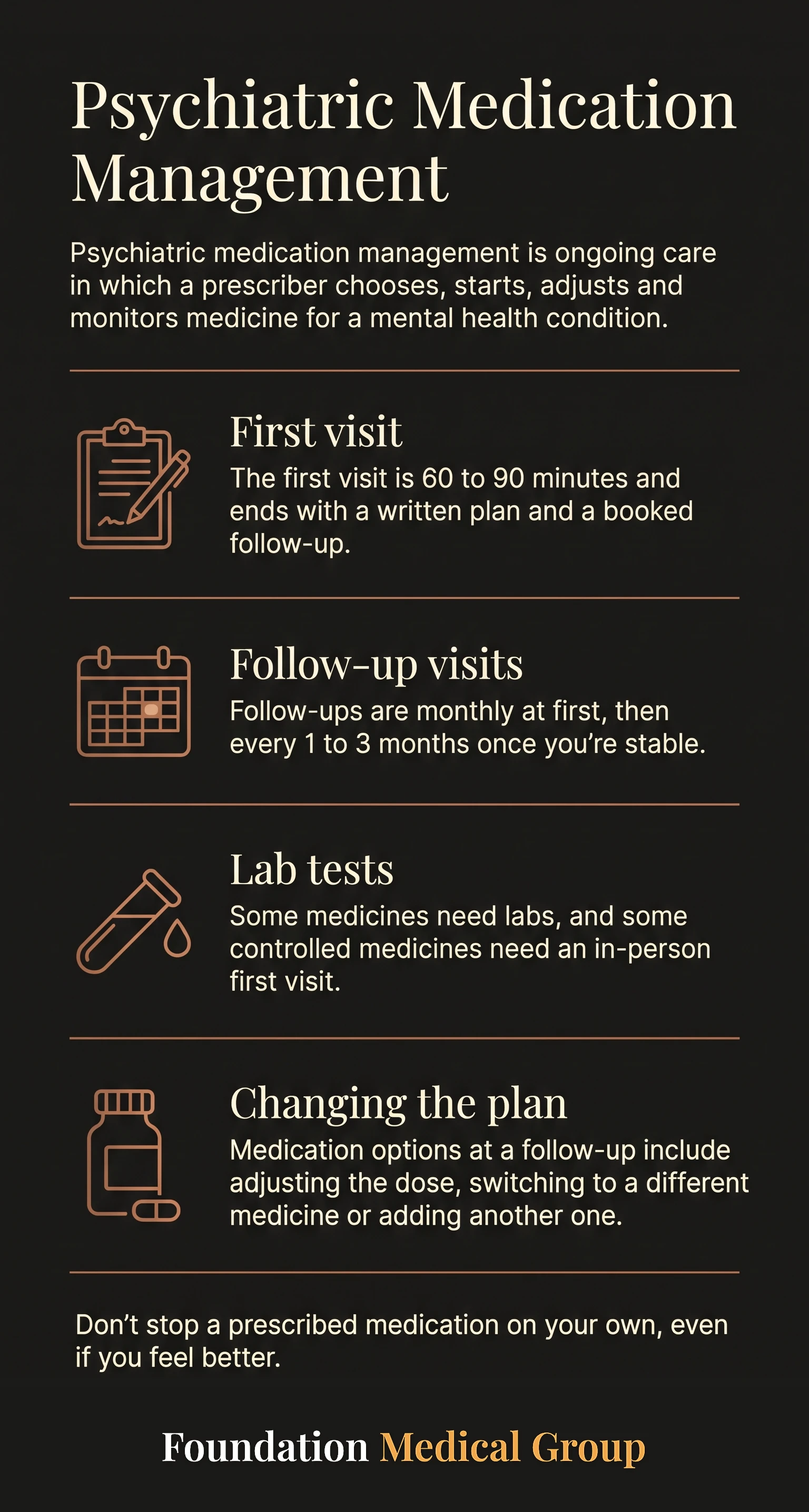
You leave the first visit with a written plan and a follow-up on the calendar. Follow-up visits run 20 to 30 minutes and happen monthly at first. At each one we check symptoms, side effects and labs when needed. Then we adjust the dose, or switch to another medicine if the current one does too little. Small, careful steps, usually.
Once the plan is working, medication management visits move to every 1 to 3 months. That spacing keeps your mental health care on track without taking up much of your time. With luck, this is the stretch where life starts to feel ordinary again. Ordinary in the best sense. A new side effect between visits? Phone us. Don’t wait for the next one.
Will I Need Lab Tests While Taking Psychiatric Medication?
Sometimes. Lithium, certain mood stabilizers and a few antidepressants need periodic monitoring. Our team coordinates the orders and goes over the results with you. You won’t be left squinting at a lab portal, trying to decode the numbers alone.
Labs depend on the medicine. NIMH notes that health care providers may ask people taking atypical antipsychotics to take part in regular monitoring of weight, glucose levels and lipid levels. People who take lithium for a mood disorder are generally asked to have their lithium levels and kidney and thyroid function checked. Nobody loves a blood draw. We get it. But these checks protect your overall health while the medicine does its work.
With video care, blood tests happen at a local lab near you, and the results come back to your prescriber before a dose changes.
What If My Medication Is Not Working or Has Side Effects?

Don’t stop a prescribed medication on your own, even if you feel better. We understand the temptation, truly. Feeling good can make the pill seem pointless. That’s the moment to call us, not the moment to quit. According to NIMH, you should stop only with the help of a health care provider, who can lower the dose slowly and safely.
Medicine not doing enough? Then the plan changes. That’s not a failure, yours or ours. It’s how this works. Medication options at a follow-up include adjusting the dose, switching to a different medicine or adding another one. Some side effects ease with time. NIMH lists upset stomach, headache and sexual dysfunction as common side effects of SSRIs and other antidepressants. It says they’re generally mild. That’s a relief for a lot of people, though mild still isn’t fun, so tell us about them.
Read the FDA Medication Guide that comes with many prescriptions. You can also look up a medicine’s side effects and warnings on MedlinePlus.
Which Mental Health Conditions Can Medication Management Help?
Our clinicians commonly treat adults living with these mental health conditions:
- Depression, including major depressive disorder, and other mood disorders.
- Anxiety disorders, including generalized anxiety disorder, panic and social anxiety.
- Bipolar disorder.
- Obsessive compulsive disorder.
- Trauma and post traumatic stress.
- Opioid use disorder, treated beside the rest.
NIMH says antidepressants are medications used to treat depression, and mood stabilizers are typically used to treat bipolar disorder. Mental illness rarely arrives one condition at a time. So one plan for co-occurring conditions usually works better than separate care. At the first visit, share every past diagnosis, such as an eating disorder or a personality disorder. Even the old ones, and even the ones that feel awkward to bring up. None of it will shock your prescriber. Your plan should fit your full history.
Medication Management vs Therapy: Which Treatment Fits?
Medication management and talk therapy do different jobs, and many people use both.
| Psychiatric medication management | Talk therapy | |
|---|---|---|
| Who | Board-certified physician or psychiatric nurse practitioner | Licensed therapist |
| Main work | Diagnosis, medicine choice, dose changes, side effects, labs | Talk-based treatment (psychotherapy) and coping skills |
| Prescribes | Yes | No |
| Visit length | 60 to 90 minute first visit, 20 to 30 minute follow-ups | Usually 45 to 55 minutes |
| In Utah | By secure video | By secure video |
The APA notes that psychiatrists often prescribe medications in combination with psychotherapy. NIMH adds that therapy is often tailored to the disorder. The approach for obsessive compulsive disorder differs from the approach for bipolar disorder, for example. In Utah, our telehealth therapists offer talk therapy by video, using approaches such as cognitive behavioral therapy. So if you’re looking for a therapist in American Fork, you have options for psychiatric mental health support alongside medication. With your permission, we also coordinate with an outside therapist. That way your mental health treatment stays in one plan, not two.
Does Insurance Cover Psychiatric Care in Utah?
Coverage for psychiatric care depends on your plan, so call (801) 876-5998 to confirm coverage before your first visit. Plans listed on our Utah page:
- Accepted now: Blue Cross Blue Shield of Utah, SelectHealth (Intermountain) and Aetna. Call to confirm coverage for your plan.
- Not accepted yet, but listed as on the way: UHC (Optum), Cigna, Utah Medicaid, Molina Healthcare and University of Utah Health Plans. Ask us for the latest status.
- Other common plans in Utah: Medicare, Humana, TRICARE, Health Choice Utah and SelectHealth Community Care. Check yours with us by phone.
If your plan sits in the second group, we know that’s disappointing to read. Call anyway. Plans change, and the front desk can tell you where things stand today.
If you have Utah Medicaid, the state currently has four managed care health plans, and members who live in Utah County must choose a health plan. Some members get their mental health services through a separate prepaid mental health plan. Honestly? That split trips up plenty of people, and it isn’t your fault. It’s a confusing setup. Check which plan covers you before you book.
When Is Medication Management Not Enough for Mental Health Care?
FMG is not emergency care. If you’re in crisis, call or text 988. The 988 Lifeline provides 24/7, free and confidential support to people in suicidal crisis or emotional distress.
For a life-threatening emergency, call 911 or go to the nearest emergency room.
We don’t offer detox, inpatient or residential care in Utah. If you need a higher level of care, our team will help you find the right next step. Needing more support isn’t a step backward.
Key Takeaways
- FMG offers psychiatric medication management for Utah adults from our American Fork team, by secure video.
- The first visit is 60 to 90 minutes and ends with a written plan and a booked follow-up.
- Follow-ups are monthly at first, then every 1 to 3 months once you’re stable.
- Some medicines need labs, and some controlled medicines need an in-person first visit.
- Call to confirm coverage for your plan. In a crisis, call or text 988.
Ready to start? Book an appointment or call (801) 876-5998.
Sources
- American Psychiatric Association, What Is Psychiatry?.
- NIMH, Mental Health Medications.
- FDA, Medication Guides (Patient Labeling Resources).
- MedlinePlus, Drugs, Herbs and Supplements.
- NIMH, Psychotherapies.
- NIMH, Depression.
- NIMH, Bipolar Disorder.
- NIMH, Tips for Talking With a Health Care Provider About Your Mental Health.
- Utah DHHS, Medicaid Managed Care.
- SAMHSA, 988 Suicide & Crisis Lifeline.