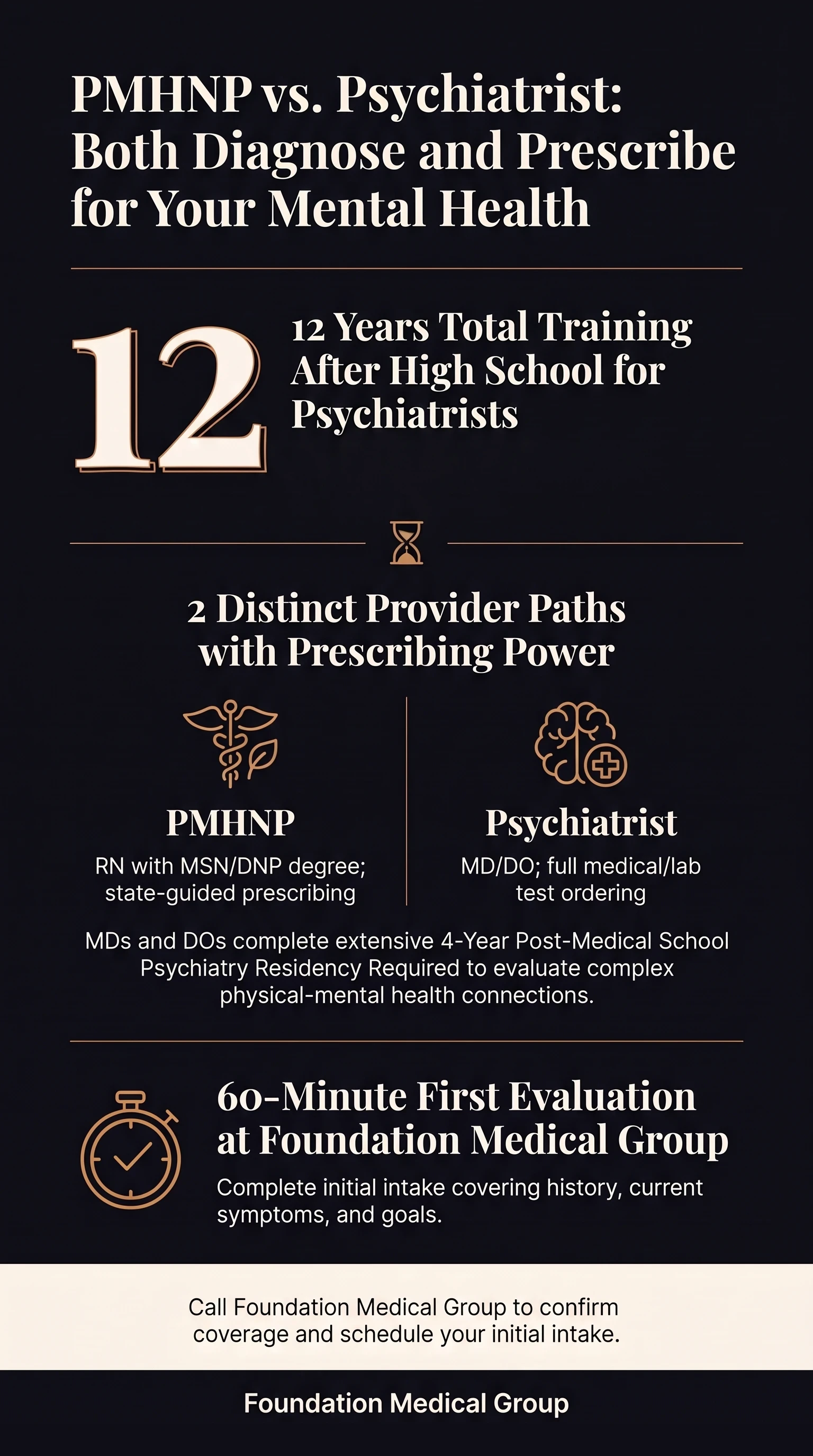
A psychiatrist is a medical doctor (MD or DO) who finished medical school and a 4-year psychiatry residency. A psychiatric nurse practitioner is a registered nurse with a graduate degree in psychiatric nursing. Both can diagnose mental health conditions and manage medication, though nurse practitioner prescribing rules vary by state.
What Is a Psychiatric Nurse Practitioner?
A psychiatric nurse practitioner is an advanced practice registered nurse (APRN) who specializes in mental health. You may also hear the title psychiatric mental health nurse practitioner (PMHNP), psychiatric NP or psych NP. Same job, different labels. Psychiatric nurse practitioners diagnose, treat and support patients with mental health disorders.
According to the American Psychiatric Association (APA), psychiatric nurse practitioners hold a registered nurse license plus a master’s (MSN) or doctoral (DNP) degree in psychiatric mental health nursing. They’re trained in diagnosis, treatment, counseling and medication management.
According to MedlinePlus, a nurse practitioner is a nurse with a graduate degree. An advanced practice nurse has education beyond what registered nurses need for licensing. And national certification exams include a psychiatric mental health specialty. Mental health nurse practitioners work in this nursing specialty.
What Is a Psychiatrist?

A psychiatrist is a medical doctor, either an MD or a DO, who specializes in mental health. Psychiatrists diagnose and treat patients with mental illness, from common disorders to more complex psychiatric conditions.
Side note, because the two words get swapped constantly: a psychiatrist isn’t a psychologist. The titles sound almost identical, but as you’ll see further down, most psychologists don’t prescribe medicine. Anyway, back to psychiatrists.
The APA says psychiatrists finish medical school, pass a licensing exam, and then complete a 4-year residency in psychiatry. That adds up to about 12 years of training after high school. That’s longer than many people guess. Board certification is voluntary for psychiatrists.
Because psychiatrists are physicians, the APA notes they can order the full range of medical lab and psychological tests. That wider lens helps them spot where physical health and mental health overlap for their patients. For the full role, read our guide on what a psychiatrist does.
Psychiatric Nurse Practitioner vs Psychiatrist: Side-by-Side Comparison
Here’s a quick side-by-side view.
| Psychiatric nurse practitioner (PMHNP) | Psychiatrist | |
|---|---|---|
| Degree | RN license plus MSN or DNP in psychiatric mental health nursing | MD or DO |
| Training after college | Graduate nursing program | Medical school plus 4-year residency |
| Diagnose | Yes | Yes |
| Prescribe psychiatric medication | Yes; rules depend on state law | Yes, after a thorough evaluation |
| Psychotherapy | Trained in counseling | Use psychotherapy (talk therapy), medication and other treatments |
| Lab and medical tests | Take histories, do physical exams, order lab tests | Full range of medical lab and psychological tests |
| Where they work | Clinics or hospitals, on their own or with doctors, depending on state law | Private practice, clinics, hospitals and other settings |
Both nurse practitioners and psychiatrists are trained healthcare professionals who can diagnose mental health conditions and prescribe medicine. The main differences? Training and, for nurse practitioners, state rules.
How Does Prescribing Work for a Psychiatric NP?

Nurse practitioners can prescribe, but MedlinePlus explains that their scope of nursing practice depends on state law.
Some states let nurse practitioners work and prescribe on their own. Others require them to work with a doctor, often called a collaborating physician, before they can prescribe. So the rulebook for a psychiatric NP really does change at the state line.
What does that look like on paper? Here’s how the rules read in the four states where FMG has clinics:
- Virginia: Virginia law says a nurse practitioner needs a practice agreement with at least one patient care team physician. That requirement holds until the NP has the equivalent of at least three years of full-time clinical experience. After that? With an attestation, the NP may practice without one. A second Virginia law lets advanced practice registered nurses prescribe Schedule II through Schedule VI controlled substances.
- Utah: Utah law says a licensed advanced practice registered nurse may prescribe prescription drugs, including Schedule II-V controlled substances.
- Georgia: Georgia’s medical board rules say an NP works under a nurse protocol agreement, a written document signed by the NP and a physician who delegates the authority. Schedule II drugs are left out of those rules, except hydrocodone and oxycodone in emergencies when the delegating physician allows it. And the agreement gets reviewed every year.
- Texas: The Texas Board of Nursing says APRNs may not provide any medical aspects of care independently. Writing prescriptions there takes physician delegation plus a prescriptive authority agreement. A Texas NP may prescribe Schedule II drugs only in certain hospital settings or for hospice patients, not in other outpatient clinics.
That’s a lot of legal detail for what feels like a simple question about your meds. We know. These rules change from time to time, so treat this as a summary, not legal advice. Patients can ask how prescribing works at their clinic. Please do. It’s a normal question.
Should I See a Psychiatric Nurse Practitioner or a Psychiatrist?
Worried about picking the wrong one? That worry makes sense, especially when you’re already worn out from feeling unwell. Here’s some relief: for a lot of patients, either one can be a good choice for mental health care. Both psychiatrists and psychiatric nurse practitioners can provide psychiatric care for common outpatient psychiatry needs, such as medication management for depression, anxiety or other mental health challenges.
Still, psychiatrists’ medical training may matter more in some cases. The APA notes that psychiatrists are trained to understand how emotional and other medical illnesses relate. Juggling complex physical health problems along with psychiatric symptoms? Then bring this up early.
Is one better for ADHD? No. Psychiatrists and nurse practitioners can both evaluate ADHD and manage treatment, and the APA notes that stimulants are typically used to treat ADHD. Need a controlled medicine? Then it’s fair to ask whether your prescriber can write it under your state’s rules.
Whether you’re in Richmond, on the Wasatch Front or up in North Dallas, practical points often decide it: who is available, what your insurance covers, and whether you feel heard. Honestly, that last one gets overlooked. Feeling brushed off is frustrating, so it’s fine to ask for someone else. Good mental health treatment and patient care depend on fit, not a title.
How Is a Psychiatric Nurse Practitioner Different From a Therapist?
A therapist usually provides talk therapy, also called psychotherapy. Remember the psychologist mix-up from earlier? Here’s where it matters. The APA explains that licensed clinical social workers and licensed professional counselors provide therapy, and that most psychologists don’t prescribe medicine.
A psychiatric nurse practitioner can diagnose disorders, prescribe medicine and offer counseling. Many patients see both as part of their mental health care: a therapist for therapy and a prescriber for medication. At FMG, talk therapy is offered by secure video in Virginia, Utah, Georgia and Texas, and in person at our Richmond clinic.
Not sure where to start with mental health issues? NIMH says a primary care provider, such as a doctor, physician assistant or nurse practitioner, can be a first stop. These healthcare providers can refer you to mental health services.
Psychiatric Care at FMG in Richmond, American Fork and Dallas
Foundation Medical Group (FMG) offers psychiatry and medication management as part of comprehensive mental health care at three clinics, one each in Virginia, Utah and Texas. Psychiatrists and psychiatric nurse practitioners can both be part of a psychiatry team.
Who handles the prescribing here? At FMG, ongoing prescribing is done by board-certified physicians and psychiatric nurse practitioners. Our team page lists 10 psychiatric nurse practitioners. All of them are based in Virginia. (One holds a DNP, the doctoral nursing degree.) Medication follow-ups run 20 to 30 minutes, monthly at first.
- Richmond, VA: 11600 Busy Street, Suite 203, Richmond, VA 23236, on the second floor, just off Midlothian Turnpike, with a free lot. It’s a short drive from Chesterfield, Midlothian, Short Pump or Henrico most days. Call (804) 506-0526. See the Virginia clinic page.
- American Fork, UT: 456 E State Street, Suite 1400, American Fork, UT 84003, our Utah home base on the Wasatch Front, with visits in person or by telehealth. Call (801) 876-5998.
- Dallas, TX: 8390 Lyndon B Johnson Freeway, Suite 500, Dallas, TX 75243, our North Dallas office on LBJ Freeway. Call (469) 909-1312. See the Texas clinic page and our Dallas psychiatry guide.
Over in metro Atlanta, our Decatur, GA clinic sits a few blocks from downtown Decatur and offers a psychiatric evaluation. Call (706) 534-8574. A first evaluation at FMG lasts up to 60 minutes, with a board-certified physician or a psychiatric nurse practitioner. At that visit, our clinicians go over your history, your current symptoms and what you want out of treatment. Expect plenty of questions, and bring your own.
Call to confirm coverage for your plan: Virginia (Anthem, Aetna, Cigna, Sentara Health Plans, UnitedHealthcare, TRICARE, Cardinal Care; Medicare is not accepted in Virginia). Utah (Blue Cross Blue Shield, SelectHealth, Aetna, Molina). Texas (Aetna, Cigna, Blue Cross Blue Shield, Medicare, Medicaid).
Key Takeaways
- Psychiatrists are medical doctors with 4 years of residency training.
- A psychiatric nurse practitioner is a registered nurse with a graduate degree in psychiatric nursing.
- Both can diagnose and prescribe, though nurse practitioner prescribing rules vary by state.
- The right choice for your mental healthcare comes down to your needs, who’s available, your insurance and, honestly, fit.
FAQ
What is the difference between a psychiatric nurse practitioner and a psychiatrist?
Training. Psychiatrists go to medical school and a psychiatry residency. A psychiatric nurse practitioner is a nurse with a graduate nursing degree. Both can diagnose and prescribe.
How does a psychiatric nurse practitioner compare to a psychiatrist with an MD?
An MD psychiatrist can order the full range of medical tests. A nurse practitioner’s scope, including prescribing, is set by state law.
Is a psychiatric nurse practitioner or a psychiatrist better for ADHD?
Neither is better. Both can evaluate ADHD and manage ADHD medicine, such as stimulants.
Should I see a psychiatric nurse practitioner or a psychiatrist?
Start with whoever is available and covered by your plan. With complex medical needs, ask whether a psychiatrist’s medical training would help.
Sources
- American Psychiatric Association, What is Psychiatry?.
- MedlinePlus, Nurse practitioner (NP).
- MedlinePlus, Types of health care providers.
- NIMH, Tips for Talking With a Health Care Provider About Your Mental Health.
- Code of Virginia, § 54.1-2957. Licensure and practice of advanced practice registered nurses.
- Code of Virginia, § 54.1-2957.01. Prescription of certain controlled substances and devices by licensed advanced practice registered nurses.
- Utah Code, 58-31b-803. Advanced practice registered nurse prescriptive authority.
- Georgia Composite Medical Board, Rules Chapter 360-32: Nurse Protocol Agreements.
- Texas Board of Nursing, APRN Practice FAQ.