
A psychiatrist is a medical doctor who diagnoses mental health conditions, prescribes medication, and adjusts it as your body responds. Foundation Medical Group brings that psychiatric care to American Fork, Utah, with one physician-led team covering diagnosis, medication management, and therapy. Visits happen in person and by telehealth where our clinicians are licensed.
What does a psychiatrist in American Fork do?
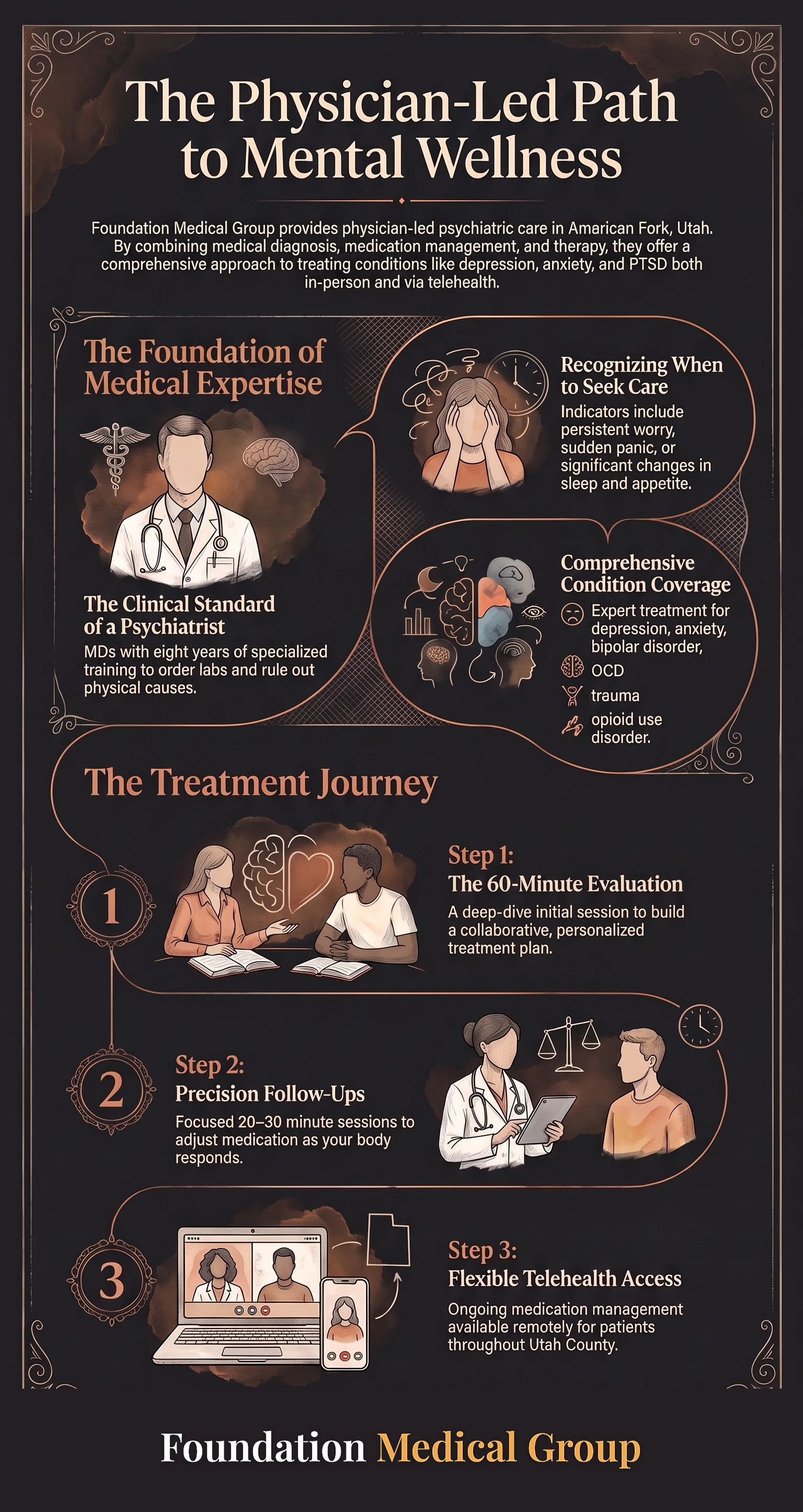
A psychiatrist trains as a physician first, then in mental health. According to the American Psychiatric Association, that path runs four years of medical school plus four years of residency. All that training is why psychiatrists can order labs, rule out physical causes, and prescribe psychiatric medications. A counselor can’t do that part.
The daily work is practical. Most of it is talk, notes, and small dose calls. Your doctor listens to your story. They ask about sleep, mood, energy, and what you’ve already tried. Then you settle on a diagnosis together and build a treatment plan in plain words.
Medication management fills most follow-up visits. Doses change. Side effects often show up early and fade later. Careful medication management means somebody tracks all of that with you instead of leaving you to guess. In our experience, the first 6 weeks on a new medication need the most contact.
Our team also connects you to therapy and, when it fits, to addiction treatment. Mental health care stays in one place rather than scattered across Utah County.
When should you see a psychiatrist?
Plenty of us wait too long, and that’s normal. You don’t have to hit rock bottom before you call a clinic.
Here’s a simple rule. Has low mood, worry, or racing thought lasted more than two weeks? Is it touching your work, your sleep, or the people you love? Then it’s worth booking. No crisis is needed first.
Signs that psychiatric care may help:
- Sadness or worry that won’t lift on its own.
- Sleep or appetite that has clearly changed.
- Panic that arrives out of nowhere.
- Big swings between very high and very low energy.
- Drinking or using opioids just to cope.
Reaching out early usually brings faster relief. For patients in American Fork, that first phone call is the hardest part of treatment. Honestly, the rest gets easier.
If you’re in crisis right now, call or text 988. The 988 Suicide and Crisis Lifeline is free and answered every hour of the day.
What mental health conditions do you treat?
You don’t need a label before you reach out. Our clinicians commonly treat adults and teens living with these mental health issues:
- Depression and other mood disorders. The National Institute of Mental Health calls depression common, serious, and treatable.
- Anxiety, including panic and social anxiety.
- Bipolar disorder, where mood swings between high and low periods.
- Obsessive compulsive disorder.
- Trauma and post traumatic stress.
- Opioid use disorder, treated beside the rest instead of somewhere else.
Mental health challenges rarely arrive one at a time. Depression and opioid use disorder often travel together, for example, and treating both under one roof holds up better than treating one, then the other. Bipolar disorder and anxiety pair up just as often. If addiction is part of the picture, our Suboxone clinic in American Fork shares that same roof with psychiatry.
What happens at your first psychiatric evaluation?

Your first visit runs longer than the ones that follow. It’s a conversation, not a form. Bring a list of every medication you take now, plus notes on what has worked before and what hasn’t.
| What to expect | First visit | Follow-up visit |
|---|---|---|
| Length | About 60 minutes | About 20 to 30 minutes |
| Main focus | Full history and diagnosis | Progress and medication management |
| Outcome | A treatment plan you helped build | Small changes to the plan |
| How often | Once, to start | Every 2 to 6 weeks, then spaced out |
Most psychiatric medications need time to work. According to the National Institute of Mental Health, an antidepressant may take 4 to 8 weeks before you feel the full effect. That is why early follow-ups matter more than patients expect. You should not have to wait it out alone.
Who else is on your psychiatric care team?
A psychiatrist isn’t the only clinician you’ll meet. A psychiatric mental health nurse practitioner diagnoses mental health conditions and prescribes too, through nursing training rather than medical school. Scope rules for a nurse practitioner vary by state, and Utah gives nurse practitioners a wide scope.
In day to day practice, a psychiatric nurse practitioner often carries much of the medication management. That usually shortens your wait for an appointment, since psychiatrists in Utah County book out fast. Care quality holds steady because the whole team reviews cases together.
Licensed therapists complete the group. Ask any psychiatric provider one plain question: how will you handle medication management between my visits? A clear answer is a good sign. A vague one tells you plenty as well.
How is psychiatry different from therapy?
Patients mix these two up all the time. They do different jobs, and they work best as a pair.
Your doctor handles diagnosis and psychiatric medication management. A therapist guides you through talk therapy. Cognitive behavioral therapy, for instance, teaches you to catch and test the thoughts that keep you stuck. Medicine can lift enough weight that therapy finally lands.
A counseling clinic offers psychotherapy and outpatient counseling, yet it can’t prescribe. That’s the practical difference. Individual therapy plus medication usually beats either one alone for moderate depression, rather than being an either-or choice. If cost is your worry, our guide to finding a therapist who takes Medicaid walks through the options.
Do you offer adolescent psychiatry for teens?

Adolescent psychiatry runs on its own rhythm. School, sleep, phones, and friendships all shape a teenager’s behavioral health, so we bring parents into the plan without taking over the visit.
Teens get a private stretch of the appointment. Kids talk more when a parent steps out. Families get clear updates on the treatment plan. Whether the concern is anxiety before school or a mood disorder that runs in the family, the same physician-led approach applies. Behavioral health for young people leans harder on therapy and lighter on medication, and we say so out loud.
Can you see a psychiatrist by telehealth in Utah?
Yes, and it suits follow-up care well. You log on from home. There is no drive on I-15 and no half day off work. Our patients join us from Lehi, Pleasant Grove, Highland, and as far south as Spanish Fork. Plenty of them drive in for the first visit, then switch to video.
Telehealth works best once your diagnosis is settled and you’re mostly adjusting doses. Some care still needs a room: certain lab work, and any visit where safety is a live question. Ask what our clinic can and can’t do by video before you book, and we’ll tell you straight.
How do you choose a psychiatrist in American Fork?
Type “psychiatrist American Fork” into a search bar and a wall of names comes back. Here are a few expert tips from our clinicians for narrowing that list.
- Check the clinic treats your main concern, not mental illness in general.
- Ask whether one team handles both psychiatry and addiction treatment.
- Ask how soon a new patient gets seen, in weeks rather than “soon”.
- Confirm your insurance before you book anything.
- Notice how staff treat you on the phone, since that tone carries into the exam room.
You’re allowed to switch, too. If the fit feels wrong after a few visits, say so, and a good doctor will help you find someone better. Comparing two or three psychiatrists near you before committing is a reasonable move, not a rude one.
Mental healthcare shouldn’t feel like a maze. Ask direct questions about treatment options, cost, and wait times, and judge the answers.
Key Takeaways
- A psychiatrist in American Fork is a medical doctor who diagnoses mental health conditions and manages your medication.
- Foundation Medical Group joins psychiatry, therapy, and addiction treatment in one physician-led clinic serving Utah County.
- Your first psychiatric evaluation runs about 60 minutes and ends with a treatment plan you helped build.
- A psychiatric nurse practitioner can shorten your wait while keeping the same standard of psychiatric care.
- Telehealth covers most follow-up medication management for patients across Utah, which supports steady mental wellness.
Talk With Our American Fork Team
Starting mental health treatment feels like a big step, and that nervous feeling is normal. Foundation Medical Group welcomes new patients in American Fork and the surrounding towns. Every patient gets time, plain answers, and a treatment plan they understand. Call us to book your first visit and sort out your mental health concerns with a real plan.
We provide outpatient psychiatric mental health services, not inpatient care. If you or someone you love needs urgent help, call or text 988. You can also reach the SAMHSA National Helpline at 1-800-662-4357, free and open 24 hours a day, 365 days a year.