
A psychiatrist in Dallas is a medical doctor who diagnoses mental health conditions, prescribes medicine, and adjusts it as you get better. At Foundation Medical Group on Lyndon B Johnson Freeway, Dr. Justin Thompson leads a team that keeps psychiatry, therapy, and addiction medicine under one roof. Here’s what that care actually looks like.
What does a psychiatrist in Dallas do?
A psychiatrist trains as a doctor first, then in mental health. According to the American Psychiatric Association, that path runs 4 years of medical school and roughly 4 more years of residency. Psychiatrists in Texas finish all of it before they treat anyone on their own.
That’s a long runway. It buys you a doctor who can spot a medical cause hiding under a mood problem.
Because of the medical degree, a psychiatrist can order labs, rule out physical causes, and prescribe psychiatric medications. A counselor cannot. That gap matters when your symptoms are tangled up with thyroid trouble, sleep loss, or a substance.
Day to day the work is practical. Your doctor listens, reaches a diagnosis with you, and builds a treatment plan you agree with. Then comes medication management, which means tracking doses, side effects, and progress over months rather than one visit. Good psychiatric care is a series of small adjustments, not one big fix. Patients hunting for medication management near them usually want that follow-through.
When should you see a psychiatrist in Dallas?
Plenty of us wait far too long. There’s no gold star for holding out, and you don’t have to hit bottom before you call.
A simple rule helps. Has low mood, worry, or racing thought stuck around longer than 2 weeks? Is it touching your job, your sleep, or the people you love? Then a psychiatry appointment is reasonable.
Signs that psychiatric care may help:
- Sadness or dread that won’t lift on its own.
- Sleep or appetite that has clearly shifted.
- Panic that arrives without warning.
- Big swings between very high and very low energy.
- Drinking or using opioids to get through the day.
Care works better early than late. If you’re in crisis right now, call or text 988. Someone answers day and night.
What conditions do Dallas psychiatrists treat?

Psychiatry covers a wide range, and you don’t need a label before you book. The National Institute of Mental Health describes depression as one of the most common mental disorders in the United States. It also responds well to treatment.
Our clinicians commonly help adults living with:
- Depression, including major depressive disorder and other mood disorders.
- Anxiety, panic, and social anxiety.
- Bipolar disorder and related mood disorder patterns.
- Obsessive compulsive disorder, or OCD.
- Trauma and PTSD.
- Personality disorders.
Psychiatric disorders sit on a spectrum. Two people can share a diagnosis and still need very different care.
We also treat opioid use disorder. That mental illness rarely travels alone, and depression often rides along with it. Mental health challenges tend to arrive in pairs. For families asking about adolescent psychiatry or child psychiatry, we’ll say plainly what we do and where to go for the rest. Adult psychiatry is our lane, and honesty about that saves you a wasted trip.
Should you see a psychiatrist or a nurse practitioner?
Both can diagnose and prescribe, so the choice confuses people. Here’s how the roles compare.
| Role | Training | Prescribes medicine | Often best for |
|---|---|---|---|
| Psychiatrist (MD or DO) | Medical school plus psychiatry residency | Yes | Complex or unclear diagnoses |
| Psychiatric nurse practitioner | Graduate nursing plus a psychiatric board exam | Yes, within state rules | Steady medication management |
| Therapist or counselor | Master’s degree plus supervised hours | No | Cognitive behavioral therapy and skills |
| Primary care doctor | Medical school plus family or internal medicine | Yes, limited scope | A first step before specialty care |
The second row is not a downgrade. Openings tend to come sooner, and the clinical expertise sits right there beside the physicians. Both routes give you real psychiatric care.
A therapist is a mental health professional too, and the job title alone won’t tell you who can prescribe. Ask. Psychiatric clinicians here share notes, so nothing falls through a gap between visits.
What happens at your first psychiatric evaluation?

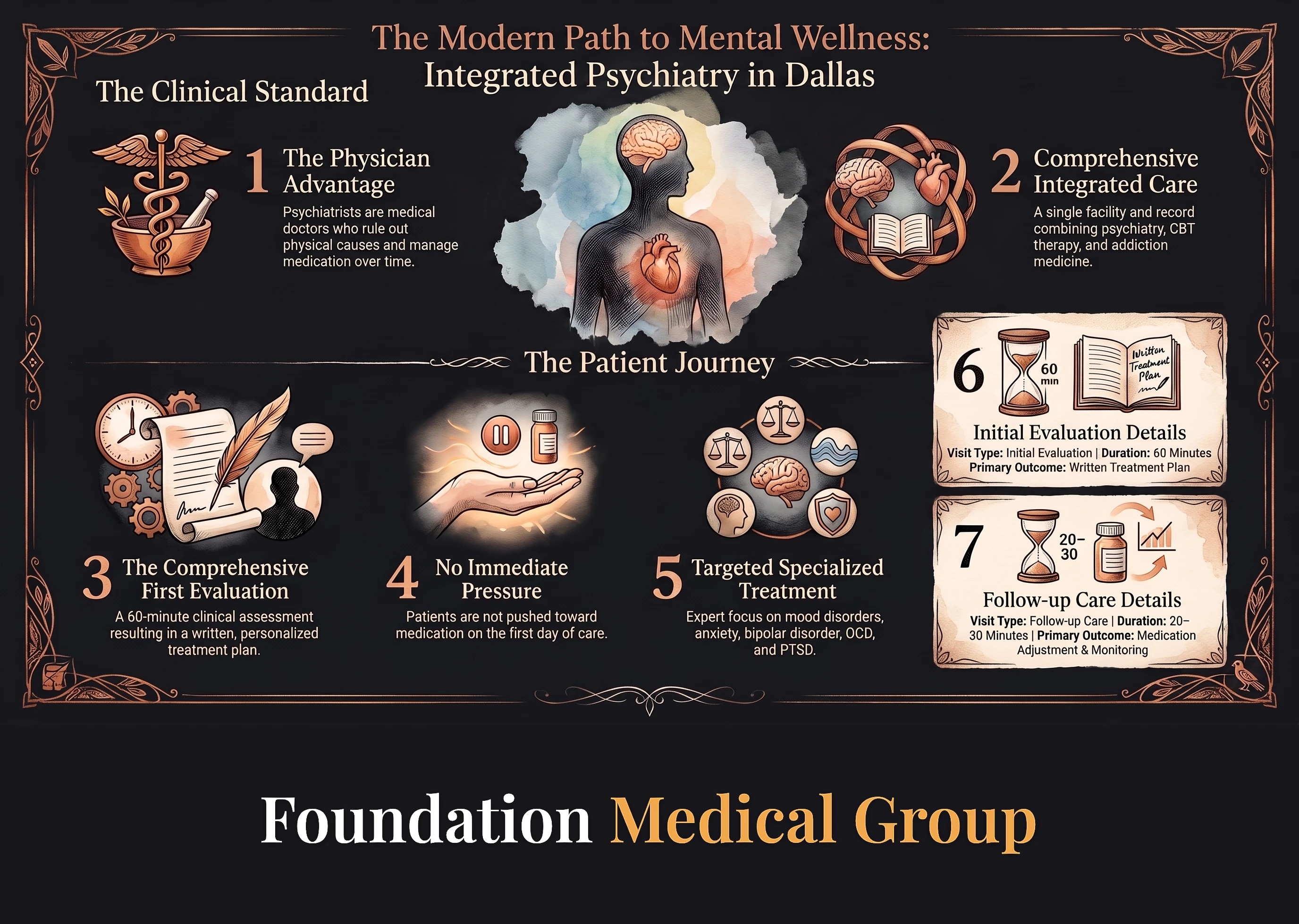
Your first psychiatric evaluation runs longer than the visits that follow, usually about 60 minutes. It’s a conversation, not a form. Expect questions about your history, your symptoms, your sleep, your family, and what you want life to look like in 6 months.
Bring three things. A list of every medicine you take now. Your insurance card. A few notes on what has helped before and what flopped.
Bring a friend as well, if that steadies you. Plenty of patients do.
Follow-up care is shorter, often 20 to 30 minutes, and it focuses on how the plan is holding up. You leave the first visit with a written treatment plan and a clear next step. You won’t be pushed into a decision about medication on day one.
What mental health services does our Dallas clinic offer?
Foundation Medical Group brings several kinds of mental health treatment together on Lyndon B Johnson Freeway, so your care doesn’t scatter across the metroplex.
- Psychiatric medication management. Careful prescribing and steady review for depression, anxiety, and bipolar disorder.
- Talk therapy. Cognitive behavioral therapy and supportive psychotherapy, alone or beside medicine. A therapist who takes Medicaid may also be an option, depending on your plan.
- Addiction medicine. For opioid use disorder we use buprenorphine and related medicines. According to SAMHSA, these approved medicines are a mainstay of recovery.
- Coordinated care. One record, one care team, and no repeating your story to strangers.
Ask any clinic whether a treatment such as TMS fits your case. TMS is not traditional psychotherapy, and it is not surgery. A straight answer about what an option does, and does not do, is part of quality mental health care.
How do you choose a psychiatrist in Dallas?
Type “psychiatrist Dallas” into a search bar and you’ll get a wall of names with almost no way to tell them apart. Narrow it with a few questions.
- Does the clinic treat your main concern, or only general mental health issues?
- Will you see a board certified psychiatrist, or another prescriber on the team?
- How soon can a new patient get in?
- Is your insurance accepted, and what will a visit cost you?
- Does one team handle psychiatry and addiction medicine together?
Ask who handles your care between visits, too. Notice how the staff treat you on the phone. That tone usually carries into the exam room. If the fit turns out wrong, say so and switch. A good psychiatrist will help you find a better match rather than take it personally. Some psychiatrists prescribe and little else, while ours sit down with therapists and share one chart.
Key Takeaways
- A psychiatrist in Dallas is a medical doctor who diagnoses mental health conditions and manages your medication.
- Foundation Medical Group joins psychiatry, therapy, and addiction medicine in one physician led clinic on Lyndon B Johnson Freeway.
- Your first visit runs about 60 minutes and ends with a treatment plan you helped shape.
- A psychiatric nurse practitioner can prescribe as well, and shorter waits often come with that route.
- Treating a mental health issue and opioid use disorder side by side supports steadier mental wellness.
Visit Our Dallas Clinic
Starting mental health care takes nerve, and that first phone call is usually the hardest part. Foundation Medical Group welcomes new patients at 8390 Lyndon B Johnson Fwy Ste 500, Dallas, TX 75243. Call 469-909-1312 to ask about openings with Dr. Justin Thompson and our psychiatry team. Our psychiatrists keep the first slot of the day open for new patients when they can. If you’re weighing options elsewhere in Texas, our guide to finding a psychiatrist near you walks through the same questions.
We offer outpatient psychiatry, not inpatient beds. For urgent help, call or text 988 at any hour. You can also reach the SAMHSA National Helpline at 1-800-662-4357, free and confidential, every day of the year.