
Yes, Medicaid covers psychiatric care in Richmond, Virginia. Most members get it through a Cardinal Care health plan, and most pay nothing for an outpatient visit. The one step that matters is confirming a clinic is in network before you book. Foundation Medical Group treats mental health and addiction under one physician led roof on Busy Street in Richmond.
Does Medicaid cover a psychiatrist in Richmond?
It does, and this is not an unusual thing to ask for. According to Medicaid.gov, behavioral health is a core part of the program. Medicaid is the single largest payer for mental health services in the country. So the benefit you are asking about is one the program was built around.
In Virginia, Medicaid goes by the name Cardinal Care. It is run by the Virginia Department of Medical Assistance Services, usually shortened to DMAS. Cardinal Care pulled two older programs, Medallion 4.0 and CCC Plus, into one on October 1, 2023. That change was mostly about paperwork behind the scenes. Your coverage for psychiatry did not shrink.
Today more than 90 percent of Virginia members get their care through a managed care plan rather than straight from the state. Practically speaking, that means a health plan sits between you and the practice. The plan name is printed on your card, and it decides which clinics count as in network.
Covered psychiatric mental health services usually include a diagnostic evaluation, follow up visits, medication management, individual and group therapy, and addiction treatment. Virginia also covers crisis services and Addiction and Recovery Treatment Services, known as ARTS. That last piece matters for anyone whose depression sits next to alcohol or opioid use.
Coverage is not the same as access, and it’s worth being honest about the gap. A benefit on paper still needs a clinic with an open slot and a spot in your network. That’s the part this guide is really about.
If you’re unsure what you have, call the DMAS Managed Care Helpline at 1-800-643-2273. The staff there can tell you which plan you’re enrolled in and how to switch during open enrollment.
Which Medicaid plan do you actually have?
Plenty of people know they have Medicaid but couldn’t name their plan. That’s fair, and it’s worth sorting out, because the plan sets the rules for referrals, networks, and prescriptions.
Flip your card over. The plan name sits on the front or the back, along with a member services number. Cardinal Care works through a small group of health plans, and that lineup does shift. In July 2025, for example, members enrolled with Molina were moved over to Humana Healthy Horizons of Virginia. So a plan name you memorized two years ago might not be the one you carry now.
A few members are on fee for service Medicaid instead of a managed care plan. In that case the state pays the clinic directly and DMAS is your point of contact. Either route covers psychiatry. Only the phone number you call changes.
Some Richmond residents carry Medicare and Medicaid at once. Dual eligible coverage is common for older adults and for people on disability, and it does not block psychiatric care. Medicare usually pays first, then Medicaid picks up cost sharing and fills gaps such as certain transportation benefits. Bring both cards to your first appointment so billing gets it right from day one.
Here is what to ask when you reach your plan:
- Is Foundation Medical Group in network for outpatient psychiatric mental health care?
- Do I need a referral before I book a psychiatric visit?
- How many therapy sessions does my coverage allow each year?
- Which mental health medication is on the plan formulary?
- Does my plan cover video visits as well as in person care?
Write the answers down with the date and the name of the person you spoke with. That short note has settled more billing questions than any of us would like to admit.
One more habit helps. Ask for a reference number for the call. Plans log those, and it turns a he said, she said moment into a two minute lookup later.
How do I find medicaid psychiatrists near me in Richmond?
Searching for medicaid psychiatrists can feel like shouting into a void, especially on a hard week. A short, ordered path works better than scrolling.
- Start with the plan directory. Log in to your health plan site and filter for behavioral health near your zip code. Those listings are the in network ones.
- Call the member line next. Ask which medicaid psychiatrists are taking new patients right now. Directories go stale, and a live person will tell you what the website will not.
- Search, then verify. Typing psychiatrist Richmond medicaid into a search bar is a fine way to build a shortlist. Treat what you find as a starting point, not a promise.
- Call the practice directly. Two questions settle it. Do you accept my Medicaid plan? Are you accepting new patients?
- Use a public locator. FindTreatment.gov from SAMHSA maps mental health and addiction providers by address.
Richmond has a real advantage here. The city sits in a dense stretch of Central Virginia, so a practice in Midlothian, Chesterfield, or Henrico is often a reasonable drive. Widening your search past the city line frequently shortens the wait by weeks.
When you call Foundation Medical Group at 804-506-0526, our front desk checks your coverage with you on the phone. You do not have to decode the insurance side alone. If the cost question is what has kept you from calling, you are in very ordinary company.
What will psychiatric care cost with Medicaid?
For most Virginia members, the honest answer is nothing. Virginia removed copays for most behavioral health services in July 2022. Before that change, a session copay ran somewhere around 1 to 3 dollars. Small either way, and now usually gone.
The bill that hurts is a different one. An out of network psychiatrist can charge you the full private rate, and that invoice arrives without warning. So ask the same question twice. Ask your plan whether the practice is in network, then ask the practice. Two clear yeses, and you are on solid ground.
| What to check | With Virginia Medicaid | Confirm before you book |
|---|---|---|
| First evaluation visit | Covered | That the clinic is in network |
| Follow up medication visits | Covered | Copay, if your plan charges one |
| Therapy sessions | Covered | Session limits for the year |
| Referral required | Depends on the plan | Ask your member services line |
| Telehealth visits | Usually covered | Whether video counts the same |
| Prescriptions | Covered on formulary | Prior authorization rules |
Two other cost traps are worth naming. A no show fee is not covered by Medicaid, so cancel early if life gets in the way. And a medication that sits off your plan formulary may need prior authorization, which our staff handles but which can add a few days.
Who will you see at a Richmond mental health clinic?
Psychiatric mental health care is a team sport, and the job titles confuse people. Here is the plain version.
A psychiatrist is a medical doctor. The path runs about four years of medical school, then four more years of psychiatry residency. That training is what allows a psychiatrist to reach a diagnosis, order tests, and prescribe. Dr. Vincent Nardone leads our Richmond practice and brings extensive experience in mood disorders and addiction medicine.
A psychiatric nurse practitioner takes a different road to a similar chair. That clinician starts as a registered nurse, builds real nursing experience at the bedside, then completes a graduate degree and a board exam in advanced nursing practice. A psychiatric mental health nurse practitioner can diagnose, prescribe, and manage medication in Virginia. Many patients see one for follow up visits and never notice a drop in quality.
That nursing background is an asset rather than a compromise. A registered nurse spends years watching how medication actually lands on real people, which is a different kind of expertise than a textbook gives. Plenty of our patients on Medicaid see a psychiatric nurse practitioner for routine follow up and the physician for the harder calls.
A therapist guides talk therapy and does not prescribe. Licensed therapists hold a master’s degree plus supervised clinical hours. Their expertise sits in the room with you, week after week.
Behind all three sits a coordinator who handles authorizations and scheduling. You’ll probably speak to that person most often, and a good one saves you hours.
| Clinician | Can prescribe | Typical focus | Covered by Medicaid |
|---|---|---|---|
| Psychiatrist (MD) | Yes | Diagnosis, complex medication management | Yes |
| Psychiatric nurse practitioner | Yes | Ongoing medication management, follow up | Yes |
| Licensed therapist | No | Psychotherapy, coping skills, relationships | Yes |
| Primary care doctor | Yes | First line care, bridge prescriptions | Yes |
Most people do best with two of these at once. Medicine can lift the weight of depression just enough that therapy finally lands.
How do psychiatry and therapy work together?

Think of them as two different tools rather than competing options. Psychiatry works on the biology, mainly through medication management and a clear diagnosis. Therapy works on the patterns, the habits, and the stories you tell yourself at 2 in the morning.
Neither one does the other’s job well. Medicine rarely teaches you how to handle a difficult parent. Talk therapy rarely fixes the sleep architecture that a mood disorder has scrambled. Put together, they cover more ground than either does alone, and that combination is standard practice for moderate to severe depression.
The sequencing question comes up a lot. Should you start medication first, or therapy first? Honestly, it depends on where you are. If you can’t get out of bed, medication often has to come first so that therapy is even possible. If you’re functioning but stuck, therapy alone is a reasonable place to begin.
Our psychiatric mental health team shares one chart, so your therapist sees the medication changes and your prescriber sees what’s surfacing in session. That sounds like a small thing. It isn’t. Patients who move between disconnected offices spend half of every appointment repeating their own history.
Whatever the mix, your treatment plan should say out loud what each piece is for. If nobody has explained why you’re taking something, ask. A clinician who can’t answer that in plain words is a clinician worth questioning.
What mental health conditions does psychiatry treat?
You do not need a label before you call. Reaching out with nothing but a rough description of a hard month is completely normal.
Our psychiatric mental health team commonly helps adults living with:
- Depression and other mood disorders. The National Institute of Mental Health describes depression as common, serious, and treatable.
- Anxiety, panic disorder, and social anxiety.
- Bipolar disorder, including the long stretches between episodes.
- Post traumatic stress and the sleep problems that ride along with it.
- Obsessive compulsive disorder.
- Schizophrenia and other conditions that involve psychosis.
- Borderline personality disorder and related patterns.
- Opioid and alcohol use disorder, treated alongside the rest.
Bipolar disorder deserves a note of its own. It is often mistaken for plain depression at first, because the low stretches are what push someone to call. A careful diagnosis matters here, since a medication that helps depression can destabilize bipolar disorder if it is prescribed on its own. That is one reason a thorough first visit is worth the hour.
Schizophrenia and psychosis also respond to steady care. Long term work with one clinic, rather than a string of emergency visits, tends to keep people out of the hospital. Virginia Medicaid covers that ongoing psychiatric care, and it covers the community supports that sit around it. For families dealing with schizophrenia, that continuity is often the single biggest factor in how the next few years go.
Mood disorders deserve the same patience. Depression and bipolar disorder are chronic for some people and episodic for others, and the difference only shows up over time. Mental health challenges rarely arrive one at a time either. Roughly half the people we evaluate are carrying two conditions at once, most often a mood disorder alongside anxiety or substance use.
Stigma is the other thing worth naming. Plenty of adults sit with mental health challenges for years because they think needing help means something about their character. It doesn’t. A mood disorder is a medical condition, treated with the same seriousness as high blood pressure, and nobody here will make you feel otherwise.
What happens at your first comprehensive psychiatric evaluation?
Your first appointment is a full psychiatric assessment, and it runs longer than the visits that follow. Plan for about 60 minutes. Later follow ups usually take 20 to 30 minutes.
It’s a conversation, not a form. Your doctor asks about your history, your sleep, your mood, your family, your work, and what you want to change. Nobody rushes you toward a label. Comprehensive psychiatric evaluations are built to catch the things a 10 minute visit misses, such as a hypomanic stretch you had written off as a good week.
Bring a few things and the hour goes further:
- Your Medicaid card and a photo ID.
- A list of every medication you take, including doses and supplements.
- Names of anything you have tried before, and how it went.
- Notes on symptoms, when they started, and what makes them worse.
- Any records from a previous practice or hospital stay.
You leave with a working diagnosis and a treatment plan you helped build. That plan usually names one or two next steps, not twelve. Individualized treatment plans work better than generic ones because your sleep, your job, and your family aren’t like anyone else’s.
A working diagnosis can change, and that’s normal rather than a mistake. Psychiatry reads patterns over months, so a first impression of depression sometimes becomes bipolar disorder once a manic stretch shows up. Good clinicians say that out loud at the start instead of pretending the first answer is final.
Feeling nervous before that first visit is so common it’s almost universal. Say so when you walk in. Naming it out loud usually takes the edge off, and it tells your clinician something useful.
How does medication management work on Medicaid?
Medication management is the quiet engine of psychiatric care. Getting a prescription is the easy part. Fitting it to your body over the following months is the actual work.
Early visits sit close together, often every two to four weeks. Your clinician watches for side effects, checks whether the dose is doing anything, and adjusts. Once things steady out, visits stretch to every one to three months. That rhythm is standard, and Virginia Medicaid covers it.
Formularies matter here. Each Cardinal Care plan keeps a list of covered medication, and generics usually sit on the preferred tier. If a specific medication needs prior authorization, our staff files it. Say a first antidepressant leaves you flat and tired. Rather than white knuckling it, tell us, and we adjust or switch.
Timelines are worth setting straight, because this is where people give up too early. Most antidepressants need 4 to 6 weeks at a proper dose before anyone can judge them. Sleep and appetite often improve first, and mood follows later. Knowing that in advance makes week 3 far less discouraging.
Thoughtful medication management also means knowing when to stop. Not every symptom needs a pill, and some do better with therapy alone. Our clinicians will tell you when that’s the case.
Never stop a psychiatric medication cold on your own, though. Some come with real discontinuation effects, and a planned taper is safer and more comfortable. Call us first, even if the reason you want to stop feels embarrassing. Stopping is a treatment decision like any other, and it goes better when we make it together. We’ve heard every reason, and none of them shocked us.
If you are comparing options across town, our guide to psychiatric medication management near you walks through what good follow up should look like. The short version is simple. You should be able to reach a human between visits.
Does Medicaid cover therapy in Richmond too?
Yes, and pairing therapy with medication usually beats either one alone. Virginia Medicaid covers individual therapy, group therapy, and family therapy, along with intensive outpatient programs for people who need more structure.
Cognitive behavioral therapy is the most studied form for depression and anxiety. It gives you tools you can practice between sessions. Supportive therapy takes a gentler shape, focused on steadying day to day life during a rough stretch. Supportive psychotherapy is often the right starting point after a loss, a job change, or a hospital stay.
Supportive therapy earns its place with people who are already stretched thin. It doesn’t ask you to dig through childhood or rebuild your thinking from the ground up. The work is steadier than that, aimed at getting through the next month with your job and your relationships intact. For patients managing treatment for a chronic illness on top of mood disorders, that lighter touch is often exactly right.
Psychotherapy is not a soft add on to real treatment. It is evidence based treatment in its own right. Our therapists coordinate directly with the prescribing side of the practice, so notes move between clinicians instead of sitting in separate files.
Session limits vary between plans. Some approve a block of visits and then review, which is normal rather than a rejection. If your plan asks for a review, our team files the paperwork.
Group therapy is worth a mention too, since people tend to dismiss it. Sitting in a room with others working through the same thing does something that individual therapy can’t replicate. It’s also usually easier to get into, which matters when the wait for a one on one slot runs long.
Healing is rarely a straight line. A good month, then a hard week, then two steadier ones. That pattern is what recovery actually looks like, and it’s worth saying plainly, because people quit therapy when they expect a smooth climb and get a staircase instead. Healing on a schedule is a fantasy nobody should sell you.
What if the wait for an appointment feels long?

Waits happen across outpatient mental health care, and they land hardest right after you finally work up the nerve to call. Being on a list does not mean you are stuck. A few moves usually shorten it.
- Ask for the cancellation list. Seats open more often than people expect, especially early in the week.
- Ask about telehealth. Virginia Medicaid covers video visits, and online psychiatrists often have earlier openings than in person slots.
- Start therapy first. Therapy is covered too, and a therapist can steady things until the prescribing visit arrives.
- Ask your primary care doctor for a bridge. Many will start or continue a basic medication until you are seen.
- Widen the map. A practice 20 minutes out from downtown Richmond may have next week open.
If things ever feel unsafe, do not wait for an appointment. Call or text 988 for the Suicide and Crisis Lifeline, free and staffed around the clock. The SAMHSA National Helpline at 1-800-662-4357 is free and confidential too, open every day of the year, and the staff there can point you toward treatment nearby.
Does Medicaid cover mental health care for children and teens?
It does, and the coverage for young people is broader than most parents expect. Federal rules require an Early and Periodic Screening, Diagnostic and Treatment benefit, usually called EPSDT, for members under 21. Under EPSDT, a medically necessary service must be covered even when the adult benefit package would not include it.
In practice that means a child’s mental health needs get evaluated, and the resulting care gets covered. Virginia also runs FAMIS for families who earn slightly too much for regular Medicaid, and FAMIS covers behavioral health as well.
Parents often ask whether a teen can be seen without a formal diagnosis in hand. They can. Screening is part of the benefit, not a hurdle you clear before it starts.
Consent rules trip families up more than coverage does. In Virginia, a minor can consent to some kinds of mental health care on their own, while other services still need a parent. Ask the clinic to walk you through it before the appointment rather than at the front desk.
What should you ask before choosing a Richmond clinic?
Once you have two or three names, a short list of questions sorts them quickly. Coverage is only the entry ticket. What you actually want is somewhere you’ll still be going in a year.
- Do you accept my Cardinal Care plan, and are you taking new patients? Both, in one call.
- Who would I see, and would it be the same clinician each time? Continuity beats convenience for most mental health conditions.
- How fast do you return calls between visits? Ask for a number of business days, not a vibe.
- Do you have therapists in house, or would I be referred out? In house usually means faster and better coordinated care.
- Do you treat addiction as well as psychiatry? For anyone with both, one team is far better than two.
- What happens if I miss a dose or run out on a weekend? A clinic with a real answer has thought about actual patient care.
Notice how the phone call feels, too. The tone of the front desk tends to carry straight through to the exam room. If you’re rushed or talked over before you’ve even booked, that’s information.
You’re also allowed to switch. If the fit is wrong after two or three visits, say so. Medicaid does not lock you to one clinic, and a decent clinician will help you find a better match rather than take it personally.
Why choose a physician led practice for Medicaid psychiatry?
When psychiatric mental health care sits in one building, fewer things fall through the cracks. Our Richmond practice keeps psychiatry, therapy, and addiction medicine together. Your diagnosis, your medication, and your follow up stay coordinated instead of scattered across three offices that never speak.
That matters more than it sounds. In our clinic we regularly see patients carrying two things at once. Depression next to an anxiety disorder. A mood disorder next to opioid use. Treating those side by side holds up better over time than treating one, waiting, then starting on the other.
Compassionate evidence based care is the standard we hold ourselves to, and it shows up in ordinary ways. Appointments that are not rushed. Plain answers about what a medication does. Experienced mental health professionals who return calls. Patient care that treats you as a person with a job and a family, not a chart number.
Good psychiatric mental health care is boring in the best possible way. Same building, same faces, notes that follow you instead of getting lost. Our patients on Medicaid get the same appointment length, the same clinical expertise, and the same treatment options as anyone else who walks in. Psychiatric mental health services shouldn’t come in two tiers based on whose name is printed on the insurance card, and healing shouldn’t either.
We are an outpatient clinic, not an inpatient hospital. For anyone who needs a higher level of care, we help arrange it rather than sending you off with a phone number.
If you want a broader picture of what our psychiatry service covers, read our guide to seeing a psychiatrist in Richmond. If you are searching from outside Central Virginia, our overview of finding a psychiatrist near you that takes Medicaid covers the same ground for other states. Both point back to the same goal, which is better mental health with coverage you already have.
Key Takeaways
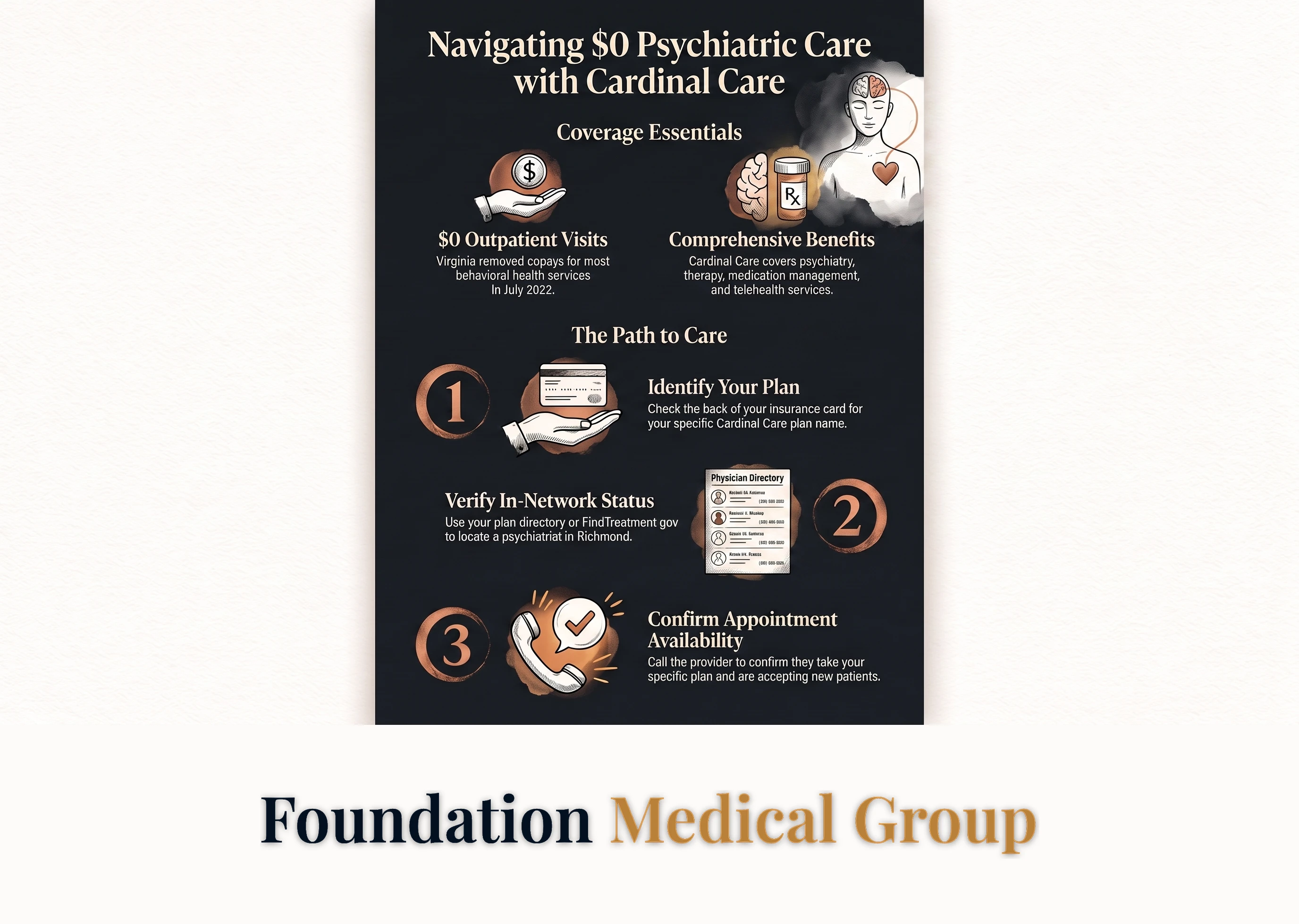
- Virginia Medicaid covers psychiatric mental health care, therapy, and medication management, and most members pay nothing for outpatient behavioral health after the July 2022 copay change.
- Cardinal Care is the name of Virginia Medicaid, run by DMAS, and more than 90 percent of members are in a managed care plan.
- Check your card, call member services, then confirm with the practice. Two yeses on network status protect you from a surprise bill.
- Your first visit is a full psychiatric evaluation of about 60 minutes and ends with a treatment plan you helped write.
- Psychiatrists and psychiatric nurse practitioners can both prescribe, and Medicaid covers visits with either one.
- Members under 21 get broader coverage through EPSDT, so a young person’s mental health concerns are covered even when an adult benefit would not include the service.
Talk With Our Richmond Team
Starting mental health care takes something out of you, and that is worth acknowledging rather than glossing over. You do not have to untangle the coverage question alone. Foundation Medical Group sees patients at 11600 Busy Street, Suite 203, Richmond, VA 23236, and our team will check your Medicaid plan with you before anything is scheduled. Call 804-506-0526, and let us help you find the next right step.
Sources
- Medicaid.gov, Behavioral Health Services, Centers for Medicare and Medicaid Services.
- Virginia Department of Medical Assistance Services, Behavioral Health.
- Virginia Department of Medical Assistance Services, Cardinal Care Managed Care.
- National Institute of Mental Health, Depression.
- SAMHSA National Helpline, 1-800-662-4357.
- 988 Suicide and Crisis Lifeline.