
Worried about the qEEG brain mapping cost and whether insurance will help? Here’s the short version. The price depends on the clinic, your area, and how detailed the report is. Some plans and Medicaid cover part of it when a doctor says it’s medically needed. Plenty of patients pay cash, and clinics can quote you an exact number.
The hard part usually isn’t the fee. It’s not knowing what shapes it or how coverage works. So let’s clear that up. Below we explain what drives the cost of a qEEG brain map, when insurance or Medicaid may step in, and the smart questions to ask before you book.
What a qEEG Brain Map Is
A qEEG, or quantitative EEG, records the tiny electrical signals your brain makes. A soft cap with many small sensors sits on your scalp for the recording. The session itself is usually short, often under 1 hour. A computer then turns those patterns into a report your care team can read. Think of it as a snapshot of how your brain is working right now.
On a bill, that computerized step usually shows up as CPT 95957, digital analysis of EEG, which is separate from the routine recording codes like 95816. Worth knowing, because the two lines get priced very differently.
One thing to keep in mind. A qEEG is a supportive assessment tool, not a stand-alone diagnosis. Your doctor uses it alongside your history, your symptoms, and other checks. It adds detail to the bigger picture, but it doesn’t replace a full evaluation.
What Drives the qEEG Brain Mapping Cost

The price isn’t random. A few clear things move it up or down. When you know them, the number stops feeling like a mystery.
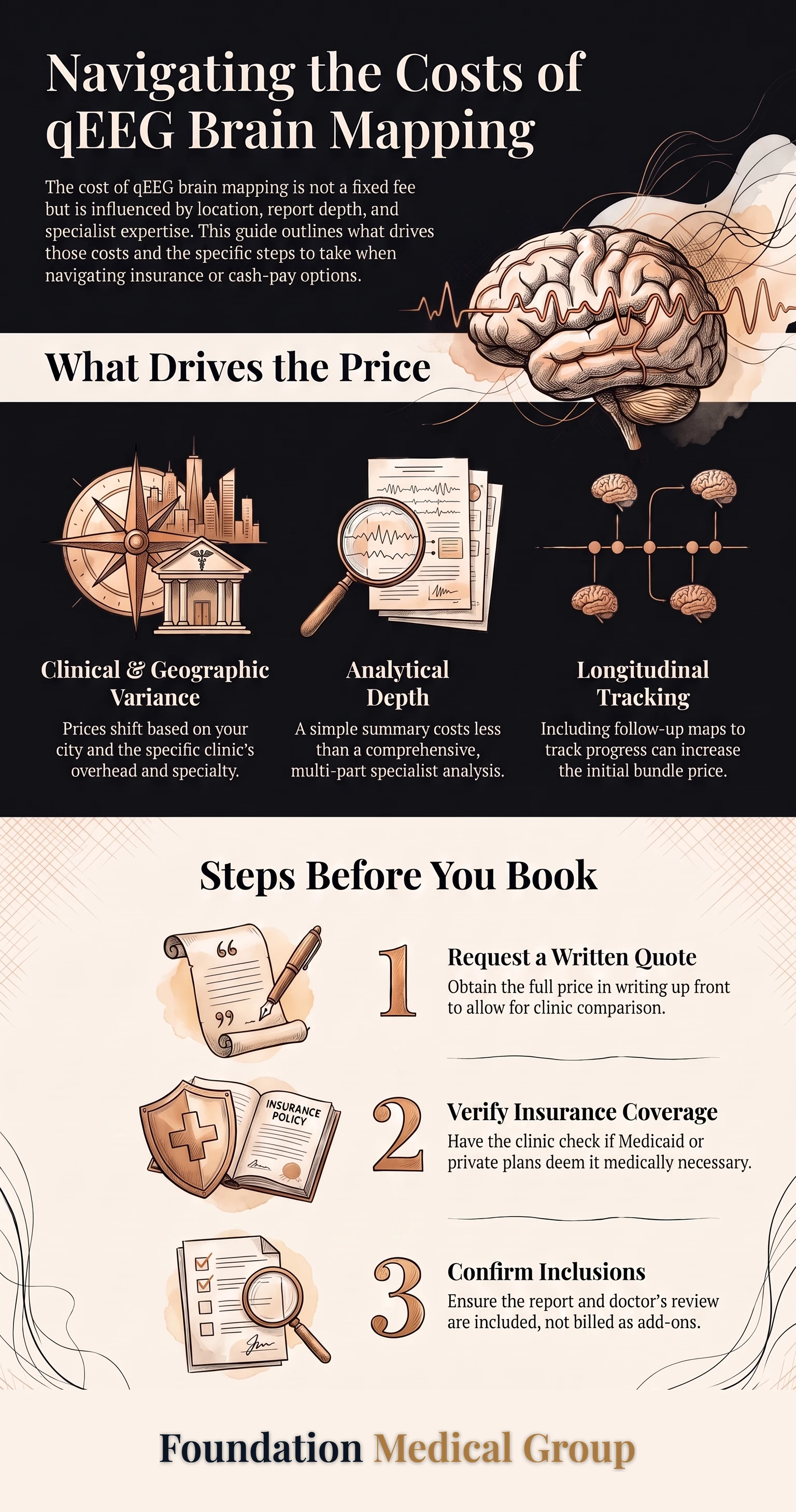
- Where you go. Costs shift by city and clinic, so two places nearby can charge different amounts.
- How detailed the report is. A simple summary costs less than a deep, multi-part analysis.
- Who reads it. A quick read differs from a full review by a specialist.
- Extra sessions. Some plans add a follow-up map later to track your progress.
For a rough anchor, look at what Medicare sees. In the 2024 physician public use file, providers submitted an average charge of $605.87 for CPT 95957 in an office setting and were allowed $290.86, versus $353.21 submitted and $97.67 allowed in a hospital facility setting. Routine EEG under 95816 ran higher on both counts, $701.62 submitted and $374.21 allowed in an office. Cash quotes from private clinics often sit above the allowed amounts and below the submitted ones. That spread, not the sticker, is the number worth asking about.
According to the Substance Abuse and Mental Health Services Administration (SAMHSA), good addiction care is built around each person, not a single template. A qEEG can support that kind of personalized plan, which is one reason clinics offer it.
When Insurance or Medicaid May Help
Coverage isn’t one simple yes or no. It depends on your plan, your state, and why the test is ordered. Still, a pattern shows up again and again.
Aetna’s clinical policy bulletin is a useful example, because it’s public and specific. It treats qEEG as medically necessary only as an adjunct to a traditional EEG in 7 named situations, such as continuous ICU monitoring, screening high-risk ICU patients for seizures, and pre-surgical mapping for intractable epilepsy. For attention disorders, anxiety, depression, bipolar disorder, autism spectrum disorders, chronic pain, and alcoholism, the same bulletin calls it experimental, investigational, or unproven. Other carriers word it differently. The shape of the answer rarely changes.
| Situation | Insurance | Medicaid | Cash pay |
|---|---|---|---|
| Doctor says it’s medically needed | May cover part | May cover part in some states | You pay the full fee |
| Ordered mainly for wellness or curiosity | Often not covered | Often not covered | You pay the full fee |
| Used to guide a treatment plan | Varies by plan | Varies by state | Clinic quotes a set price |
| Repeat map to track progress | Check first | Check first | Ask about a bundle price |
The takeaway is simple. When a doctor documents a clear medical reason, coverage is more likely. When the map is optional, cash pay is common. Either way, call your plan first so there are no surprises. Ask specifically whether they’ll process CPT 95957, and whether prior authorization is required. Two different questions, and clinics get tripped up by the second one more often than the first.
Questions to Ask Before You Book
A few questions up front save money and stress later. Write them down and ask before you schedule. These 4 are a good start.
Ask what the full fee covers, and whether the report and the doctor’s review are included. Ask if a follow-up map costs extra. Ask the clinic to check your insurance or Medicaid, or tell you exactly how to check yourself. And ask for the cash price in writing, so you can compare it fairly. Even 2 quick calls can save you real money.
Why It Can Be Worth It

A qEEG isn’t the whole answer, but it can make your plan sharper. It also isn’t a diagnosis, and regulators have been clear about that line. When the FDA authorized the first EEG-based ADHD product, the NEBA System, in July 2013 under de novo DEN110019, it cleared the device as an assessment support alongside a clinical exam, not as a test that stands on its own. Read your qEEG report the same way.
Think of it as one more clue. When your team understands more about how your brain is functioning, they can tailor care to you. Staying in care is where the real gains sit, and the evidence there is much stronger than anything a brain map can show you. A 2020 JAMA Network Open study followed 40,885 people with opioid use disorder. Buprenorphine and methadone were the two pathways linked to lower overdose risk, at an adjusted hazard ratio of 0.24 at 3 months. Just 12.5 percent of that group received either medicine. Spend your money on the thing that moves that number first. Our brain mapping in Texas hub explains how this fits a full plan.
Cash-Pay Tips That Actually Help
No coverage? You can still get a qEEG, and these 4 moves can lower the total.
- Ask for the full price up front. A clear quote lets you plan and compare clinics.
- Bundle if you can. If you’ll need a follow-up map, ask whether two together cost less.
- Ask about payment plans. Some clinics let you spread the fee over time.
- Check what’s included. Make sure the report and the doctor’s review are part of the price, not add-ons.
For a local look at how this works, our brain mapping in Dallas page walks through what to expect in one Texas city.
Fitting It Into Your Bigger Plan
A brain map works best as part of care, not on its own. It pairs well with medical treatment, counseling, and support for any other conditions you’re facing. Plenty of patients in recovery also deal with depression or anxiety, and a fuller picture helps the whole team.
At Foundation Medical Group, care is led by a physician and built around you. If you’re managing more than one condition, our guide on Suboxone and co-occurring depression or anxiety shows how the pieces connect. The aim is care that fits your life and your budget.
Infographic: What Really Drives qEEG Brain Mapping Cost
Frequently Asked Questions
Does insurance cover qEEG brain mapping?
Sometimes. Coverage depends on your plan and whether a doctor documents a clear medical reason. When the test is ordered as part of treatment, coverage is more likely. Call your plan and ask before you book, since answers vary a lot.
How much does a qEEG brain map cost?
It varies by clinic, area, and how detailed the report is. That’s why we don’t quote a single number here. The best move is to ask the clinic for an exact price in writing, so you know what the fee covers.
Will Medicaid pay for qEEG brain mapping?
It depends on your state and why the test is ordered. In some states, Medicaid may cover part of it when a doctor says it’s medically needed. Ask the clinic to help you check your specific coverage first.
Is a qEEG a diagnosis by itself?
No. A qEEG is a supportive tool, not a stand-alone diagnosis. Your doctor reads it alongside your history and symptoms. It adds helpful detail, but a full evaluation still guides your care.
Is qEEG brain mapping worth the cost?
For some patients, yes. It can make a recovery plan more personal, which helps you stay engaged in care. Whether it’s right for you is a conversation to have with your doctor.
Key Takeaways and Next Steps
Here’s what to hold on to. The qEEG brain mapping cost depends on 3 things: your clinic, your area, and how detailed the report is. Insurance or Medicaid may help when a doctor documents a clear medical need. If you pay cash, a clear quote and a payment plan can make it easier. And remember, a qEEG supports your care, but it doesn’t replace a full evaluation.
- Ask the clinic for an exact price in writing before you book.
- Have the clinic check your insurance or Medicaid, or ask exactly how to check yourself.
- Confirm the report and the doctor’s review are included in the fee.
- Talk with your doctor about whether a qEEG fits your personal plan.
Ready to learn more? Reach out to Foundation Medical Group and ask what a qEEG would cost for you. One call turns the unknown price into a clear, honest plan you can act on.
Sources
- Centers for Medicare and Medicaid Services. Medicare Physician and Other Practitioners, by Geography and Service, 2024 (CPT 95957 and 95816). https://data.cms.gov/provider-summary-by-type-of-service/medicare-physician-other-practitioners/medicare-physician-other-practitioners-by-geography-and-service.
- Aetna. Clinical Policy Bulletin 0221, Quantitative EEG (Brain Mapping). https://www.aetna.com/cpb/medical/data/200_299/0221.html.
- U.S. Food and Drug Administration. De Novo DEN110019, NEBA System, decision 15 July 2013. https://www.accessdata.fda.gov/scripts/cdrh/cfdocs/cfpmn/denovo.cfm?id=DEN110019.
- Wakeman SE, et al. Comparative Effectiveness of Different Treatment Pathways for Opioid Use Disorder. JAMA Netw Open. 2020;3(2):e1920622. https://pmc.ncbi.nlm.nih.gov/articles/PMC11143463/.
- Substance Abuse and Mental Health Services Administration. Buprenorphine. https://www.samhsa.gov/substance-use/treatment/options/buprenorphine.