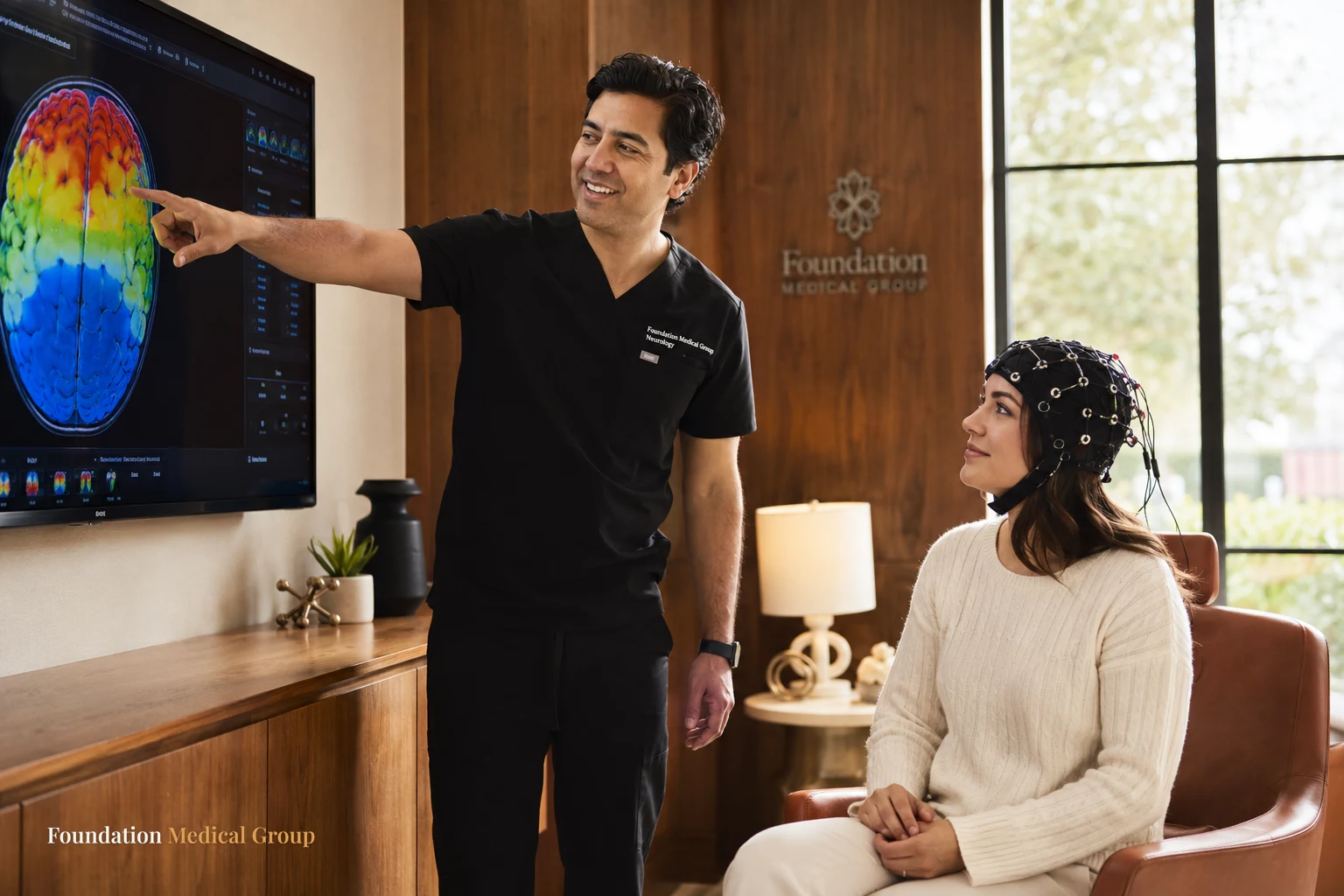
qEEG brain mapping is a painless test that reads your brain’s electrical activity and turns it into a color picture called a brain map. In plain words, it records your brainwaves, then compares them to typical patterns so your care team can see how your brain is working right now. For people in Texas recovering from addiction, that picture can make a treatment plan feel more personal.
You might have heard of an EEG before. A qEEG is the next step up. This guide walks you through what qEEG brain mapping is, how it differs from a plain EEG, and how it can support recovery in Texas. We’ll keep it simple, and we’ll be honest about what it can and can’t do.
What qEEG Brain Mapping Really Means
Let’s break the name down. EEG stands for electroencephalogram, a fancy word for a recording of your brainwaves. The “q” means quantitative, so a qEEG is a measured, number-based version of that same recording.
A regular EEG shows the raw squiggly lines a doctor reads by eye. A qEEG takes those signals and runs them through software. That software compares your brainwaves to a large group of healthy brains, matched roughly to your age. The result is a brain map, a picture that shows which areas run fast, slow, or out of sync.
The software sorts your activity into frequency bands: delta below 4 Hz, theta from 4 to 8, alpha from 8 to 12, and beta from 12 to about 30. Most of the ADHD research you’ll hear about focuses on 1 number pulled from those bands, the theta/beta ratio at the top of the head.
So think of it this way. An EEG is the recording. A qEEG is the recording plus the math. A brain map is the picture that math creates. All three come from the same gentle scalp sensors, and none of them send anything into your head.
EEG vs qEEG vs Brain Mapping in Plain Words
These three terms get mixed up a lot. This table sorts them out.
| Term | What it is | What you see |
|---|---|---|
| EEG | A raw recording of brainwaves | Squiggly lines a doctor reads |
| qEEG | The same recording, measured by software | Numbers compared to healthy patterns |
| Brain map | The picture built from those numbers | A color map of your brain’s activity |
The takeaway is simple. They’re steps in one process, not three separate tests. You get one recording, and the qEEG turns it into a map you can actually look at and understand.
How qEEG Personalizes Addiction Recovery in Texas
Addiction changes the brain, not just your choices. It affects areas tied to reward, focus, and handling stress. A qEEG can show where those patterns look off, which gives your care team real data instead of guesswork.
That data helps make your plan yours. Two people can have the same diagnosis but very different brain maps. One might show patterns linked to anxiety. Another might show patterns tied to low focus or brain fog. Your team can shape your care around what your own map shows.
According to the National Institute on Drug Abuse (NIDA), addiction is a brain disorder that affects circuits for reward and self-control. A qEEG gives clinicians a window into those circuits. Here’s how that helps day to day:
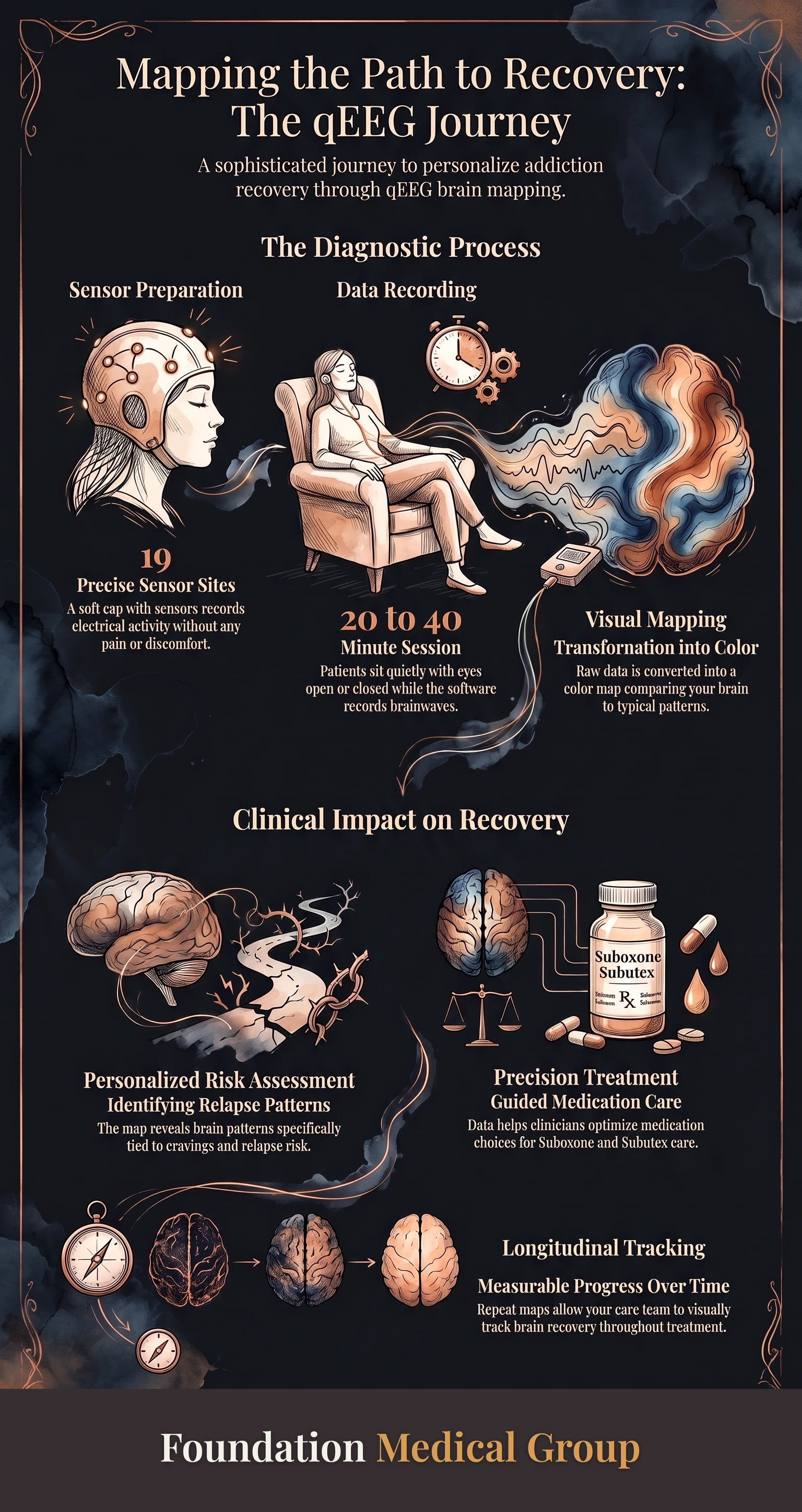
- It points to brain patterns tied to cravings and relapse risk.
- It can guide medication choices in Suboxone and Subutex care.
- It helps set clear goals for therapy and neurofeedback.
- It lets your team track changes over time with a repeat map.
Paired with medication for opioid use disorder, this insight makes each step feel less like a shot in the dark.
Who Might Consider a qEEG
A qEEG isn’t for everyone, and that’s fine. It tends to help most when there’s more going on than substance use alone.
You might consider one if you also struggle with anxiety, low mood, poor focus, or lingering brain fog. It can also help if a past head injury is part of your story. Learn how mood and recovery connect on our Suboxone and co-occurring depression and anxiety page.
If your recovery already feels steady, you may not need one. A qEEG is a tool, not a requirement. Your physician can tell you whether it would add anything useful to your plan.
What to Expect During Your qEEG Session

Good news first. The test is easy, and nothing about it hurts. You just sit still and let the sensors do their job.
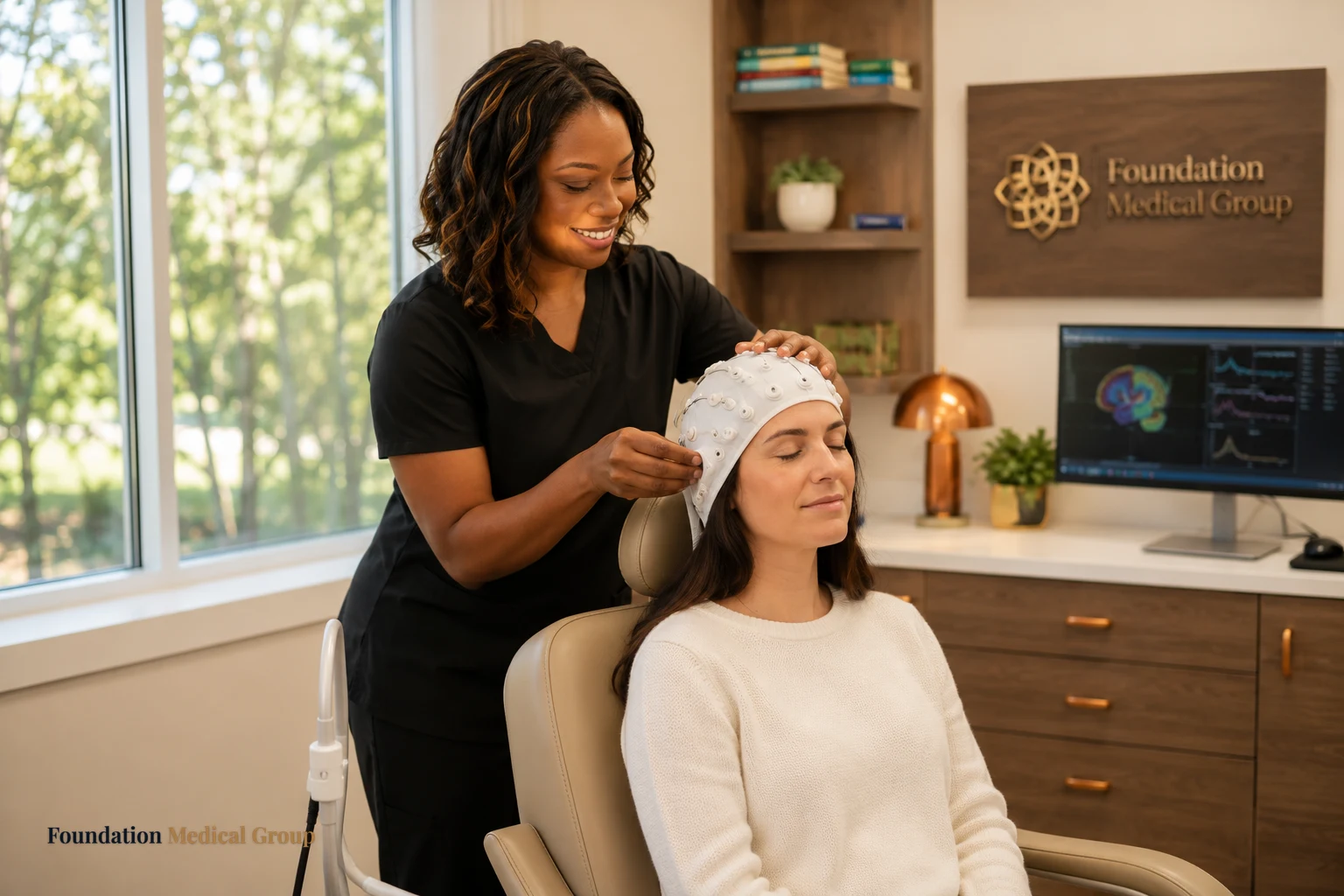
A technician places small sensors on your scalp, often using a soft cap. Standard setups use 19 sensor sites, positioned by the international 10-20 system that clinical EEG has used since the 1950s. You sit quietly, sometimes with your eyes open and sometimes closed. The recording usually takes about 20 to 40 minutes.
Afterward, the software builds your brain map. A clinician reviews it and walks you through what it shows in plain language. Plenty of patients feel calmer once they see real data about their own brain.
One practical note on cost. Aetna’s clinical policy bulletin on quantitative EEG treats it as medically necessary only as an adjunct to a traditional EEG for a short list of indications, and as experimental or investigational for everything else. Other carriers read the evidence the same way. So budget for self-pay unless your clinic tells you otherwise, and ask for the number before you book. To compare this with a standard EEG, visit our brain mapping in Texas hub.
The Honest Limits of qEEG
Now for the straight talk. A qEEG is helpful, but it isn’t magic, and it won’t fix anything on its own.
It doesn’t diagnose addiction, and it can’t tell the future. It shows patterns, and those patterns need a trained clinician to read them in context. Results can shift with sleep, caffeine, stress, or even a bad night. So one map is a snapshot, not the whole story.
The published evidence deserves the same plain talk. A 1997 assessment from the American Academy of Neurology and the American Clinical Neurophysiology Society concluded that qEEG stays investigational for attention disorders, depression, alcoholism and drug abuse. The same report did accept it as an addition to digital EEG in epilepsy screening and ICU monitoring. The AAN has since retired that document rather than replacing it, so treat it as a historical position, not a live guideline.
On the ADHD marker specifically, a 2013 meta-analysis in the Journal of Attention Disorders pooled 9 studies covering 1,253 young people with ADHD and 517 without. The grand-mean effect size came out at 0.75 for ages 6 to 13, but the authors flagged significant heterogeneity, called the figure an overestimate, and concluded that theta/beta ratio can’t serve as a reliable diagnostic measure.
Neurofeedback, the training that often follows a map, sits in a similar spot. A 2016 meta-analysis in the Journal of the American Academy of Child and Adolescent Psychiatry looked at 13 randomized trials with 520 participants. Effects reached a standardized mean difference of 0.35 when the raters were closest to the treatment, and lost significance once the raters were blinded or a sham control was used. That’s a real result, and it’s a modest one.
Compare that with the medicine. A 2017 BMJ meta-analysis of 19 cohorts found 4.3 deaths per 1,000 person-years among people on buprenorphine while in treatment, versus 9.5 per 1,000 after leaving. That’s the difference in evidence weight between the map and the medication, and it’s why we frame one as supporting and the other as the core.
According to the Substance Abuse and Mental Health Services Administration (SAMHSA), medication combined with counseling is the proven core of opioid use disorder care. A qEEG supports that core. It doesn’t replace it. Think of the map as a helpful guide, and think of your care team, your medication, and your effort as the things that actually drive recovery.
Infographic: Your qEEG Brain Mapping Journey in Texas
Frequently Asked Questions
Is qEEG brain mapping the same as an EEG?
Not quite. An EEG is the raw recording of your brainwaves. A qEEG takes that recording and measures it with software, then compares it to healthy patterns. The result is a brain map you can actually see and discuss.
Does qEEG brain mapping hurt?
No. It’s completely painless and noninvasive. The sensors only listen to activity your brain already makes. Nothing is sent into your head, and you simply sit quietly while it records.
Can qEEG cure addiction?
No, and no honest provider will claim it can. A qEEG is a supportive tool that helps personalize your plan. Real recovery comes from medication, counseling, and steady support over time.
How long does a qEEG session take in Texas?
Most sessions run about 20 to 40 minutes. A technician places the sensors, you sit still, and the software records your brainwaves. Then a clinician reviews the map with you afterward.
Who should ask about a qEEG?
It helps most when other things ride alongside addiction, like anxiety, low focus, or a past head injury. If your recovery already feels steady, you may not need one. Your physician can tell you if it fits.
Key Takeaways and Next Steps
Here’s what to hold on to. A qEEG brain map records your brainwaves and turns them into a clear picture of how your brain is working. For Texas readers in recovery, that picture can make your plan more personal and easier to follow. It supports your care, but your medication, counseling, and effort are what truly move you forward.
- Remember the order: an EEG records, a qEEG measures, and a brain map shows the result.
- Ask about a qEEG if anxiety, focus, or a past head injury are part of your story.
- Expect a short, painless session of about 20 to 40 minutes.
- Treat the map as a helpful guide, not a cure or a promise.
Curious whether a qEEG fits your recovery? Reach out to Foundation Medical Group and ask. One conversation with a physician can turn a confusing idea into a clear, personal next step.
Sources
- Nuwer M. Assessment of digital EEG, quantitative EEG, and EEG brain mapping: report of the American Academy of Neurology and the American Clinical Neurophysiology Society (retired). Neurology 1997;49(1):277-92.
- Arns M, Conners CK, Kraemer HC. A decade of EEG theta/beta ratio research in ADHD: a meta-analysis. J Atten Disord 2013;17(5):374-83.
- Cortese S, et al. Neurofeedback for attention-deficit/hyperactivity disorder: meta-analysis of clinical and neuropsychological outcomes from randomized controlled trials. J Am Acad Child Adolesc Psychiatry 2016;55(6):444-55.
- Aetna, Clinical Policy Bulletin 0221: Quantitative EEG (Brain Mapping).
- Sordo L, et al. Mortality risk during and after opioid substitution treatment. BMJ 2017;357:j1550.
- National Institute on Drug Abuse, Medications for Opioid Use Disorder.