
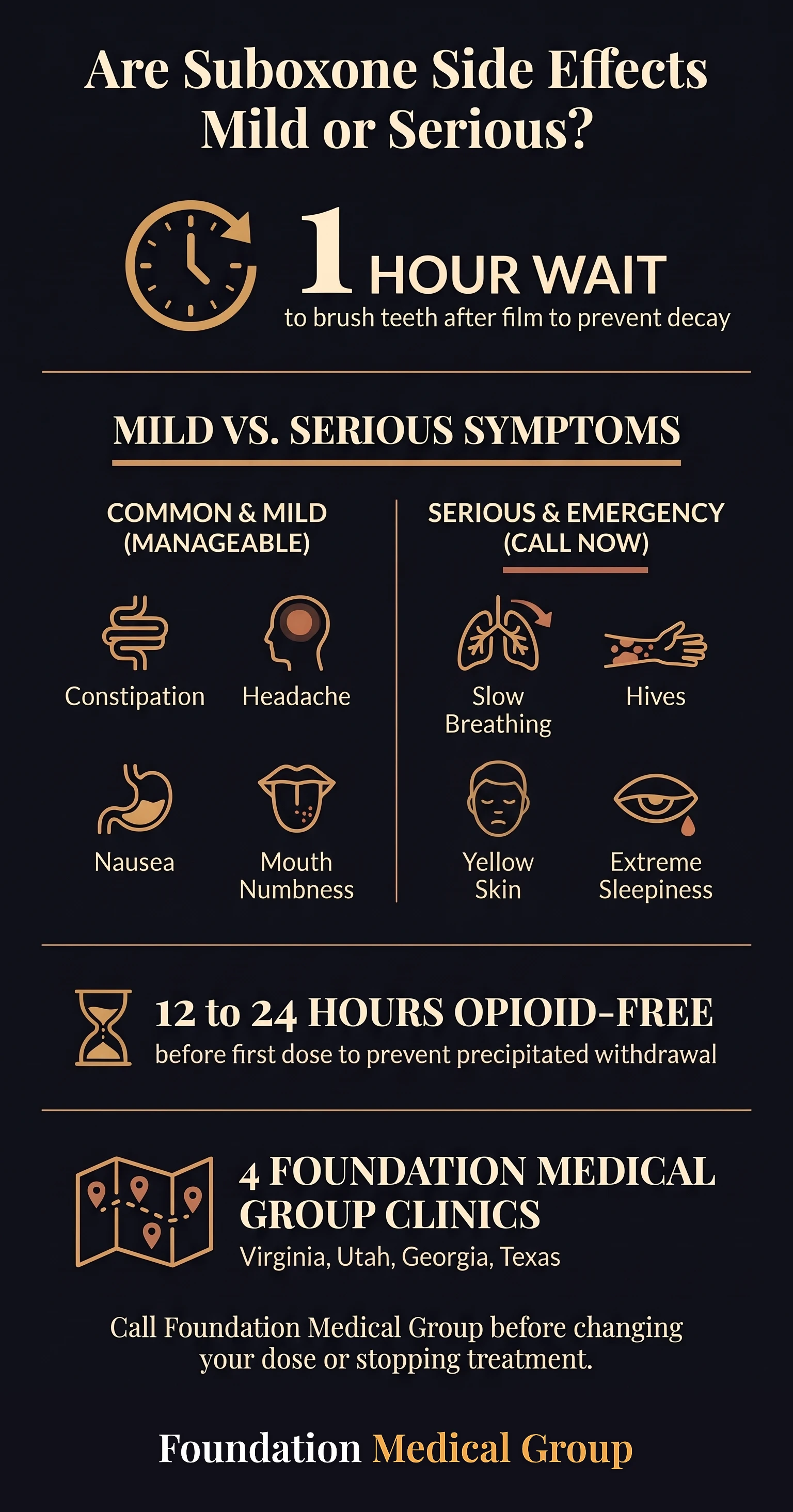
The most common side effects of Suboxone are constipation, headache, nausea, sweating, trouble sleeping and a numb mouth from the film. Most of these symptoms are mild. Slow or shallow breathing, extreme sleepiness, signs of an allergic reaction or yellow skin need help right away. Never stop Suboxone suddenly. Call your prescriber instead.
Below, we walk through what’s normal, what’s serious and what to do, using the FDA label, MedlinePlus and SAMHSA as our sources. The safety basics are the same at every FMG clinic, from our Richmond flagship on Busy Street to the North Dallas office off LBJ Freeway.
What Are the Side Effects of Suboxone?
Suboxone is a film that dissolves under your tongue or inside your cheek. The FDA prescribing information on DailyMed lists two active ingredients: buprenorphine hydrochloride and naloxone hydrochloride. Doctors use it in medication assisted treatment for opioid use disorder. Like other opioid medicines, it can cause side effects. Most are mild. A few are serious.
Why would a treatment medicine make you feel off at all? It sounds backwards. It stops sounding that way once you see how it works. SAMHSA explains that buprenorphine is a partial opioid agonist. An opioid agonist switches on the opioid receptors in your brain and body. Full opioid agonists switch them on all the way, while buprenorphine produces weaker effects. MedlinePlus describes it as an opioid partial agonist-antagonist that prevents withdrawal symptoms by producing effects similar to other opioid drugs. So it can cause some opioid-like effects, just milder ones.
Naloxone is the second ingredient. It’s an opioid antagonist, which means it blocks opioid effects. SAMHSA says it’s added to decrease misuse. If you’re curious how the two medicines work as a pair, read our guide on how Suboxone works.
Here’s the order this guide follows: common, serious, film and dental, long-term, withdrawal, and what you can do.
What Are the Most Common Side Effects of Suboxone?

SAMHSA lists these common side effects of buprenorphine.
- Constipation
- Headache
- Nausea and vomiting
- Dizziness
- Drowsiness and fatigue
- Sweating
- Dry mouth
- Tooth decay
- Muscle aches and cramps
- Trouble sleeping
- Fever
- Blurred vision or dilated pupils
- Tremors
- Heart palpitations
- Trouble paying attention
It’s a long list. And the FDA label for the Suboxone film adds more detail from its clinical trial. In that trial, mouth numbness was the most common side effect. Others included tongue pain, redness inside the mouth, headache, nausea, vomiting, sweating, constipation, signs of withdrawal, insomnia, pain and swelling in the legs.
Seeing it all written out can feel scary, especially early in treatment. Take a breath. Most of these are mild side effects.
So when does a mild symptom deserve a phone call? MedlinePlus gives a simple rule. Tell your doctor if any of these symptoms are severe or don’t go away:
- Headache
- Stomach pain
- Constipation
- Trouble falling asleep or staying asleep
- Numbness or redness in the mouth
- Tongue pain
- Blurred vision
- Back pain
Lists have limits. They can’t tell you how a symptom feels in your own life. If a side effect makes it hard to work, sleep or take your medication the way it was prescribed, that’s worth a call, even if it’s on the “common” list. Your prescriber can look at your Suboxone use and every other medication you take. Please don’t change your dose on your own.
Common vs Serious Suboxone Side Effects at a Glance
This table sorts Suboxone side effects by how serious they usually are and what to do next. It draws on SAMHSA, MedlinePlus, the FDA label and the FDA’s 2022 dental warning.
| Side effect | Usually mild or serious? | What to do |
|---|---|---|
| Constipation, headache, nausea, sweating | Common, often mild | Tell your prescriber if severe or it does not go away |
| Mouth numbness, tongue pain, mouth redness | Common with the film | Tell your prescriber if it does not go away |
| Tooth decay, cavities, mouth infections | Serious dental risk | Rinse with water after the film dissolves, wait 1 hour to brush, see a dentist |
| Hives, rash, swelling of face, throat or tongue, trouble breathing | Serious (allergic reaction) | Call your doctor immediately; get emergency care if breathing is hard |
| Slow or shallow breathing, extreme sleepiness, cannot wake | Serious (possible overdose) | Call 911; use naloxone if available |
| Yellow skin or eyes, dark urine, upper right stomach pain | Serious (possible liver problem) | Call your doctor immediately |
| Nausea, vomiting, weakness, dizziness, low blood pressure | Possible adrenal gland problem | Call your doctor |
How do you read it? The first two rows are usually mild, so mention them to your prescriber if they’re severe or stick around. The rows marked serious mean you should call your doctor right away. Signs of an opioid overdose, or severe allergic reactions that make breathing hard, mean you call 911.
Some symptoms, like nausea, show up in more than one row. That’s why it’s smarter to share new symptoms at every visit instead of guessing. Your risk of the most serious rows goes up if you mix Suboxone with drugs that slow your brain and breathing, such as alcohol or benzodiazepines, which we explain next.
What Serious Side Effects of Suboxone Need Help Right Away?
SAMHSA lists the serious side effects of buprenorphine as respiratory distress (trouble breathing), overdose, adrenal insufficiency, dependence and withdrawal. Here’s what to watch for and what to do.
Signs of an opioid overdose. MedlinePlus lists these overdose symptoms: narrow pupils, extreme sleepiness, slow or shallow breathing, and not being able to respond or wake up. If you see them in yourself or someone else, call 911 right away. You can also call Poison Control at 1-800-222-1222. MedlinePlus suggests asking your prescriber about keeping naloxone, a rescue medication, at home. Teach your family or friends how to use it, because you may not be able to use it yourself.
Mixing with CNS depressants. This is the biggest danger. The FDA label reports coma and death in people who took buprenorphine together with benzodiazepines or other sedating drugs, including alcohol. That includes another opioid drug, sleep aids and sedatives. Talk to your prescriber before you take any medication like these. At Foundation Medical Group, we check for medication interactions at your first visit, so bring a full list of what you take. Substance abuse is a health problem. It isn’t a verdict on who you are. If you’re dealing with substance abuse beyond opioids, such as drinking or using sedatives, tell your prescriber honestly. It can feel uncomfortable to say out loud. But your prescriber can’t protect you from a risk they don’t know about.
An allergic reaction. It can happen, too. MedlinePlus lists these signs: hives, rash, itching, trouble breathing or swallowing, and swelling of the face, throat, tongue, lips or eyes. Call your doctor immediately, and get emergency care if breathing is hard. The FDA label lists anaphylaxis, the most severe of the allergic reactions.
Liver problems. Watch for yellow skin or eyes, dark urine, light-colored stools and pain in the upper right part of your stomach. Call your doctor immediately if you notice any of these. The FDA label says liver tests should be checked before you start and during treatment. That’s why your prescriber may order blood work.
What Side Effects Can Suboxone Strips or Film Cause?
Suboxone strips are thin films that sit under your tongue or inside your cheek until they dissolve. The FDA label lists mouth numbness, tongue pain and redness inside the mouth among its common local reactions.
The bigger concern is your teeth. In January 2022, the FDA warned about dental problems with buprenorphine medicines that dissolve in the mouth. Reported problems include tooth decay, cavities, mouth infections and tooth loss. Some of these happened in people who had no history of dental problems, which is unsettling if your teeth have always been healthy.
You can lower the risk with a few simple steps from the FDA and MedlinePlus:
- Wait until the film has fully dissolved.
- Take a large sip of water and swish it gently around your teeth and gums.
- Swallow the water.
- Wait at least 1 hour before you brush your teeth.
- Tell your dentist that you take buprenorphine, and tell both your dentist and your prescriber about any tooth problems.
The FDA also says the benefits of these medicines clearly outweigh the dental risks. So tooth worries are a reason to talk with your prescriber, not a reason to stop your Suboxone therapy. Good dental habits are simply part of your treatment.
What Are the Long-Term Side Effects of Suboxone?
For a lot of people, buprenorphine isn’t a short-term medication. They stay on it for months or longer, so it helps to know which effects can show up over time. Keep your prescriber informed instead of trying to wait a side effect out.
Adrenal insufficiency. The FDA label says this hormone problem has been reported with opioid use, more often after more than one month of use. The signs can be vague, which is frustrating: nausea, vomiting, poor appetite, tiredness, weakness, dizziness and low blood pressure. If these show up, tell your doctor.
Sexual side effects. The label says long-term opioid use may lead to low levels of sex hormones (androgens). This can show up as low sex drive, erection problems, missed periods or infertility. The label also notes that the role of opioids in causing these changes isn’t proven. MedlinePlus says to call your doctor if you can’t get or keep an erection, have irregular periods or notice lower sexual desire. These topics can feel awkward. Still, they’re a normal part of treatment visits.
Your teeth. Dental problems can build slowly, so keep up the film steps above for as long as you take buprenorphine.
Opioid dependence. Your body gets used to buprenorphine. SAMHSA lists dependence among the serious side effects. With daily use, physical opioid dependence is expected, and it’s the reason stopping needs a plan with your prescriber. It isn’t the same as addiction, which we explain below.
Pregnancy. If you take buprenorphine while pregnant, your baby may have neonatal opioid withdrawal syndrome after birth. That can sound frightening. The FDA label says this is expected and treatable. SAMHSA calls it neonatal abstinence syndrome.
What Happens with Suboxone Withdrawal Symptoms If You Stop Suddenly?
Don’t stop your medicine without talking to your prescriber. MedlinePlus warns that stopping suddenly can cause withdrawal symptoms such as:
- Hot or cold flushes
- Restlessness
- Teary eyes and a runny nose
- Sweating and chills
- Muscle pain
- Vomiting and diarrhea
Sound familiar? These are opioid withdrawal symptoms, and they can feel a lot like what you went through before treatment. A big goal of your care is to keep opioid withdrawal and opioid cravings under control. Stopping cold can drag you right back into that misery, which is the last thing you want after all the work it took to feel steady.
The FDA label says that when it’s time to stop, the dose should be tapered gradually to avoid withdrawal symptoms. Your prescriber sets that pace with you. At FMG, if and when tapering makes sense, we plan it slowly and check in often. That holds whether you’re seen in Richmond, in Utah County, in metro Atlanta or in North Dallas. Our guide on how to taper off Suboxone explains what that process can look like.
Precipitated withdrawal is a different problem. It happens at the start of treatment, not the end. The label explains that if you take your first dose before the effects of other opioids have worn off, buprenorphine can bring on sudden opioid withdrawal. SAMHSA says a person should go 12 to 24 hours without opioids and be in early withdrawal before starting. Your prescriber will tell you when to take your first dose, and our team coaches you through it. Our page on precipitated withdrawal explains more.
How Do You Manage Suboxone Side Effects?

Most of these steps are small, everyday habits. Small doesn’t mean optional, though. They help you stay safe during treatment.
- Tell your prescriber. SAMHSA advises telling your practitioner about any side effect that bothers you or doesn’t go away. Don’t change the dose or stop on your own.
- Take it exactly as prescribed. MedlinePlus says to take buprenorphine exactly as directed. Don’t take more medication or take it more often than your prescriber told you.
- Protect your teeth. Use the water rinse after each film, wait an hour to brush and see your dentist.
- Avoid alcohol and sedatives. SAMHSA advises against alcohol and sedatives during treatment. It also says not to take other medications without your doctor’s approval. Share your full medication list, including anything you buy over the counter.
- Keep naloxone nearby if advised. Ask your prescriber whether naloxone at home makes sense for you.
- Report serious side effects. SAMHSA notes you can report them to the FDA MedWatch program online or at 1-800-FDA-1088.
Side effects are a normal part of opioid use disorder care. You might worry that bringing one up means your treatment is failing. It doesn’t. It gives your prescriber what they need to fine-tune your treatment while you keep working on your recovery from opioid use.
Suboxone Misuse and Addiction: What Is the Difference From Dependence?
SAMHSA notes that buprenorphine can be misused, particularly by people who don’t have opioid dependency. That’s one reason naloxone is part of the film. The FDA label says buprenorphine can be abused in a way similar to other opioids. Prescribers are told to watch for signs of diversion and addictive behaviors.
Suboxone misuse can also backfire. The label says abusing Suboxone by injecting it can bring on opioid withdrawal in people who are dependent on full opioids. So Suboxone abuse carries real risk.
What about Suboxone addiction? Physical dependence when you take Suboxone as prescribed is expected, and it isn’t the same as addiction. Addiction is a substance use disorder, and Suboxone taken under a prescriber’s care is a treatment for opioid addiction. If you ever use your medication in ways that weren’t prescribed, tell your prescriber. That can be hard to admit. Saying it lets your prescriber adjust your addiction treatment before a small slip turns into a bigger one.
Getting Suboxone Treatment and Side Effect Follow-Up at FMG
Foundation Medical Group offers medication assisted treatment with Suboxone at all four of its clinics:
- Richmond, Virginia: our flagship clinic, at 11600 Busy Street, Suite 203, Richmond, VA 23236.
- American Fork, Utah: 456 E State Street, Suite 1400, American Fork, UT 84003 (Suboxone and Vivitrol).
- Decatur, Georgia: 160 Clairemont Ave, Suite 200, Decatur, GA 30030 (Suboxone and Subutex), a few blocks from downtown Decatur in metro Atlanta.
- Dallas, Texas: 8390 Lyndon B Johnson Freeway, Suite 500, Dallas, TX 75243 (Suboxone and Vivitrol). That’s the LBJ Freeway, up in North Dallas.
If you live in Utah County or anywhere along the Wasatch Front, the American Fork clinic on E State Street offers Suboxone for opioid addiction treatment. You can learn more on our Utah clinic page or in our guide to the Suboxone clinic in American Fork.
At any clinic, bring every side effect to your follow-up visits, even small ones. Our addiction treatment has limits too: FMG does not offer detox, IOP, PHP, residential care or 24/7 supervision.
Coverage depends on your plan, so call to confirm coverage before your visit. Plans to ask about include:
- Virginia: Virginia Medicaid (Cardinal Care). Call to confirm coverage. FMG does not accept Medicare in Virginia.
- Texas: Texas Medicaid. Call to confirm coverage.
- Utah: Utah Medicaid plans such as Health Choice Utah, Healthy U, Molina Healthcare of Utah and SelectHealth Community Care. Call to confirm coverage.
- Georgia: Georgia Medicaid plans such as CareSource Georgia, Peach State Health Plan and Amerigroup Community Care. Call to confirm coverage.
You can also ask about Aetna, Cigna and Blue Cross Blue Shield. Call to confirm coverage for these too. When you’re ready, call the clinic nearest you (Richmond, American Fork, Decatur or Dallas) to ask about Suboxone treatment for opioid use.
Key Takeaways
- Most Suboxone side effects are mild: constipation, headache, nausea, sweating, sleep trouble and mouth numbness from the film.
- Slow breathing, extreme sleepiness or not waking up can be an opioid overdose. Call 911, and use naloxone if you have it.
- Rinse with water after the film dissolves and wait 1 hour to brush to protect your teeth from buprenorphine-related dental problems.
- Never stop suddenly, because withdrawal symptoms can follow. Taper only with your prescriber.
- Don’t mix Suboxone with alcohol, benzodiazepines or other sedatives, and report any symptoms that are severe or don’t go away.
FAQ
Do the side effects of buprenorphine go away?
It depends on the person, and nobody can promise a set timeline. MedlinePlus and SAMHSA both advise telling your prescriber about any side effect that’s severe, bothers you or doesn’t go away. Your prescriber can look at your dose, your other medicines and your health history and help you find a plan that feels better.
Does Suboxone cause sexual side effects?
It can. The FDA label says long-term opioid use may lower sex hormone levels, which can show up as low sex drive, erection problems or missed periods. The label also says the cause isn’t proven. MedlinePlus advises telling your doctor about these changes, so bring them up at your next visit.
Can you have an allergic reaction to Suboxone?
Yes, it’s possible. The FDA label lists anaphylaxis, a severe allergic reaction, and says people who are allergic to buprenorphine or naloxone shouldn’t take Suboxone. Hives, swelling of the face or throat, or trouble breathing need urgent care. Call 911 if breathing is hard.
Is it safe to take Suboxone with alcohol or benzodiazepines?
No, not on your own. Alcohol and benzodiazepines are CNS depressants, and the FDA label links reports of coma and death to buprenorphine taken with them. SAMHSA advises avoiding alcohol and sedatives during treatment. Talk to your prescriber before you take any sedative, sleep aid or anxiety medicine.
Does Medicaid cover Suboxone?
Many Medicaid plans do, but coverage depends on your plan and your state. Foundation Medical Group names Medicaid plans in Virginia, Texas, Utah and Georgia, and you should always call to confirm coverage before your visit. Our guide on whether Medicaid covers Suboxone explains more.
Sources
- SAMHSA, Buprenorphine.
- MedlinePlus, U.S. National Library of Medicine, Buprenorphine Sublingual and Buccal (opioid dependence).
- DailyMed, U.S. National Library of Medicine, SUBOXONE (buprenorphine and naloxone) sublingual film prescribing information.
- U.S. Food and Drug Administration, FDA warns about dental problems with buprenorphine medicines dissolved in the mouth (Drug Safety Communication, Jan 2022).