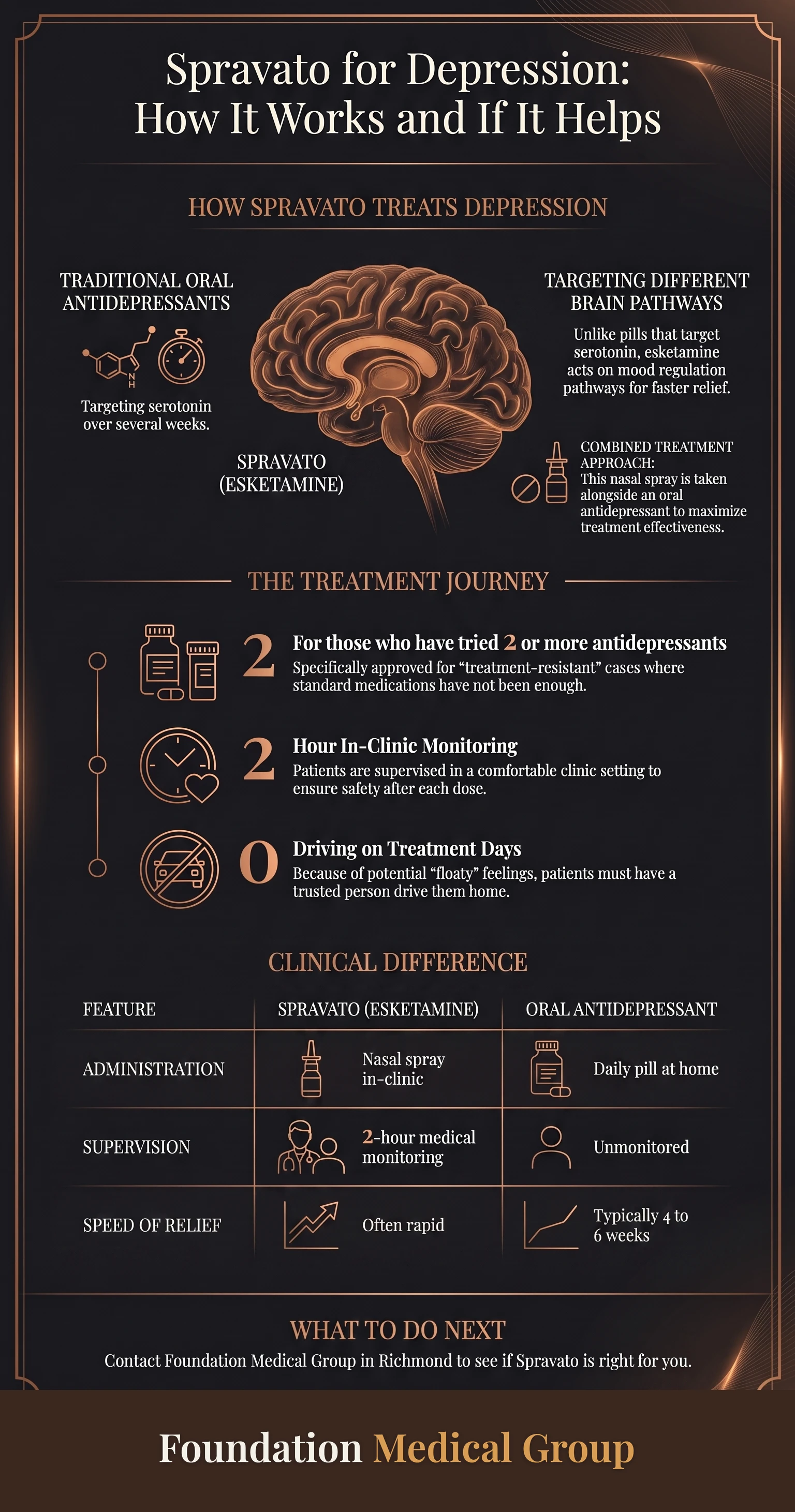
If you’re asking how Spravato treats depression and whether it helps, here’s the short answer. Spravato is an FDA-approved nasal spray that contains esketamine, a medicine closely related to ketamine. It acts on a different brain pathway than most antidepressants. That’s why it can bring relief for treatment resistant depression when standard treatments haven’t been enough.
At Foundation Medical Group in Richmond, VA, our physician-led team helps you work out whether Spravato is a good fit. This guide walks through how it works, who it’s for, what the visit feels like, and what to expect during care.
What Is Spravato and How Does It Work?
Spravato is the brand name for esketamine. It’s an antidepressant medication you take as a nasal spray. You don’t swallow it like a pill. You spray it into your nose in a clinic, and your body takes it in quickly.
Traditional antidepressants act on brain chemicals such as serotonin. They often need 4 to 6 weeks to help. Esketamine works on a different pathway, one tied to mood regulation. That path runs on a chemical messenger called glutamate. It’s why some patients feel a lift sooner. Clinicians call this a more rapid antidepressant effect.
Scientists are still working out why it helps. One idea is that depression wears down the links between brain cells. Esketamine seems to help those links rebuild. It isn’t a magic switch. It does give your brain a different kind of nudge than a daily pill does.
According to the FDA, Spravato was approved in 2019 for treatment resistant depression. That means depression that hasn’t improved after trying at least 2 other antidepressants. In 2020 the FDA added a second use. It covers depressive symptoms in adults with major depressive disorder who have acute suicidal ideation or behavior. The current label allows Spravato for treatment resistant depression either on its own or alongside an oral antidepressant. Your provider will tell you which one fits your plan.
Does Spravato Really Work for Depression?
This is the question we hear most, and it’s a fair one. Spravato went through clinical trials before the FDA approved it. It’s meant for adults who haven’t found enough relief from standard antidepressants.
It isn’t a cure. It doesn’t help every patient. So here’s the honest answer. For people living with severe depression that hasn’t budged, esketamine opens a door that conventional antidepressants left shut. It’s also a treatment your care team has to watch closely, dose by dose.
At our Richmond clinic, we track your mood and depression symptoms at each visit, usually with a short questionnaire. That gives us a number to compare week to week instead of relying on memory alone. We’re watching for two things: fewer depressive symptoms week to week, and a path toward remission, which simply means your symptoms fade far enough that they stop running your day.
In our Richmond practice, we’ve watched patients who felt stuck for years finally get some traction after traditional medications fell short. One patient had lived in a fog for a decade. She told our team it began to lift within the first few weeks. Some patients notice more rapid relief than they ever got from a daily pill. Others need the full induction course before they can tell, and plenty of patients reach us after years on a traditional treatment path of pill after pill.
Not every patient responds, and not every patient reaches remission. We’re honest about that from the first visit. Stories like hers are still why we offer esketamine treatment as part of our care.
The FDA is clear about one limit, and we repeat it to every patient. Spravato hasn’t been shown to prevent suicide or reduce suicidal ideation on its own. It never replaces crisis care, hospital care, or a safety plan.
Spravato is also one piece of a wider depression treatment plan. That plan often includes an oral antidepressant, talk therapy, steady sleep, and people around you who know what’s going on. Many patients keep seeing their counselor right through esketamine therapy, and we encourage it.
Spravato is one of several treatment options for treatment resistant depression. Another is TMS therapy, a noninvasive treatment that uses magnetic pulses instead of medication. During a psychiatric evaluation, your provider helps you weigh which path fits your history and goals. If you’re searching for Spravato treatment near me or Spravato in Richmond, a good evaluation is where any safe plan begins.
Who Is Spravato For?
Spravato is built for adults whose depression hasn’t improved after trying other antidepressants. Clinicians call this treatment resistant depression, and it’s more common than it sounds. If traditional antidepressants haven’t helped after a fair trial, it’s worth asking about.
Spravato therapy may be worth discussing if you:
- Have tried multiple antidepressants without enough relief.
- Live with a depressive disorder that keeps coming back despite treatment.
- Have major depressive disorder along with acute suicidal thoughts.
- Want to talk through every treatment option with a physician.
Spravato isn’t right for every patient. The FDA label rules it out for a few conditions. Those include a bulging or malformed blood vessel, a history of bleeding in the brain, or an allergy to esketamine or ketamine. Heart, blood pressure, and lung conditions need a careful look first. Spravato can push your blood pressure up for a while after each dose. Tell your provider if you’re pregnant or breastfeeding, because it isn’t recommended then.
Your provider reviews your full history, including any bipolar disorder or other mental health conditions, before writing anything down. We build personalized treatment plans around the person in front of us. Nothing you say here is a reason for shame. Honest answers help your care team keep you safe.
How Is Spravato Different From Ketamine?

Patients ask us this every week, and the confusion is fair. Esketamine is one half of the ketamine molecule. Spravato is the nasal spray form, and it’s the version the FDA has approved for depression.
Ketamine given through an IV is a different story. Clinics offer it off-label for depression, which means the FDA hasn’t approved it for that use. Insurance rarely covers it. Doses, settings, and safety rules vary from one ketamine clinic to the next.
Spravato runs on a fixed rulebook instead. Dosing follows the label, the clinic has to be certified, and every patient is watched for the same 2 hours. You also can’t get it through online therapy or a mail-order pharmacy, because the rules require supervised dosing. If you’ve been weighing an IV clinic against esketamine therapy, that gap in oversight is the thing to look at hardest.
What Happens During a Spravato Appointment?
Esketamine is a close relative of ketamine, so it carries real risks. Those include heavy drowsiness, dissociation (a feeling of being disconnected from yourself or your surroundings), slowed breathing, and a potential for misuse. For that reason, Spravato is only available through a restricted safety program called the Spravato REMS.
In plain terms, you can’t take Spravato home. It has to be given in a certified clinic, with a care team in the room. You use the nasal spray yourself while we watch. Then you stay, and we monitor you for at least 2 hours after each dose.
A little planning makes the day much smoother. The FDA label asks you to skip food for at least 2 hours before your dose. Skip drinks for the last 30 minutes. That lowers the chance of nausea. If you use a nasal steroid or decongestant spray, take it at least 1 hour ahead. Line up your ride the day before. Headphones help too, if music settles you.
We check your blood pressure before the dose and again about 40 minutes after, when the medicine peaks. If your readings are settling and you look steady, you can head home at the end of the monitoring window.
Many of our patients tell us the first 2 hours feel calmer than they expected. Some notice a floaty or dreamlike feeling during the dose. That’s the dissociation we mentioned, and it usually fades before you leave. We keep the room quiet and comfortable, and we don’t send you on your way until you’re steady.
Don’t drive for the rest of that day. Wait until the next day, after a full night of sleep, before you drive or use machinery.
Here is a simple look at how Spravato compares with a daily pill.
| What to expect | Spravato (esketamine) | Oral antidepressant |
|---|---|---|
| How it is given | Nasal spray in a certified clinic | Pill taken at home |
| Supervision | Monitored at least 2 hours each dose | No monitoring needed |
| Typical schedule | Twice a week at first, then less often | Once daily, often long term |
| Time it may take to help | Some patients notice change within weeks | Often 4 to 6 weeks |
| Driving | Not allowed until the next day | Usually no driving limits |
What Are the Side Effects of Spravato?
Most side effects show up during the dose or the monitoring window, and they fade the same day. According to the FDA label, the most common ones are dissociation, dizziness, nausea, and sedation. The list also covers vertigo, numbness, anxiety, low energy, raised blood pressure, vomiting, headache, and a drunk-like feeling.
Here’s what that looks like in the chair. You may feel floaty, sleepy, or a little off balance. Some patients feel queasy, which is exactly why we ask you to skip food beforehand. Most of it settles well before you go home.
Serious risks exist too, which is why the label carries a boxed warning covering sedation, dissociation, respiratory depression, abuse and misuse, and suicidal thoughts or behavior. Those risks are the reason for the 2-hour watch and the clinic-only rule. Speak up right away if something feels wrong, whether you’re still at the visit or back at home.
How Long Does Spravato Treatment Last?

There’s a rhythm to it. For treatment resistant depression, the label sets an induction phase of twice a week for the first 4 weeks. Weeks 5 to 8 usually move to once a week. From week 9 on, many patients go to once a week or once every 2 weeks. Unlike traditional antidepressants, you don’t take it at home every day.
Your provider reviews your progress at the end of the induction phase. If your depressive symptoms are easing, you carry on with the lighter schedule. If they aren’t, you and your provider look at other options rather than push on for months. If your symptoms creep back later, say so early rather than waiting for the next scheduled visit. The rapid antidepressant effects that draw people to Spravato don’t mean a short course of care.
Plan the practical side early. In our experience, the hardest part of month one is the logistics, not the medicine. Each visit runs about 2 to 3 hours once you add the monitoring time. Patients who sort out a driver and a flexible work plan in advance find that first month far less stressful.
Is Spravato Covered by Insurance?
Cost is a common worry, and it’s understandable. Insurance often covers Spravato for treatment resistant depression. It usually needs prior authorization first, and coverage varies from plan to plan.
We don’t quote a set price here, because your out-of-pocket cost depends on your plan and your benefits. Ask for an exact quote. Let our Richmond team verify your benefits before you start, so nothing catches you out in week 2. Some patients also qualify for manufacturer support programs, and we’ll point you there.
You can read more about Spravato cost and whether Spravato is covered by insurance. The same care applies to TMS coverage if you’re comparing options.
Key Takeaways
- Spravato is an FDA-approved nasal spray containing esketamine, closely related to ketamine.
- It’s approved for treatment resistant depression, on its own or with an oral antidepressant.
- It acts on a brain pathway tied to mood regulation, so some patients feel better sooner.
- It works alongside an oral antidepressant and talk therapy, not instead of them.
- Risks like sedation and slowed breathing mean it’s given only in a certified clinic under the Spravato REMS program.
- You’re monitored for at least 2 hours after each dose, and you can’t drive until the next day.
- Skip food for 2 hours and drinks for 30 minutes before your dose to cut the risk of nausea.
- Dosing starts twice weekly for 4 weeks, then eases to weekly or every 2 weeks.
- Insurance often covers it with prior authorization, so verify your exact benefits first.
Start Your Care in Richmond
Living with depression that hasn’t eased is exhausting, and you don’t have to sort out your next step alone. At Foundation Medical Group in Richmond, Virginia, our physician-led team will listen to your story and explain your choices in plain words. Then we help you decide if Spravato is right for you.
When you’re ready, our Richmond Spravato treatment team is here to help you begin. Reach out today, ask your questions, and take the next step toward feeling like yourself again.
Sources
- Spravato (esketamine) prescribing information, current FDA label.
- US Food and Drug Administration, Spravato approval label.
- Spravato REMS, the FDA restricted safety program.
- National Institute of Mental Health, Depression.
- American Psychiatric Association, What Is Depression.