
There’s no single Spravato success rate. In the clinical trials, success was measured three different ways: as a drop in the MADRS total score, as remission, or as staying well without a depressive relapse. Each one gives a different number, and they’re easy to mix up. Trial results are also averages across many people, so individual results vary.
So let’s take them one at a time. Below, we walk through the figures from the FDA label and the main trials, and what each one actually means for a patient sitting in the chair. Our team gets asked about these numbers a lot, usually by people who’ve already read three different figures online and aren’t sure which one to trust.
What Is Spravato (Intranasal Esketamine) Used For?
Spravato is intranasal esketamine, a nasal spray. According to the FDA label, it’s approved for two uses in adults:
- Treatment-resistant depression (TRD), either as monotherapy or together with an oral antidepressant.
- Depressive symptoms in major depressive disorder with acute suicidal thoughts or behavior, together with an oral antidepressant.
The label adds an important limit. Spravato hasn’t been shown to prevent suicide or to reduce suicidal thoughts or behavior, and it doesn’t replace a hospital stay when one is needed.
Esketamine is the S-enantiomer of racemic ketamine, so it’s related to ketamine but isn’t the same thing. It’s also not IV ketamine. The success rates on this page come from studies of Spravato, packaged by Janssen Pharmaceuticals, not from IV ketamine studies. (People mix those two up constantly, which is understandable given the names.) If you want to know how the drug acts in the brain, our guide on how Spravato works covers that.
Spravato treatment is only given in certified settings under the Spravato REMS safety program. MedlinePlus explains that you, your doctor and your pharmacy must all be enrolled in that program. You can read more on our Spravato treatment in Richmond, VA page.
What Do Response, Remission and Relapse Mean in Spravato Studies?

Almost every Spravato figure is based on the MADRS, the Montgomery-Asberg Depression Rating Scale. The total score runs from 0 to 60, and higher scores mean more severe depression. In the label’s TRD trials, patients started with average scores of about 37.
Researchers then turn the score into a few kinds of result:
- Change in score. How many points the MADRS total score fell, compared with placebo.
- Response. A large drop in symptoms. In the label’s long-term study, stable response meant a fall of 50% or more in the MADRS score over the last 2 weeks without being in remission.
- Remission. Few or no symptoms left. The SUSTAIN studies used a MADRS score of 12 or less, while ESCAPE-TRD used a stricter cutoff of 10 or less.
- Stable remission. In the label, a MADRS score of 12 or less for at least 3 of the last 4 weeks.
- Depressive relapse. A MADRS score of 22 or more for 2 weeks in a row, or a hospital stay for worse depression (again, the label’s definition).
Because the cutoffs differ, a remission rate from one trial can’t simply be compared with a rate from another. That’s the part people miss, honestly, and it’s where most of the confusion starts.
What Is the Success Rate of Spravato in Short-Term Trials?
The short-term trials measured success as the average drop in MADRS score after four weeks, compared with placebo.
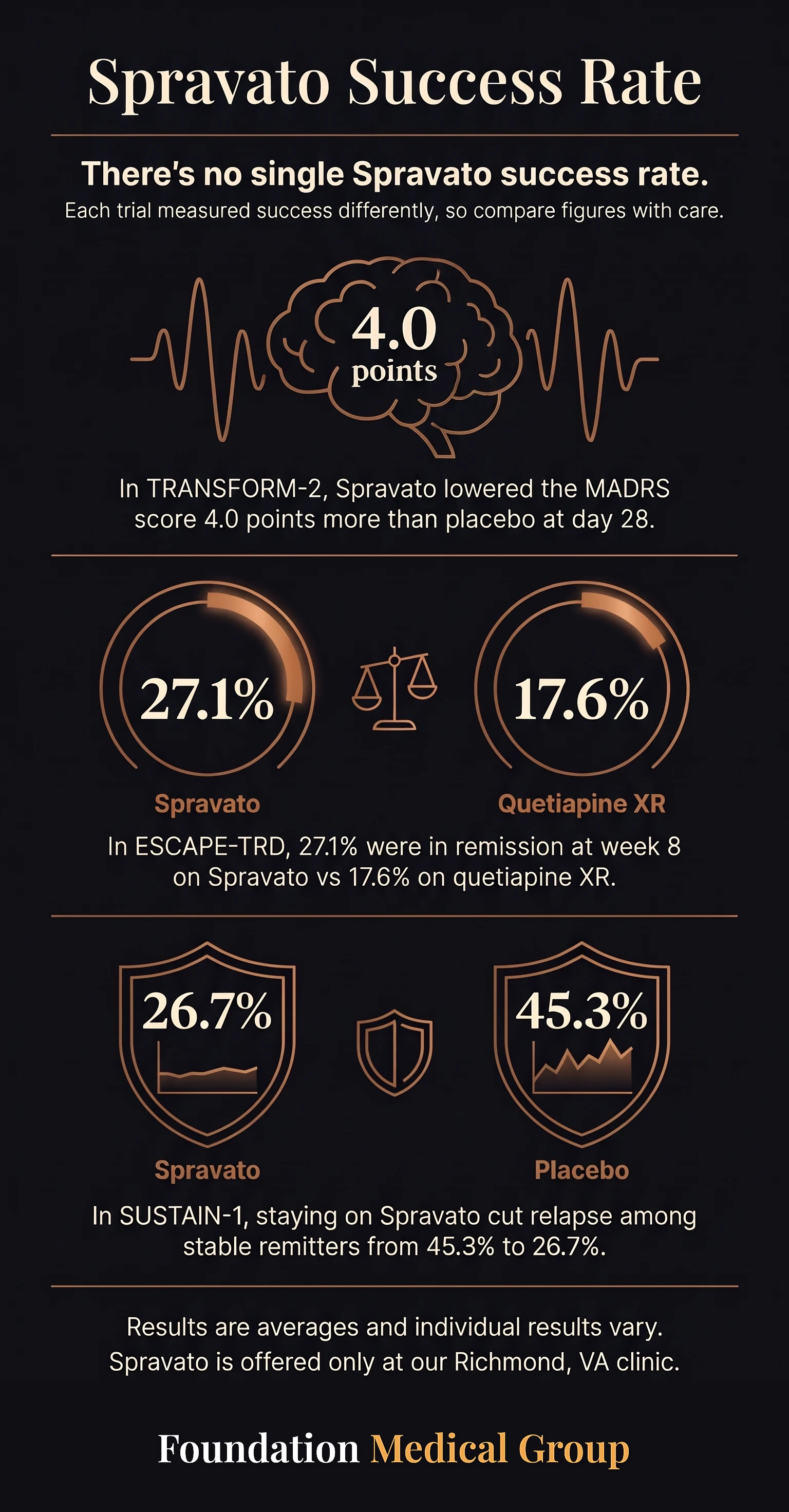
The main one is TRANSFORM-2, listed in the label as Study 1. All patients started a new oral antidepressant, and 227 were randomly assigned to add Spravato or a placebo nasal spray. In label Study 1, the MADRS score fell by 19.8 points with Spravato and by 15.8 points with placebo at day 28. In TRANSFORM-2, Spravato lowered the MADRS total score 4.0 points more than placebo at day 28, with a 95% CI from -7.3 to -0.6. That difference is statistically significant. But notice that both groups improved a lot.
The label also reports a newer monotherapy trial, Study 3, in which Spravato was given without an oral antidepressant. In label Study 3, the MADRS score fell 11.4 points with 56 mg and 13.0 points with 84 mg, vs 6.3 points with placebo, a difference of 5.1 and 6.8 points.
Read these numbers with care. A 2025 reanalysis of the patient data used for approval, published in BMC Medicine, concluded that the advantage over placebo was statistically significant but small, and that its clinical relevance is unclear given the risk of side effects. Is a few points on a scale worth it? For any one person, the question is whether the change is a meaningful improvement in daily life. That’s something you judge with your psychiatrist, not something a trial average can settle for you.
How Does Spravato Therapy Compare With Quetiapine for Remission?
ESCAPE-TRD was a large trial that compared Spravato therapy with extended-release quetiapine (quetiapine XR) added on as augmentation therapy. Both groups also took an SSRI or SNRI antidepressant. The main measure was remission at week 8, using a MADRS cutoff of 10 or less.
| ESCAPE-TRD result | Spravato | Quetiapine XR |
|---|---|---|
| Patients assigned | 336 | 340 |
| Remission at week 8 (MADRS 10 or less) | 27.1% | 17.6% |
| Remission at week 8 and no relapse through week 32 | 21.7% | 14.1% |
In the ESCAPE-TRD trial, 27.1% of patients on Spravato vs 17.6% on quetiapine XR were in remission at week 8. So roughly one in four people reached remission by week 8 in this phase of depression treatment. Most didn’t, even though more did on Spravato. That’s sobering, and it’s also more honest than the big round numbers you sometimes see quoted.
A later analysis of the same trial looked at what happened to people who responded early. In the ESCAPE-TRD trajectory analysis, 89.6% of week 4 responders reached remission at some point by week 32, and 78.3% of week 8 responders did. In plain terms, people who responded early tended to do better over the following months. It doesn’t tell you what happens to people who don’t respond early, though.
How Well Does Spravato Prevent Depressive Relapse?
Staying well is a separate question from getting well. SUSTAIN-1 tested it. People who had improved on Spravato plus an oral antidepressant for at least 16 weeks were randomly assigned to keep taking Spravato or switch to a placebo spray, while staying on their antidepressant. In total, 297 adults entered this maintenance phase.
The results:
- Among people in stable remission, 26.7% on Spravato had a depressive relapse vs 45.3% on placebo in SUSTAIN-1.
- Among people with a stable response who weren’t in remission, 25.8% relapsed on Spravato vs 57.6% on placebo.
The FDA label reports the hazard ratio for the stable remitters as 0.49 (95% CI 0.29 to 0.84). It also notes that this ratio didn’t appear constant throughout the trial. In everyday words, continuing maintenance treatment roughly halved the chance of relapse over the study period for people who were already doing well. Halved, not removed.
Do I Need Spravato Maintenance Treatment Forever?

The sources don’t set an end date. The label lays out three phases. In the induction phase, weeks 1 to 4, Spravato is given twice a week. From weeks 5 to 8 it’s given once a week. From week 9 on, it’s given every 2 weeks or once a week, and the label says dosing should be set to the least frequent schedule that keeps remission or response.
For long-term data, the main source is SUSTAIN-3, an open-label extension study with 1,148 people enrolled. In SUSTAIN-3, 35.6% of participants were in remission at the end of the induction phase and 46.1% at the end of the maintenance phase. Improvement generally held among people who stayed in maintenance treatment, and no new safety signal was found with up to 4.5 years of treatment.
Here’s the catch. Because SUSTAIN-3 was open-label, with no placebo group, it describes people who chose to continue rather than proving the drug caused every result. Whether you keep going, space out sessions or stop is a decision you make with your prescriber based on how you’re doing.
How Fast Does Spravato Treatment Bring Relief?
The label gives two useful answers. In Study 1, most of the difference between Spravato and placebo was seen at 24 hours. After that, both groups kept improving through day 28, and the gap between them stayed about the same. In the monotherapy Study 3, both doses beat placebo at Day 2, about 24 hours after the first dose, and the effect remained through Day 28.
These are group averages. Some people notice relief within the first days of Spravato treatment, and others take longer or don’t respond. Which can be frustrating when you’ve already waited through other medications. That’s why our team tracks your symptoms over the first month and beyond, rather than judging the treatment on one visit.
Can Treatment-Resistant Depression Be Cured With Spravato?
The trials talk about remission and relapse, not cure. Remission means few or no symptoms, and SUSTAIN-1 and SUSTAIN-3 show it can last with continued treatment. They also show that depression can come back, especially when treatment stops. So success is better thought of as reaching and keeping remission. For the bigger picture, including other options, see our guide to treatment resistant depression.
Spravato Treatment Side Effects and Monitoring
According to the label, the most common side effects in TRD trials included dissociation, dizziness, nausea, sedation, vertigo, numbness, anxiety, lethargy, raised blood pressure, vomiting, feeling drunk and headache. In TRANSFORM-2, side effects generally appeared shortly after dosing and resolved by 1.5 hours after dosing.
Because of the risks of sedation, dissociation and slowed breathing, the label requires that patients be monitored for at least 2 hours at each session. MedlinePlus notes that your blood pressure is checked before each dose and again afterward. At our Richmond clinic, our team does that monitoring on site, in the same visit. You shouldn’t drive or operate machinery until the next day after a restful sleep, so plan a ride home. Our Spravato side effects guide goes into more detail.
How to Read a Spravato Success Rate for Yourself
When you see a Spravato success rate online, a few questions help you judge it:
- What was measured? A drop in MADRS points, response, remission and relapse are different results, and they give very different numbers.
- Compared with what? TRANSFORM-2 and SUSTAIN-1 compared Spravato with placebo. ESCAPE-TRD compared it with quetiapine XR. A figure with no comparison group tells you less.
- When was it measured? Day 28, week 8 and week 32 aren’t the same point in treatment.
- Who was in the study? Trial patients had depression that hadn’t responded to other antidepressants, so the results apply most directly to treatment-resistant depression.
- Where does the number come from? A rate with no named trial or label behind it (a broad range quoted without a source, say) is hard to check.
Your own success is measured against your own starting point, not a headline figure. Your psychiatrist will track your symptoms with you over time.
Spravato Treatment at Foundation Medical Group in Richmond, VA
Spravato is offered only at our Richmond, Virginia clinic, where our REMS-certified team supervises each session for about two hours. Our Utah, Georgia and Texas clinics don’t offer it. We don’t publish a clinic success rate; the figures above are from published trials. For what the path looks like from first call to maintenance, read Spravato for depression, and start with a psychiatric evaluation.
Insurance. At Richmond, common plans include Aetna, Anthem, Cigna, UnitedHealthcare, TRICARE, Virginia Medicaid and Sentara Health Plans, each one call to confirm coverage. Our Richmond clinic doesn’t accept Medicare. Our guide to whether Spravato is covered by insurance explains what to ask. Call (800) 983-1974 or the Richmond office at (804) 506-0526.
Key Takeaways
- There’s no single Spravato success rate. Each trial measured success differently, so compare figures with care.
- In TRANSFORM-2, Spravato lowered the MADRS score 4.0 points more than placebo at day 28.
- In ESCAPE-TRD, 27.1% were in remission at week 8 on Spravato vs 17.6% on quetiapine XR.
- In SUSTAIN-1, staying on Spravato cut relapse among stable remitters from 45.3% to 26.7%.
- Results are averages and individual results vary. Spravato is offered only at our Richmond, VA clinic.
Sources
- DailyMed, SPRAVATO (esketamine hydrochloride) nasal spray label.
- FDA, Approved Risk Evaluation and Mitigation Strategies (REMS): Spravato.
- MedlinePlus, Esketamine Nasal Spray.
- American Journal of Psychiatry, Efficacy and Safety of Flexibly Dosed Esketamine Nasal Spray Combined With a Newly Initiated Oral Antidepressant in Treatment-Resistant Depression (TRANSFORM-2).
- JAMA Psychiatry, Efficacy of Esketamine Nasal Spray Plus Oral Antidepressant Treatment for Relapse Prevention in Patients With Treatment-Resistant Depression (SUSTAIN-1).
- Neuropsychopharmacology, Long-term safety and maintenance of response with esketamine nasal spray: interim results of the SUSTAIN-3 study.
- New England Journal of Medicine, Esketamine Nasal Spray versus Quetiapine for Treatment-Resistant Depression (ESCAPE-TRD).
- European Psychiatry, Trajectory of response to esketamine nasal spray for treatment resistant depression: Findings from ESCAPE-TRD.
- BMC Medicine, Efficacy and safety of esketamine for “treatment resistant depression”: registered report for a systematic review with an individual patient data meta-analysis.